Review: A Ball for Daisy by Chris Raschka

ball for daisy

A Ball for Daisy by Chris Raschka

Daisy, the dog, adores her red ball.  She plays with it and even sleeps next to it on the couch.  When her owner takes her for a walk, Daisy brings along her ball.  At the park, she plays and chases after it.  When it gets stuck behind a fence, Daisy frets until it has been retrieved by her owner.  But when another dog tries to play with Daisy’s ball… it pops!  Daisy is broken-hearted, carrying the tattered remains of her ball.  And there is nothing that will make her feel any better.  Or is there?

This wordless book works because of the gorgeous illustrations.  Daisy is a black-and-white dog and her world is colorful and bright.  From the bright red of her ball to the striped couch in green, the book embraces color.  Raschka also uses color to convey emotion, which is particularly effective when the air itself is colored with purples and blues after Daisy’s ball is popped.  Before that, the background was done in pale blues and yellows, light and airy, even playful. 

The storyline is clear with the illustrations filling double page spreads or broken into panels.  Children will immediately relate to Daisy’s loss of a favorite toy and to her emotions throughout.  It is a book that naturally leads to discussion of when the child lost something, or something was broken, and the way that they felt about it.

A winning wordless read, this book is a joy to share with children or perhaps with your favorite furry friend.  Appropriate for ages 2-4.

Reviewed from library copy.

Also reviewed by:

The Artist Who Painted a Blue Horse Charity Auction


Inspired by Eric Carle’s The Artist Who Painted a Blue Horse, artists and celebrities across the country are creating and auctioning off art.  The paintings are from luminaries of the children’s book world and celebrities.  The NEA Foundation will receive all proceeds from the auctions and will use the funds to support arts education in schools. 

This is a worthy cause that could get you an original Ed Young, Tomie DePaola, David Ezra Stein, or Emily Arnold McCully for your home or office.  You know you want one!

Guardian–What Makes a Classic?

In the Guardian today, Lucy Mangan takes a look at what makes some children’s books classics. 

Ultimately, the books have to be read, and re-read, by children. Blyton, most of us discover, is a phase. A warm, joyful and, in its own way, valuable phase, but a phase nevertheless. But what unites both old, modern and future classics is their ability to deal with larger themes, involving eternal truths rather than just taking Timmy the dog out for a run.

Hurrah!

And don’t miss her list of her favorite children’s books, which include many of my own personal favorites.  What about yours?

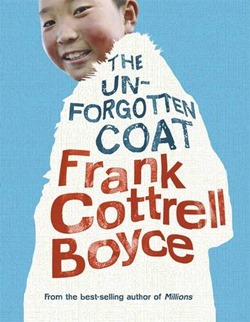
Review: The Unforgotten Coat by Frank Cottrell Boyce

unforgotten coat

The Unforgotten Coat by Frank Cottrell Boyce

Frank Cottrell Boyce has done it again, creating a book that surprises, amazes, and twists.  This is the story of what happens when two Mongolian boys join a class in England.  They appear out of nowhere, suddenly there in school.  The two brothers refuse to be separated, so the younger boy, Nergui, stays in his older brother’s class.  The two wear large coats and fur hats.  They immediately capture the imagination of Julie, one of their classmates, who is thrilled to be selected as their “Good Guide.”  She wonders where they live, trying for days to follow them home, but they elude her.  Chingis, the older boy, has photographs of Mongolia that he shares with everyone.  The entire class learns more about Mongolia than they had ever known.  But everything is not as it seems, and Julie discovers the truth too late to be of any help in the end.

The book is short, under 100 pages, with most of it being told in a flashback by an adult Julie.  The design of the book adds much to the story, with lined pages that resemble a notebook and Polaroid photographs that capture Mongolia and England, perhaps a mix of both.  The photographs in particular are cleverly done, hiding the truth and then revealing with equal success.

This is a powerful story that seems easy.  It reads as a simple story about two unusual children joining a classroom, and then twists and turns.  It speaks to community and acceptance throughout, showing a class that is eager and willing to embrace the new children, much to my delight.  Then the story takes on a more serious subject, about immigration, fear and deportation.  There is no didactic message here that is too heavy handed, instead it is kept serious but not message driven. 

The book also dances along an edge of imagination and reality where children who pay close attention will realize that even in the end there are questions about what has happened and what truly was.  This dance strengthens the novel even more, making it a powerful choice for discussion.

Highly recommended, this book may just be his best, and that is definitely saying something.  The short length, powerful subject and complex storyline all combine to make a package that is approachable for young readers, discussable by classes, and pure delight to experience.  Appropriate for ages 9-12.

Reviewed from library copy.

Also reviewed by:

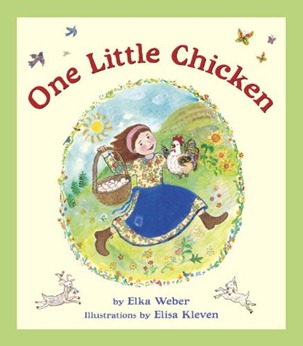
Review: One Little Chicken by Elka Weber

one little chicken

One Little Chicken by Elka Weber, illustrated by Elisa Kleven

When Leora finds a chicken has wandered into their house, her mother reminds her that finders aren’t keepers.  When her father returns from work, he agrees.  But it is their duty to take care of the chicken until its rightful owners claim it.  So, they build a chicken coop.  When the hen lays eggs, they do not eat them but the eggs hatch into chicks.  Soon there are chicks everywhere.  So they take them to market and sell them for coins that they use to purchase a little goat.  They milk the goat, turn the milk into cheese, but again do not eat it, because it is not their cheese.  They sell the cheese for coins and buy another goat.  Soon they have a family of goats who are often causing mischief, creating odors, and wreaking havoc.  Finally, Leora’s mother has had enough and runs off down the road with the goats chasing after her.  And who do you think she meets on the road?

This is the retelling of a story from the Talmud and retains the feel of a classic story.  The story is not only about “finders aren’t keepers” but also speaks to the responsibility of community to care for one another.  Weber’s writing incorporates small details that add to the depth of the story.  For example, when Leora and her father are building the chicken coop: “Sawdust flew, wood shavings scattered, nails bent.”  It reads aloud with a lovely rhythm and ease.

Kleven’s illustrations are done in mixed-media collage using watercolors, ink, pastels and colored pencils.  They have a detail that is very engaging.  Some of the panels are framed in flowing flowers, others have interesting textures, and all have a warmth that is welcoming.

A great addition to units on cooperation or community, this book will also be a good pick for chicken story times.  Appropriate for ages 4-6.

Reviewed from copy received from Tricycle Press.

Also reviewed by Journey of a Bookseller.

2012 Astrid Lindgren Award Nominees

There are 184 candidates from 66 countries nominated for the Astrid Lindgren Memorial Award.  The recipients will be announced on March 20th, 2012.  These are some of my favorite lists to explore, because I get to see names that I would otherwise never see and book covers that I’d never get to glimpse. 

Wales’ First Young People’s Laureate Named


Catherine Fisher will be named the first Young People’s Laureate for Wales, according to the BBC.  Literature Wales will be making the appointment which will be announced by Charlotte Church. 

Here is how the role of the laureate is explained:

It said the Young People’s Laureate post is the first of its kind in the UK and aims to inspire young people in Wales to become involved with reading and creative writing.

Fisher is the author of several fantasy series, including Incarceron, which is my favorite of hers.

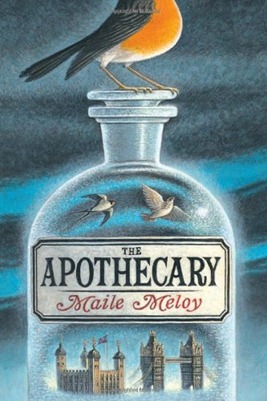
Review: The Apothecary by Maile Meloy

apothecary

The Apothecary by Maile Meloy

Janie and her parents have just fled California and headed to Cold War London.  There she meets Benjamin, a boy who stands up for himself.  As the two of them attempt to follow Soviet spies around London, they discover a real plot, a dangerous one.  When Benjamin’s father disappears as they hide in the cellar below, Benjamin and Janie must try to use an ancient book of potions and spells to try to find him.  But first they have to keep the book and themselves out of the hands of the enemies who are trying to find them.  It’s not that easy when you don’t know who to trust or what to believe in anymore.

When I opened this book, it was like tumbling into a world that felt like home to me, but at the same time surprised and delighted me too.  Meloy’s writing has a solid feel to it, hearkening back in tone to classic children’s books of adventure.  At the same time, she has created a wondrous world to explore, one that she brings to life with strong characters, memorable settings, and a lot of magic. 

The two protagonists are winning characters, filled with both whimsy and charm.  They are characters that readers will relate to instantly.  Their sudden friendship and mutual attraction is written in a way that makes sense.  Both characters are brave, inventive, and creative.  They are just whom one would want to take a grant adventure with. 

The ARC I read of the book only had a few of the illustrations in it, but those that I have seen are beautiful.  The design of the book plays with light and dark and so do the images, many of them capturing moments of action and importance in the story. 

A dazzling fantasy novel, this book also has a strong sense of period and setting that can be missing in magical books.  Appropriate for ages 10-13.

Reviewed from ARC received from Penguin Young Readers Group.

Also reviewed by:

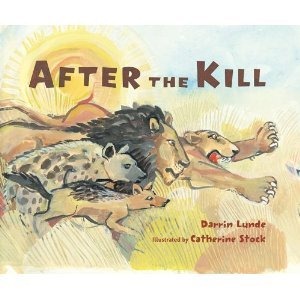
Review: After the Kill by Darrin Lunde

after the kill

After the Kill by Darrin Lunde, illustrated by Catherine Stock

Explore what happens after the lioness kills a zebra on the Serengeti Plain.  While the hunt and the kill are part of the story, they are only the beginning.  After the zebra is killed, the lion pride comes to eat and then other species start to gather.  There are the vultures who share with the lions.  Then the hyena clan that is able to drive the lions away and claim their share.  Jackals use trickery to grab some food for themselves.  The lions reclaim the carcass and continue to eat until they are sated.  Other vultures arrive.  The small scraps of flesh that remain are eaten by meat-eating beetles until the bones are white in the African sun. 

Lunde, a mammalogist at the Smithsonian Institute, creates a compelling story here.  There is no shying away from predator and prey, just a frank description of the food chain.  Nicely, Lunde injects his narrative with plenty of detail, noises, and an obvious love of his subject.  He paints a verbal picture of what is happening, helping young readers better understand what is actually happening.  The pieces of the book in the smaller font have additional scientific information that readers will find fascinating. 

Stock’s illustrations have a bright, hot quality to them thanks to the yellow tones throughout.  The heat of Africa is built into every page.  She also embraces the kill, the scavenging, and the story, creating a book filled with action-filled images.

An unflinching look at the battle for food on the Serengeti Plain, this book will be riveting for young readers.  Appropriate for ages 5-8, though this is a book that some children may find upsetting, so it is important to be aware of the sensitivity of the child you are sharing it with.

Reviewed from copy received from Charlesbridge.