Hunger Games Posters

Oh my, now this is one gorgeous line of posters!  Spread across several movie and entertainment sites, you can see the new posters for The Hunger Games movie due out on March 23rd. 

IGN has Woody Harrelson as Haymitch, as well as links to the other posters.  My favorites are Rue, Katniss and Cinna.  Lovely! 

Here is Rue:

How about you?  Do you have a favorite?

Review: Amplified by Tara Kelly

amplified

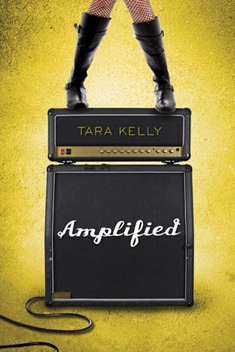
Amplified by Tara Kelly

The author of Harmonic Feedback returns with another book that centers around music.  Jasmine has decided that she doesn’t want to attend Stanford in the fall, so that she can follow her dream of becoming a musician.  She finds herself homeless when her father kicks her out for her decision.  Jasmine’s car breaks down in Santa Cruz.  She finds a listing for a place that she can almost afford but the kicker is that she needs to audition for a band and get picked as their guitarist in order to get the room.  All she has to do is convince three jaded, ultra-cool guys and one amazing girl that she can do it.  The problem is that she’s never played for anyone except her best friend.  Can Jasmine fool them all and for how long?

This book sings.  The character of Jasmine is complex, haunted, frigid, closed off, wide open, and entirely human.   The other band members are equally fascinating, often veering away from what you would expect from them, making them all the more intriguing.  Though it would have been easy to make Jasmine’s father a cardboard stereotype, Kelly didn’t.  One of the conversations with her father shows that both Jasmine and her father are trying yet unable to connect. 

Music is difficult to write about in novels, but Kelly manages to invite readers into a band, allow them to experience the hard work, the drive, the crap and the intensity of the relationships that music creates.  The music in this book is not subtle, this is not another book about a quiet pianist or violinist.  Instead this book thrashes and rocks. 

Impossible to put down, readers will thrum to the rhythm of disaster, recovery, lies and truth.  It is a compelling and remarkable combination.  Appropriate for ages 15-17.

Reviewed from copy received from Henry Holt and Company.

Also reviewed by

Review: The Artist Who Painted a Blue Horse by Eric Carle

artist who painted a blue horse

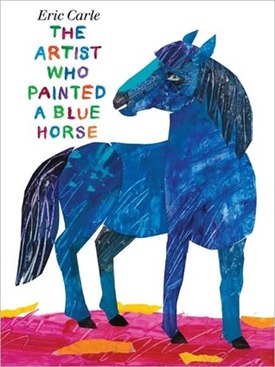
The Artist Who Painted a Blue Horse by Eric Carle

A young artist paints a blue horse running against a yellow sky, then continues to paint animals in amazing colors.  There is a red crocodile, a yellow cow, a pink rabbit, and an orange elephant.  The book speaks powerfully and simply to the spirit of creativity, the ability to change the world through art, and the right to express yourself.  This becomes even more clear as the book ends with Carle’s own childhood experiences in Nazi Germany where he first saw the forbidden work of Franz Marc who painted Blue Rider.  This is not a picture book biography, but rather a statement of support for all artists who see the world in unique ways.

Carle’s art is really the center of the book with the words just naming the color and animal.  As I read it, I could see it being used very nicely in elementary art classes to encourage children to break away from the norm.  In toddler story times, it could also be used to learn colors and animals perhaps even with some animal noises thrown in to add to the fun. 

This is a book that will speak to many ages, adapt well to projects and conversation, or simply be used as a color and animal book.  It is infinitely flexible, wonderfully expressive, and makes a powerful statement.  Appropriate for ages 2-8.

Reviewed from copy received from Philomel Books.

You can also check out the auction of art by artists and celebrities that was inspired by this picture book.

Review: Peter and the Winter Sleepers by Rick De Haas

peter and the winter sleepers

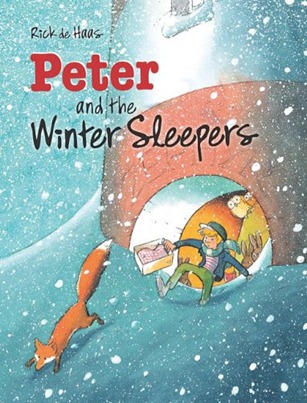
Peter and the Winter Sleepers by Rick De Haas

This snowy book is the story of Peter, who lives with his grandmother and pet dog in a lighthouse.  One day, it snowed, a wonderful clean fluffy snow that was perfect for making snowmen.  But then it just didn’t stop snowing.  They moved the chicken and goat inside to be safe, and then there was a scratching at the front door.  It was a rabbit.  Peter made a bed on the stairs for the rabbit when there came another noise at the door.  It brought more animals: squirrels, mice, hedgehogs, birds, a bat.  It got hard to sleep at night and the droppings were smelly.  After a few more days, the came another knock on the door.  It was a fox.  At first, Peter was eager to welcome a new animal to the lighthouse.  But how in the world was a fox going to live with the animals that it usually eats?

De Haas has created a friendly, cozy world here.   There is a gentle feel to the entire book, a hominess.  Anyone who has been stuck at home during a blizzard will recognize the feeling, and will probably start to wish that the animals would knock at their door next time.  The text of the book has a gentle quality as well, a quiet building as animals enter the lighthouse.

The lighthouse is filled with curved lines from the arched doorways to the curve of the stair to the gentle arc of the walls.  Complementing the curves is the warm yellow tones of the interior, that contrasts well with the cool blues of the snowy landscape outside.  This is a haven that is deliciously warm and welcoming.

A great pick for wintry story times, this book is quiet, gentle and welcoming just like its storyline.  Appropriate for ages 4-6.

Reviewed from copy received from NorthSouth.

Review: 11 Experiments That Failed by Jenny Offill

11 experiments that failed

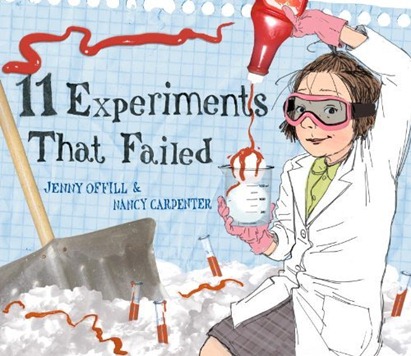
11 Experiments That Failed by Jenny Offill and Nancy Carpenter

A series of experiments take place in this book, each one funnier than the next.  They attempt to answer questions like: Can a kid make it through the winter eating only snow and ketchup?  Do dogs like to be covered in glitter?  Will a piece of bologna fly like a Frisbee?  The only way to find out is for the protagonist to test it scientifically.  That means trying to eat only ketchup and snow and observing the results.  Sprinkling her dog with glitter to see what happens.  Testing flight capabilities of bologna in the lunchroom of school.  All of the experiments have a question, a hypothesis, instructions, and results.  Budding scientists are sure to find plenty to laugh along with in this book, along with new ideas for experiments of their own.

This very funny book and also great fun to share.  The book design plays a big role in the fun.  Since the results are after a page turn, we enjoyed guessing what the results of the experiments would be.  Each experiment is unique, silly and entirely engaging.  The other winning part of the book is that this is a girl doing science, wearing her pink goggles and gloves, and her lab coat. 

The illustrations add to appeal.  The collage illustrations mix photographs and drawing.  They are quirky, colorful and glorious.

Get this one in the hands of science teachers who are teaching the scientific process.  Young scientists will also love it as well as any kid who enjoys silliness in their books.  But beware of flying bologna!  Appropriate for ages 5-8.

Reviewed from copy received from Schwartz & Wade Books.

Also reviewed by Pink Me and Young Readers.

Review: E-mergency! by Tom Lichtenheld

e-mergency

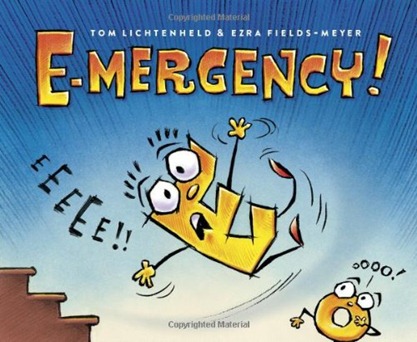
E-mergency! by Tom Lichtenheld

The entire alphabet lived together in one house.  Every morning they all ran down the stairs to breakfast, but one morning there was an accident.  E was running down the stairs too fast and took a tumble.  The ambulance arrived and took E off to the ER.  With E gone, A took charge and assigned E’s duties to O.  In order for E to heal, no one could use that letter.  The letters took to the airwaves to ask people not to use the letter E until E recovered.  They even went to DC to tell the government.  With O filling in for E, things got vory confusing.  But E wasn’t gotting any bottor.  Who could bo causing tho problom?

This book had me laughing aloud.  First was the puns with the different letters, the jokes told in the asides.  They are the real treasure of this book and will get young readers laughing too.  Then readers have to watch the letter characters too.  They tend to spell out appropriate words as the action in the book changes, adding another layer of humor to the book.  Add into that the humor of trying to read a book without the letter E, and you have this zany, silly wonderful book.

Lichtenheld’s illustrations are filled with humor and motion as well.  They are bright, busy and great fun to look closely at.  My favorite spread is the double-page illustration of a busy city street where E is not being used.  It results in lots of humor. 

This book reads aloud well, but I would not recommend it without reading it first, especially the many pages with O filling in for E.  It makes for a tongue-twister, but also one that young listeners will love to see you attempt. 

Hilarity, alphabet, and word play, what more could one ask for?  Appropriate for ages 4-7.

Reviewed from copy received from Chronicle Books.

Review: Where’s the Party? by Katharine Crawford Robey

wheres the party

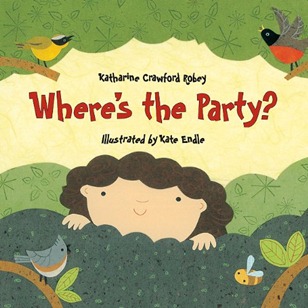
Where’s the Party? by Katharine Crawford Robey, illustrated by Kate Endle

When Kate wakes up, a robin is sitting on her windowsill and sings about “news!”  Then a cardinal whistles about a party.  Kate definitely wants to go!  So she heads outside and follows one bird to the next as they lead her along a path, to the wild strawberries, along the brook, and to the duck’s nest.  Finally, she arrives at the party, and it’s a very special one!  The birds in the story include a titmouse, meadowlark, yellowthroat, oriole, bluebird, heron, ducks, and killdeer.  

Robey’s text is just enough to keep the story moving.  The calls of the birds are translated into words that help Kate find the party.  Nicely, the birds are not humanized except for their calls being heard as words.  They are described with their markings and some of their habits.  The end pages include some more details on the species in the book.

Endle’s illustrations are done in collage and are filled with texture, pattern, and color.  The cut paper gives clean lines that work well with the natural setting and birds.  There is a simplicity thanks to the medium used that keeps this book very friendly to the youngest readers.

A great pick for young birdwatchers or for units about birds.  The illustrations are clear and crisp and will work well with a group, so this will also make a good choice for summer story times.  Appropriate for ages 3-5.

Reviewed from copy received from Charlesbridge.

Review: Saint Louis Armstrong Beach by Brenda Woods

saint-louis-armstrong-beach

Saint Louis Armstrong Beach by Brenda Woods

Saint loves playing the clarinet.  He plays it for tourists in New Orleans to earn money for a new clarinet and for his future at Julliard.  Life isn’t all easy though, he has taken to a stray dog that his father will not allow him to adopt and his best friend has outgrown him, now spending her time partying with the cooler, older kids.  As Hurricane Katrina approaches, Saint and his family are not that concerned since it is expected to miss New Orleans, as the days progress, the tension builds and the warnings increase.  Though Saint’s family tries to send him to safety, things don’t go as planned and Saint is trapped by the weather and the flood waters.

Woods has written a book that captures the power of music in a young man’s life nicely, bridging the days before the storm, the time during the storm, and the time afterwards together with song.  The bulk of this book is the period before the storm hits, showing the loving family that Saint comes from, his close-knit neighborhood, friends, crushes, and his love of a dog.  While I know that this had a large part in establishing reader relationships with Saint, it is lengthy and could have been made more focused.  In particular, his friendship with Money is talked about at length, but the book never returns to her after the storm. 

The period during the storm is dramatic, with Woods leaving the drama of the storm to stand on its own.  More time could have been spent here with the reader, truly exploring the emotions and complexity of survival.  The same is true of the time after the storm, where only a few chapters are left for the aftermath.  My hope is that there is a sequel that will let us better understand the effect of the storm on Saint and his family, neighbors and friends.

There were also portions of the book that were too neat and tidy.  One such instance was when Shadow, the dog, brings Saint’s parents to him after the storm.  It was just too convenient and should have been foreshadowed more clearly to work better.

In the end, I have mixed feelings about this book.  A sequel may very well fix a lot of the dangling story lines, which would go a long way.  Saint is a strong male character and this is a book that children will find shows a close-up perspective on the storm.  Appropriate for ages 9-12.

Reviewed from ARC received from Penguin.

Arctic Board Books

ArcticLand ArcticSea ArcticSky

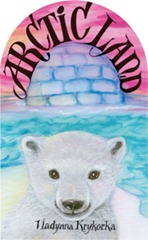
Arctic Land

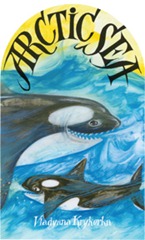
Arctic Sea

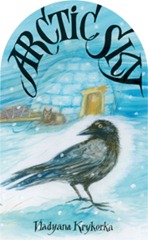
Arctic Sky

Author Vladyana Krykorka has created three board books that each look at a different aspect of wildlife in the Arctic.  The books are done in accordion style, so they spread out across laps or tables, creating even more of a vista of the Arctic landscape.  Arctic Land features caribou, wolves, musk ox, Arctic hare and polar bears.  Arctic Sea has whales, seals, narwhal, and walrus.  Arctic sky is filled with swan, crane, raven, ptarmigan, loons, and owls. 

There is a short verse that ties the animals together, but the real beauty here are the illustrations.  Done in watercolor, they have a movement that is captivating.  The long line of animals when the book is fully open is beautiful, filled with color and creatures.

While this book’s format may not survive long in public libraries, it will make a charming and education gift for a tiny naturalist.  Appropriate for ages 1-3.

Reviewed from copies received from Annick Press.