Review: The Mighty Miss Malone by Christopher Paul Curtis

mighty miss malone

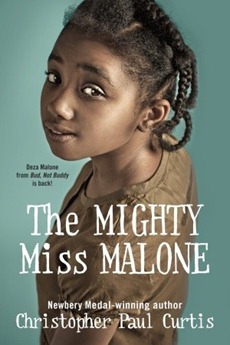
The Mighty Miss Malone by Christopher Paul Curtis

Deza loves school, loves to read, and dreams of being a writer.  However, the Great Depression is raging in Gary, Indiana and her father has been unable to find work for some time.  Deza finds solace in her best friend and in her teacher, who has offered to tutor them both when school starts again.  When her father is almost killed in a boating accident, he doesn’t return as the same funny, smart man.  Instead he is withdrawn and almost silent, deciding soon after recovering to head up to Michigan to try to find work.  Deza’s mother refuses to let the family be separated and takes Deza and her brother on the road to follow him.  Unfortunately, the journey to becoming a complete family again is not that easy, taking them on a long road that will challenge them all.

Curtis’ writing is marvelous.  He renders the Great Depression with great detail, giving modern readers a way to not only understand the past but tie it directly to our present.  He also shows us the depth of poverty in the Depression, offering a view not only of the shanty town but of the kindness that could be found there too.  Nothing is simple in this book, the setting and time is complicated and the characters are complex.

Deza herself is a stellar protagonist, who loses much but keeps on moving and caring deeply.  She is luminous in the book, made fascinating by the small touches.  Her life is filled with challenges, including her rotting teeth, but they make her stronger and become coping mechanisms that make her all the more memorable. 

The depiction of this African American family that falls on hard times is one of deep caring, expansive love, and incredible strength.  While her father may leave to find a job, readers will know that his reasons for doing so are complicated and very human.  One feels the same thing for all of the characters in the book, no matter how minor.  They all seem to be carrying their own stories with them, even if they are just in a few pages.  This is a world populated with human beings with pasts and futures. 

This book cut right into my heart and lived there as I read it.  When I finished it, I wept because of the power, the people, and the story.  This is a wrenchingly honest, beautifully written, and noteworthy novel that I simply adored.  Appropriate for ages 9-12.

Reviewed from copy received from Random House Children’s Books.
Review: George Flies South by Simon James

george flies south

George Flies South by Simon James

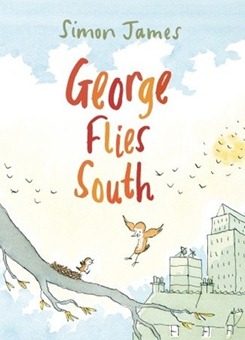
Winter was coming, but George was not quite ready to try to fly yet.  George waited for his mother to return with some worms, when a gust of wind picked up his nest and carried the nest and George into the air!  The nest landed softly on the top of a car, which promptly started driving with George’s mother chasing behind.  The nest flew off the car and then landed on a boat.  From there, George and the nest were lifted high up into a tall building that was being constructed.  George slept safely up in the building until he was awoken by a pouncing cat.  Now George was falling without his nest and without knowing how to fly! 

James has written a story that feels very familiar but has its own personal twists.  The combination of the baby bird and his nest traveling through a city together makes this all the more charming.  Add in the appeal of different kinds of transportation, the thrill of the chase, and the daring high building, and you have a book that will appeal to the wiggliest of preschoolers.  The need to learn a new skill under pressure will also be something that will appeal to this age group.

James’ illustrations are done in ink and watercolor.  They have fine lines, washes of color, and a wonderful feel of motion throughout.  They add much to the cheery story.

A great pick for autumn story times, this book will have children cheering George along and seeing that they too are capable of much more than they may think they are.  Appropriate for ages 3-5.

Reviewed from library copy.

Review: Just a Second by Steve Jenkins

just a second

Just a Second: A Different Way to Look at Time by Steve Jenkins

Jenkins always manages to make science and nature even more fascinating than it usually is.  In this book, he shows the passage of time in unique and  intriguing ways that will get young scientists thinking differently.  What happens in one second?  Well, in that second a bat can make 200 calls or hummingbird beats its wings 50 times.  What happens in one minute?  In a minute a grizzly bear can charge up to one half-mile or a skydiver falls 2 miles during free fall.  How about an hour?  A day?  A week?  Longer?  For all of these, Jenkins selects intriguing examples of what happens during that time period that will have you thinking about time and what can be done in ways you never expected.

Jenkins’ paper collage art is on display here, vibrant against the plain backgrounds of the pages.  His exacting art uses pattern, subtle color changes and textures to great effect.  His collage work is done with such attention to detail that it often doesn’t look like cut paper work.  It is as beautiful as his work always is.

Jenkins has selected fascinating bits of trivia to put on display here.  This book will not give you the complete story of the natural examples, but will definitely open readers’ minds to new ways of looking at time and action.  It is one of those books that invites you to explore the ideas that capture your imagination further in other places. 

A great gateway book that broadens the mind, this nonfiction book is appropriate for ages 5-9. 

Reviewed from library copy.

Review: Trains Go by Steve Light

trains go

Trains Go by Steve Light

This board book celebrates the various sounds that trains make as they travel the rails.  There is the
“Squeak Clang Ting Bing Bing Bing!” of the freight train.  The streamliner makes a long “wooo wooo” sound in contrast.  Mountain train noises are full of “trip trap” and “fuff puff.”  The noises include toots, whistles, dings and of course a few choo choos too!  This is a great pick for the smallest train enthusiasts.

Light’s illustrations are done in deep colors with plenty of strong black lines to offer a mechanical foundation to the illustrations.  Against the white backgrounds, the bright colored trains pop as they whiz past.  Light uses the full page, filling it with the sounds of the trains, the tracks, and the smoke and steam they create.  They have a strong sense of motion as they sound their whistles and zoom by.

A fun read aloud, this is one that will be popular with little train fans.  If you are doing baby or toddler story times, this just might get everyone along for a train ride together!  Appropriate for ages 1-3.

Reviewed from copy received from Chronicle Books.

Review: The Princess and the Pig by Jonathan Emmett

princess and the pig

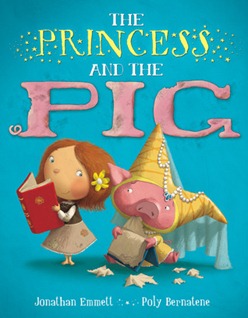
The Princess and the Pig by Jonathan Emmett, illustrated by Poly Bernatene

I have to admit, I came to this book with a lot of reservations.  It’s ANOTHER princess book in a time filled with sparkly pink books.  But if you are as sick of the regular princess books as I am, then this is just the book for you!   A farmer had a little pig in the back of his hay cart.  He decided to name it Pigmella.  At the same time, in the tower high above, a queen picked up her baby daughter and decided to name her Priscilla.  But the queen dropped the baby out of the window without noticing and up flew the piglet in her place.  Soon the piglet was being treated as a princess and the princess was happily adopted by the farmer and his wife.  After all, this sort of thing happens all the time in books!  The princess was happy at the farm, growing up and making everyone happy.  Unfortunately, the same thing can’t be seen of the piglet, who grew into a pig, could not learn to read, and refused to wear her finery.  But what is to happen when the mix-up is discovered and the young woman is told she is a princess?

Emmett has inundated his book with references to other fairy tales that the characters in the book use to rationalize what has happened.  They blame things on evil fairies and magic, which is why the mix-up is not discovered for so long.  The writing is merry and filled with humor.

That same humor is carried out to great effect in the illustrations.  They are filled with the funny things that would happen if a pig were a princess, the pomp and ceremony that would still be attempted, and the gentle, loving family of farmers raising a real princess.  The illustrations are done so that the characters pop on a softer background.  The jolly nature of the book is embraced in full here.

Exactly the antidote to children who have read too many princess books, this is a shining example of what a twisted fairy tale book can be.  Great fun and very satisfying.  Appropriate for ages 4-7.

Reviewed from library copy.

Also reviewed by:

Review: Who Has What? by Robie Harris

who has what

Who Has What? All About Girls’ Bodies and Boys’ Bodies by Robie H. Harris, illustrated by Nadine Bernard Westcott

Have a child asking about their body and the ways that boys and girls are different?  Here is a picture book for younger children that answers those questions clearly, simply and with a great matter-of-fact tone.  Told through a family trip to the beach, the book starts with the child characters having questions themselves.  Emphasis is placed on the fact that boys and girls are mostly the same in their bodies.  They both love to play, love to laugh, but they do have some body parts that are different.  Even then, most of their body parts are the same.  As the children move into the changing rooms, the different body parts are shown and defined.  The book covers both the external organs and the internal ones.  As always, Harris presents the information with clarity and makes it easy to understand.

This book is appropriate for preschoolers who are asking questions about their bodies.  The answers here cover the body parts only.  No sexual explanations are given in this book about how babies are made or arrive.  It’s a great early lesson in bodies that speaks to the questions children that age have.

Westcott’s illustrations are charming and factual, nicely combining clear images of the body parts but also having an inviting cartoon feel.  The addition of the dogs in the dressing rooms and when talking about general body parts will also help answer questions that children have about pets.  It’s another way that this book is clearly designed for this specific age group.

Ideal for families looking for clear information to share with their children, this book belongs in every public library.  Appropriate for ages 4-8.

Reviewed from library copy.

Digital Future for Picture Books

4070018782_a9f76393b0

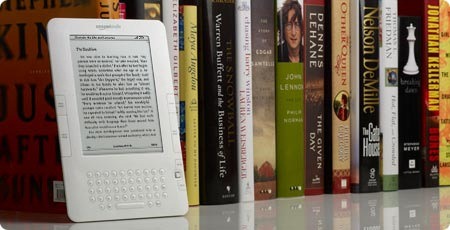
Photo credit to goXunuReviews.

The Shatzkin Files is one of my go-to blogs for information on e-books.  I appreciate that his point of view is not one of librarians, but instead looks with from the point of view of someone in the publishing industry. 

A recent article on his blog talks about the challenges of bringing highly illustrated and children’s books to e-books.  This is something I have also been wondering about.  I see business books, adult fiction, and even teen fiction working well on e-books, but it seems that picture books are being transformed into apps rather than e-books. 

The layout itself is a challenge because with e-books the size of the text changes to match the settings on the device.  Add illustrations that that becomes immensely more complicated to manage.

Here is one of Shatzkin’s paragraphs that speaks to children’s books, but the entire article is definitely worth reading, especially if you are a librarian trying to figure out how e-books are changing things:

I have been asking publishers about sales of their children’s and illustrated trade material. I haven’t found anybody yet that says they’re going well. On the children’s side, where there have been pockets of success, the one Big Six digital executive who expressed an opinion to me felt that price was killing sales for the ebook versions of successful franchises. Children’s apps from such distributors as Touchy Books are priced quite low, generally $2.99 and less. But many branded titles like Eloise are $9.99 and $12.99 and up! This executive points out that paying that price for a novel you will spend many hours with is much less painful than paying it for a children’s book your kid will work through in 15 minutes or less.

Review: Samantha on a Roll by Linda Ashman

samantha on a roll

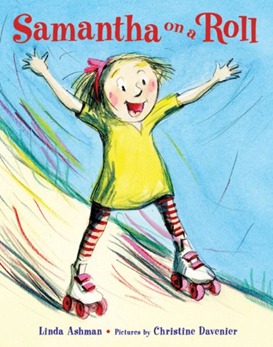
Samantha on a Roll by Linda Ashman, illustrations by Christine Davenier

Samantha wants to try out her new roller skates so badly!  But her mother is too busy to help her right now.  So what does a determined little girl do?  First, she quietly puts on the skates and skates up and down the hall for awhile.  Her mother doesn’t notice.  Then, she heads outside and skates on the sidewalk a bit.  Her mother doesn’t notice.  She’s doing fine on the skates, so she heads up Hawthorn Hill.  The view is great, but she doesn’t notice how close she is getting to the steep edge until she is already out of control.  Chaos and humor ensues as Samantha runs past all sorts of characters in her wild, zipping rush.

Ashman’s rhymes have a jaunty rhythm that set the pace nicely, from the wandering earlier part of the book to the grand ride at the end.  I also appreciated the Samantha’s mother is not negligent or ignoring her, just busy with other parts of the family and household.  This is a caring family with a girl who just can’t stop playing with her skates. 

Davenier’s art is fine lined and filled with pastels.  Her work has a pleasing roughness to it.  She captures motion convincingly in just a few lines; something that is very important in this book. 

This dynamic rollercoaster ride of a book will add some speed to your next story time or bedtime reading.  Appropriate for ages 3-5.

Reviewed from library copy.

Review: Cinder by Marissa Meyer

cinder

Cinder by Marissa Meyer

Cinder is the best mechanic in New Beijing, so it is natural that the prince would bring his broken android to her for repair.  What he doesn’t know is that Cinder herself is also an android.  She is owned by her cruel stepmother, who uses Cinder to bring in the income for the entire household.  As a plague ravages Earth, the world is also under threat from above as the Lunar queen arrives to pressure the prince into marriage.  As the plague reaches her own family, Cinder is given away to become a test subject.  This brings her into direct contact again with the prince and also gives her new information about her unknown past.  It’s a past that may just be the key to the entire planet’s safety.

This is a glorious melding of science fiction and fairy tale where androids and Cinderella mash up.  It is the strength of the story itself that works well here.  The blend makes the book compulsively readable with the science fiction giving a grittiness to the expected fairy tale story.  At the same time, one looks for the fairy tale components and how they are reinterpreted.  The entire concept works brilliantly.

The middle of the novel does have some pacing issues.  While the reader knows Cinder’s secret past before Cinder does, that knowledge contributes to the slowing of the novel.  There is also a pivotal plot point that is set aside what seems to be a very long time, further slowing the pace. 

Cinder is a dynamic heroine who is notably human and caring.  She is strong, but beyond that is also reassuringly sometimes clumsy and confused.  The reworking of some of the characters of the fairy tale, including one of the step sisters works well.  While the book follows the arc of the Cinderella story, Meyer also inserts new facets that fill the tale with surprises for the reader.

A riveting book that features a strong heroine and a brilliant storyline, this book will be enjoyed by dystopian and romance fans alike.  Appropriate for ages 13-17.

Reviewed from copy received from Feiwel & Friends.

Also reviewed by: