Review: You Are (Not) Small by Anna Kang

you are not small

You Are (Not) Small by Anna Kang, illustrated by Christopher Weyant

An orange bear declares to a smaller blue bear that the shorter one is “small.”  The little one says that that is not true, rather the orange bear is “big.”  The orange bear shows that he has other big creatures just like him and just his size, but so does the blue bear.  The two groups start to argue and fight about whether they are big or small.  Then another creature arrives and another one yet that help put size into perspective for everyone. 

This very simple book has a great sense of humor throughout.  The creatures that seem like bears to me are fuzzy and friendly.  Against the white background, the bears pop on the page.  With only a few lines per page, this book will be enjoyed by small children learning about concepts like big and small.  The humor makes the entire lesson in size and relativity completely enjoyable and it will be a book that children will ask to be read again.  There is even a great little (or big) twist at the end.

Weyant’s illustrations are a large part of the appeal of the book.  The New Yorker cartoonist has created fuzzy creatures that are loveable and cute as can be, no matter what size they are.  Weyant has clearly loved playing with the differences in sizes, creating characters who live large on the page.

Bold illustrations, charming characters and funny situations make this a winning picture book for the smallest (and largest) among us.  Appropriate for ages 2-4.

Reviewed from ARC received from Two Lions.

A Monster Calls – The Movie

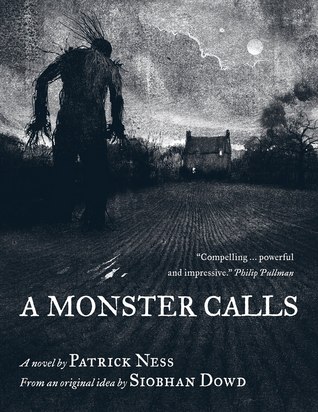
A Monster Calls

The Hollywood Reporter has the latest on the casting of the film version of Patrick Ness’ A Monster Calls.   Sigourney Weaver has now joined that cast that also includes Felicity Jones and Liam Neeson. Weaver will be playing the grandmother, Jones the mother and wonderfully, Neeson will be the monster.   Juan Antonio Bayona will be directing the Focus Features film. 

It’s an incredible read, so I hope they do it proud and keep the truly frightening aspects of the book without making the child character older.

Review: Anybody Shining by Frances O’Roark Dowell

anybody shining

Anybody Shining by Frances O’Roark Dowell

Released September 23, 2014.

12-year-old Arie Mae loves living in the Appalachian Mountains.  She is so proud of her mother, who sings the old songs like an angel and her father who loves modern and traditional music.  All that is missing in her life is a best friend.  Arie Mae starts writing letters to her cousin who lives far away in Baltimore and whose mother had grown up in the mountains.  After sending letter after letter, Arie Mae gets no response, but continues writing anyway, sharing the details of her life and adventures.  Then Arie Mae gets another chance to make a new friend.  A group of children from Baltimore are coming to the mountains along with the song catcher ladies, who will record the traditional songs and who have also created a new school for people to learn traditional crafts that can then be sold.  Arie Mae knows right away that she won’t be friends with the bossy girl who looks down on the mountain children.  But there is a boy with a limp who loves to hear the traditional stories and refuses to let his limp stop him from exploring.  His mother warns Arie Mae that he should not exert himself much because of his health, but nothing is going to slow either of them down now that they are friends and there are woods and mountains to discover together. 

Dowell writes with a beauty that brings the Appalachians to life.  She captures the lifestyle of these people without flinching from the poverty that they live in, but also revealing the incredible simplicity of this life that makes it possible.  She shows the tension between traditional ways of life and the modern world in a very developed way, where the outsiders are the ones who want the traditions to continue and their lives to be undisturbed by modern conventions.  This is a beautiful novel about the power of writing, the question of whether those living in the mountains need saving, and the quest for a best friend.

Arie Mae is a wonderful character.  She is the lens through which we see the mountains and it is her love for them that appears on the page.  So does her voice, which is clarion clear and written with the rhythm of the mountains entwined in it.  Here is a passage from page 22 of the e-galley where she writes to her cousin about how writing has changed her:

I have found that since I started writing letters to you I’ve been paying close attention to all the doings and comings and goings of a day.  It’s like saving secrets to share with a friend late in the evening, when the lights are dimmed but for a single lantern hanging on a neighbor’s porch across the holler.

These are the sorts of images shared throughout the book, sprinkled throughout.  The setting of the mountains is as much a character on the page as Arie Mae is.  And it is brought to life just as vividly.

Strongly written, with beautiful passages, this novel for middle graders invites them to spend time with Arie Mae in the mountains and to join in the adventures.  Appropriate for ages 9-12.

Reviewed from digital galley received from Atheneum Books for Young Readers and Edelweiss.

Review: Beetle Boy by Margaret Willey

beetle boy

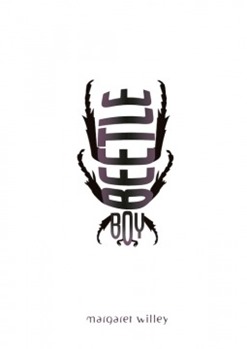
Beetle Boy by Margaret Willey

Charlie Porter never expected to have a girlfriend who cared this much for him.  Enough to bring him into her home after he had surgery on his Achilles tendon and care for him while he could not walk.  But now Clara is starting to ask pointed questions about Charlie’s childhood and his family, questions that Charlie does not want to answer.  Clara knows that Charlie was once billed as the world’s youngest author and sold story books about beetles.  She also knows that he has nightmares every night that usually involve screaming.  She doesn’t know though that Charlie’s dreams are filled with huge black beetles or that the books he sold were not really his own stories.  She doesn’t know that his mother abandoned him, that his father forced him to sell books, that his brother hated him then and still does for abandoning him.  She knows so little, but can Charlie open up and let her see the truth about him without her leaving him entirely?

Willey paints a tragic and painful look at a young man continuing to wrestle with the demons of his childhood.  At 18-years-old, Charlie continues to dream about his past and to live as if it is his future as well.  The book shows how difficult dysfunctional and neglectful childhoods can be to escape, even after one has physically left if behind.  Willey manages to create a past for Charlie that does not become melodramatic.  She makes it painful enough but not too dramatically so. 

Charlie is a very interesting protagonist.  He is not a hero, because he is too damaged to be called that.  He is certainly a survivor, wrestling with things that will not let him go or let him progress.  He is frightened, shy, and can’t see a future for himself.  He is a tragic figure, one that readers will root for entirely, but also one that drips with anger, shame and sadness.  One of the best parts of the novel is the end, which does not end neatly or give a clear path for Charlie.  The ending has hope, but continues the complexity of the issues that Charlie faces.  Perfectly done.

A brilliant and powerful look at neglect and abuse and the long shadow it casts over a life.  Appropriate for ages 14-17.

Reviewed from digital galley received from Carolrhoda Books and Netgalley.

Review: Julia’s House for Lost Creatures by Ben Hatke

julias house for lost creatures

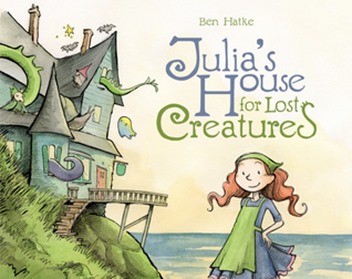
Julia’s House for Lost Creatures by Ben Hatke

The author of Zita the Spacegirl has created his first picture book and it has all of the charm and zip one would expect.  Julia lives in a house carried on the back of a turtle.  They arrive on a quiet beach by the sea where Julia quickly settles in, but it is far too quiet.  So Julia makes a sign that says “Julia’s House for Lost Creatures.”  She didn’t have to wait long before something is at the door, and then more and more creatures.  Soon she has a house full of odd beasts, including a dripping troll, a patchwork cat, a dragon, a ghost, and a mermaid.  Things quickly get out of hand as they all make themselves at home.  Now Julia needs another plan, and maybe another sign or two.

Hatke’s jaunty protagonist is what makes this book work.  She moves quickly and with plenty of determination and is filled with ideas.  One can almost see her thinking on the page.  Perhaps the best part of the book is when she becomes overwhelmed and has to rethink.  The book has been galloping along and then pauses as Julia does, slowing to a pace that lets one catch their breath.  It’s a wonderfully done moment just like many others in the book.

Told very simply, the book relies nicely on the illustrations to show much of the action rather than the text explaining it.  This makes for a very readable picture book, but also one that is better for lap reading than for a group.  Listeners will want to look closely at the page even before the amazing creatures fill them.

An exceptional picture book debut, one hopes that Hatke keeps created both picture books and graphic novels for children.  Appropriate for ages 4-6.

Reviewed from copy received from First Second.

Review: Who Was Here? by Mia Posada

who was here

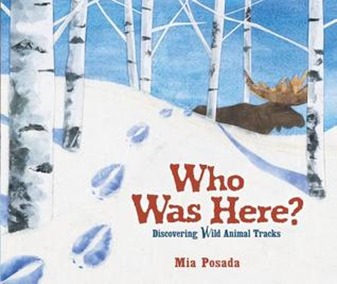
Who Was Here? Discovering Wild Animal Tracks by Mia Posada

The riddle of animal tracks is deciphered here in a fun guessing game.  The tracks of each animal are displayed along with information about the tracks and the animal that left them.  Readers then turn the page to see whether they guessed right about what animal left those tracks.  The pages with the animal have scientific information about the animal, their size, weight and their tracks.  Tracks are left in mud, snow, sand and more.  These too are hints about the animals, making the book speak to habitat too.  This interactive book will have children embracing science and learning about animals without even realizing it.

Posada encourages children to learn more in the final pages of her book.  She gives hints to decode animal tracks, offering ideas of what to look for in unknown tracks to help identify them.  The book ends with links to websites and recommended books to read.  Posada uses the page turn to great effect in this book, allowing the reveal to be a big part of the delight of reading this book.  The guessing game element will be popular in story times but also for single readers. 

Done in watercolor and collage, the illustrations have dimension and texture.  The animals pop on the page and their tracks are clear and beautiful.  When Posada has two creatures from the same habitat, their tracks are well defined and clearly different from one another.  This adds to the fun of the read.

A nonfiction picture book that children will enjoy, this readable and accessible book will be a hit at any story time.  Appropriate for ages 6-9.

Reviewed from digital galley received from Netgalley and Millbrook Press.

Review: Miss Brooks’ Story Nook by Barbara Bottner

miss brooks story nook

Miss Brooks’ Story Nook by Barbara Bottner, illustrated by Michael Emberley

A sequel to Miss Brooks Loves Books, this picture book celebrates story telling.  Missy loves going to Miss Brook’s Story Nook right before school each day.  She takes the long way to school, because otherwise she has to go past Billy Toomey’s house and he steals her hat and yells at her.  Then one day at Story Nook, the power goes out so they have to tell their own stories.  Missy though insists that she’s a reader not a storyteller.  But soon she is telling her own story, inspired by Billy Toomey.  It is the story of an ogre named Graciela who has a pet snake that escapes.  The trick is that Missy needs to figure out a satisfying ending to her story of an ogre and a bully.

Bottner has created another engaging story filled with humor and clever solutions.  Miss Brooks is inspiring with her enthusiasm for books and stories and the way she encourages the children to keep making their stories better.  It’s a joy to see Missy tell her very creative story, struggle with some of it but persevere and create a satisfying tale for the entire class to enjoy.

Emberley’s illustrations add a lot of zing to the book.  He captures moods so clearly in his characters from the jaunty excitement of Miss Brooks to Missy’s ever-changing moods.  They are told through expressions and also body language. 

Smart and funny, this is a book to inspire young readers to create their own stories just like Missy.  Appropriate for ages 6-8.

Reviewed from digital copy received from Edelweiss and Random House.

Review: Forget Me Not by Nancy Van Laan

forget me not

Forget Me Not by Nancy Van Laan, illustrated by Stephanie Graegin

This look at the impact of Alzheimer’s is personal and touching.  Told in the first person, the book looks at the changes of Julia’s grandmother.  Her grandmother used to make favorite foods, have her house just so, and even smelled of cinnamon and lilac when they cuddled.  But as time passed, her grandmother started forgetting more and more.  She made mistakes and even started to forget who her family members were.  A little later and Julia’s grandmother started to forget what they had done together in the past, she wasn’t allowed to drive anymore, and her cooking wasn’t the same.  She got worse and worse until she had to be given special care in a home.  Julia and her family have to make the best of it, and that means that Julia has to find a way to continue to connect with her grandmother even though she can’t remember her.

Van Laan uses a delicacy of language her to weave her story.  Since the entire book is about loss of memory and the loss of a grandparent to Alzheimer’s, this delicacy sets a lovely tone for the book.  As the changes start to happen, Van Laan describes them: “But ever so slowly, like a low tide leaving the bay, a change came along.”  Filled with constant change, the book captures moments along the way, showing how Julia’s grandmother is worsening but also how they continue to keep her spirit alive and well during the changes.

Graegin’s illustrations show the changes in the grandmother but also maintain a sweetness that never leaves the story.  Despite the grandmother’s decline, the light remains bright in the illustrations and the family stays close knit in a visual way.

There are many books about Alzheimer’s available now, but this one takes just the right tone and gives information that young children are looking for.  Appropriate for ages 4-6.

Reviewed from digital galley from Edelweiss and Random House Children’s Books.

Review: Sisters by Raina Telgemeier

sisters

Sisters by Raina Telgemeier

Released August 26, 2014.

The exceptionally talented and incredibly popular Raina Telgemeier returns with a sequel to her beloved Smile.  This is the story of Raina and her little sister, Amara.  Raina was desperate to have a little sister, but Amara is not working out the way she had pictured.  Now Raina is stuck on a road trip with her sister, little brother and her mother.  They are all stuck in a van traveling from San Francisco to Colorado for a family reunion.  The relationship between the two sisters is tense, not only because they have very different personalities but also because they are both artists.  Then you add in the clear issues of Raina’s parents and you have a dynamic view of a family on the brink of big changes.  It’s just up to Raina and Amara as to how their relationship with one another will change.

Telgemeier has created another breathtakingly honest graphic novel for elementary and middle grade readers.  Through her illustrations and humor, she shows a family at the crux of a moment that could change things forever.  The book though focuses on flashbacks showing the family and how relationships have altered.  Readers may be so focused on the story of the two sisters that they too will be blindsided along with Raina about the other issues facing their family.  It’s a craftily told story, one that surprises and delights.

As always, Telgemeier’s art is fantastic.  She has a light touch, one that invites readers into her world and her family and where they long to linger.  Her art is always approachable and understandable, more about a vehicle to tell the story than about making an artistic statement on its own.  It is warm, friendly and fantastic.

Highly recommended, this book belongs in every library that works with children.  A dynamite sequel that lives up to the incredible first book.  Appropriate for ages 9-12.

Reviewed from ARC received from Scholastic.