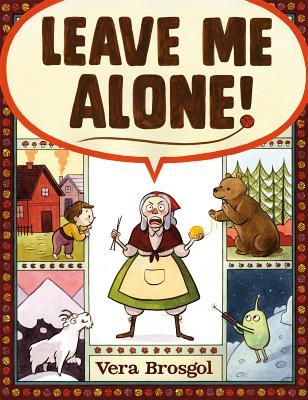
Leave Me Alone by Vera Brosgol

leave-me-alone-by-vera-brosgol

Leave Me Alone by Vera Brosgol (InfoSoup)

A grandmother is all set to start knitting for her very big family, but they just keep on interrupting her. The children love to play with her balls of yarn and she can’t seem to find a quiet place to work. So she packs up her knitting things and heads out the door, shouting “Leave me alone!” She finds a quiet place in the woods to knit, but soon she catches the interest of some hungry bears. She again has to pack up and leave, shouting “Leave me alone!” It doesn’t get any better when she climbs a mountain and finds a cave to work in. The mountain goats find her yarn delicious and even eat her scarf too. So the grandmother climbs up the mountain and onto the moon. Even there, the aliens won’t leave her alone. Where can one grumpy grandma go to knit? You will be surprised by the answer!

I applaud a picture book willing to take something that has a traditional folklore theme hearkening back to The Old Woman in the Shoe and then twists it into a modern and wild picture book that you never ever realized was even headed your way. It’s an impressive shift that happens in the story, leading back ultimately to an ended that restores the folkloric tradition but along the way takes it in a scientific and funny direction. Children will love the twist, adults will enjoy the surprise making this a great book to share aloud.

Brosgol’s illustrations are a hoot. With every new area that the grandmother attempts to quietly knit in, it seems like the perfect choice at first. Then slowly and with great pacing, the interruptions appear and then devolve into wild abandon. There are very clever moments in the illustrations: a goat perched on the mountain of yarn, the hungry bear who doesn’t scare the grandmother a whit, and the goat that wanders up to the moon too.

An outstanding read aloud with a very surprising twist, this picture book is a great example of mixing folklore and science. Appropriate for ages 4-6.

Reviewed from library copy.

My Friend Maggie by Hannah E. Harrison

my-friend-maggie-by-hannah-e-harrison

My Friend Maggie by Hannah E. Harrison (InfoSoup)

Maggie and Paula have been friends since they were babies. Maggie, an elephant, is great at a lot of things like splashing in puddles and reaching apples on the tree. But when Veronica tells Paula that she thinks Maggie is too big, Paula starts to notice things about Maggie. She sees that Maggie is clumsy, can’t hide during games, and her clothes are snug. Paula knows that she should stand up for Maggie, but instead Paula starts to pretend she doesn’t see Maggie at all, something that is particularly hard with an elephant. When Veronica starts to pick on Paula for her teeth and the way they stick out, Maggie is the first to defend her, showing exactly how a friend should act.

Harrison tells the story of a little problem in a strong friendship, a situation that will be very familiar for young children who are just figuring out how to be friends and what that means. Children will feel for Maggie and the way she is shunned but thanks to Harrison having the voice of Paula tell the story, they will also understand Paula’s point of view and even see how they themselves could make the same choice.

Harrison’s art shines as always. Her detailed artwork shows Maggie in all of her size and also captures her friendly spirit as well. Throughout the book, you can tangibly feel the emotions of the characters. Maggie’s ears alone do a great job of conveying how very sad and hurt she is by the way she is being treated. And look out when Maggie is angry!

This is a beautiful picture book about a cherished friendship that stumbles and then rights itself. Appropriate for ages 3-5.

Reviewed from ARC received from Dial Books.


Who Broke the Teapot? by Bill Slavin

who-broke-the-teapot-by-bill-slavin

Who Broke the Teapot? by Bill Slavin (InfoSoup)

Thanks to Fuse #8 for bringing this one to my attention!

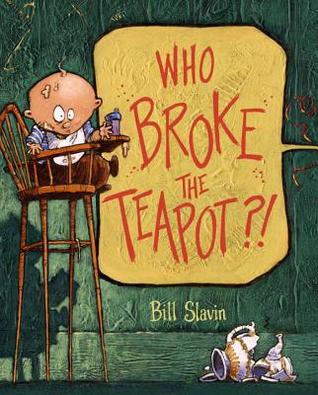
Mom is furious when she discovers the teapot broken on the floor. Who could have broken it? Each family member denies it being them. It wasn’t Sister who is busy eating just like Bowser the dog. It wasn’t Kitty who is so tangled in her wool that she can barely move. It wasn’t Brother who is stuck up on the fan by his overalls. It wasn’t Dad who is still reading the newspaper in his underwear. So who could it have been? Luckily, readers get to watch it all happen when time is rolled back to five minutes earlier. But even then, will they know exactly who broke the teapot?

Slavin has written a book that gallops along. It has a wonderfully brisk pace that suits the high emotions of the book perfectly. There is rhythm and rhyme aplenty, adding to the rollicking feel of the title. The text is filled with dialogue as well, creating a book that is a gleeful readaloud, one that almost reads itself and will have young listeners entirely entranced. Just leave enough time to potentially read it more than once!

Slavin’s illustrations are a strong mix of cartoon characters against textural backgrounds that add real depth. There are other elements with texture like Kitty’s string as well. As the action really gets going, Slavin plays with the colors of the background, revving them up to oranges from the greens and blues. Sounds words are also added, creating a comic book zaniness.

Grab this one and use it in your next story time. Giggles and guffaws are guaranteed! Appropriate for ages 3-5.

Reviewed from library copy.


Snow White by Matt Phelan

snow-white-by-matt-phelan

Snow White by Matt Phelan (InfoSoup)

The Snow White tale is redone with a new setting and great villains in this graphic novel. Snow White’s mother dies in 1918 and she is left with her father who is the King of Wall Street. Soon after her mother’s death, her father falls for the Queen of the Follies, a performer who immediately sends Snow White away to school. When the stock market crashes, her father survives only to die suddenly. Snow White returns home to find that there is no place for her there, only to be rescued by seven small urchins on the street. Meanwhile, her stepmother takes her dire instructions from a ticker tape machine that orders her to KILL.

With all of the magnificence of the roaring 20s that then tumble into the Great Depression, this graphic novel version of the beloved tale truly rethinks the story and recreates it in a new and vivid way. Keeping true to core parts of the original story, this version has the wicked queen, a new version of the seven dwarves, the huntsman ordered to kill Snow White, and apples. Throughout there is darkness, violence and murder. Exactly what any great noir mystery needs.

If you have enjoyed Phelan’s previous graphic novels, he continues his use of watercolor in this book. Done in grays, blacks, blues and shot with touches of red, the art has a painterly feel to it that is unusual in graphic novels. There is a lovely roughness to the framing of the panels, giving the entire book a natural and organic feel.

A brilliant retelling of a classic tale, this dark story is a striking and brilliant departure. Appropriate for ages 9-12.

Nanobots by Chris Gall

nanobots-by-chris-gall

Nanobots by Chris Gall (InfoSoup)

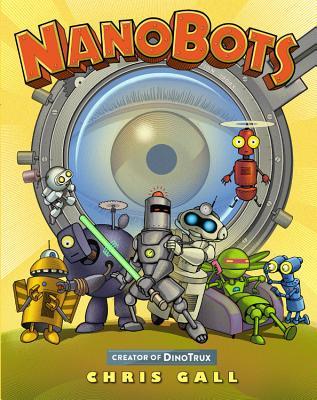
A boy creates robots that are so small, you can’t see them with the naked eye. He calls them “nanobots” and starts to equip them for special jobs that only they can do. There are the Seekerbots that explore amoebas, Mechanobots that work fixing things, Helobots that stick together to make something new, Medibots that work in the human body to repair it, and many more. So the boy took the robots to the science fair where there was also a very large robot. The large robot though was not put together quite right and not functioning well. So the little nanobots rushed to help and repair him. Soon he was a huge and amazing robot that looked new! But would the nanobots still win the science fair?

Gall has created a picture book that will appeal to children who love superheroes and comic books. Filled with lots of details about each of the nano-sized heroes, there is a pleasure in just learning about each type of tiny robot. The story is eclipsed by the robots themselves, but it serves both as a structure for the book and a way to show exactly what an impact the nanobots can have out in the world.

Told with a broad sense of humor, the illustrations highlight the various types of nanobots. Each has a personality all their own with some being very hip and others more childlike. The illustrations are bright and colorful and have a throwback vibe to robots from the 50s and 60s that is very appealing.

Sure to appeal to fans of robots and comics, this picture book is smart and funny. Appropriate for ages 5-7.

Reviewed from library copy.


National Book Award Finalists

The finalists for the National Book Award were announced yesterday. Winners will be announced on November 16th. Here are the finalists in the Young People’s Literature category:

Ghost March: Book Three (March, #3)

Ghost by Jason Reynolds

March: Book Three by John Lewis, Andrew Aydin & Nate Powell

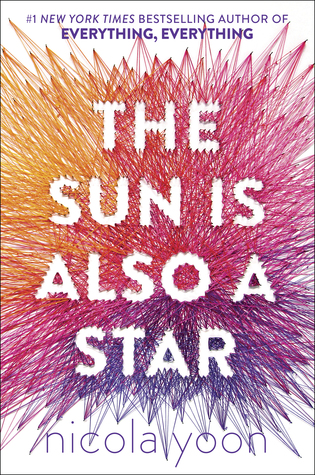
Raymie Nightingale The Sun Is Also a Star

Raymie Nightingale by Kate DiCamillo

The Sun Is Also a Star by Nicola Yoon

When the Sea Turned to Silver

When the Sea Turned to Silver by Grace Lin


This Weeks Tweets, Pins & Tumbls

Here are the links I shared on my Twitter, Pinterest, and Tumblr accounts this week that I think are cool:

So true:

CHILDREN’S BOOKS

The “Goosebumps” Conundrum: What Makes a Children’s Book Good? – The New Yorker

The Grown-Up Lives Behind Classic Children’s Books

How Banning Books Marginalizes Children

Meet the Illustrator: Erin E. Stead | Brightly

Missed the on nurturing empathy thru ? Have no fear! Full archive here:

Mo Willems’ best-selling book series comes to life in ‘Elephant & Piggie’s We Are in a Play!’

Oliver Jeffers: ‘I was always an artist’ – but not a child of books

A plentiful harvest of Halloween picture books

Plenty of new kids’ books for Jewish New Year | j. the Jewish news weekly of Northern California

These election-year kids’ books get our vote

Want to Teach Kids About Money? These 9 Books Will Help

Writing Children’s Books Helped Grace Lin Embrace Being Asian American

EBOOKS

Print or Digital, It’s Reading That Matters

How Are You Celebrating The Freedom To Read -- also known as Banned Books Week ?:

LIBRARIES

New York Public Library has a mini roller coaster for books

Official ‘Outraged’ About Charges After KC Library Arrests

Photographing All 211 New York Public Library Branches

See the stunning renovation: Iconic New York Public Library reading room reopens Oct. 5

i love this quote:

TEEN LIT

From Baby-Sitting to Magic Pants: Why I Love Female Friendships in Young Adult Fiction

Magic In The Air: 3 Young Adult Fantasy Reads For Fall

YA Authors Get Out the Vote with

Follow Me by Ellie Sandall

follow-me-by-ellie-sandall

Follow Me by Ellie Sandall (InfoSoup)

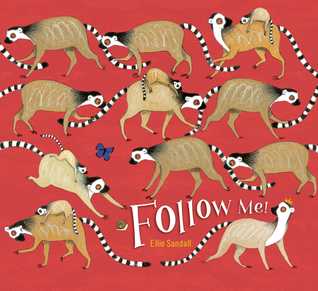
A lemur leads his extended family on a journey in this picture book. First he wakes them up and they climb down from the tree encouraged by his “Follow me, follow me, follow me!” They have a lot to do with things to chase after, discover and scare. They climb scrawny trees, munch on cactus for lunch. But when they are crossing the river, they get quite a surprise that has them moving a lot faster! They return to the safety of their tree after that, the book becoming almost sleepy in the end.

Sandall has written a rhyming book that works really nicely thanks to its simplicity. The “follow me” refrain creates a strong structure for the book. She uses the refrain in a variety of ways, from encouragement to warning to eventual dozing sleep. This change in tone is key to the book working so well since it adds dimension and changes in pace as the book moves along.

The illustrations are large and bright, perfect for using with a group of children. Backgrounds are kept simple and geometric with branches, leaves, and plants. The lemurs themselves shine on the page with their ringed tails and round orange eyes.

A simple and fun picture book with plenty of zing. This is one to follow! Appropriate for ages 2-4.

Reviewed from copy received from Margaret K. McElderry.


How to Be a Hero by Florence Parry Heide

how-to-be-a-hero-by-florence-parry-heide

How to Be a Hero by Florence Parry Heide, illustrated by Chruck Groenink (InfoSoup)

Gideon is a boy who knows exactly what he wants and that is to be a hero. So he reads a lot about heroes and looks forward to having his picture in the newspaper. At first he thinks that in order to be a hero you need to be strong, brave and clever. But then as he reads more stories, he realizes that a lot of heroes just happen to be in the right place at the right time. So Gideon starts walking around looking for opportunities to simply step in and be the hero. One day at the grocery store, Gideon is shopping for candy when something happens. Will Gideon be the hero he hopes to be?

There is something delightfully irreverent about this picture book. It shows glimpses of fairy tale heroes and princes who all become heroes via no skills of their own. Then there is Gideon, a boy in search of fame and acclaim. He is not driven at all by hopes of helping someone, making his search for heroism all the more cynical. As readers watch the opportunity for real heroism literally pass Gideon by, they will realize that it is those who are not searching for fame who are the real heroes. Still, Gideon gets his own taste of fame in the end.

Groenink’s illustrations add to the story. He has small touches in the book that add real life and dimension. While the real life images are more muted, the heroes in the stories are boldly colored and fill the page. That same feel is echoed again in real life when heroism happens at the grocery store. Breaking that moment into steps allows the readers to mistake what is happening at first, deepening the truth about heroism.

A mix of fairy tale heroes, one hero in waiting and one true hero, this picture book is impressive for its tone and attitude, setting it apart on the crowded library shelves. Appropriate for ages 4-6.

Reviewed from copy received from Chronicle Books.