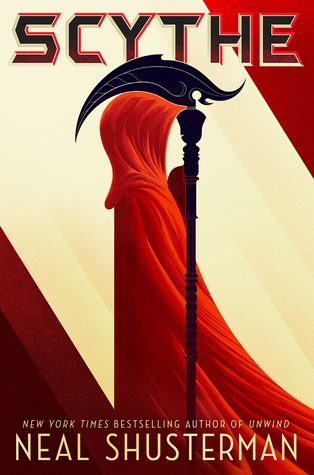
Scythe by Neal Shusterman

scythe-by-neal-shusterman

Scythe by Neal Shusterman (InfoSoup)

Released November 22, 2016.

Set in a future where death no longer exists for humans, the only way to die is to be selected at random to be gleaned by a Scythe. Scythes live separately from other people and want for nothing though they usually live minimally. When Scythe Faraday appears in Citra’s home, her life changes even though he is only there for a meal and not to glean anyone in her family. Faraday also visits Rowan’s school where he gleans the school’s football star. Faraday then selects Citra and Rowan to serve as his apprentices and compete for the honor of becoming a scythe. However, there are forces at work in the scythe web of power that will set Citra and Rowan truly against one another and call into question everything that the scythes have been built upon. Citra and Rowan must figure out how to maneuver through the political and personal intrigue and survive.

Shusterman has created a future that many of us would say is a utopia, one where no one dies. Against that vivid and bright wonder he has created killing machines, people who glean or  murder with a personal touch that is horrifying, unsettling and all too real and logical. Shusterman has built a world that is striking and vivid. He has teens who kill themselves just to be restored to life again. He has elderly people who can reset their age back to their twenties again and again, so no one knows how old people actually are. It is a society both free from death and still obsessed with it.

Shusterman at the heart of the novel is also asking what makes us human. And could it be that mortality itself is a vital part of our lives? Is that what makes us musicians, artists and lifelong learners? It is against this dearth of art and knowledge that Citra and Rowan are growing up, looking forward to nothing in life other than its inevitability and endlessness. Then they are made scythe apprentices and the world shifts to something dark and dangerous. Suddenly though, they are alive.

Brilliant and complex, this novel asks real questions about life, death and the ability to murder for society. Appropriate for ages 14-17.

Reviewed from ARC received from Simon & Schuster.


Publisher’s Weekly Best Children’s and YA Books of 2016

Publisher’s Weekly has released their top picks for the year. These are the top 50 books from the over 2000 children’s and teen books they reviewed this year. So many favorites on the list!

The list is nicely broken into picture books, middle grade and young adult so that the 50 books are placed in bite-sized collections for you. Enjoy!

This Weeks Tweets, Pins & Tumbls

Here are some cool links I shared on my Twitter, Pinterest, and Tumblr accounts this week:

Writing:

CHILDREN’S BOOKS

8 Books About Real-Life Kids Who Changed the World | Brightly

The 50 best children’s and YA books of 2016

At 90, Hilary Knight Launches Two Book Projects with Macmillan

Carson Ellis kindly sent us dev work for the brilliant DU IZ TAK? (more here: | buy book: )

“Diary of a Wimpy Kid”: The anti-Harry Potter

The Latest Trend: Beautifully Illustrated Nonfiction Picture Books

Little, Brown to Publish ‘Creativity Project’ by Michigan Teacher Colby Sharp

Marilyn Nelson wins 2017 NSK Neustadt Prize for Children’s Literature

This Beautiful Children’s Book Is Exploring Queer South Asian Themes

Check out these easy BUT not boring books perfect for beginning readers. Each book is leveled so you know which books are the easiest and which are a bit harder.:

READING

Don’t Tell Me Boys Can’t Read As Well! | Huffington Post

Here’s my secret weapon: I read – Creatomic – Medium

 :

TEEN LIT

The 10 Best New Young Adult Books in October 2016

Once Taboo, Gay Characters Are Taking Over YA Fiction | Broadly

Watch Emma Watson Hide Books on the London Underground via

Benny and Penny in How to Say Goodbye by Geoffrey Hayes

benny-and-penny-in-how-to-say-goodbye-by-geoffrey-hayes

Benny and Penny in How to Say Goodbye by Geoffrey Hayes (InfoSoup)

Benny and Penny return in another graphic novel perfect for new readers. In this story, the two mouse siblings start the story by jumping in piles of leaves. Penny worries that Benny will hurt the leaves, but Benny explains that the leaves are already dead. Then Penny discovers a dead salamander in the yard. Penny wants to bury the salamander but Benny gets angry and tries to stop her over and over again. As Penny moves ahead with burying the salamander with the help of another friend, Benny listens in and then starts feeling sad rather than angry about the little dead creature.

Hayes speaks to the experience of death for young children in a gentle and understanding way. He captures the movement from anger at loss to grief in a way that is organic and natural, allowing Benny the ability to feel his emotions and contrasting those with the way his sister is reacting. Both reactions are supported by the book, allowing children to think about their own emotions.

Hayes sets the book in autumn, showing seasonal aspects throughout the story. There are fallen leaves, bare trees, and a sense of change throughout the book. As always, Hayes beautifully illustrates his graphic novels, allowing them to be an ideal bridge between picture book and chapter book.

A lovely look at a child’s first experience with death, this graphic novel is gentle and filled with kind understanding. Appropriate for ages 5-7.

Reviewed from copy received from TOON Books.


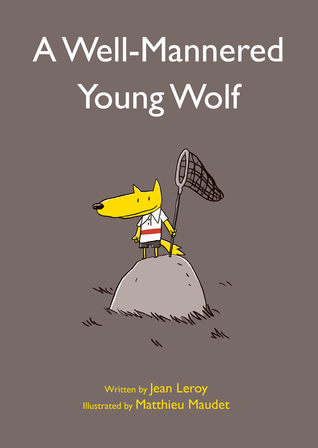
A Well-Mannered Young Wolf by Jean Leroy

a-well-mannered-young-wolf-by-jean-leroy

A Well-Mannered Young Wolf by Jean Leroy, illustrated by Matthieu Maudet (InfoSoup)

A young wolf who has been taught good manners by his parents heads into the wolf to hunt alone for the first time. One of the most important rules is that he must honor the final wishes of his prey. When he nets a rabbit, the rabbit requests that the young wolf read him a story. So the wolf heads home to find his favorite book but when he returns to the woods, the rabbit has left. Next, the wolf captures a chicken who requests music. After the wolf returns with an instrument, the chicken is gone too. The wolf then captures a little boy, who asks for a drawing. The wolf almost doesn’t agree, but the little boy has said please. When the wolf returns, the boy is still there waiting! And the boy loves the picture so much that he wants to show his friends. In a twist ending that is both satisfying and wonderfully dark, the wolf finally succeeds in his hunt.

Leroy sets a brisk pace in this picture book where much of the dialogue is done in speech bubbles and the text is kept to a minimum. The book dashes along on the hunt with the wolf, to and fro from his house and back to his disappearing prey. As the book gains momentum thanks to the repeating pattern, Leroy breaks it and moves ahead with the story at just the right time. It’s a wild and wolfish look at manners that everyone will enjoy.

Maudet’s illustrations convey the frustration of the young wolf very clearly. The wolf uses the book to capture the chicken and then leaves the instrument smashed on the ground in frustration. The limited color palette is filled with orange and red, played against gray and brown.

The book is completely wonderful, satisfying and the twist ending will leave children surprised and asking to hear it again. Appropriate for ages 4-6.

Reviewed from copy received from Eerdmans Books for Young Readers.


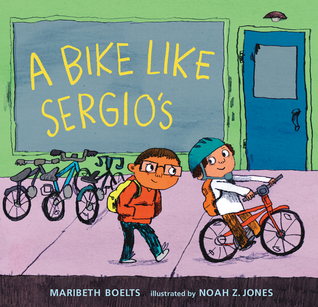
A Bike Like Sergio’s by Maribeth Boelts

a-bike-like-sergios-by-maribeth-boelts

A Bike Like Sergio’s by Maribeth Boelts, illustrated by Noah Z. Jones (InfoSoup)

Ruben would love to have a bike like his friend Sergio has. Even though his birthday is coming, Ruben knows that he doesn’t get presents like bicycles. His family is large and there’s not enough money even for all of the groceries they need some weeks. One day when he is at the store for his mother, a lady in front of him drops a dollar bill. Ruben picks it up and puts it in his pocket, but when he looks at it later he discovers it’s actually a one-hundred dollar bill! That’s enough for him to get the bike he’s always wanted. Now Sergio has a dilemma, does he give the money to his family for groceries? Does he give it back to the woman? Or does he buy the bike of his dreams?

Boelts has created a story that is much more than a lesson in morals. This story is about ethical choices yes, but also about economic disparity and families living on the edge. It is a story told with real subtlety and offering an understanding of what would drive a child who is good at heart to steal what they thought was a dollar. It’s a book about the stories we tell ourselves to make our decisions “right” and the way that doing the right thing may not always be easy or clear.

The illustrations by Jones are modern and rather quirky. They fill the page with the vividness of the urban setting. The love and caring of Ruben’s family are also celebrated in the illustrations.

Subtle and smart, this book about decisions and doing the right thing asks all the right questions. Appropriate for ages 5-7.

Reviewed from library copy.

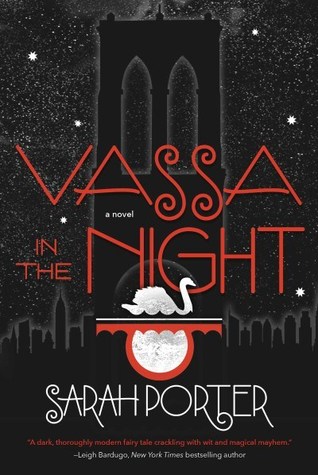
Vassa in the Night by Sarah Porter

vassa-in-the-night-by-sarah-porter

Vassa in the Night by Sarah Porter (InfoSoup)

When the nights in Brooklyn seem to be getting longer and longer, lasting almost entire days, Vassa finds herself looking forward to school just not to be home any longer. Part of it is her stepmother and stepsisters and part is pure boredom. It doesn’t help that Erg, the wooden doll that Vassa’s mother gave her before she died, is stealing things from her stepsisters which are then blamed on Vassa. So when one of her stepsisters basically dares Vassa to head to the dangerous local convenience store, Vassa accepts the challenge. She heads to Babs Yagg’s store, the one that dances on chicken legs and that you have to sing down. She makes sure that Erg is with her, as always, and knows that she is in for an unusual experience. What Vassa doesn’t realize is that she is headed straight into her dangerous destiny and will discover an entire magical world that she never knew existed: one with bleeding swans, a dark motorcyclist, severed hands, and beheaded teens.

Inspired by the Russian folktale, Vassilissa the Beautiful, this novel for teens embraces all of the strange and bizarre in that story and takes it even further. Baba Yaga’s home on chicken feet becomes an amazing convenience store filled with some treats that are tempting and others that seem odd and still others that nauseate. The modern Babs Yagg is still very much a witch, and one that toys with her prey in haunting and excruciating ways. There are impossible tasks, the need for plenty of bravery, and real loss and death threatened at every turn.

This is a mesmerizing book, one that is filled with gorgeous writing that stays out of its own way and then rises beautifully to create new moods. Throughout the book the story turns briefly away and into other perspectives like those of the swans themselves or of the attorneys who are after Babs. The language changes and weaves new patterns, creating completely different worlds and experiences and then gently carrying the reader back to the main story. It’s a powerful magic all its own.

Beautifully written, this twist on a folktale is bizarre, wild and extraordinary. Appropriate for ages 14-17.

Reviewed from e-galley received from Edelweiss and Tor Teen.


Natalie Babbitt Has Died

Tuck Everlasting Tuck Everlasting

Natalie Babbitt, author of the incredible Tuck Everlasting, has died of lung cancer. She died on October 31 at the age of 84. Tuck Everlasting celebrated its 40th anniversary last year.

From the Publisher’s Weekly obituary:

In a statement, Samuel F. Babbitt shared this reflection: “Natalie was a remarkable woman. While more than fulfilling her roles as wife and mother, she sharply observed her fellow humans, shaping stories that helped her and her readers grapple with both the trivial and fundamental trials of life. Words were precious things to her, and she chose them, shaped their facets, and set them on the page like a master jeweler.”

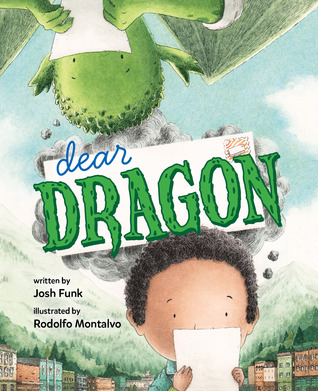
Dear Dragon by Josh Funk

dear-dragon-by-josh-funk

Dear Dragon by Josh Funk, illustrated by Rodolfo Montalvo (InfoSoup)

At two different schools, two boys are assigned to be penpals with one another. Their letters have to be written in rhyme. The boys start by talking about the assignment and school and then quickly move on to what they enjoy doing and their families. What the boys don’t know though is that George is a human and Blaise is a dragon. As each boy misinterprets the clues that the other is giving them about how different they are, a picnic approaches where the penpals are going to meet. What happens when the class of humans and the class of dragons finally meet one another? Success!

Funk cleverly uses fantasy to speak about how we see differences between one another. His use of dragons and the intelligent way that he hides the truth while all the while revealing it too makes for a fun book to share. This would be a great book to offer to children who are starting their own penpal assignments and also offers an opportunity for any child to see how things can be misunderstood even when they are stated clearly. It also speaks to our ability to think that people are just like us and the ability to see beyond physical differences and to the person (or dragon) inside.

The illustrations are playful and bright. They capture the ways that the two boys are meaning their messages. So one image is the way that the writer intended the message to be read and the other is thought bubbles for how the message is being interpreted by the reader. There is plenty of action and drama imagined about simple messages and then in reverse there are dramatic scenes that are completely misunderstood and downplayed.

Funny and clever, this picture book demonstrates that humans can see beyond green scales to the pal underneath. Appropriate for ages 4-6.

Reviewed from ARC received from Viking Books for Young Readers.