What Color Is the Wind? by Anne Herbauts

what-color-is-the-wind-by-anne-herbauts

What Color Is the Wind? by Anne Herbauts (InfoSoup)

A child who is blind walks through the world asking what color the wind is. He gets very different answers from those he asks. The wolf says the wind is “the dark smell of the forest.” For the bees, the wind is “the color of  sunshine.” The apple tree sees the wind as “a sugary color” while its roots view it as “the color of sap and pomegranates.” By the end of the book, the child reaches a giant who says that the wind is the color of all of these things. Then readers are encouraged to flip the pages of the book, creating a rainbow of colors along the way and a breeze of wind too.

Herbauts’ book is exceptional. She has created a book filled with the senses. She incorporates touch into her illustrations, taste and smell are in many of the colors of the wind, and throughout there is a feel for the lack of vision and the increased vitality of the other senses. The imagery she matches with each character’s point of view is spot on. It’s done in a lush and lovely way that makes the experience of reading it intense and fascinating.

The illustrations have raised ridges in places that can be felt by the fingertips. They also have gloss on them to bring some of the tactile features out visually as well. Others are almost hidden until you run your fingers along them. The pages are filled with colors and playfulness with the child’s black boots walking along from page to page and other pages covered in raindrops or laundry.

Immensely beautiful, lush and wondrous, this picture book is a feast for all of the senses. Appropriate for ages 3-5.

Reviewed from copy received from Enchanted Lion Books.

Things Too Huge to Fix by Saying Sorry by Susan Vaught

things-too-huge-to-fix-by-saying-sorry-by-susan-vaught

Things Too Huge to Fix by Saying Sorry by Susan Vaught (InfoSoup)

Dani’s grandmother suffers from Alzheimer’s and is slowly reaching the end of her life cared for by Dani and her parents. So when her grandmother sends Dani on a mission to find a letter and key, Dani isn’t sure that it’s real. She discovers both the letter and key, then has to follow the trail of clues her grandmother left in her writing to discover the truth of a feud that her grandmother had with Avadelle Richardson, a novelist who wrote about a riot that happened at Ole Miss. It’s a riot that both Dani’s grandmother and Avadelle actually were caught up in. As Dani gets closer to the end of the trail, she finds more and more secrets and history and modern life begin to collide.

Vaught has written a taut novel that takes readers on a journey through Civil Rights history in Mississippi. Told through the eyes of Dani, the book is accessible to modern children and shows that racism is far from over. With our recent election, it is also a timely book that speaks to the deep-seated racism still at work in our country today. Vaught uses excerpts from Avadelle’s fictitious novel to show the historical context that the riot took place in. It does show how far we have come, but also speaks to how far we have to go.

The complex friendships of middle grade children are captured here, with Dani and her best-friend Indri sharing the adventure while her “not-friend” Mac, grandson of Avadelle continues to also be a part of it though at times the two are not speaking, just like their grandmothers. This modern division is a clever way to show how friendships change, shift and fall apart, something that mirrors what is seen in the novel and in the grandparents’ relationship.

A rich look at Civil Rights, racism and the decisions too big to be unmade, this novel is a timely look at today and our shared past. Appropriate for ages 9-12.

Reviewed from copy received from Simon & Schuster.


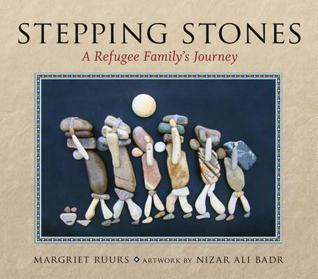
Stepping Stones by Margriet Ruurs

stepping-stones-by-margriet-ruurs

Stepping Stones: A Refugee Family’s Journey by Margriet Ruurs, artwork by Nizar Ali Badr (InfoSoup)

Told in both English and Arabic, this picture shares the story of a family of Syrian refugees. The book begins with Rama talking about their life in Syria and how things have changed and freedoms have been lost. War arrived with a lack of food and people began to leave. Still, Rama and her family stayed until bombs fell too close to their home and they joined “the river of people.” They walked and walked until they reached the sea where they boarded a small boat. People died aboard but Rama’s family survived. They walked farther, no longer in a world torn by war until they came to their new home and were greeted by smiling new neighbors.

This picture book is simple enough to share with children. It speaks to the horrors of war but with a delicate touch. Still, it is a book that will spark questions and discussion for children who will want to understand if they will ever need to be refugees themselves and how they can help. It is a picture book that speaks to our universal humanity, the power of war and the courage of hope.

The illustrations are spectacular. Ruurs opens the book with an explanation of discovering his art on Facebook and reaching out to him to see if he would do a book with her on Syrian refugees. His art is moving and emotional, the faceless rocks somehow capturing fear, strain, despair and eventually joy. Done with subtle natural colors, the art is powerful and wrenching.

A noteworthy and extraordinary picture book on the refugee crisis, this picture book belongs in all libraries. Appropriate for ages 5-8.

Reviewed from library copy.


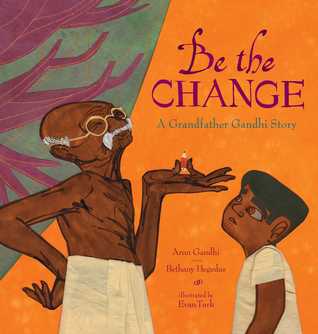
Be the Change by Arun Gandhi

be-the-change-by-arun-gandhi

Be the Change: A Grandfather Gandhi Story by Arun Gandhi and Bethany Hegedus, illustrated by Evan Turk (InfoSoup)

Arun lives in a village with his grandfather. The purpose of life in the ashram was to work in service for one another. For Arun, that meant following his grandfather’s rules as well and the hardest for Arun was not to waste. One day, Arun grew tired of his vow not to waste and threw an almost worn out pencil away into the grass. When he asked for a new pencil that night, his grandfather said that he had had a fine pencil just that morning. He went on to explain that the thing of importance was not the pencil but Arun himself. So Arun set off after dark to find the pencil nub in the grass. Still, it would take more teachings from his grandfather for Arun to finally connect wasting nothing with nonviolence as Arun works to define what passive violence actually is.

In a lesson ideal for our time of large consumption and rude political discourse, this picture book is a gentle salve. It speaks of small moments of choice actually shaping our persona and our ideas. One small pencil nub is actually a decision to live without excess and without damaging others. The message is delivered through the curious eyes of a young boy who asks the questions that readers will also have. This is a lovely and accessible look at the teachings of Gandhi.

Turk’s illustrations are lush and patterned. He uses collage at times, fabric folds popping off the page. Gorgeous colors fill nature with purple trees, silver rimmed clouds, the glow of orange understanding after a darkness of shadow.

This second picture book about Grandfather Gandhi is a treat and offers opportunity for discussions about waste and care for others. Appropriate for ages 5-7.

Reviewed from copy received from Atheneum.


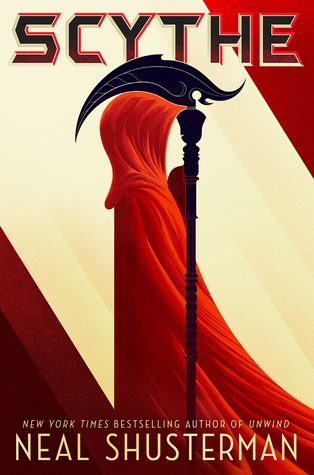
Scythe by Neal Shusterman

scythe-by-neal-shusterman

Scythe by Neal Shusterman (InfoSoup)

Released November 22, 2016.

Set in a future where death no longer exists for humans, the only way to die is to be selected at random to be gleaned by a Scythe. Scythes live separately from other people and want for nothing though they usually live minimally. When Scythe Faraday appears in Citra’s home, her life changes even though he is only there for a meal and not to glean anyone in her family. Faraday also visits Rowan’s school where he gleans the school’s football star. Faraday then selects Citra and Rowan to serve as his apprentices and compete for the honor of becoming a scythe. However, there are forces at work in the scythe web of power that will set Citra and Rowan truly against one another and call into question everything that the scythes have been built upon. Citra and Rowan must figure out how to maneuver through the political and personal intrigue and survive.

Shusterman has created a future that many of us would say is a utopia, one where no one dies. Against that vivid and bright wonder he has created killing machines, people who glean or  murder with a personal touch that is horrifying, unsettling and all too real and logical. Shusterman has built a world that is striking and vivid. He has teens who kill themselves just to be restored to life again. He has elderly people who can reset their age back to their twenties again and again, so no one knows how old people actually are. It is a society both free from death and still obsessed with it.

Shusterman at the heart of the novel is also asking what makes us human. And could it be that mortality itself is a vital part of our lives? Is that what makes us musicians, artists and lifelong learners? It is against this dearth of art and knowledge that Citra and Rowan are growing up, looking forward to nothing in life other than its inevitability and endlessness. Then they are made scythe apprentices and the world shifts to something dark and dangerous. Suddenly though, they are alive.

Brilliant and complex, this novel asks real questions about life, death and the ability to murder for society. Appropriate for ages 14-17.

Reviewed from ARC received from Simon & Schuster.


Benny and Penny in How to Say Goodbye by Geoffrey Hayes

benny-and-penny-in-how-to-say-goodbye-by-geoffrey-hayes

Benny and Penny in How to Say Goodbye by Geoffrey Hayes (InfoSoup)

Benny and Penny return in another graphic novel perfect for new readers. In this story, the two mouse siblings start the story by jumping in piles of leaves. Penny worries that Benny will hurt the leaves, but Benny explains that the leaves are already dead. Then Penny discovers a dead salamander in the yard. Penny wants to bury the salamander but Benny gets angry and tries to stop her over and over again. As Penny moves ahead with burying the salamander with the help of another friend, Benny listens in and then starts feeling sad rather than angry about the little dead creature.

Hayes speaks to the experience of death for young children in a gentle and understanding way. He captures the movement from anger at loss to grief in a way that is organic and natural, allowing Benny the ability to feel his emotions and contrasting those with the way his sister is reacting. Both reactions are supported by the book, allowing children to think about their own emotions.

Hayes sets the book in autumn, showing seasonal aspects throughout the story. There are fallen leaves, bare trees, and a sense of change throughout the book. As always, Hayes beautifully illustrates his graphic novels, allowing them to be an ideal bridge between picture book and chapter book.

A lovely look at a child’s first experience with death, this graphic novel is gentle and filled with kind understanding. Appropriate for ages 5-7.

Reviewed from copy received from TOON Books.


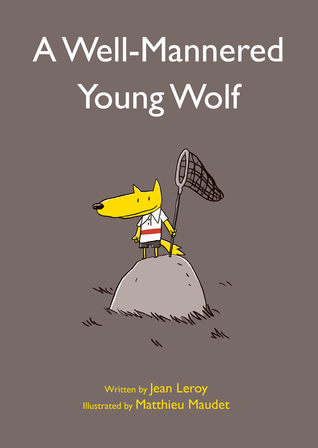
A Well-Mannered Young Wolf by Jean Leroy

a-well-mannered-young-wolf-by-jean-leroy

A Well-Mannered Young Wolf by Jean Leroy, illustrated by Matthieu Maudet (InfoSoup)

A young wolf who has been taught good manners by his parents heads into the wolf to hunt alone for the first time. One of the most important rules is that he must honor the final wishes of his prey. When he nets a rabbit, the rabbit requests that the young wolf read him a story. So the wolf heads home to find his favorite book but when he returns to the woods, the rabbit has left. Next, the wolf captures a chicken who requests music. After the wolf returns with an instrument, the chicken is gone too. The wolf then captures a little boy, who asks for a drawing. The wolf almost doesn’t agree, but the little boy has said please. When the wolf returns, the boy is still there waiting! And the boy loves the picture so much that he wants to show his friends. In a twist ending that is both satisfying and wonderfully dark, the wolf finally succeeds in his hunt.

Leroy sets a brisk pace in this picture book where much of the dialogue is done in speech bubbles and the text is kept to a minimum. The book dashes along on the hunt with the wolf, to and fro from his house and back to his disappearing prey. As the book gains momentum thanks to the repeating pattern, Leroy breaks it and moves ahead with the story at just the right time. It’s a wild and wolfish look at manners that everyone will enjoy.

Maudet’s illustrations convey the frustration of the young wolf very clearly. The wolf uses the book to capture the chicken and then leaves the instrument smashed on the ground in frustration. The limited color palette is filled with orange and red, played against gray and brown.

The book is completely wonderful, satisfying and the twist ending will leave children surprised and asking to hear it again. Appropriate for ages 4-6.

Reviewed from copy received from Eerdmans Books for Young Readers.


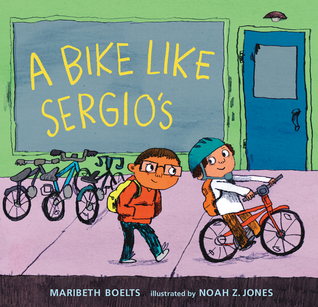
A Bike Like Sergio’s by Maribeth Boelts

a-bike-like-sergios-by-maribeth-boelts

A Bike Like Sergio’s by Maribeth Boelts, illustrated by Noah Z. Jones (InfoSoup)

Ruben would love to have a bike like his friend Sergio has. Even though his birthday is coming, Ruben knows that he doesn’t get presents like bicycles. His family is large and there’s not enough money even for all of the groceries they need some weeks. One day when he is at the store for his mother, a lady in front of him drops a dollar bill. Ruben picks it up and puts it in his pocket, but when he looks at it later he discovers it’s actually a one-hundred dollar bill! That’s enough for him to get the bike he’s always wanted. Now Sergio has a dilemma, does he give the money to his family for groceries? Does he give it back to the woman? Or does he buy the bike of his dreams?

Boelts has created a story that is much more than a lesson in morals. This story is about ethical choices yes, but also about economic disparity and families living on the edge. It is a story told with real subtlety and offering an understanding of what would drive a child who is good at heart to steal what they thought was a dollar. It’s a book about the stories we tell ourselves to make our decisions “right” and the way that doing the right thing may not always be easy or clear.

The illustrations by Jones are modern and rather quirky. They fill the page with the vividness of the urban setting. The love and caring of Ruben’s family are also celebrated in the illustrations.

Subtle and smart, this book about decisions and doing the right thing asks all the right questions. Appropriate for ages 5-7.

Reviewed from library copy.

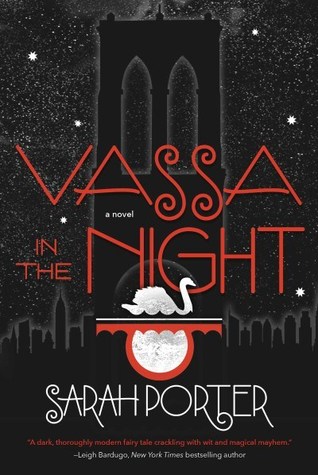
Vassa in the Night by Sarah Porter

vassa-in-the-night-by-sarah-porter

Vassa in the Night by Sarah Porter (InfoSoup)

When the nights in Brooklyn seem to be getting longer and longer, lasting almost entire days, Vassa finds herself looking forward to school just not to be home any longer. Part of it is her stepmother and stepsisters and part is pure boredom. It doesn’t help that Erg, the wooden doll that Vassa’s mother gave her before she died, is stealing things from her stepsisters which are then blamed on Vassa. So when one of her stepsisters basically dares Vassa to head to the dangerous local convenience store, Vassa accepts the challenge. She heads to Babs Yagg’s store, the one that dances on chicken legs and that you have to sing down. She makes sure that Erg is with her, as always, and knows that she is in for an unusual experience. What Vassa doesn’t realize is that she is headed straight into her dangerous destiny and will discover an entire magical world that she never knew existed: one with bleeding swans, a dark motorcyclist, severed hands, and beheaded teens.

Inspired by the Russian folktale, Vassilissa the Beautiful, this novel for teens embraces all of the strange and bizarre in that story and takes it even further. Baba Yaga’s home on chicken feet becomes an amazing convenience store filled with some treats that are tempting and others that seem odd and still others that nauseate. The modern Babs Yagg is still very much a witch, and one that toys with her prey in haunting and excruciating ways. There are impossible tasks, the need for plenty of bravery, and real loss and death threatened at every turn.

This is a mesmerizing book, one that is filled with gorgeous writing that stays out of its own way and then rises beautifully to create new moods. Throughout the book the story turns briefly away and into other perspectives like those of the swans themselves or of the attorneys who are after Babs. The language changes and weaves new patterns, creating completely different worlds and experiences and then gently carrying the reader back to the main story. It’s a powerful magic all its own.

Beautifully written, this twist on a folktale is bizarre, wild and extraordinary. Appropriate for ages 14-17.

Reviewed from e-galley received from Edelweiss and Tor Teen.