Dear Dragon by Josh Funk

dear-dragon-by-josh-funk

Dear Dragon by Josh Funk, illustrated by Rodolfo Montalvo (InfoSoup)

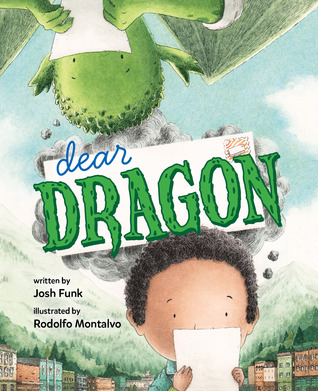
At two different schools, two boys are assigned to be penpals with one another. Their letters have to be written in rhyme. The boys start by talking about the assignment and school and then quickly move on to what they enjoy doing and their families. What the boys don’t know though is that George is a human and Blaise is a dragon. As each boy misinterprets the clues that the other is giving them about how different they are, a picnic approaches where the penpals are going to meet. What happens when the class of humans and the class of dragons finally meet one another? Success!

Funk cleverly uses fantasy to speak about how we see differences between one another. His use of dragons and the intelligent way that he hides the truth while all the while revealing it too makes for a fun book to share. This would be a great book to offer to children who are starting their own penpal assignments and also offers an opportunity for any child to see how things can be misunderstood even when they are stated clearly. It also speaks to our ability to think that people are just like us and the ability to see beyond physical differences and to the person (or dragon) inside.

The illustrations are playful and bright. They capture the ways that the two boys are meaning their messages. So one image is the way that the writer intended the message to be read and the other is thought bubbles for how the message is being interpreted by the reader. There is plenty of action and drama imagined about simple messages and then in reverse there are dramatic scenes that are completely misunderstood and downplayed.

Funny and clever, this picture book demonstrates that humans can see beyond green scales to the pal underneath. Appropriate for ages 4-6.

Reviewed from ARC received from Viking Books for Young Readers.
Before Morning by Joyce Sidman

before-morning-by-joyce-sidman

Before Morning by Joyce Sidman, illustrated by Beth Krommes (InfoSoup)

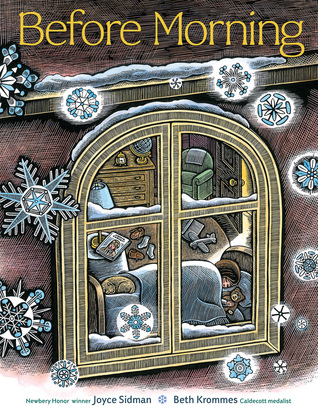
Days are busy, filled with activity. One child whose parent is heading off to pilot a plane in the early morning put her wishes into words in the form on an invocation. She asks for snow to come, to change the face of the city and the pace of their life. She wishes for a slowness and as the book continues readers will see the snow start to fall, the parent leave for the airport, then the airport start to fill with waiting passengers who are not going anywhere. Then the parent catches a snowplow ride back home where the family spends a day together in the snow sledding.

Sidman’s invocation is simple and heartfelt. She voices it with the clarity of a ringing bell and real honesty. She plays her quiet voice against the hustle and busyness of an urban setting, allowing the snow and the wonder of it to slow the entire book down to the pace of the invocation itself. It’s a beautiful effect, strengthened by the illustrations and the beauty of the words themselves.

I was thrilled to see another pairing of Sidman and Krommes. Krommes creates scratchboard illustrations that have the organic feel of block prints. They are rich with details and fill the pages with subtle colors and dancing snow. The art has an inherent warmth to it, inviting snuggling under covers together.

Another great achievement for this author and illustrator pair, this is a great winter story that focuses on family and time spent together. Appropriate for ages 3-5.

Reviewed from library copy.


The Secret Horses of Briar Hill by Megan Shepherd

the-secret-horses-of-briar-hill-by-megan-shepherd

The Secret Horses of Briar Hill by Megan Shepherd (InfoSoup)

Emmaline lives at a hospital that used to be a grand house. The gardens still exist, but they are overgrown and in shambles. When Emmaline looks into the mirrors in the hospital, she sees winged horses living in the world in the reflection. Then one day when she climbs into a walled garden on the grounds, she discovers a wounded winged horse named Foxfire who is unable to fly and seems to have entered Emmaline’s world. On the sundial, Emmaline discovers a letter from the Horse Lord that gives her a quest to surround Foxfire with all of the colors from the rainbow to protect her from a dark horse who is hunting her. But where is Emmaline going to find bright colors in her world of World War II gray?

Shepherd has crafted a novel for young readers that offers a glimpse into another world where mirrors are filled with wild winged horses. It is a world with a kind Horse Lord who needs a child’s help and also one filled with the hoof and wing beats of a huge Black Horse. Beautifully, she allows readers to wonder if Emmaline is entirely imagining the horses, and keeps that question up until the end and beyond. Yet readers who believe will adore this book filled with mirror magic and dreams.

The “still waters” that Emmaline fights are tuberculosis. Shepherd makes sure that readers know that this can kill when Emmaline loses her closest friend at the hospital. Emmaline’s own tragic past is also revealed late in the book. Though Emmaline is fighting for her life, she is also filled with determination to save the horses and fight back against darkness. As the still waters rise in her, so does the full moon which is the deadline of when she must find all of the colors.

Beautifully written, this novel takes readers to World War II England and the battles fought on the homefront. Appropriate for ages 9-12.

Reviewed from e-galley received from Edelweiss and Delacorte Books for Young Readers.

A Morning with Grandpa by Sylvia Liu

a-morning-with-grandpa-by-sylvia-liu

A Morning with Grandpa by Sylvia Liu, illustrated by Christina Forshay (InfoSoup)

Mei Mei’s grandfather, Gong Gong, is in the garden doing his tai chi forms. He sways his arms and explains that the form is called “White Crane Spreading Its Wings.” He also tells Mei Mei that tai chi is a martial art which makes Mei Mei start doing karate chops. Gong Gong continues to show Mei Mei about tai chi and its slow and smooth motions. Mei Mei does each motion with her own style. Then it is time for Mei Mei to teach Gong Gong about yoga. With stretching movements like Downward Dog and the Mermaid, Gong Gong is soon learning new poses of his own.

This book won Lee & Lows New Voices Award. It is a lovely look at the relationship of grandparent and grandchild through shared experiences and trying new things together. The incorporation of Tai Chi and Yoga is also done very well and there is a section in the back of the book that offers more information on the poses and forms demonstrated in the story. The way that Mei Mei is able to both learn from her grandfather and then teach him what she knows is a noteworthy element to the story, demonstrating that children can both be students and teachers.

The art by Forshay is bright and refreshing. She captures the various forms and poses with ease, showing the balance required for both Tai Chi and Yoga. She also demonstrates the energy of Mei Mei and the deep affection that the two of them have for one another. It is a book filled with movement and motion.

A joyful look at grandparents and grandchildren and the dynamic of learning from one another, this picture book is superb. Appropriate for ages 4-6.

Reviewed from library copy.


Six Dots by Jen Bryant

six-dots-by-jen-bryant

Six Dots: A Story of Young Louis Braille by Jen Bryant, illustrated by Boris Kulikov (InfoSoup)

Louis Braille lost his sight at age five from an accident and a resulting infection. His family helped him learn to cope, making him a cane that he could use to explore a little farther from home each day. His brothers taught him to whistle and his sisters made him letters out of straw. He could play dominoes, knew trees by touch, flowers by their smell and could listen to books being read aloud. But there were no books for blind children like him. Even when he got into a school for the blind in Paris he had to work very hard and become one of the best students to be able to access their books. When Louis achieved that though, he found that the books were done in large raised wax letters so thick books were actually quite short. Then there was news that a French army captain had created a way to send secret messages that was read by touch. Louis worked to make the system readable by the blind, creating his own alphabet system as a teenager!

Bryant writes in first person from Braille’s point of view. She explains how Louis lost his sight with just enough detail to make it understandable how tragic it was but doesn’t overly linger there. When Louis’ sight is gone, the text changes to become filled with noises and other senses than sight. Bryant moves the story forward using Braille’s desire to read for himself, that drives both the story and Braille’s own life. As each opportunity proves to be disappointing, Braille does not give up hope, instead developing throughout his life a tenacity to find a solution.

Kulikov’s illustrations play light against dark. When Braille loses his sight, the pages go black with shadowy furniture forms only. Color is gone entirely. The reader is not left there, but moves back into the world of color unless the story is speaking about Braille’s blindness specifically, so when Braille finally gets to try reading the wax lettering, the page goes dark again, also showing his disappointment in the solution.

Intelligently designed and depicted, this is a warm and inspiring look at the life and achievements of Louis Braille. Appropriate for ages 6-9.

Reviewed from copy received from Knopf Books for Young Readers.


The Singing Bones by Shaun Tan

the-singing-bones-by-shaun-tan

The Singing Bones by Shaun Tan (InfoSoup)

I’m not really sure how to best review this work. It has a brilliant foreword by Neil Gaiman, who says, “Shaun Tan makes me want to hold these tales close, to rub them with my fingers, to feel the cracks and the creases and the edges of them.” The introduction by fairy-tale expert Jack Zipes states, “…Tan has transformed the Grimms’ tales into miraculous artworks that will move and speak for themselves.” I can only echo this sentiment, because the sculptures that Tan has created bring the Brothers Grimm stories into reality, make the solid and strange in a way that reading them doesn’t.

The sculptures are brilliant, showing aspects of familiar stories that bring new meaning to the tales but also revealing new and less familiar stories to readers and inviting them to indulge in more darkness and wonder. Turning the pages in this book is like a journey filled with gasps of disbelief and realization. New images are revealed on each page and so are the intimate hearts of the tales.

A stunning and brilliant series of sculptures with glimpses into the tales they represent. This book shows older children that the darkness of Grimm tales will still call to them. Appropriate for ages 9-13.

Reviewed from ARC received from Arthur A. Levine Books.


Du Iz Tak? by Carson Ellis

du-iz-tak-by-carson-ellis

Du Iz Tak? by Carson Ellis (InfoSoup)

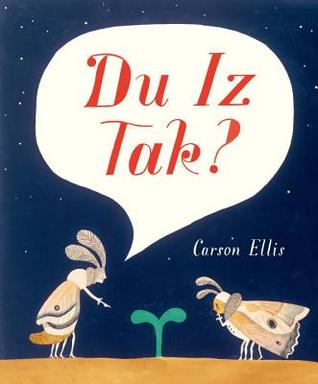
This inventive picture book takes a close-up look at a garden filled with insects. There is the caterpillar who enters his chrysalis, beetles and a ladybug who notice a sprout growing. They go to Icky, who lives in a log nearby and who has a ladder they can use. The sprout continues to grow and grow. At night other insects and bugs come out. Soon a fort is built in the growing plant but then, disaster! A spider comes and webs the entire plant. As nature continues to take its course, more insects arrive to see the plant flower. Slowly the plant tips over and the fort falls. Seeds drift to the ground. Fall arrives and the butterfly emerges from her cocoon. In spring, new sprouts appear.

The summary above does not capture what is truly amazing about this book. It is the language play, the word choices and the way that at first it seems like a foreign language but by the end of the book you are “speaking” and understanding bug. The language has phrases that are recognizable, allows for decoding of the language and then repeats in a way that allows readers to better understand. It’s very cleverly done and a book unlike any other I’ve experienced.

Ellis’ illustrations add to the otherworldly appeal of this book. Many of the insects are recognizable and still they are strange and wild. The illustrations beautifully focus on the same log and plant throughout, with seasons changing, the plant growing, and the insects coming and going. It is rather like an organic theatrical set and stage.

I have a deep affection for this zany picture book. Children who enjoy word play will love this and may find themselves speaking the bug language for awhile. Appropriate for ages 3-6.

Reviewed from copy received from Candlewick Press.


Some Writer! by Melissa Sweet

some-writer-by-melissa-sweet

Some Writer!: The Story of E. B. White by Melissa Sweet (InfoSoup)

The life of E. B. White, author of several beloved children’s books, is shown here in a children’s biography from a two-time Caldecott Honor winner. White’s upbringing as a child with his summers spent on a lake in Maine shows the impact of childhood experiences. He won several writing awards as a teenager, knowing exactly what he wanted to do. His work for The New Yorker and other publications as a column author and poet is shown as well as Sweet spends much of the book on the author’s adult life. The strong connection he had with water, nature and Maine shines on the page just as it does in his work. Issues with Stuart Little being accepted in libraries and other moments of note are wonderfully portrayed in original wording of letters. A writer who lived away from the fame he was garnering, White continued to do farm work, sail his boats, and enjoy the simple life he adored.

Sweet has written a simply incredible biography. Her writing flows with that of White. Hers has a frankness and an honesty that is particularly important in biography. Sweet intersperses White’s writing throughout the book, sometimes in clippings from magazines or newspapers and other times clearly typed using a typewriter to get the right feel. Unlike many children’s biographies, Sweet depicts White’s childhood and then moves on to his work and his adult life. While his childhood informs his work, it is not the sole focus of the biography, which honors young readers will plenty of information on his full life.

Sweet’s illustrations are equally amazing. She uses physical items on the page, weathered wood, screws, rope, typewriter keys, and leaves. She incorporates photographs and then her own art as well, creating a world of found objects, drawn Wilburs and Templetons, photos and actual documents that is rich and wondrous. It is like opening a drawer and discovering a treasure trove, a book you want to curl up with and read just as you did those beloved childhood books.

In short, this is a masterpiece. A book with just the right tone, style and organic nature. Terrific! Appropriate for ages 8-12.

Reviewed from library copy.


Finding Wonders by Jeannine Atkins

finding-wonders-by-jeannine-atkins

Finding Wonders: Three Girls Who Changed Science by Jeannine Atkins (InfoSoup)

This compelling verse novel tells the story of three girls who grew up to be women who made their own personal mark on science. There is Maria Merian, a girl born in 1647 who loved nature. Through careful observation, she discovered the metamorphosis of butterflies. Her artistic talents also helped document the life cycles of insects. Born in 1799, Mary Anning helped her father collect stone curiosities in England. When she saw a huge creature in the rocks, she discovered the first of the many fossils and dinosaurs she would uncover during her life. Born in 1818, Maria Mitchell grew up helping her mapmaker father in Nantucket. Exploring the night sky together, she spent years looking through her father’s telescope before discovering a new comet. All of these women battled societal expectations and familial pressures to become the scientists they were.

Atkins uses verse to directly tell the stories of these girls, the way they were raised and how they grew to become scientists. Readers unfamiliar with them will be amazed that they were able to reach such prominence in the time periods they lived and that their fathers were the ones who allowed them the freedom to learn and explore. These women demonstrate that through tenacity and determination one can become exactly who they were meant to be, despite almost everyone disapproving. The tales are inspiring and insightful.

Atkins has chosen three women whose stories work particularly well together. There are commonalities between them even though they span more than a century and involve different types of scientific endeavors.  The strong focus on faith in all of the stories shows the way that scientists even today must reconcile their religious beliefs with scientific truths. Faith is handled with a frank sincerity here, an important part of family and life, but also something that can be personal to an individual.

Beautifully written, these brief glimpses of amazing women in science will introduce new sources of inspiration to young readers. Appropriate for ages 9-12.

Reviewed from copy received from Atheneum Books for Young Readers.