The White Cat and the Monk by Jo Ellen Bogart

Groundwood Logos Spine

The White Cat and the Monk by Jo Ellen Bogart, illustrated by Sydney Smith (InfoSoup)

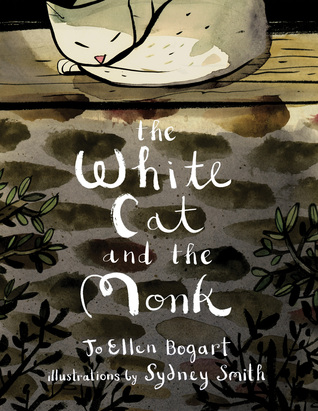
A white cat named Pangur and a monk live together. At night, by candlelight the two work side by side. The monk quietly studies his books. The cat hunts mice along the walls, examining a mouse hole. The two do not disturb one another. At the end of the night, as day comes, they have both found what they were seeking. One searching for the joy of an answer to a puzzle and the other for the satisfaction of a successful hunt.

This picture book is a retelling of a classic Old Irish poem “Pangur Bán.” It is a tale that is contemplative and quiet. It offers space to simply be, a world of solitude and study, and also one that is filled with richness of the most simple forms. Bogart captures the power of a man’s simple monastic life accompanied by an animal companion. In particular, it is the interplay of their evening activities that demonstrate the impact of the natural world on even the quietest of evenings.

Smith’s illustrations evoke a period of time that is filled with illuminated texts, thick stone monastery walls and the light of several candles. They are done with rich blacks and subtle colors, the light playing across the page as the cat seeks dark corners.

A beautiful look at the power of contemplation, mindfulness and cats. Appropriate for ages 5-7.

Reviewed from library copy.

This Is Not a Book by Jean Jullien

This Is Not a Book by Jean Jullien

This Is Not a Book by Jean Jullien (InfoSoup)

Open this “book” and you will find that it is not a story and doesn’t act like a book at all. Some pages open up to be held at an angle and become computers, couches and refrigerators. Others flap like monster mouths chomping, butterfly wings flapping, and hands clapping. Still others turn upside down like the tent. It’s a book that is meant to be interacted with, seen in new ways and that becomes something new with each turn of the page.

Done in sturdy board book pages, this book will withstand being turned around, passed to other children and interacted with by small hands. Libraries will appreciate the lack of tabs and moving parts, the magic of the book is brought to life solely by the illustrations in this wordless masterpiece.

One of the most inventive and simple board books around, this one is a keeper! Appropriate for ages 1-3.

Reviewed from library copy.

I Am Pan! by Mordicai Gerstein

I Am Pan by Mordicai Gerstein

I Am Pan! by Mordicai Gerstein (InfoSoup)

From the minute he is born, Pan is filled with mischief. Born with his goat horns and hoofed feet, he is immediately silly and even gets the grumpy Zeus to smile. As Pan grows, he becomes bored with life on Olympus and gets into so much trouble that the Gods ask him to return to Arcadia where he was born. While there, he invents panic, falls in love with the moon, and helps battle the monster Typhon. He also falls in love and marries Echo and discovers his love of music and the pan pipes. Story after story shows the power of merriment, music and mischievousness.

Gerstein embraces the spirit of Pan on the page by telling the tales with a zany spirit and a wild feel. There is not attempt to contain Pan here, just a feeling of being along on a very rambunctious ride. This suits the subject beautifully, giving space to the large personality of Pan. The graphic novel format also works very nicely with retelling Greek myths, keeping them brief and showing rather than telling a lot of the action.

The illustrations of this picture book/graphic novel are done in loud colors with lots of action and movement. Pan almost flies off the page in some sections, particularly when creating panic personally. The illustrations match the subject, offering a loud and cheery look at this wild God.

I am hoping this is not the only Greek God book that Gerstein does, since this book works so well and offers a very approachable and funny look at Pan. Appropriate for ages 6-9.

Reviewed from copy received from Roaring Brook Press.


The Great American Whatever by Tim Federle

The Great American Whatever by Tim Federle

The Great American Whatever by Tim Federle (InfoSoup)

Quinn has always dreamed of being a Hollywood screenwriter and creating films with his sister Annabeth directing. Then Annabeth died. Now Quinn spends a lot of time in his room alone, not looking for the phone that has Annabeth’s final text to him on it sent right before she ran a red light. As summer starts, Quinn longs for air conditioning and his best friend Geoff shows up with a solution. It means that Quinn has to finally leave the house. It also means heading to his first college party where Quinn meets a very hot guy. As Quinn works to see his life playing out as a screenplay, life as other ideas.

Wow. Federle has a gift with voice. He has created in Quinn a gay teen boy who does not fit into any stereotype at all. Quinn is very smart, very sarcastic and amazingly self-centered. He could have been completely unlikable, but Federle has also made Quinn one of the most stunningly human protagonists of all time. Riddled with grief and unable to voice or even think about his loss, he hides from everyone but most particularly himself.

This is a profound look at grief, but it is also a book about being a gay teenager. It’s a book that thinks deeply about coming out to friends and family, finding out other people’s secrets, exploring new love. It’s a book where there is sex, gay teenage boy sex, and it is wonderfully awkward and normal.

Thank you to Federle for creating a gay protagonist where the book is not driven by the angst of being gay, but where sexual orientation is also not ever ignored as the important piece of life that it is. Beautifully done. Appropriate for ages 15-18.

Reviewed from copy received from Simon & Schuster Books for Young Readers.

Elizabeth Started All the Trouble by Doreen Rappaport

Elizabeth Started All the Trouble by Doreen Rappaport

Elizabeth Started All the Trouble by Doreen Rappaport, illustrated by Matt Faulkner (InfoSoup)

This nonfiction picture book looks at all of the women critical to the suffrage movement in the United States. From Abigail Adam’s plea in 1776 for her husband to “remember the ladies” to Sojourner Truth’s attendance at a meeting to remind the white women of the  movement that African-American women deserved the vote too, this book looks at the many voices of the movement with a particular focus on Elizabeth Cady Stanton who started the called on women in the mid-1800’s to fight for the right to vote. It is a dynamic book that will remind young readers that the right of women to vote in our country only happened in 1920.

Rappaport captures the tremendous tenacity that it took for women to fight actively for the right to vote for nearly 75 years. Moving in a vibrant way from one historical figure to another, Rappaport highlights not just those who were suffragists but also women who broke female stereotypes by becoming doctors and starting schools where women learned the same subjects men did. This global look at the movement demonstrates the number of ways it took to get changes made that would allow women to voice their own opinions through elections.

The illustrations have a humorous quality to them with near-caricatures of each of the women. There is a feel of a political cartoon to them which is particularly appealing given the subject matter. Their bright colors also help show the passion of the women and their drive to make change.

A great addition to public libraries, this book offers a neat package showing the full history for women’s right to vote. Appropriate for ages 7-10.

Reviewed from library copy.

Bloom by Doreen Cronin

Bloom by Doreen Cronin

Bloom by Doreen Cronin and David Small (InfoSoup)

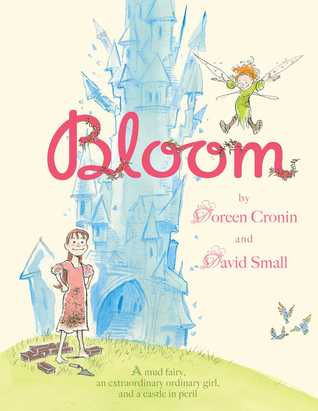
Bloom was a fairy who dealt in dirt and plants. She could spin sand into glass and turn small amounts of water into rivers. She lived in a glass kingdom and as the years passed, the kingdom’s inhabitants only saw the mess that Bloom left behind with her mud and not the way that she helped. Bloom finally left and went to live in the forest. More years passed and the glass kingdom started to fall into disrepair. The king remembered the powerful fairy and went to seek her help, because such a creature could only be asked by a monarch. But when Bloom offered the king to save his kingdom with mud, the king stormed off. The queen tried too with similar effect. Finally, they decided that they must send someone ordinary to ask Bloom for help and so Genevieve was selected. It will take a girl working with a fairy to save the kingdom, but even more it will take getting dirty along the way.

Cronin has created a story that is surprising and delightful. This is a fairy tale where girls save the day rather than being rescued by princes. It reads like a traditional fairy tale but with a feminist viewpoint that is not overplayed at all. There is also a beautiful attitude about getting your hands dirty and the fact that hard work is the way to solve problems along with working together.

Small’s illustrations are playful with delicate lines that swoop on the page. They are alive with action, particularly when Bloom is on the page. Small captures the delight of mud and getting dirty, the connection of the two girls, and the efforts that it takes to rebuild a kingdom even with magic. I must also mention the text design, which makes the book a joy to read aloud, creating real feeling around words like MUD and DIRT.

A feminist and intelligent fairy tale just right for modern children. Appropriate for ages 4-6.

Reviewed from copy received from Atheneum.


A Hungry Lion by Lucy Ruth Cummins

A Hungry Lion by Lucy Ruth Cummins

A Hungry Lion, or A Dwindling Assortment of Animals by Lucy Ruth Cummins (InfoSoup)

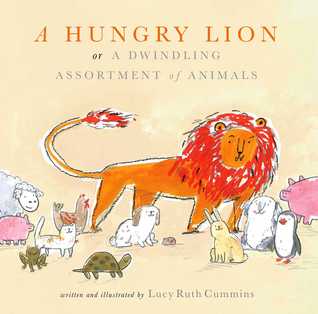
There was once a hungry lion in a room in a large number of small animals like a penguin, a pig, a could of bunnies, a mouse, a frog, a bat and many more, including a turtle. But as you turn the pages, more and more animals no longer appear on the page. Soon there is only the pig, a bunny and the turtle. Then only the turtle. Then just the lion and then after looking right at the reader, the lion leaves too and everything goes dark. What do you think happens next?!

Reminiscent of Jon Klassen’s classic I Want My Hat Back, this picture book has a delightful darkness about it. Even better, it toys with that darkness, allowing readers to think all is well right before plunging them right back into it again. It’s rather like a picture book roller coaster ride that will have readers demanding to ride again immediately. Cummins paces the book cleverly, filling it with a sense of impending doom.

The art adds to the emotional twists and turns. Readers can watch the lion’s face for clues, since at times he is far too innocent to actually not have done something wrong. Other times, he appears completely villainous with arched brows and big teeth. Yet all along, things may not be as they seem adding to the delicious tickles of dread.

Dark and delightful, this picture book is one wild ride worth sharing. Appropriate for ages 4-6.

Reviewed from copy received from Atheneum Books for Young Readers.


Their Great Gift by John Coy

Their Great Gift by John Coy

Their Great Gift: Courage, Sacrifice and Hope in a New Land by John Coy, photographs by Wing Young Huie

This picture book is filled with gorgeous photographs of diverse people who live in the United States. The book speaks about the way that families came to our country. It talks of the dreams that they had and how difficult it was to make the journey and learn a different language. It is about the hard work that it takes to be an immigrant, the mistakes that are made, the way money is sent back home. At it’s heart this is a book about determination, grit and resilience, qualities that make our country great and that exemplify the immigrants who add so much.

Coy’s words are simple and yet very powerful. He states each fact in a way that makes it easy to understand but also in a tone that rings with truth. His focus is on humanizing immigrants, showing that they are just like all of us who may have been born here, no matter how they worship, dress or what language they speak. Don’t miss the final pages of the book where the author and the illustrator speak to the ways both their families arrived here.

The photographs in this book are what make it so lovely. Done in a mix of black and white and color, the photographs capture people of various backgrounds and cultures. There are children, adults and the elderly and each page opens to reveal faces that form a tapestry of diversity on the page.

A very timely and important picture book, this book will open discussions for elementary-aged children about the larger topic of immigration in a way they can understand. Appropriate for ages 5-7.

Reviewed from library copy.


Waylon! One Awesome Thing by Sara Pennypacker

Waylon One Awesome Thing by Sara Pennypacker

Waylon! One Awesome Thing by Sara Pennypacker (InfoSoup)

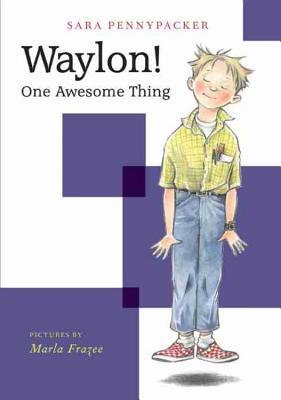
Waylon loves science and spends a lot of his time thinking about all of the cool inventions he could create from his scientific knowledge. His favorite ideas right now focus on how to manipulate gravity for his own means. But things in his life are not all going smoothly right now. His sister, who insists on being called Neon, doesn’t act like she used to now that she’s a teenager. One kid at school is splitting the fourth grade boys into two teams and Waylon isn’t sure which team he is on. A kid with a criminal record just came back to school and is even scarier than last year. It’s all changing around him and it looks like only Waylon can solve the crisis by being a bridge from one side to the other.

This novel brings young readers another amazing character from the author of the Clementine series. Waylon, just like Clementine, is incredibly easy to relate to. He is dynamically human, getting into scrapes and situations that readers may face themselves. As always, Pennypacker’s prose is written with a surety and skill that allows young readers to relax and simply immerse themselves in the world that she has created for them.

Pennypacker makes sure to bring just enough humor to the novel to make it accessible for reluctant readers. The playground dynamics set just the right tone. The unique way that Waylon views the world through science makes those issues more dramatic as Waylon sees himself very isolated. The theme of loneliness and then finding a way to reconnect is done in just the right tone.

An awesome new protagonist from Pennypacker is something worth celebrating! Appropriate for ages 6-8.

Reviewed from e-galley received from Disney-Hyperion and Edelweiss.