Twenty Yawns by Jane Smiley

Twenty Yawns by Jane Smiley

Twenty Yawns by Jane Smiley, illustrated by Lauren Castillo (InfoSoup)

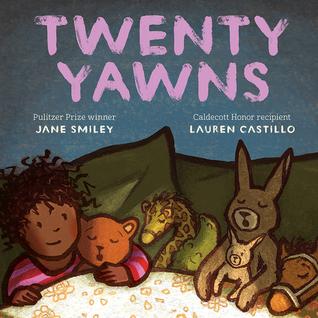
Lucy spent a long time playing at the beach with her mother and father. The three of them played in the waves, dug holes in the sand, and rolled down the dunes. Soon they were all yawning and Mom declared it was a day for early bedtime! As they got ready for bed, everyone was yawning and Lucy’s mom even fell asleep reading the bedtime book. In the middle of the night the moon shone brightly through Lucy’s window and she was suddenly wide awake. She tiptoed out of bed and through the living room where her father was asleep in a chair. Lucy was looking for Molasses, her bear. She found not only Molasses but all of her stuffed animals who all wanted to come with her to bed. Once again everyone was yawning, even the pictures on the wall, as Lucy fell asleep with her bed full of stuffed friends.

Smiley has done a brilliant job of capturing a day at the beach and then the wonder of being awake at night as a small child. She keeps the language simple, so this book can be shared successfully with very small children who will relate to the joy of playing at a beach, the quiet of early bedtime and then the pure loveliness of moonlight, tiptoeing to find a treasured toy and the imagination at play.

Castillo’s illustrations are glorious. She captures the brilliant light of summer sun at a sandy beach, the hours of play, and the languid sleepiness that rolls over you after a day like that. Her illustrations keep the dark night from being dangerous or frightening, instead keeping the house dimly lit and easily navigated. It is much more a delight than a fright to be alone and awake.

A lovely book of celebrating the warmth of both family togetherness and then the joy of being little and awake alone. Appropriate for ages 2-4.

Reviewed from copy received from Two Lions.


This Is My Dollhouse by Giselle Potter

This Is My Dollhouse by Giselle Potter

This Is My Dollhouse by Giselle Potter (InfoSoup)

Released on May 10, 2016.

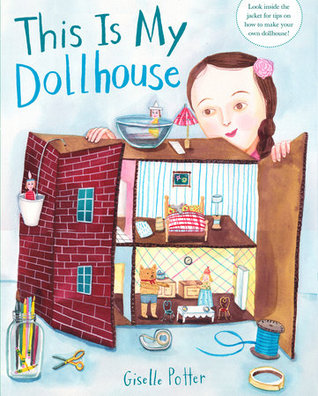
A little girl shows readers the dollhouse she has made from a cardboard box. It is filled with inventive furniture, food made from string and paper, and a set of dolls that don’t all match. The house has an elevator on the side and even a swimming pool on the roof. Then she sees her friend Sophie’s dollhouse where everything matches. The dolls all look the same, all of the rooms match with furniture that is all perfect. But when the girls play a little with the dollhouse, it doesn’t really work. When Sophie comes over, the girl is very nervous about showing her the handmade dollhouse, but soon the two girls are playing together in a way that they never did with Sophie’s perfect dollhouse.

I absolutely adored this book. It captures the wonder of creating your own toys and your own world of play. The cardboard dollhouse and all of the art supplies allows a little girl’s imagination to really soar. The book does include instructions for making your own dollhouse out of a box. And the story also shows how to make furniture from blocks and a TV from a small silver box. Children will be inspired to make their own.

The illustrations here are such an important part of the story. They clearly show that there is a warmth and homeyness to the handmade dollhouse. When the girls play with the perfect purchased one, readers will immediately feel the chill of that dollhouse and realize all that it is missing. This plays so beautifully against children’s own expectations too.

A grand picture book that will inspire creative play and the building of a place for adventures of your own. Appropriate for ages 4-6.

Reviewed from digital galley received from Schwartz & Wade and Edelweiss.

Hector and Hummingbird by Nicholas John Frith

Hector and Hummingbird by Nicholas John Frith

Hector and Hummingbird by Nicholas John Frith (InfoSoup)

A bear named Hector was best friends with Hummingbird. But sometimes Hector wanted to just eat a snack in peace and Hummingbird would not stop talking. He wanted to scratch his back on a tree, but Hummingbird kept chatting. He wanted a nap and Hummingbird wanted to tell a story. One day Hector had had enough and stormed away from Hummingbird and into the jungle. Hummingbird let him go, kind of. But having complete quiet was not what Hector expected and soon he was missing Hummingbird. Luckily, Hummingbird was right there when Hector needed him.

Frith captures the dynamics of friendship in a very clear and clever way in this picture book. You have a rather quiet bear and a very talkative bird and the two of them may be best friends but sometimes it’s too much. Seeing an existing and strong friendship run into problems is a good set up for a picture book where often you are seeing new, budding friendships instead. The choice of animal for each of the characters makes the book a joy to share aloud, from the fast high Hummingbird to the slower and grumpier Hector.

The art in this picture book shines. Filled with lovely tropical colors of bright pinks, greens and teal blues, the illustrations have a vintage feel but a modern zing and energy. The color palette changes when the friends are reunited, becoming even more pink and filled with the energy of their friendship. It’s a clever transition that shows visually what is happening emotionally.

A great pick for friendship story times, this book is a winner as a read aloud. Appropriate for ages 4-6.

Reviewed from copy received from Arthur A. Levine Books.


Ask Me How I Got Here by Christine Heppermann

Ask Me How I Got Here by Christine Heppermann

Ask Me How I Got Here by Christine Heppermann

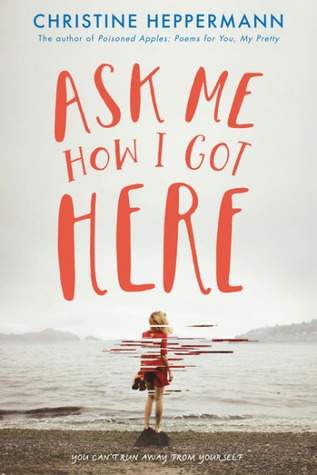
The author of Poisoned Apples: Poems for You, My Pretty returns with a powerful verse novel. Addie is one of the stars of her Catholic high school’s cross country team and dating a popular boy in a band. Then after having unprotected sex, Addie ends up pregnant and decides to have an abortion. After that everything changes as Addie keeps her pregnancy and decision secret from everyone except her parents and her boyfriend. Addie tries to keep on running, but she has lost her drive to excel at it. She quits the team but doesn’t tell anyone about her decision. Spending time in a coffee shop away from school, she runs into Juliana, an old friend who is having her own troubles.

Heppermann writes superb poetry. I enjoyed the fact that she incorporates the title of the each poem right into the poem itself or makes the title turn the poem a new direction for the reader. She uses each word in the same way, creating tightly crafted verse that is distinct for its powerful message. Addie’s own voice in these poems is consistent, aching at times with pain and defiant as hell in others. It is the voice of a teenager struggling with  huge decisions and their repercussions as they lead her to really be true to herself.

Throughout the book, the Virgin Mary is used as a symbol but also as a figure of worship. She is seen as intensely human as well as a religious figure. It is the poems about her that really shine in this novel, each one stunningly fierce and unrepentant. Religion is part of Addie’s life and a large part of the novel. Heppermann demonstrates in her poetry how one’s faith is complex and personal and can get one through dark times.

A great verse novel that takes on big topics like pregnancy, abortion and what happens afterwards. Appropriate for ages 14-18.

Reviewed from digital galley received from Edelweiss and Greenwillow.

Gordon and Tapir by Sebastian Meschenmoser

Gordon and Tapir by Sebastian Meschenmoser

Gordon and Tapir by Sebastian Meschenmoser (InfoSoup)

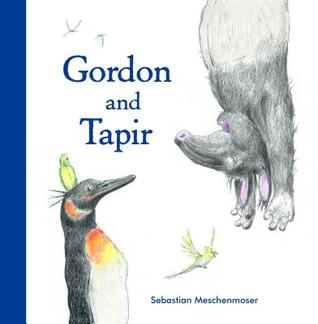
Gordon is a very tidy penguin who lives with a very untidy tapir. The two of them simply can’t get along together. Tapir takes all of the toilet paper to make a hammock in his room and a hat to go with it. He doesn’t do the dishes and the living room has started to look like a jungle. Tapir has complaints about Gordon too. Gordon is too orderly and won’t let Tapir join his club of penguins. Finally Gordon has had enough, particularly when Tapir’s friend moves in and lives in the bathroom. So Gordon moves out. Tapir misses him dreadfully, but Gordon soon reaches out and the two discover that sometimes friendships work best when you don’t share the same space.

Shortlisted for the German Children’s Book of the Year, this picture book is entirely delightful. A large part of that comes from the skillful mix of anthropomorphic animals but also keeping them very realistic as well. These are real-feeling animals who just happen to have couches, dishes and bathrooms. The art is beautifully and detailed, allowing the text to fade into the background for much of the book. My favorite pages are actually free of text as the two of them struggle to make living together work.

The use of the odd-couple dynamics in the book doesn’t feel stale at all and is further freshened by the unique animals chosen as the protagonists. Young readers will want to discover more about Tapirs even if they are slovenly. The book has a lovely story arc that gives a satisfying ending to the book, one that young readers will appreciate as they navigate their own friendships whether they are the tidy or messy one.

A clever look at friendships that gives new life to an old trope. Appropriate for ages 4-6.

Reviewed from library copy.


Ideas Are All Around by Philip C. Stead

Ideas Are All Around by Philip C Stead

Ideas Are All Around by Philip C. Stead (InfoSoup)

Stead captures a day in search of a story to write. He takes a walk with his dog named Wednesday since it’s a sunny day. They greet Frank, a turtle who lives near the bridge. They wave to Barbara a neighbor who owns the home where the author used to live and where he dropped blue paint in the shape of a horse. Ducks float by. Trains rush past. They walk through town and listen to the birds and watch the blue sky. Wednesday chases a squirrel back to Barbara’s house where they have coffee together. And soon a story has been found.

This is a treasure of a picture book. It offers a glimpse into the writing process, into the importance of getting outside and taking a walk. It shows how little things turn into stories and become big ideas. It also shows the author as a product of his personal landscape, whether that is filled with a story based firmly in reality like this one or one that is more fantastical or whimsical.

Stead’s illustrations are a rich mix of media. There are photographs of Wednesday combined with collage, painting and printed words. Some of the paintings have gorgeous textures that remind me of stencils or the roughness of stamping. The entire book sings with invention and inspiration.

A perfect leaping off point for young writers, this book shows that not only can any idea become a story but ideas can become great picture books too. Appropriate for ages 6-9.

Reviewed from library copy.


Booked by Kwame Alexander

Booked by Kwame Alexander

Booked by Kwame Alexander (InfoSoup)

In his follow up to the Newbery-Award-winning The Crossover, Alexander once again blends sports and poetry. Nick loves soccer and is really good at it too. Nick and his best friend are on opposing teams in an upcoming soccer cup and Nick is also getting ready to ask out April, a girl he can’t stop thinking about. Everything is going well except for his father who insists that Nick read the dictionary of large words that he personally created. That’s when Nick finds out that his mother is moving away for a job working with horses, leaving Nick with his father, not a great combination. Nick will have to rely on soccer and his best friend to get him through this rough patch. Because there is more tough road to come.

Alexander is quite simply amazing. He writes verse that is both poetic and beautiful but also accessible and welcoming to young teens who may be far more interested in kicking a ball than reading a book, especially a book of poetry. Alexander also demonstrates throughout the book the power of words both in his poetry itself and through the story line, where Nick is clearly smart and uses words from his father’s collection without even thinking about it. Nicely, definitions are provided in footnotes.

Nick is a protagonist who is easy to relate to. He has several things on his mind: soccer, girls and gaming. It is life though that pulls him outside of those interests and broadens his scope. His father does this in a clumsy way, forcing Nick to learn words. A school librarian also helps, getting books that Nick will clearly love directly into his hands. So as much as this is a book about a smart young teen boy, it is also a book about the power of having adults who care in your life.

A worthy follow-up to his first verse novel, this book is just as beautifully written. Appropriate for ages 11-13.

Reviewed from library copy.


When Spring Comes by Kevin Henkes

When Spring Comes by Kevin Henkes

When Spring Comes by Kevin Henkes, illustrated by Laura Dronzek (InfoSoup)

So I admit that I waited for spring to actually come to Wisconsin before I reviewed this and that means that even now I am being optimistic that it has finally arrived even though it was in the 30s here overnight. But even if you are almost headed into summer, this is a great book to share in early, mid and late spring. Written at a level just right for toddlers, this book shares the transformation that spring bring us. Bare trees become covered in blossoms and leaves. Snowmen disappear. Puddles appear. Grass turns from brown to green (with flowers). Gardens grow and soon there is green everywhere, breezes, robins and worms.

Henkes’ writing is made to share aloud with small children. His verse doesn’t rhyme but it has a great natural rhythm to it that makes the book almost sing. The joy here is in the exploration of the changing season, one that brings a certain beauty with it, a freshness. Henkes captures the turning of the season, the aspects of early spring all the way through to almost-summer and he does it in a way that shows small children what they can see and experience themselves.

Dronzek’s illustrations are big and bright and simple. She moves from the lighter colors of early spring through to the bold robustness of near summer. The images change too, moving from small images surrounded by white to double-page spreads that run right to the edge of the pages and seem to spill over with the bounty of late spring.

A gorgeous book for the smallest of children, this is a triumphant toddler look at spring. Appropriate for ages 1-3.

Reviewed from copy received from HarperCollins Publishers.


Wolf Hollow by Lauren Wolk

Wolf Hollow by Lauren Wolk

Wolf Hollow by Lauren Wolk (InfoSoup)

Growing up in rural Pennsylvania in 1943, Annabelle lives a quiet life where she hopes for adventure. She attends a one-room schoolhouse with her two younger brothers, walking there from their family farm each day. That quiet life changes when Betty Glengarry arrives at school. She immediately targets Annabelle, demanding payments in exchange for not hurting Annabelle and her brothers, killing a bird without remorse. Annabelle does not want to worry her family with her troubles, so she keeps them to herself. Soon though things escalate with her youngest brother running into a sharpened wire along the path. After that, Annabelle’s best friend is maimed with a rock that Annabelle knows was thrown by Betty. Betty though blames Toby, a reclusive man who walks the paths all day long with guns slung on his back. Toby has been nothing but kind to Annabelle and her family, but he is considered strange by many. When Betty disappears soon after making the allegation, Annabelle decides that she must rescue Toby from the new accusations being made.

Wolk has created a rich and beautiful world for Annabelle to live in. The hills and valleys of the Pennsylvanian countryside offer not only a rich farming world but also a place where secrets can hide and dangers lurk. The setting of Wolf Hollow itself with its history of trapping wolves in pits is a striking analogy for what happens in the novel. Annabelle herself is brave and clever, a girl who is bullied awfully and then has the power placed in her hands to make a difference for someone she cares about.

This book focuses on the courage it takes to stand up for what is right, for what one knows deep down to be true. It is a book that speaks to all of those who are strange among us and the way that rumors and accusations tend to target them. It is also about the power a child can have in an adult world, the difference one person can make. It is also a book that is dark and complicated: one where girls disappear, where Germans are not welcome, and where hate is fast to develop.

This is a complex and layered novel that is a deep and compelling read focusing on bullying and the impact of war. Appropriate for ages 10-13.

Reviewed from ARC received from Dutton Books for Young Readers