Alan’s Big Scary Teeth by Jarvis

Alans Big Scary Teeth by Jarvis

Alan’s Big Scary Teeth by Jarvis (InfoSoup)

Alan is known for the way that he is able to scare the other animals with his big scary teeth. He spends time each day caring for his teeth and practicing his scary faces in the mirror. Then he heads into the jungle, snapping, growling and declaring how scary his teeth are. The other animals are terrified. Then Alan goes home, relaxes and takes out his false teeth. One day, Barry the beaver discovers Alan’s teeth in their hiding place. He takes them away and leaves Alan without his teeth. Alan tries to scare the other animals, but they just laugh at his toothless threats. Alan was terribly sad, though the other animals were relieved not to be scared anymore. Maybe Alan can learn some skills beyond scaring others?

Jarvis writes in a very engaging way that is perfect for sharing aloud. The entire book gallops along at a fast pace with plenty of action and humor. The reveal of Alan having false teeth is nicely timed, so that the listening audience will be just as surprised as the animals are. The playful tone of the book is helped by the humor throughout with surprises adding to the fun.

Jarvis’ illustrations are childlike and bold. The backgrounds on the illustrations show jungle lushness without being overwhelming or dark. The illustrations have just as much charm as the story itself, creating funny moments and showing products like “Snap Snap Toothpaste.” The entire book works as a seamless package with the illustrations skillfully supporting the story.

This picture book is sure to get toothy grins from any audience you share it with. Appropriate for ages 3-5.

Reviewed from library copy.


Little One by Jo Weaver

Little One by Jo Weaver

Little One by Jo Weaver (InfoSoup)

As Big Bear leaves her den in the spring, she has a tiny baby cub along with her. The two explore their world together as the baby bear learns to survive in the landscape. They swim together, eat berries, catch fish and play. The baby bear grows and thrives alongside Big Bear. The seasons keep changing from spring to summer to the blustery weather of autumn and the geese flying overhead. Big Bear leads her Little One back to their den, but not before they take a long last look at their world, sitting on a high hill and seeing the water, the forest and their domain below.

The text of this picture book is gentle and lovely. The tone is pure warmth and care, a mother bear who is not going to leave her little one’s side and one who is dedicated to the safety and growth of her little cub. The text celebrates the connection between the two bears and then their connection to the natural world around them. It’s a touching look at a family and then at their world too.

The illustrations are simply stunning. Done in charcoal, they are filled with light, with flowers that seem to bob on the page. Often there are sprigs of leaves and grass done in white in the foreground, caught in a sunbeam coming from off the page. This luminous effect is particularly effective and breathtaking.

A simple and gorgeous book about mothers and children and the incredible beauty of nature. Appropriate for ages 2-4.

Reviewed from library copy.

The Charmed Children of Rookskill Castle by Janet Fox

The Charmed Children of Rookskill Castle by Janet Fox

The Charmed Children of Rookskill Castle by Janet Fox (InfoSoup)

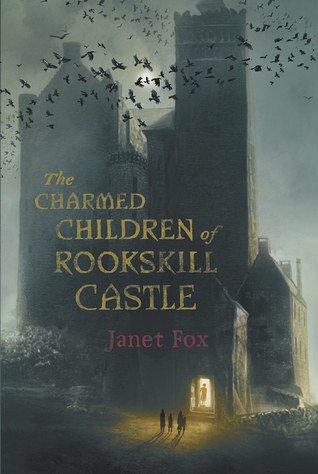
Something horrible is happening at Rookskill Castle, a remote castle in Scotland. When Kat and her two younger siblings are sent there to escape the Blitz in London during World War II, they see odd things. There are children who don’t attend classes with the others but can be seen outside fishing in an empty pool, singing in the old part of the castle or polishing silver down in the basement rooms. The Lady who runs the school is also strange, aloof and beautiful, she has hands that are cold and amazingly strong. Kat believes that there may be a Nazi spy at the school, though she doesn’t believe at all in the magic object that her aunt gave her. But things are odder than Kat could ever have dreamed and soon she has to face that there may be magic at work after all as one child after another disappears.

This tantalizing story is pure dark fun. With a glorious mix of mystery and history, there are also elements of horror that are delightful to encounter. There is real risk here, perhaps worse than death itself and that makes this book all the more impressive. Horror for children is a growing genre and here it is handled particularly well with British flavors, historical information, and plenty of hidden passages and magical relics.

As with any great horror story for children, the children here are left to save themselves. The adults are particularly unhelpful and the story explains why in a clear way. Particularly wonderful is a female protagonist who loves numbers, can solve code algorithms better than her teacher, and who can be prickly but also adores her siblings. She’s complicated and exactly the main character this story needs to really work as Kat doesn’t believe at all in magic.

Smart, intelligently written and gorgeously scary, this historical horror for children is a fantastic read. Appropriate for ages 9-12.

Reviewed from ARC received from Viking Books for Young Readers.

Fairy Tales for Mr. Barker by Jessica Ahlberg

Fairy Tales for Mr Barker by Jessica Ahlberg

Fairy Tales for Mr. Barker by Jessica Ahlberg (InfoSoup)

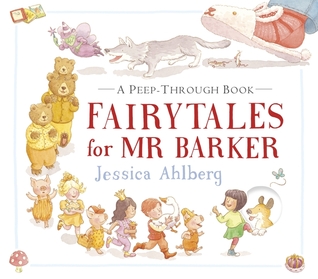
When Lucy tries to share a story with her dog, Mr. Barker, he follows a butterfly right out the window. As Lucy follows him through the window, they end up in the house of the Three Bears with Goldilocks eating porridge at the table. Then the three bears come home and it’s time for the two girls to follow the dog into the next story. They head right into the Three Little Pigs where a wolf is on his way to the house. One-by-one Lucy has different protagonists join her from several fairy tales and they get chased by all sorts of characters as well. Just as they are almost caught though, they return to Lucy’s room where she tucks them all in bed with a story.

Ahlberg has a great touch for the dramatic in this picture book. She cleverly offers just enough information for the reader to recognize the story that Lucy and Mr. Barker have entered. Then she gives the reveal on the next page, so parents and adult readers will know that children should be given a chance to guess the story. In that way, it is also an invitation to read stories that small children may not know yet, like Jack and the Beanstalk.

Ahlberg uses cutouts in this picture book, having each switch to a new story as a cut out through which the characters climb. There are windows, doorways and then even holes in cheese that make great escape routes to another tale. The illustrations have Ahlberg’s signature softness and fine lines where watercolors have an appealing mix of bright colors and gentleness.

A winning mix of cut outs to jump through, fairy tales to explore and a guessing game too, this picture book is a great choice for children who love fairy tales. Appropriate for ages 3-5.

Reviewed from library copy.


Will’s Words by Jane Sutcliffe

Wills Words by Jane Sutcliffe

Will’s Words: How William Shakespeare Changed the Way You Talk by Jane Sutcliffe, illustrated by John Shelley

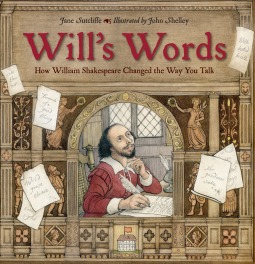
Though she set out to write a book about the Globe Theatre and Shakespeare himself, the author was quickly caught up in all of the ways that Shakespeare has impacted our modern language and wrote the book about the instead. The result is a book that is immensely engaging and great fun to read. It is still in so many ways a book about the bard, his work and his theater, but it is also a vibrant and fascinating book about language and how modern colloquialisms hearken back to Shakespeare himself.

Sutcliffe clearly tells the story of Shakespeare and his theater on one part of the page and then in a side note shown on a scroll on the other page she pulls words directly from her explanation and shows exactly how they connect with Shakespeare and his writing. So many of the words are surprising words like “fashionable” and “hurry.” Other phrases have interesting connections like “dead as a doornail” or “green-eyed monster.”

Shelley’s illustrations are playful and vibrant, showing the bustling London streets and the crowded theater jammed with people. Some pages show the Globe Theatre from above while another shows how the stage appeared from the audience on the floor of the theater. Care has been taken with each face even in the crowd, each person reacting in their own way to what is happening in the scene.

This book should generate lots of “excitement” and “amazement” allowing people to read about Shakespeare to their “heart’s content.” Appropriate for ages 8-12.

Reviewed from copy received from Charlesbridge.


Thanks for the Trouble by Tommy Wallach

Thanks for the Trouble by Tommy Wallach

Thanks for the Trouble by Tommy Wallach (InfoSoup)

Parker spends his time in hotels, watching people and stealing from them. He hasn’t spoken in five years. That’s when he meets Zelda, a girl with silver hair and a wad of hundred dollar bills who just leaves her purse behind at the table. Parker takes her money but then realizes he has left his notebook behind, a place where he records his stories and also that he uses to communicate with others. When he goes back, Zelda is holding it. Soon the two of them are talking about life and death, a conversation where Zelda claims to be much older than Parker, and not by just a few years. Parker wants to save Zelda at the same time that Zelda wants Parker to not waste his life. The two together set off on a series of adventures that may just prove that life, no matter how long it is, is worth living well.

Told in the first person, the framework of this novel is that Parker is writing an essay to get into college. That structure alone speaks volumes throughout the novel even as readers are just getting to know Parker and Zelda, since Parker agrees to apply to colleges. The writing throughout is just as rich and thoughtfully done as that framework, allowing these two incredibly unique characters to come fully alive. The book asks deep questions and dances along dark lines, yet it is entirely a delight to read and keeps lightness even as it asks the most difficult of questions.

The two main characters are phenomenally written. Parker’s lack of speech becomes much more than a device, informing readers about his deep pain and the way in which he has truly shut himself off from life. Zelda too is complicated, she is playful and light and then by turns also filled with a resolve that life is not worth continuing. Parker’s short stories are also a source of amazement in this novel and Wallach has quite a way with them, offering even more insight into relationships in the novel. It is all so gorgeously done.

A rich, complicated and exceptional novel for teens, this book handles grief, suicide and questions of how to live your life in a wondrous way. Appropriate for ages 13-17.

Reviewed from copy received from Simon & Schuster.

Tree by Britta Teckentrup

Tree by Britta Teckentrup

Tree by Britta Teckentrup (InfoSoup)

The seasons pass as an owl looks out of a hole in a tree in this engaging picture book. Beginning in winter, owl is alone in the cold landscape. When spring comes, the snow melts and buds form on the tree. Baby bears play and climb the tree’s trunk. Leaves and blossoms form and squirrels, birds and fox cubs arrive. With summer, the apples start to form on the tree and the tree spends long warm nights swaying in the breeze. Autumn comes with colder temperatures and the animals start to leave. Apples fall to the ground and the tree’s leaves turn red and fold. Snow comes and winter arrives. Soon everyone is gone, even the owl. But he is peeking out again soon as spring comes once again.

Teckentrup uses simple rhymes to tell the story of one large tree and the ways that it supports the ecosystem around it. The seasons are clearly noted in the rhymes, the changes explained and each one is celebrated for how unique it is. The various animals too change what they are doing as the weather shifts. This is a dynamic book about weather and seasons.

It is the illustrations that make this book so noteworthy. Teckentrup’s cut out designs allow each page turn to show the owl for most of the book but also to add the other animals as they appear in the story. Then as the story reverses and the animals leave, the cut outs play out that way too.

A clever and striking look at one tree, one ecosystem and many seasons. Appropriate for ages 2-4.

Reviewed from copy received from Random House.

What This Story Needs Is a Hush and a Shush by Emma J. Virjan

What This Story Needs Is a Hush and a Shush by Emma J Virjan

What This Story Needs Is a Hush and a Shush by Emma J. Virjan (InfoSoup)

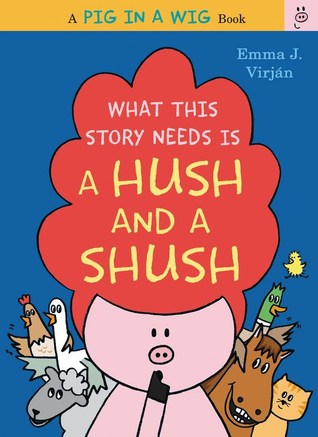
This second book in the A Pig in a Wig series keeps up the zany silliness of the first even though it’s a bedtime story. Pig is getting ready for bed still in her wig, brushing her teeth and combing her hair. She’s all settled into bed with her teddy bear when other animals start showing up and making noise. They all climb into the bed with Pig, but soon it is too much to take and Pig shushes them all and sends them back to the barn. Soon all is silent again until the owl outside Pig’s window starts to hoot. Where will she find a quiet place to sleep?

Just as with the first book, this book is written in a jaunty and bouncy rhyme that sets a brisk pace. Despite the silliness and the rhyme though, the book does slow down at the end in a natural way, becoming downright dozy by the end. The illustrations are simple and funny, particularly when all of the animals are piled high on the bed.

A great addition to beginning reader collections, this book had just the right mix of silly and sleepy. Appropriate for ages 4-6.

Reviewed from copy received from HarperCollins.

Allie, First at Last by Angela Cervantes

Allie First at Last by Angela Cervantes

Allie, First at Last by Angela Cervantes

Released March 29, 2016.

Allie has never won anything in her life. Her entire family though has a shelf of trophies. Her older sister is a national debate champion. Her brother is a star soccer player. Even her little sister is a rising star as an actress. Allie is almost certain she is going to win the science fair, but it ends up a disaster instead of a win. That’s thanks to “help” from Victor, a new boy at school. When another opportunity to win an award comes up, Allie knows that she has to try hard. She decides to do a photo essay on her great-grandfather who is a decorated World War II veteran. But her ex-best friend who won at the science fair has also decided to use Allie’s grandfather as the subject of her entry. When is it going to be Allie’s turn to shine?

This is a very accessible book, written with a light hand and a friendly tone. That lightness allows this book to deal with deeper truths without getting caught up in darkness. It is a book that speaks to the importance of doing well, healthy competitiveness and the pleasure of a job well done. It also looks deeply at how that healthy competition can twist and become something that is no longer positive in one’s life. Allie’s entire family tries to teach her this in different ways, some by being more competitive and others speaking to her intrinsic worth whether she has trophies or not.

While Allie was a great protagonist, two secondary characters really stand out in this book. First is Victor, a boy who is from a poor family and someone that Allie assumes is being tutored. It turns out that Victor is incredibly smart and is doing the tutoring. Victor though is less concerned with acclaim than with his future. Allie’s great-grandfather is another amazing character. He offers sage advice and a point of view that is particularly filled with grace and compassion. The fact that almost all of the characters in the novel are Hispanic and offer a wide array of points of view about life makes this book all the more winning.

A charming story with strong characters and a clear message that winning is not everything. Appropriate for ages 9-12.

Reviewed from ARC received from Scholastic.