The House that Zack Built by Alison Murray

The House that Zack Built by Alison Murray

The House that Zack Built by Alison Murray (InfoSoup)

Zack built a house out of blocks outside under a tree. A fly buzzed by, the cat stalked the fly, then got more interested in the cream up high on a shelf. The dog was asleep when down fell the cream, knocked over by the cat who was still looking to catch that fly. The lambs in the field are calm and quiet, then the dog runs through still covered in cream and the sheep dash out of the field. Then Zack looks around, amazed at the mess of the farm. He jumped into action and set it all right. Then they all sat quietly and looked at the incredible house that Zack had built.

This British import is a cumulative tale that doesn’t solely stick to the traditional structure of building and building onto the length of the sentence with each new addition. Instead here it is the story itself that is the focus and the cumulative structure is used when it works and then merrily abandoned to make the storyline work better and to also make the book much more enjoyable to read. The result is a cumulative tale that will not leave you breathless or with a spinning head when shared aloud.

Murray’s art is simple and friendly. The illustrations will work well for a crowd since they are not filled with small details. Children will enjoy the cat in particular as it causes almost all of the problems that emerge.

There is a real satisfaction in this story of watching chaos happen and then having it set to rights. Appropriate for ages 2-4.

Reviewed from library copy.
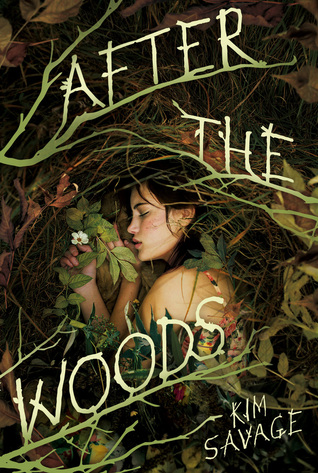
After the Woods by Kim Savage

After the Woods by Kim Savage

After the Woods by Kim Savage (InfoSoup)

Julia can’t remember what happening in the woods except in brief flashbacks. She knows that she saved her best friend from an attacker and then was taken by the man for 48 hours. A year later, Julia is still trying to understand what happened to her in the woods. Liv, her best friend, is urging her to forget and move on. Then a girl’s body is found in the same woods, triggering more memories that Julia had suppressed. Liv too is caught up in what happened, seemingly intent on her own destruction by dating a dangerous boy and participating in other risky behavior. As Julia starts to recreate what really happening in the woods, the incredible truth will lead to understanding what makes someone a hero.

Savage’s writing is dark and gorgeous. Early in the novel as the two friends enter the forest, the writing shows the danger coming:

Despite the desolation  – no one runs at four p.m. in November after weeks of rain – the woods pulse. The canopy shatters fast-dropping light into glittering shards. A chipmunk skitters close to my foot and ducks into a hole.

Throughout the novel, Savage offers clues of what happened in her language. It’s a wrenching combination of what Julia is discovering herself and also allowing the reader to see a bit farther ahead towards the conclusion without revealing all quite yet. The tempting and seductive mixture makes this book an especially great read.

Julia is a jagged character, covered in the pain of what happened to her, striking out at those who protected her, reaching out to those who wronged her. At the same time, she is very bright, looking at the world and this mystery as something that logic can solve. And she is funny and sarcastic too. She’s a survivor, a hero and everything that that complexity brings is shown on the page.

A brilliant novel for teens about heroism, survival and what bravery it takes to keep on going. Appropriate for ages 14-18.

Reviewed from digital galley received from Farrar, Straus & Giroux and Edelweiss.

Solving the Puzzle Under the Sea by Robert Burleigh

Solving the Puzzle Under the Sea by Robert Burleigh

Solving the Puzzle Under the Sea: Marie Tharp Maps the Ocean Floor by Robert Burleigh, illustrated by Raul Colón (InfoSoup)

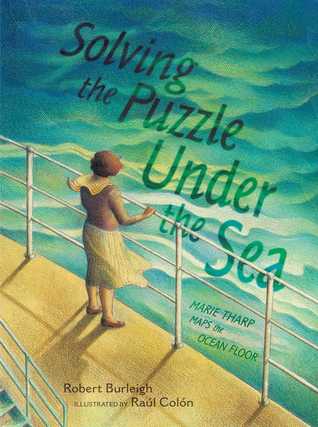
This picture book biography tells the story of Marie Tharp, a scientist who was the first to map the ocean floor. The daughter of a mapmaker, Marie grew up following her father into the field as he created his maps. In the 1940s, Marie became a scientist and looked for a place to focus her attention where she could have a new idea. Scientists were just starting to measure the ocean depths using soundings, using echoes to assess depth. Marie worked to piece all of these measurements together into a map of the ocean floor, revealing mountain ranges under water and helping prove the theory of plate tectonics as she revealed a deep narrow valley running the length of the Atlantic Ocean. Marie Tharp is one of the 20th centuries most important scientists thanks to her discoveries as she mapped the ocean floors of our planet.

Burleigh has once again captured a female scientist and the importance of her role in science and in breaking barriers. The understated drama here is nicely handled, the defensiveness of some male scientists, the way that women were not welcome on boats, and the quiet way that Tharp worked to make her own unique impact on science. As readers see the importance of perseverance in scientific discovers and the importance of resilience in the face of resistance, they will understand that these apply to their own lives as well.

Working once again with Burleigh, Colón shows in images the vital importance that mapping the ocean floor had in understanding our planet and the way that it functions. The mapping of the ocean floor offers great images from the large maps to the underwater scenes that invite readers to think about what lies unseen under the ocean.

A dynamite pick for public and school libraries, this is an opportunity to learn about an important female scientist. Appropriate for ages 7-9.

Reviewed from library copy.

Daniel Finds a Poem by Micha Archer

Daniel Finds a Poem by Micha Archer

Daniel Finds a Poem by Micha Archer (InfoSoup)

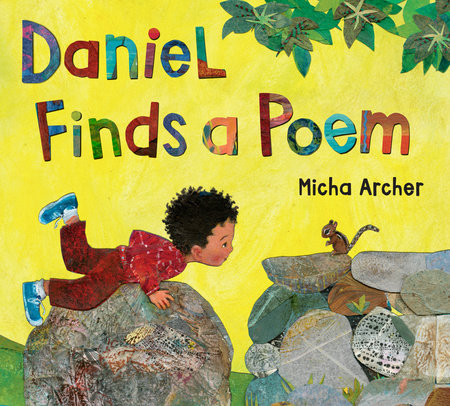
When Daniel discovers that there will be Poetry in the Park on Sunday, he begins to wonder what poetry is. The friends he has made in nature help him start to understand it. Spider says that poetry is “morning dew when it glistens.” For Squirrel, it is “when crisp leaves crunch.” Frog sees it as “a cool pool to dive into.” Owl has many ideas about stars, moonlight and her own silent wings. As Daniel listens to all of the creatures, he realizes that he has created a poem, one that lets him see poetry everywhere just as they do.

Archer’s look at poetry is delightful. She shows poetry connected to each creature’s life, each animal having its own unique way of viewing the world and then turning it into something poetic and special. Young readers will understand poetry just as Daniel does, piece by piece, symbol by symbol in an organic and natural way. While Daniel’s poetry at the end is lovely, I really enjoyed that the book had one final moment where Daniel finds his own personal piece of poetry.

Archer’s illustrations are exceptional. Using a layered technique that involves paint, hand-made block prints, and collage, the illustrations are rich and detailed. They have deep colors that sing on the page and a complexity in texture that is particularly pleasing.

A lush and striking book about poetry and its power in everyone’s life. Appropriate for ages 3-5.

Reviewed from ARC received from Nancy Paulsen Books.

Where My Feet Go by Birgitta Sif

Where My Feet Go by Birgitta Sif

Where My Feet Go by Birgitta Sif

Follow the activities of a young panda and his feet as he goes through his day. First, in the morning his feet go into yellow boots and head outside. He pretends he is walking through a jungle (actually a garden), climbing a high mountain, splashing in the ocean, and crossing a dangerous bridge. In the afternoon, his feet help feed the dinosaurs (birds), swing high in the sky, and cross a sandy desert. At night, his feet explore underwater in his bath and shoot into the sky like the stars as he listens to a bedtime story. Where do your feet go?

This picture book is told by the little panda in first person, aiding in the use of imagination throughout the book. Children will recognize their own daydreams and moments of pretend as the panda goes through his day. The book is simple and playful, inviting children to see what their own feet are up to that day.

The illustrations are hand-drawn with pencil and then digitally colored. They are filled with bright colors like the yellow boots. At the same time, they are subtle too with some parts that read as watercolors particularly in the sky. Filled with shadows to add depth, the entire book has a very unique feel.

Something special is afoot with this picture book that is sure to give children some kicks. Appropriate for ages 2-4.

Reviewed from digital galley received from Penguin Random House and Edelweiss.

Giant Days by John Allison

Giant Days by John Allison

Giant Days Volume 1 by John Allison, Lissa Treiman, and Whitney Cogar (InfoSoup)

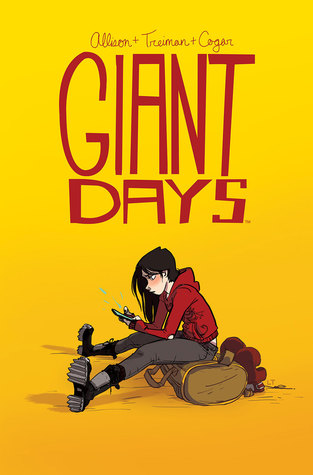
Susan, Esther and Daisy are new friends having just met a few weeks ago at the start of university. The three could not be more different from one another. Daisy is innocent and naive, just beginning to explore her sexuality. Esther, on the other hand, is part goth and brings drama wherever she goes. Meanwhile, Susan has to deal with a man from her past suddenly appearing on campus. The three friends have lots to face, including illness, a list of the hottest new coeds, and the pressures of their courses too. It will take the three of them supporting one another to get through it all.

This graphic novel is the first four issues of the comic book. This is a colorful and glorious look at the first weeks of college, the friendships that are made, and the way that these friends are some of the most unique and special of your life. The three lead characters all have a lot of depth, surprising readers as they grow as one gets to know them better.

The entire series so far embraces important and timely issues like slut shaming, sexuality, open mindedness, and feminism. But beyond that, this is a book that is about real women, making real choices both good and bad, and learning to live after high school. Beautiful.

Perfect for fans of Lumberjanes, this graphic novel embraces girl power and LGBT issues too. Appropriate for ages 16-18.

Reviewed from library copy.

Into the Snow by Yuki Kaneko

Into the Snow by Yuki Kaneko

Into the Snow by Yuki Kaneko, illustrated by Masamitsu Saito (InfoSoup)

Head into the snow with this picture book that shows the joy of winter and the wonder of a snowy day. A child heads out into the snow after bundling up inside. They have a sled along and also explore the way the snow falls softly, the cold of the day, and the icicles hanging nearby. There is a climb to the top of the hill, then the rush of going so quickly, a tumble and the joy of landing softly at the bottom. The snowy day ends with hot chocolate inside, a perfect treat after the cold snow.

This very simple book is told from the youngster’s point of view. Kaneko uses different senses to let the child explore their world. The snow is “soft” and “fluffy” while the icicle is “shiny and clear like glass.” It’s a book of exploration on one’s own, their parent only joining them to call them in at the end and offer the cocoa. The lack of gender for the child is also a great choice, allowing this to be any child’s adventure. This is an empowering read for small children who will want their own explorations on a joyous snowy day.

Saito’s illustrations are done in oil pastels, gouache, acrylic colors and color pencils. They have a delightful roughness that conveys the warmth of the child’s clothes and transformation created by the snow cover. The snow flakes are large and dense. They dance along with the colorful glitter on the child’s hat.

A great snowy day book for small children, this book evokes the feel of a snow day perfectly. Appropriate for ages 2-4.

Reviewed from copy received from Enchanted Lion Books.

The First Step by Susan E. Goodman

The First Step by Susan E Goodman

The First Step: How One Girl Put Segregation on Trial by Susan E. Goodman, illustrated by E. B. Lewis (InfoSoup)

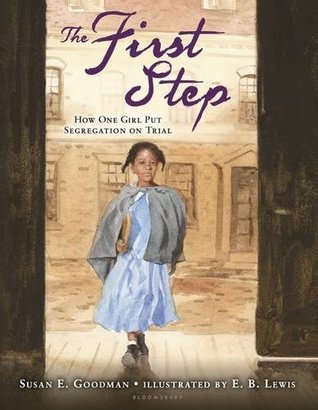
This picture book biography tells the story of Sarah Roberts. Sarah was attending school in Boston in 1847 when she was told that she would have to stop. Instead she would be required to attend the school for African American children across town where there were fewer books and the subjects were not as robust. Sarah’s parents decided not to accept this decision and instead decided to fight for change in the courts. Two lawyers agreed to take Sarah’s case, Robert Morris the second African-American attorney in the United States and Charles Sumner known for his way of orating about justice. Though they lost this first court case challenging school segregation, it set other events in motion and in 1855, Boston became the first major American city to integrate its schools.

Goodman writes an inspiring book about how even losses can begin to change the way people view laws. She does not stop with the longing for change and the case itself, continuing to tell the story of Boston’s changes and then the way that this case led to more cases which resulted in the end of segregation in the nation. This book demonstrates many things to young readers. First that they themselves can create change in the world around them. Second that a loss does not mean the end, it means the fight continues in a different way.

Lewis’ illustrations are done in watercolor and gouache. They echo with historical significance, showing the power of a dream for change, the sorrow of one little girl, and the determination that it takes to make society better. The illustrations range from the subtlety of black and white photographs to the bright colors of change and hope.

A powerful and important story of how children change their world, this picture book is inspiring. Appropriate for ages 7-9.

Reviewed from ARC received from Bloomsbury.

The Radiant Road by Katherine Catmull

The Radiant Road by Katherine Catmull

The Radiant Road by Katherine Catmull (InfoSoup)

When Clare and her father move back to Ireland and the house that Clare was born in, Clare discovers memories of her dead mother that she had forgotten. Clare has always believed in the Strange, fairies and magic, makings that only she seems to notice in real life. Returned to her family home, Clare discovers that the Strange and fairies are real and have been in her life for some time. She remembers the powers of the yew tree that forms part of the house and serves as a gate to Timeless, the world of the fairies. She meets Finn again, a boy she has known since she was an infant. Now the two of them must figure out how to stop a threat to both the human world and Timeless, a threat that is coming for Clare’s family, her tree, and Finn personally.

Catmull’s writing is rich and beautiful. She creates a different world of fairy on the page, a world where yes there is danger and iciness, but there is also an important connection between humans and fae, one that if lost will change both worlds in a permanent and devastating way. Catmull’s writing unfolds at its own pace, sometimes languorous and almost dreamlike and other times rampaging and racing. It’s a book that dances and moves, circles and threatens, where things are not what they seem.

Catmull uses imagery and poetry to add even more richness to the book. Clare writes, reluctantly at first, and then more openly. Her poetry is fresh and lovely, offering a glimpse into a world that Clare herself has mostly forgotten. The book encourages each person to make things as they will, showing the importance of creativity to our lives and to the way we connect to our world.

An unusual and exceptionally gorgeous look at fairies and their world, this book is just right for teens who don’t mind a book that meanders a bit like a night in Timeless. Appropriate for ages 12-14.

Reviewed from library copy.