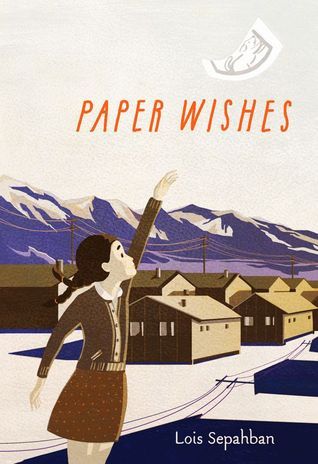
Paper Wishes by Lois Sepahban

Paper Wishes by Lois Sepahban

Paper Wishes by Lois Sepahban

Manami loves her home on Bainbridge Island where she can walk with her grandfather and his dog on the beach. Everything changes when Pearl Harbor is bombed in 1941. Manami and her family along with the other Japanese Americans are gathered up and forced to move to internment camps far from the sea. Manami’s grandfather has arranged for someone to care for his dog, but Manami cannot bear to leave him behind so she hides him in her coat. But she is not allowed to bring the dog with them. Heartbroken, when they reach the camp, Manami stops speaking entirely, unable to force words past her dusty throat. Manami keeps hoping that their dog will find them, sending pictures on the wind to him.

Told in spare and elegant prose, Sephaban captures the devastating impact of World War II policies on Japanese Americans. Losing all of their property and belongings except what they can fit into one suitcase each, the families work to put together a semblance of a life for themselves and their children. Sepahban sets this story in a prison camp that had a riot break out and one can feel the tension building. This novel manages to show the impact of loss of civil rights and also be a voice for moving forward to embracing diversity and differences.

Manami is an amazing character. Her pain is palpable on the page, her voice buried under guilt and compounded by their internment in the camp. Everything changes for her in one moment, taken from the place she loves, removed from the life she has been living. Manami has to find a way to make a new life, but it is devastating for her as she is unable to forgive herself for what she has done.

Beautiful writing, a complex heroine and a powerful story make this short historical novel worth reading and sharing. Appropriate for ages 9-12.

Reviewed from e-galley received from Farrar, Straus and Giroux and Edelweiss.
I Am a Bear by Jean-Francois Dumont

I Am a Bear by Jean Francois Dumont

I Am a Bear by Jean-Francois Dumont (InfoSoup)

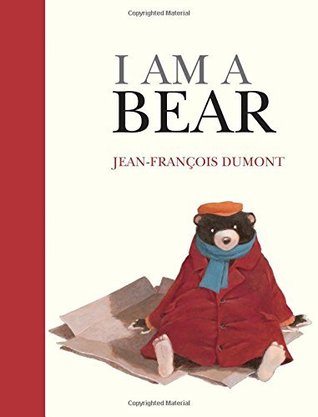
Told in the first person, this is a story of a bear who finds himself living on the streets of a city. He has a stack of cardboard boxes that make up his home. He isn’t welcome in any of the stores, and finds it safer to scrounge for food after dark. That means that he sleeps most of the day. He had tried to talk with people, but he scared them since he’s such a big bear. He gave up after awhile, paying no attention to those walking past him anymore. Until one day, a little girl notices him and talks directly to him. She returns the next day too and the bear has made an effort to clean up himself and his home. She calls him a teddy bear and visits again and again. Suddenly the bear has something to look forward to each day, and there is hope.

Dumont is the author of The Chickens Build a Wall and the series of silly books that follow it. This book though is a departure from that frenetic cheery tone. Here there is darkness, hunger and need. Here there is a bear who clearly is not actually a bear, but treated as such by society. It does not matter if young readers realize that the bear is a symbol. The story works much the same with a real bear or a real person. The life is hard, the city stark, and hope nonexistent, at first.

The art here is lush and lovely. It shows life on the street both from the bear’s point of view and also from that of an observer like the little girl. The buildings lean and tower above, the traffic is dangerous and close, and the alley is like a canyon. With sharp angles, the perils of life on the street are evident here as appropriate for a child.

A book that will help talk about homelessness and that offers a way forward, kindness. Appropriate for ages 3-5.

Reviewed from copy received from Eerdmans Books for Young Readers.

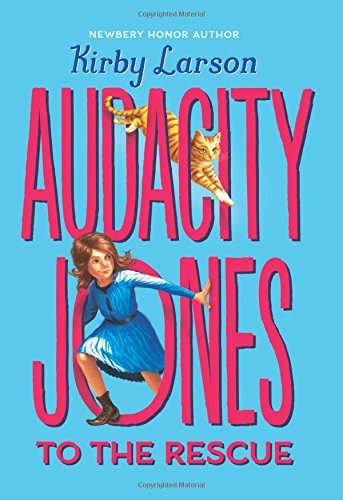
Review: Audacity Jones to the Rescue by Kirby Larson

Audacity Jones to the Rescue by Kirby Larson

Audacity Jones to the Rescue by Kirby Larson

Released January 26, 2016.

Audacity Jones is the only orphan at Miss Maisie’s School for Wayward Girls. She’s also the only student there who knows that the Punishment Room is actually a lovely library, so she is very well read. When Commodore Crutchfield visits the school and asks for a girl to take on a journey, Audie is up for the challenge. But all is not what it seems with the reason for the travel and Audie finds herself in Washington, DC with the distracted Commodore and his shifty chauffeur. As this historical novel unfurls, Audie will need to call on all of the friends she has made in her adventure to foil a plot of presidential proportions!

This historical novel takes place in 1910 when President Taft was in office and features Taft, Mrs. Taft and their son. Larson weaves real history into her novel, cleverly combining the two into a truly engaging read. The story of a poor girl brought into luxury and then used as a potential pawn in a heist is entirely engrossing. Larson’s plotting is noteworthy, allowing her merry chases and close calls but also offering enough space to give historical details that make the setting clear and important.

I fell hard for Audacity. She’s exactly the sort of girl protagonist that is engaging to read and she will remind readers of other great girl protagonists who also love books and adventures alike. She takes her place by other literary orphans who capture your heart with their spirit and determination.

A delight of a novel, this is the first in a new series from the Newbery-Honor winning author. I can’t wait to see what Audie gets up to next! Appropriate for ages 8-11.

Reviewed from ARC received from Scholastic Press.

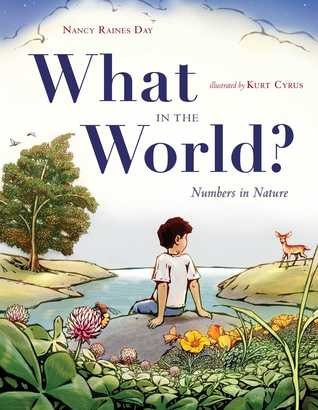
What in the World? by Nancy Raines Day

What in the World by Nancy Raines Day

What in the World?: Numbers in Nature by Nancy Raines Day, illustrated by Kurt Cyrus (InfoSoup)

In this rhyming counting book, the concept of numerical sets is introduced. The book opens asking “What in the world comes one by one?” It then answers, explaining that the moon, your nose and your mouth come in singles. Then the book counts upwards, each time asking the question of what comes in that set and answering it. The book ends by looking up at the stars and the infinity of them. It invites young readers to start to think about the patterns in the natural world around them.

Day has created a rhyme that makes this book an engaging mix of poetry and science. As the rhyme dances along, the book will inspire conversation and thinking of more things that come in that type of set. The book is wisely limited to a coastal area where a young boy plays, dangling his toes and fingers in the water, sets of ten.

The art is simple enough to allow this book to be both a counting book and a book about sets. Smaller children will merrily count the nine spines on the back of a fish while older children will start to think about other things in their world that match the set. The digital art is bright colored, and cheery.

An engaging math book that can be read at different levels, this rhyming science book will be enjoyed by several ages of child. Appropriate for ages 3-5.

Reviewed from copy received from Beach Lane Books.

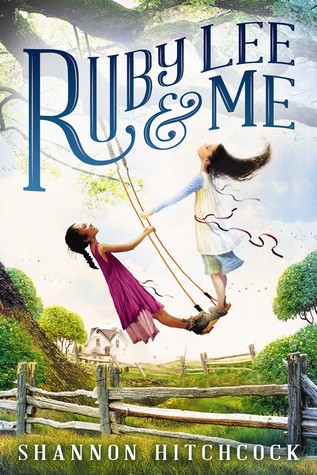
Review: Ruby Lee and Me by Shannon Hitchcock

Ruby Lee and Me by Shannon Hitchcock

Ruby Lee and Me by Shannon Hitchcock

Sarah knows that she is responsible for her little sister being hit by a car. Their entire summer has changed now with Robin in the hospital and her prognosis unclear. Sarah has moved to live with her grandparents on their remote farm, which is usually one of her favorite places but even that has changed. Her best friend, Ruby Lee, is changing too because the color of their skin has become all the more important in North Carolina as the school desegregate. When it looks like the girls will be going to school together, they struggle with their friendship under the rules of their parents and grandparents and their own high expectations. Sarah has a lot to navigate in this summer before middle school.

Based on the author’s family history with a car accident and a sibling, this book’s real heart is the family itself. The warmth of the grandparents’ love and care during the tragedy are palpable as they feed Sarah all sorts of good homemade cooking and teach her skills in the kitchen too. Sarah discovers that she is surrounded by people who care, but even that is not enough to assuage her guilt at what has happened to her sister as well as her guilt about how she treats Ruby Lee.

As this guilt builds, it becomes almost another character in the book, unspoken and real. It traps the real Sarah beneath it, unable to speak of what she needs to say most desperately. This is an honest depiction of what it is to feel this level of responsibility and not be able to communicate that at all. The book embraces these large feelings, gives them space to come out and be revealed, and also shows how these emotions play into civil rights in a larger scale where guilt, tradition and societal expectations come together and stop forward momentum.

A powerful mix of personal story and Civil Rights history, this book shows how important change is at every level. Appropriate for ages 10-13.

Reviewed from ARC received from Scholastic Press.


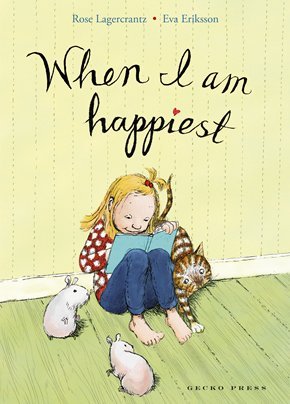
When I Am Happiest by Rose Lagercrantz

When I Am Happiest by Rose Lagercrantz

When I Am Happiest by Rose Lagercrantz, illustrated by Eva Eriksson (InfoSoup)

The third in the charming series about Dani, this book has school ending. Dani has now managed to finish the school year after her best friend moved away. She has a project to finish, a book about how happy she is. But then her father is hit by a car on his bicycle, and suddenly Dani is not happy at all. Dani is taken home by her grandparents where they wait for updates on her her father is doing. How can Dani ever finish her book now? And what will happen if her father never wakes up again?

Translated from the Swedish, this series is one of my favorites. Lagercrantz captures the emotions of having your best friend move away and then the long process of recovering from that. In this novel, she shows how a sudden accident can sweep the air out of your life as a child. Lagercrantz never lectures about being positive, but that’s exactly what her books embrace. Through Dani’s reactions to adversity, readers can see the power of positive thinking and how the good outweighs the bad even when you don’t realize it.

Eriksson’s art is done in line drawings that help break the text up, making this book just right for elementary readers who may still find large paragraphs overwhelming. The art is done with a sense of humor, such as the image of Dani getting her ears pierced with her father unable to look but bravely holding her hand anyway. When Dani is overwhelmed by the news of her father, you can see it in every bone of her body as it curves protectively inward.

Another winner in this great series, get these into the hands of fans of Clementine for another amazing young heroine. Appropriate for ages 6-8.

Reviewed from library copy.

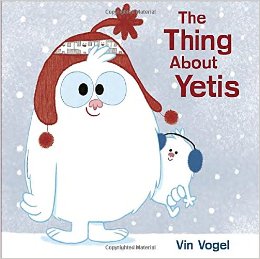
The Thing about Yetis by Vin Vogel

The Thing about Yetis by Vin Vogel

The Thing about Yetis by Vin Vogel (InfoSoup)

The one thing you should know about yetis is that they love winter. They love playing in the snow, sliding down hills, ice skating in their own unique way, making the best snowballs, and building snow castles. But even yetis can get too cold and have to head inside to warm up. When winter gets a bit too rough, yetis can also get crabby, particularly when they run out of cocoa. They also love summer, you see. They miss playing outside in the sun, sliding down slippery slides, swimming, sleeping in tents, and building sand castles. There’s just one thing for a grumpy winter yeti to do, make their own summer day!

This book has such an appeal about it. It’s the googly-eyed yetis throughout the book, the ones who delight in both cold and warm weather. The ones who get grouchy when they are too cold, poofy when their fur dries, and who sometimes need to be cozy inside on a blustery winter day. Vogel captures these elusive yetis with a cartoon feel that has universal appeal for readers.

The story is brief but cleverly done. Rather than just an ode to winter and all that it brings in terms of snowy fun, this is also a book that will appeal to any of us who live in the north and know that snow and cold can get very old after awhile. Children will relate to longing for summer.

Read this one as February is getting brutal and be prepared to have your own summer day inside. Appropriate for ages 3-5.

Reviewed from copy received from Dial Books.

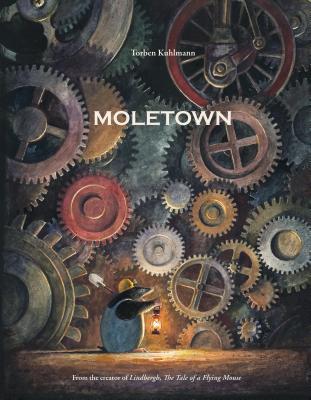
Moletown by Torben Kuhlmann

Moletown by Torben Kuhlmann

Moletown by Torben Kuhlmann (InfoSoup)

With just a few words at the beginning and ending of the book, this nearly wordless picture book looks at progress. It begins with one lone mole moving into a green meadow. He was soon joined by more moles and each dug out space of their very own. Soon there was electricity, plumbing and heat. The shaft got larger and deeper and then large machinery was used to dig the tunnels. The meadow was dotted with mounds. Public transport was added, cities grew up, apartments were jammed closely together, traffic was awful, and the lush green meadow disappeared. But not quite.

Kuhlmann shows human progress but with a mole point of view. His gorgeous illustrations show the wheels of change, the machinery of digging, the way that progress takes over and has a speed all of its own. It is a story that is dark and sad, one that shows that starting with a lone mole and freedom to make choices can quickly turn into a society bound by the machines that once built it. Much like our own, perhaps exactly like our own.

As I mentioned, it is Kuhlmann’s illustrations that show all of this without words. Each illustration is detailed and lush. The little mole homes are cleverly depicted from the happiness of the early days to the jammed apartments at the end. I particularly enjoyed the page filled with paperwork and records with one bored mole at a desk. All of these work together to show what loss was suffered with progress.

A book to start discussions or to pore over on your own, this picture book takes a mole-eye view of what we humans are doing to ourselves. Appropriate for ages 5-7.

Reviewed from library copy.


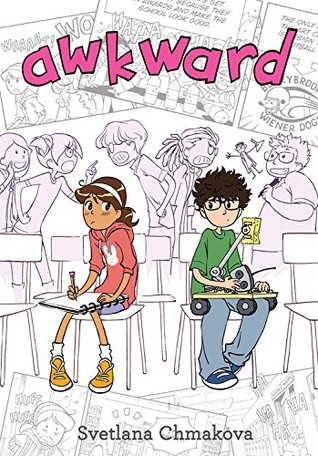
Review: Awkward by Svetlana Chmakova

Awkward by Svetlana Chmakava

Awkward by Svetlana Chmakova (InfoSoup)

Peppi has just started a new school when she manages to trip over her own feet in the crowded hallway. When a boy tries to help her, she panics and pushes him away when kids start to say she’s his “nerder girlfriend.” Peppi feels awful about this and buries herself in her new group of friends in the art club. Though she tries to avoid him, Jaime is everywhere. He’s assigned as her science tutor and is part of the science club, the art club’s arch rivals. Soon the two clubs are at war with one another, but Peppi is starting to be friends with Jaime. How can a budding middle school friendship survive the club apocalypse?

The story is over the top in a good way. It captures the story of Peppi, a nice artistic girl who just cannot bring herself to apologize to Jaime, even if she knows that what she did was wrong. So often protagonists are either completely socially inept or entirely extroverted, Peppi is a clear introvert but one with lots of friends and a clear social circle.

Chmakova has a style that will appeal to manga readers and anime viewers. She uses several tropes from those genres to great effect from the streaming tears on people’s faces in reaction to great dismay to the isolated images of angry leaders where they are backlit and scary. Chmakova also manages to keep her graphic novel very diverse, not only is Peppi herself diverse, but other characters who populate the story are diverse as well with a variety of racial, ethnic and abilities. It is subtly done and makes the entire book feel like a real school.

A dynamic graphic novel, this book will appeal to those in middle school and those headed there, artists and scientists alike. Appropriate for ages 10-13.

Reviewed from library copy.