The Knights Before Christmas by Joan Holub

The Knights Before Christmas by Joan Holub

The Knights Before Christmas by Joan Holub, illustratead by Scott Magoon (InfoSoup)

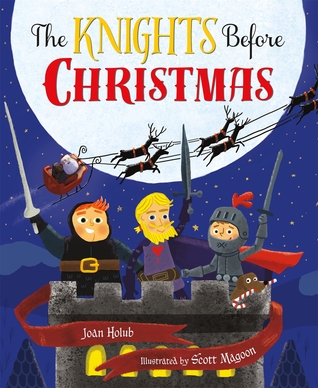
Three knights are guarding the castle when suddenly out on the drawbridge there arose a clatter! Outside there is a red-and-white knight with his eight dragons who is trying to get inside the castle. He asks where the chimney is, but castles don’t have a chimney, so Santa has to go to extreme measures to get gifts to these three knights. Meanwhile the knights try to defend the castle but take the instructions a bit too literally. Santa does not give up, deciding to launch the presents at the castle using a flexible pine tree. The knights successfully defend the castle from this barrage of cookies, candy and gifts. Then they merrily bring it all indoors and set up their holiday celebration. Santa has won too!

This is such a clever play on Twas a Night Before Christmas. At first I wondered if it would work, but the author manages to pay homage to the traditional story but also strike out on her own and make a very enjoyable holiday tale. The rhythm and feel of the original story is still here, but this new version does not feel bound by it. Rather it launches the story forward and gives the author room to play. Children will love these three confused knights and their battle against the holiday.

Magoon’s art is digitally done, offering a feeling of plenty of texture and even collage. The three knights are unique from one another and Santa himself is unmistakable in his red and white costume. Each image is filled with humor. Make sure to take time to read the asides too as they add to the merriment.

A modern twist on a traditional poem, this is a welcome new version for fans of knights and castles. Appropriate for ages 3-5.

Reviewed from copy received from Henry Holt and Company.
The Red Hat by David Teague

The Red Hat by David Teague

The Red Hat by David Teague, illustrated by Antoinette Portis (InfoSoup)

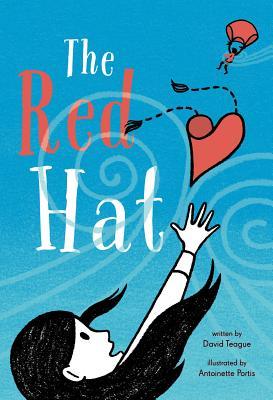
A boy named Billy Hightower lives at the top of the tallest building in the world, so high that he is above the clouds. Then one day, another building is built nearby. Billy soon sees a girl on top of the building wearing a red hat. Billy tries to call to her, but the wind sweeps away his words before she can hear them. He tries to send her a note via paper airplane, but the wind snatches that away too. The kite doesn’t work either. When Billy tries to use a blanket to fly across the gap to the girl, the wind pushes him down to street level and takes the girl’s hat too. The vicious wind continues to push Billy around, but soon Billy has figured out where the girl lives and finds a way through the wind to see her.

Teague keeps his text very simple in this picture book. He tells a straight forward story, but one that also is about loneliness and how important it is to reach another person. It is also clearly a book about love, about obstacles and finding an alternate way to connect and be together. Children may see it as a book more about wind, and that is completely wonderful too. Some of the best books work on different levels.

Portis’ illustrations use a little gimmick of the wind being shiny on the page. But these illustrations are beautiful in their simplicity and the wind itself is so capricious and involved in the story that it deserves its own style and feel. Done in only a few colors, the red pops on the page, the color of love.

A lovely picture book that can be enjoyed on different levels by different readers. It would make an interesting discussion for slightly older children about imagery and hidden meanings. Appropriate for ages 3-5.

Reviewed from library copy.


Ada Byron Lovelace and the Thinking Machine by Laurie Wallmark

Ada Byron Lovelace and the Thinking Machine by Laurie Wallmark

Ada Byron Lovelace and the Thinking Machine by Laurie Wallmark, illustrated by April Chu (InfoSoup)

Ada Lovelace was born the daughter of the famous poet, Lord Byron. But she was more like her mother and interested in numbers rather than words. As a young woman, Ada invented a flying machine that she did all of the mathematics for. She spent time experimenting with wind and sails to inform her calculations. Despite a health scare that left her blind and paralyzed for some time, Ada continued to learn math and love numbers. When she met Charles Babbage, the inventor of the first mechanical computer, she found a person she could talk to about her love of numbers. It was his machine that inspired her to write the first computer program ever so that others could understand this amazing computer he had built. This makes Ada the first computer programmer.

It is inspiring to see a girl from such an early time period who was clearly a mathematical genius. She had a mother who was also interested in math and supported her daughter’s education and love of numbers throughout her life. This book shows the power of mathematics to inspire new ideas and inventions. It also demonstrates that women in computing goes back to the very beginning.

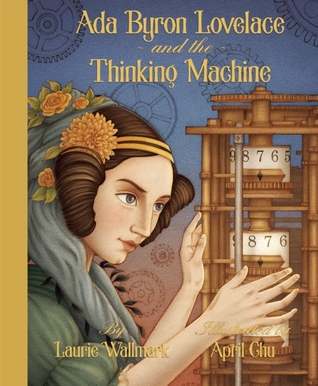
Chu’s art is done with pencil on paper and then as the copyright information says “colored on an Analytical Engine” also known as a computer. The illustrations are rich and lovely. They have interesting perspectives like looking down on Ada in the bath with her muddy boots on the floor nearby. Ada is shown as an active person, a youthful presence among older people, and shines on the page as she must have in life.

A powerful and inspirational read for children interested in math and science, this picture book will show young readers a heroine that they may never have met before. Appropriate for ages 7-10.

Reviewed from library copy.

Review: Rules for Stealing Stars by Corey Ann Haydu

Rules for Stealing Stars by Corey Ann Haydu

Rules for Stealing Stars by Corey Ann Haydu (InfoSoup)

Silly is the youngest of four sisters and the older sisters tend to leave her out of a lot, like the secret boyfriend one of the twins has and what they are doing for hours in their bedroom so quietly. Their family has moved to New Hampshire to a home that used to be used just in the summer, the house where their mother grew up. But the move is not helping their mother who is quickly declining into alcoholism and abusive behavior. It isn’t until their mother turns on Silly too that the sisters bring Silly into their secret: their closet can take them to a different world. The sisters are shocked when Silly joins them and the magic becomes much stronger. As the sisters turn more and more to the closet for relief from their lives, they have to face the darkness they discover there as well. It may just be the answer for them all.

Haydu has created a lush book based loosely on The Twelve Dancing Princesses. She embraces the darkness of family life, offering a family dancing on the edge of something terrible, avoiding the truth about what is happening to their mother and what happened in her past, a father unable to cope with reality, and children trying to hold them all together. It is against that dark backdrop that the closets glimmer and glitter, beckoning the sisters and the reader to a different place where there is wonder and magic. But escaping into that place is not reality and Haydu shows this with a daring climax that speaks volumes about facing truth and being a family.

A book filled with four sisters can be challenging. Haydu pulls it off with grace and style, offering each of the girls a distinct personality but keeping them from being stereotypical. Silly is the main character, a girl who has been left out of much that the sisters have done and feels that she has no special sister to pair with the way the twins do. Silly feels alone even in a bustling houseful of people, which speaks volumes about her family. Silly is also the one protected from much of the abuse, but she witnesses more than the others do.

This brilliant starry novel takes a dark reality and a dazzling magic and creates wonder all its own. Appropriate for ages 11-14.

Reviewed from library copy.

Miracle on 133rd Street by Sonia Manzano

Miracle on 133rd Street by Sonia Manzano

Miracle on 133rd Street by Sonia Manzano, illustrated  by Marjorie Priceman (InfoSoup)

On their first Christmas Eve after moving to the Bronx from Puerto Rico, things are just not going well. Their tree is tiny and now the holiday roast is too big to fit in their tiny oven! So Jose and his father head off to find an oven large enough for their big roast. As they leave their apartment building, they bump into neighbor after neighbor, each having a bad holiday too. The children are too noisy, an older couple won’t be seeing their family this year, and others are having money troubles. They head to the local pizzeria where the Ray lets them put the roast in his huge pizza oven. On the way back home with the meal, the smell of the roast tantalizes everyone they pass, making their day better. And best of all is the sharing of the roast and the sharing of the holiday with everyone.

Manzano played Maria on Sesame Street and has been creating marvelous books for children for the last few years. In this picture book, she captures the diversity of a Bronx neighborhood and the way that you can be neighbors but not know one another well. Then she turns it all around and shows how community can suddenly be created by acts of caring and generosity and how those choices can impact everyone around you.

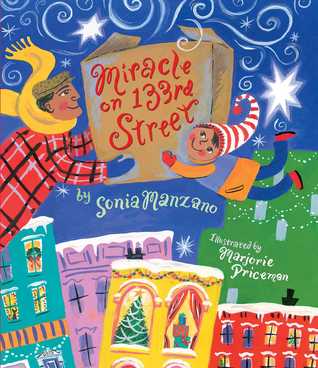
Caldecott-honor winning, Priceman has brought the urban Bronx neighborhood to vivid life here. The buildings sway, bright colored against the dark night sky that is alive with stars and the milky way. The snow shines on the ground. All is filled with spicy colors that fill the holiday with a unique feeling of a diverse community.

A great pick for holiday reading, this picture book has the rhythm of different languages on the page, the joy of diverse holiday traditions and the beauty of a community coming together. Appropriate for ages 3-5.

Reviewed from copy received from Atheneum Books for Young Readers.

Review: I Am Henry Finch by Alexis Deacon

I Am Henry Finch by Alexis Deacon

I Am Henry Finch by Alexis Deacon, illustrated by Viviane Schwarz (InfoSoup)

The finches live all together in a flock making a huge racket and not thinking at all. They all say good morning, good afternoon, good evening and good night each day, starting over again each day. The only thing that changed their routine was when the Beast came and ate one or more of them. After that, the flock would shout about the Beast and fly higher in the tree. But then something different happened. Henry woke up and heard a thought in his head. He thought and thought, and realized that someone had to stop the Beast and that he could be a hero! But when he tried to best the Beast, it did not go as planned. Can thinking some more save Henry?

I am a fan of strange picture books and this is certainly one of them. It has a philosophical feel to it, changing from what is at first a look at the cacophony of the modern world and the lack of thinking happening in mobs to then the power of thought, the importance of ideas, and the way that thinking alone can change the world. This is a book that is not pat. It will instead inspire discussion. If you are looking for a picture book to inspire a metaphysical discussion with children, this is it. Clever and smart, it allows children themselves to start to think too.

Using thumbprints as the finches is a fascinating choice. Fingerprints are unique but these birds are anything but. The book then moves to darkness where Henry is inside the Beast. The pages black with white lines, all deep and dark and filled solely with silence and thought. It’s a powerful visual transition.

Not for everyone, this picture book will delight some and confuse others. I hope it delights you like it did me! Appropriate for ages 5-8.

Reviewed from library copy.

Review: Oskar and the Eight Blessings by Richard Simon

Oskar and the Eight Blesssings by Richard Simon

Oskar and the Eight Blessings by Richard Simon and Tanya Simon, illustrated by Mark Siegel (InfoSoup)

Oskar survived Kristallnacht in Nazi Europe and has been sent by his family to live with his aunt in New York City. When he arrives, he has to walk over 100 blocks down Broadway to reach her, hopefully before she lights the menorah at sunset. Along the way, Oskar is reminded again and again about looking for blessings in life. He is given bread by a woman feeding the birds, a comic book by the man who runs the newsstand, mittens by a boy in the park. But most of all in his long walk in the cold, he is given hope once again that he is somewhere safe.

The authors have created a picture book that speaks to the horrors of the Holocaust only in passing. Instead it is much more focused upon feeling embraced by a city even as a newly-arrived immigrant. It is about the small things that we do in kindness each day and the way that those small things build to something larger and more important for someone. This book celebrates New York City and the shelter and home that can be found there.

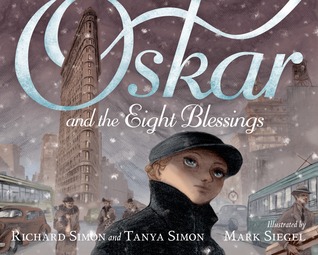
The illustrations are interesting for a book set in the past. They incorporate comic-like panels on the page that really work well. The illustrations have a sense of wonder about them. They capture small pieces of New York, allowing the snow and city to swirl around the reader just as they do around Oskar himself.

A lovely holiday book that is about more than either Christmas or Hanukkah but about home and hope. Appropriate for ages 3-5.

Reviewed from copy received from Roaring Brook Press.

Review: You Can’t See the Elephants by Susan Kreller

You Cant See the Elephants by Susan Kreller

You Can’t See the Elephants by Susan Kreller, translated by Elizabeth Gaffney (InfoSoup)

Mascha has been sent to spend the summer at her grandparent’s house. Their neighborhood is perfect in many ways with neat yards, gardens and neighborly gatherings. When Mascha meets Julia and Max at the playground, she is desperate for friends. There’s not a lot for a 13-year-old to do. Soon though Mascha realizes that something is wrong and then witnesses for herself Julia and Max being abused by their father. Mascha tells her grandparents and even other neighbors, but no one is willing to do anything. So Mascha decides to step in herself and stop the abuse.

This German novel has already won several international awards. The writing is haunting and beautiful. My quibble with the translation is that I wish it had maintained its German setting rather than being moved to the United States. It reads as a European book and I’m not sure the story works as well with an American setting. But that is a minor factor in such a powerhouse of a book.

First, the setting in an upper-class community focused on image rather than real warmth is a cunning choice. It reveals the thin veneer of neighborliness, the unwillingness to look deeper at what could be happening, and the ability to turn away from the ugly truth to see only the good. Mascha herself is a brilliant heroine. Facing the death of her mother and sent to stay long term with her grandparents, she is not connected to this community at all. She sees the truth, speaks the truth and then is forced to find her own solution. And what a solution it is. It is clever but flawed, a plan only a child could produce. It is entirely believable and therefore a truly riveting read.

A great book, this novel about abuse, friendship and the importance of protecting the vulnerable in our world is one of the best of the year. It is startling, provocative and timely. Appropriate for ages 10-13.

Reviewed from copy received from G. P. Putnam’s Sons Books for Young Readers.

Review: Ketzel the Cat Who Composed by Leslea Newman

Ketzel the Cat Who Composed by Leslea Newman

Ketzel, the Cat Who Composed by Leslea Newman, illustrated by Amy June Bates (InfoSoup)

Moshe Cotel enjoyed his noisy apartment since he heard all of that sound as music that he added to his musical compositions. Each day, Moshe would compose in the morning and then he would head out into the city for a walk to listen to all of the noises outside. One day, he discovered a tiny kitten and took it home. There he discovered that the cat loved music. When he got notice of a contest at The Paris New Music review, Moshe despaired since each composition could be no more than sixty seconds long. It was then that Ketzel walked across the keyboard, creating a song that took only 21 seconds to play. Moshe and Ketzel received a Special Mention in the contest and both of them attended and even took a bow together on stage.

Based on a true story, this picture book shows the beautiful bond that a composer had with his very talented cat. More than that though, it shows a very special man who could hear music everywhere even in his cat stepping on keys. The story is written in a very engaging way, allowing the reader to fall for both Moshe and Ketzel. The Author’s Note at the end offers more information, including what CD has the song on it so readers can hear it.

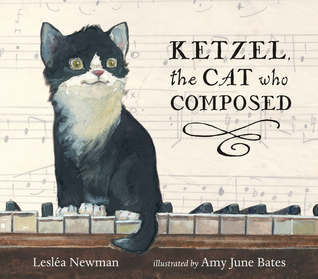
Bates’ illustrations are done in watercolor, gouache and pencil. They have a subtle coloring and distinct warmth to them. From the cluttered apartment of Moshe with coffee cups, papers and his glasses strewn about to the vibrant streets outside, this book is like entering a memory. Ketzel herself is a rich ball of black-and-white fur who owns each page she is on, filling it with her personality if not her size.

An engaging true story, this picture book is an inspiring look at the gifts that animals bring to all of our lives. Appropriate for ages 4-6.

Reviewed from library copy.