Review: Zen Socks by Jon J. Muth

Zen Socks by Jon J Muth

Zen Socks by Jon J. Muth (InfoSoup)

Stillwater, the giant panda, returns for another picture book filled with Buddhist wisdom. The book takes a look at different ways to reach wisdom. The first section of the book looks to sharing a story as a way to learn. It’s a story about learning too, about the importance of patience, practice and hard work. The next story focuses more on action as a learning tool, about being a bad guy and being a good person, and more positive ways to manage conflict. The final part of the picture book is about taking action to help even if you think your small action won’t make any difference to the world.

The entire book shines with Stillwater’s quiet and wise presence. His guidance is done with subtlety and kindness, modeling the way that parents can inspire different ways of thinking in their children. The stories while based on old tales are also effortlessly modern in their presentation here. These are lessons that transcend any age and remain all the more true in our current world.

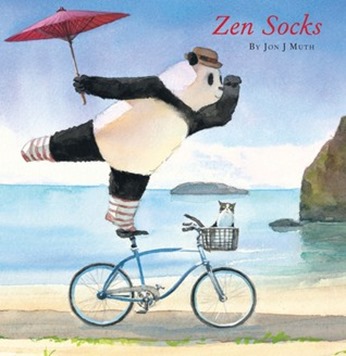
Muth’s illustrations are luminous and lovely. They are filled with light and humor, inviting children outdoors to play and explore without ever mentioning it as a goal. As in all of his Zen books, Stillwater is a major presence that demonstrates the importance of having a child’s mind in his playfulness and also being engaged in his community as he teaches the children new ways to see the world.

Another brilliant Zen book, this picture book will be embraced by Buddhists and others looking for some quiet wisdom in our busy world. Appropriate for ages 4-6.

Reviewed from copy received from Scholastic.
Review: In, Over and On the Farm by Ethan Long

In Over and On the Farm by Ethan Long

In, Over and On the Farm by Ethan Long

Following his Geisel Award-winning Up, Tall and High, Long returns to prepositions. Four animals friends have adventures on the farm in this easy reader. Broken into three short stories, each story focuses on one pair of prepositions. Chicken can’t get in the coop, so she is left out in the rain, until she realizes that everyone else is warm and dry in there, so she orders them to get out. In the next story, Chicken can’t get over the fence or go under it either. Luckily Cow has another solution for her, go around! In the last story, Pig is on the tractor and Cow and Goat join him there. When they are all on the tractor though, it starts to roll away and soon they are all thrown off. But they want to go on it again.

Long is a very prolific author and excels at creating books for beginning readers which are a winning mix of humor and simplicity. It also helps that he is a natural storyteller and so his short stories in the book have the feel of being complete tales despite their brevity. His characters are also universal, in their group and individual dynamics. The book is entirely relatable by children and will be enjoyed in classrooms looking at prepositions as well as by individual readers.

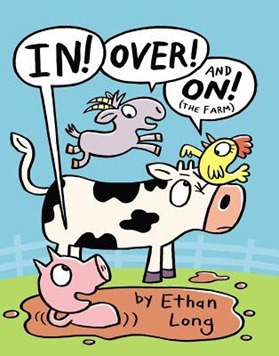
Long’s illustrations are funny and filled with a cartoon appeal. The colors are candy-bright and even gray rainy days are tinged in lavender. The incorporation of a few flaps to lift is also very appealing for young readers who will enjoy that the twist for each story is revealed in a physical way.

Silly and very easy to read, these stories have massive appeal. Appropriate for ages 3-5.

Reviewed from copy received from G. P. Putnam’s Sons.

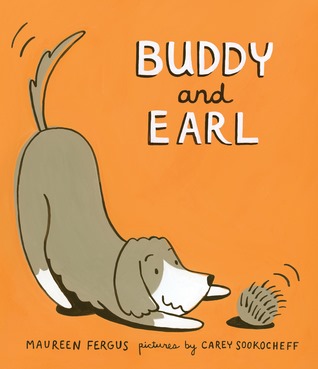
Review: Buddy and Earl by Maureen Fergus

Groundwood Logos Spine

Buddy and Earl by Maureen Fergus, illustrated by Carey Sookocheff (InfoSoup)

When Meredith comes home with a mysterious box, Buddy just can’t quite manage to stay on his bed. Soon he is exploring the box and discovers a strange creature named Earl inside, who claims to be a giraffe, though Buddy is sure that he isn’t and Earl’s not a sea urchin either. When Earl tries to guess what Buddy is, he never guesses that Buddy is a dog. Earl announces that he is a pirate, and Buddy finds himself called a pirate too. The two of them start to play together, sailing the couch into a storm. They are interrupted by Mom, who scolds Buddy for being on the couch and for playing with Earl. But when her back is turned, Buddy is right there near the box again, announcing that he knows exactly what Earl is: a friend.

This little picture book has a lot of depth to it. The simple story is given details thanks to the conversational tone of the text that is focused on allowing children to understand how this unlikely friendship develops. The two animals explore one another but are also figuring out one another’s personalities, something that proves much more interesting to them both rather than labeling their species. Playing pretend together seals the friendship, but then it is made even stronger when Earl tries to take the blame for Buddy being on the couch.

The illustrations nicely break the text into manageable chunks. The illustrations are simple, done in thick black lines and washes of subtle color. They have a pleasing roughness to the edges that offers a modern feel.

Friendship in a nutshell, this picture book offers an adventure for new friends. Appropriate for ages 4-6.

Reviewed from library copy.

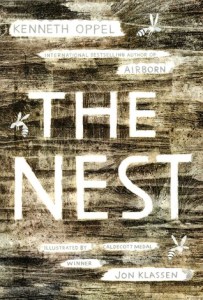
Review: The Nest by Kenneth Oppel

The Nest by Kenneth Oppel

The Nest by Kenneth Oppel

Steve’s new baby brother isn’t healthy, so his parents keep having to meet with doctors and specialists to see if they can help. Steve struggles with worries much of the time and now it is getting worse. He worries about the baby, about his parents, about his little sister, about the odd man who drives the knife sharpening cart, and about the wasps. Steve doesn’t like wasps and when he is stung out in the yard one day, he discovers that he is allergic to them too. So Steve has to carry an Epi-pen to keep safe. As the summer continues, Steve begins to have weird dreams. It seems that the queen of the wasp nest outside under the eaves is communicating with him. And she is steadily explaining something horrible and tantalizing, promising that she can help his little brother by fixing him. But it takes Steve saying “yes” and helping them get the new baby in the house. As the pressure mounts, Steve is told by his doctor that dreams are only in his head and not reality. But what happens when your dreams actually start coming true?

Oppel has written a spectacular horror book, combining a fear of bees and wasps with the myths of changelings. The way that Oppel incorporates the science of reason and has adults dismissing Steve’s dreams and concerns makes for a horror book that uses parents and polite adult sensibility as the way the main character is isolated. This benign busyness of the parents though they care deeply will be something that most modern children will recognize. It’s far more effective than having no parents at all.

The queen wasp in the story is a brilliant villain, attractive and kind. She offers Steve attention when he is getting none, plenty of praise, and the sweetness of power in a situation where he has no control. It is an irresistible mix and a trap that Steve realizes far too late. Readers too will tell themselves that this is all in Steve’s head, just pretend, only a dream. But Oppel does not let that happen, taking it all the way through to its horrific conclusion.

Frightening, magical and impossible to stop reading, this horror novel for older elementary children is one of the best. Appropriate for ages 9-12.

Reviewed from ARC received from Simon & Schuster.

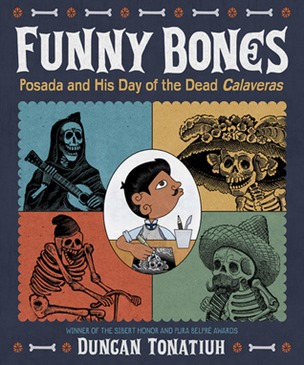
Review: Funny Bones by Duncan Tonatiuh

Funny Bones by Duncan Tonatiuh

Funny Bones: Posada and His Day of the Dead Calaveras by Duncan Tonatiuh (InfoSoup)

Award-winning author and illustrator, Tonatiuh brilliantly tells the story of Jose Guadalupe Posada. Called Lupe by his family, he showed artistic promise early in life. At age 18, he went to work in a print shop where he learned lithography and engraving. Lupe starting doing drawings for the small local paper, including political cartoons. Lupe eventually opened his own print shop and starting to create illustrations for books and pamphlets. After his shop was ruined in a flood, he moved with his family to Mexico City where he opened a new shop. Lupe began creating broadsides and that is where he started creating his calaveras or skeletons. Some have specific meanings while others are unknown, many of them make political commentary on Mexican society. Lupe was soon recognized for these prints more than any of the rest of his work. Posada continues to be known for these images thanks to other Mexican artists like Diego Rivera who investigated who had drawn the etchings.

Tonatiuh does a great job of telling the story of the full life of Posada while focusing on making it accessible to children and also making it a compelling tale. Readers will recognize some of the images in the book, creating a firm connection between the artist and the images. The story of Posada’s life is a mix of tragedy and accomplishment, rather like the images he created. The Author’s Note at the end of the book adds details to the story of Posada and his art.

Tonatiuh’s art is as unique and marvelous as ever. He uses his stylized characters, usually shown in profile. They have a wonderful folk-art feel to them and work very nicely with Posada’s own skeletons. His illustrations are a rich mix of collage and line drawings, mixing textures and colors very effectively.

A great book to share for Dia de Muertos or Day of the Dead, this will be a welcome addition to all public library collections, but particularly those serving Hispanic populations. Appropriate for ages 5-8.

Reviewed from library copy.

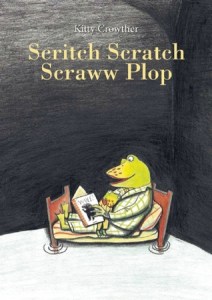
Review: Scritch Scratch Scraww Plop! by Kitty Crowther

Scritch Scratch Scraww Plop by Kitty Crowther

Scritch Scratch Scraww Plop! by Kitty Crowther

Jeremy doesn’t like the dark. So when bedtime comes, he is just fine as he gets ready for bed. He’s happy when his father reads him a bedtime story and his mother comes in for a final hug and kiss. But once he is left alone in the dark in bed, he hears something. It’s a “scritch scratch scraww plop” and Jeremy is fairly sure that it is some sort of monster in his room. He goes to tell his father, but his father just moves him back to bed. Eventually after being unable to sleep after several tries, Jeremy climbs in bed with his parents. His father can’t sleep then, and goes to sleep in Jeremy’s room. And that is when he hears a “scritch scratch scraww plop!” He heads back to get Jeremy and the two of them go outside together to figure out what is making that noise.

Crowther takes a universal situation of being scared of the dark and places a lovely natural twist at the end. The fact that Jeremy is not making up or imagining the scary noise he is hearing is central to the story. Reading this book aloud is a treat with the “scritch scratch scraww plop” offering a great opportunity to add a little shiver into the room. The design of the book is old-fashioned and warm. I immediately thought of Jeremy Fisher by Beatrix Potter when I opened the book. The clear celebration of nature at the end of the book is a strong way to finish on a high note.

Crowther’s art is done in discrete panels on each page adding to the vintage feel. The art itself is jaunty and friendly. The pools of water on the floor that make up their carpet is funny and the real darkness on the page done in black is deep and adds to the scary feel when Jeremy is alone.

This import from Belgium will be welcomed as a bedtime story for those who have their own monsters and scary noises to deal with at night. It may also invite exploration out into yards and gardens to discover what is making those noises. Appropriate for ages 3-5.

Reviewed from copy received from Enchanted Lion Books.

Review: Half a Creature from the Sea by David Almond

Half a Creature from the Sea by David Almond

Half a Creature from the Sea by David Almond

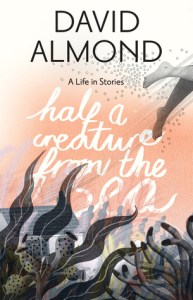
In a series of short stories, master author Almond takes readers back to the magical times of his childhood as well as our own. The stories are all set in the places that Almond grew up in. The stories range in topic, but each one offers glimpses of wonder and deep understanding. They also all speak to the power of stories in our lives, whether they are to reveal or to hide the truth. The eight stories in the book give us characters living normal yet extraordinary lives. There is the girl rejected by school and society who finds it easy to believe she comes from somewhere far away. There is the home with a monster hidden inside it where you can hear its noises if you put your ear on the wall outside. There are the boys who run miles and miles to swim in the sea on one perfect summer day. There are poltergeists mixed with soccer games, bullies mixed with heroes. It is a beautiful collection of stories which put together make up a glimpse of a world past that still is relevant in our modern one.

Almond’s writing is exceptional. This shorter form allows him to create little worlds of magic, astonishing moments of clarity, decisions that reverberate in the community. He invites us into his home, revealing in paragraphs before each story the way that the story ties to his childhood or to a place that is dear to him. It gives us a look at his process, a way to understand the fictionalizing of memories and the beauty of turning everyday into amazement. The fantasy elements are there, dancing under the cloak of faith but there still, explained but also not completely fictional. There is a delicacy to this writing and yet a robustness to the setting that work particularly well together.

One of the best short story collections I have read in a very long time, this collection is exceptional. Appropriate for ages 8-12.

Reviewed from ARC received from Candlewick Press.

Review: Waiting by Kevin Henkes

Waiting by Kevin Henkes

Waiting by Kevin Henkes (InfoSoup)

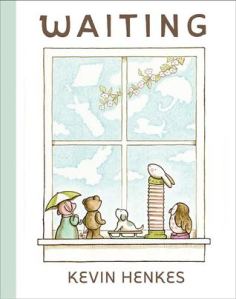
The award-winning Kevin Henkes returns with a new picture book about waiting. Five toys wait on a windowsill, looking outside. The owl waits for the moon, the pig waits for rain, the bear waits for wind, the dog waits for snow and the rabbit waits because he enjoys waiting and watching out the window. Seeing what they are waiting for makes each of them happy and so do new objects and visitors. Some visitors stay for only a short time while others stay longer. They all wait together. When a cat joins them, she too is waiting but for something very specific and it will be a wonderful surprise for everyone when it comes.

This is such a quiet and marvelous book. Do not read it expecting action and adventure, rather this is a book about waiting and patience. It is a book that shows the beauty of just being, of mindfulness, of acceptance of your day. Yet it is also a book about the tug of wanting and wishing, about time passing and about being friends in the most quiet and yet deep way. There is a silence about the book too that is compelling and superbly done. This is a philosophical book, one that quietly sneaks up on the reader how deep it actually is.

Henkes’ illustrations are done in a limited color palette. They have a quiet tone all their own in their pastels. The objects themselves have an old-fashioned feel, one of timelessness which is quite appropriate here. There are sections of the book done just in pictures, which allow the reader to see the relationships between the characters as well as the patience it takes to wait.

A gem of a picture book, this one is difficult to explain well but such a great read. Appropriate for ages 3-5.

Reviewed from library copy.

Review: I Am Yoga by Susan Verde

I Am Yoga by Susan Verde

I Am Yoga by Susan Verde, illustrated by Peter H. Reynolds (InfoSoup)

A girl explains how yoga helps her in her day. When she is feeling the world is moving too quickly and that her thoughts are racing, she uses yoga to slow her mind, stop her heart from racing, and make room for creativity and ideas. The book then moves into the girl doing yoga positions which she describes in terms of the way that they make her feel. They make her shine like a star, feel like she is dancing with the moon, seeing far and wide, and sailing on the sea. She also talks about what those moves do, like make her more focused, open her heart, and be more playful. Basically, it is a book that celebrates yoga and the many ways that it can impact your day and make you more mindful.

Verde’s words are ones of joy and cheer. She captures the zing of the busy day and the distractions that come with it. Then comes the centering and slowing and the yoga, that are quieter and even more joyful. The focus is on the beauty of those moments, the way they transform a person and the feeling that you are left with afterwards. The mindful piece is clearly there, though yoga and its movements takes center stage.

Reynolds uses simple images to convey the feelings of the various movements. Awash with watercolors, the line drawings glow on the page. Some pages have just one color while others have sunsets of oranges, yellows and purples. The use of the bright colors makes the book a rainbow to read, moving from one feeling to the next and guided by the colors themselves.

A vivid and lovely look at yoga and its power to transform, the book ends with a guide to the yoga positions seen in the book. Appropriate for ages 3-6.

Reviewed from library copy.