Review: All the Rage by Courtney Summers

All the Rage by Courtney Summers

All the Rage by Courtney Summers (InfoSoup)

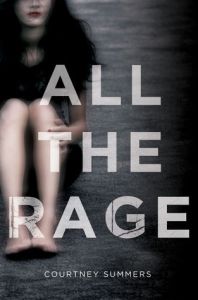
When Romy is raped at a party after having too much to drink, no one believes her that it happened. After all, she accused the sheriff’s oldest son and she’s the daughter of the town drunk. A year later, Romy has tried to put her life back together. She and her mother have moved in with her mother’s new boyfriend and her alcoholic father has left town. Romy works at a diner where no one knows about the scandal that she was involved in. But all is not good, she is bullied mercilessly at school for the “lie” that she told and she can’t trust anyone at her high school to have her back. Romance starts to bloom with the cook at the diner, a boy whom Romy is not sure she can trust and knows that she can’t let anyone at her hometown know about. As the annual senior party approaches, Romy knows she can’t attend but news that another girl may have been raped in a neighboring town sends her into a downward spiral, one that she may not survive.

This is one incredible read. The prose is beautiful, roaming and wild with a lusciousness that lingers in the mind. Summers makes the act of putting on finger polish and lipstick into one of battle paint and bravery. She also has a distinct feminist point of view that is a delight to read, one that shows the violence towards women and girls and rejects the notion that women are to be used and thrown away. She does that all by having a story where women are abused, raped, objectified and thrown away and where girls are called names, bullied and beaten. It is a story that is brutal in its fierce honesty and burning with anger at what we are allowing to happen to ourselves.

Romy is a spectacular heroine. She is a ball of ferocious pain, painted with makeup that allows her to control things, searching for a way to be a new person and finding it impossible to leave her anger and herself behind. Add to the appeal an African-American love interest where that is not the issue at the heart of the book. And a mother who is involved and cares deeply but is unable to save her daughter from the world they live in together. And a stepfather who is kind and lovely, disabled and disrespected. These people make up Romy’s family and heart. They hold her together when she cannot, though she fights to stand alone always.

A piercingly compelling read, this is a compelling feminist book that teenagers need to read to understand our society and what has to change. Appropriate for ages 15-18.

Reviewed from library copy.
Review: Poet by Don Tate

Poet by Don Tate

Poet: The Remarkable Story of George Moses Horton by Don Tate

Released September 1, 2015.

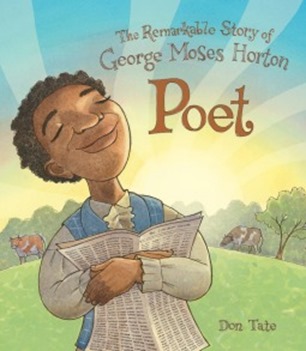
George’s family were slaves in North Carolina. Though he loved words, George was not allowed to learn to read. But he listened when the white children did their ABCs and then got himself an old spelling book along with a book from his mother and taught himself how to read. He read everything that he could find, but loved poems most of all. He spent his workdays composing poems in his head, though he didn’t know how to write them down. Soon after, his family was split apart and he was sent to live on another farm. He worked in the fields and was sent to Chapel Hill to sell fruit and vegetables to the students. While there, he started to share his poetry aloud. The students loved his words and helped him by giving him more books to read and paying him to write poems for them. He was also taught to write his poems down and soon had his writing published in newspapers. George could then negotiate with his master to pay him for his time away from the farm where he could write. As George created the best life he could while still living a slave, the country was changing and a war for freedom was about to be fought. It was a war that would free George finally and allow him to continue writing but this time a free man.

Tate captures the life and times of this remarkable man with a tone of wonder at times. What Horton managed to do in his lifetime under slavery is amazing and a sign of the quality of the words he wielded so well. As readers watch Horton grow up and then fight for his freedom in his own way, with words, they will be devastated when he continues to be a slave despite his best efforts. Even the work of others on his behalf could not get him free.

Tate’s illustrations are exceptional. One can see the yearning for education on Horton’s face as he watches the white children learn to read. Tate also makes sure that Horton’s image shines on the page. He is regularly lit from outside lights of candles and the sun, creating a light around him. The illustrations also show North Carolina in the mid-1800s and Chapel Hill in particular. Tate also incorporates some of Horton’s poems into the illustrations, allowing them to flow past visually.

This is a choice nonfiction picture book that shows the strength of one man, his intelligence and the power of his words. Appropriate for ages 6-8.

Reviewed from digital galley received from Peachtree Publishers and Netgalley.

Review: Sun and Moon by Lindsey Yankey

Sun and Moon by Lindsey Yankey

Sun and Moon by Lindsey Yankey (InfoSoup)

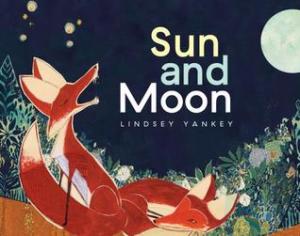
All Moon wanted was to spend just one day as the Sun. The Sun agreed with two conditions. The first was that their switch would not be for just one day, but it would be permanent. The second was that Moon had to spend one more night in the sky, and this time he had to spend his time really looking at the earth below. The Moon agreed though he expected to only see a sleepy earth below him. Instead though, he saw city lights, foxes getting ready to hunt, children dreaming, flowers blooming that only open at night, the stars around him, and much more. There were even fireworks in the sky and fireflies darting too. Will Moon still want to change spots with Sun?

Structured like a folktale, this picture book speaks to the importance of both day and night. And to the important role that both our sun and our moon play in the sky and for life on earth. Yankey makes sure to honor both of them, creating timeless moments that show the Moon just how beautiful night actually is.

Yankey shows the brilliance of the night in this picture book. First she shows the beauty of the daytime with her tigers lounging and bright flowers blooming. But the book truly comes to life as the pages turn dark midnight blue and the world gets filled with the light of the moon and stars. Some pages are filled with celebrations of dreams and the wonder of the forest at night while others are quiet and subtle.

A lovely bedtime read, this picture book celebrates nighttime and its beauty. Appropriate for ages 3-5.

Reviewed from library copy.

Review: I Will Never Get a Star on Mrs. Benson’s Blackboard by Jennifer K. Mann

I Will Never Get a Star on Mrs Bensons Blackboard by Jennifer Mann

I Will Never Get a Star on Mrs. Benson’s Blackboard by Jennifer K. Mann (InfoSoup)

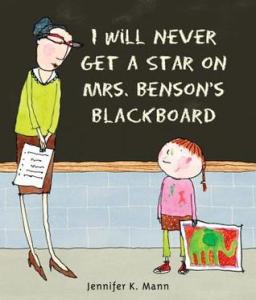
Mrs. Benson gives stars on her blackboard for things like spelling, neatness and raising your hand. Rose though, struggles with all of those things. Plus she isn’t good at math, her voice is too quiet for a star in reading, and she spilled snack on Mrs. Benson. Rose had been distracted by the artist who came to speak with them and dreaming of all of the things that she could create. At the end of the day, there was going to be a check for desk neatness, and Rose knew that she would never get a star for that. Mrs. Benson didn’t quite reach Rose’s desk that evening, so the next day Rose came in early and cleaned her desk. Then they got to make thank you cards for the artist who had visited, but doing art was messy and Rose undid all of her cleaning. At the same time, Rose had made an incredible card and who knows maybe art was a way that she could finally get that star!

Mann captures the pressure that a student who does not conform to classroom norms can feel. Rose desperately wants to do what is right, but none of the qualities that Mrs. Benson wants come easily or naturally to her. The presentation of someone to inspire her to do her best on something that she is definitely good at makes for a natural turning point in the book and allows Rose to continue to be herself all the way to the end. This is a celebration of artistic children who may lack in social graces but make up for it in boundless enthusiasm and creativity.

Mann’s illustrations make the book very kid-friendly as does the subject matter. The friendly round-headed characters are shown in a variety of ethnic backgrounds. Rose stands out in the illustrations with her bright-colored clothing and then the fact that at the artist presentation she is standing and listening rather than sitting. It all shows that she is a vibrant kid, filled with so much zing that it would be impossible to contain her.

A celebration of kids who don’t fit into classrooms easily, this picture book celebrates creativity and being yourself. Appropriate for ages 4-6.

Reviewed from library copy.

Review: I Yam a Donkey! by Cece Bell

I Yam a Donkey by Cece Bell

I Yam a Donkey! by Cece Bell (InfoSoup)

This silly little book is a read-aloud gem. A donkey declares on the cover “I yam a donkey!” But unfortunately, he’s speaking to a yam and a rather persnickety one at that. The yam can’t leave the donkey’s odd grammar alone, and tries to correct him, but that quickly devolves into a “Who’s on first” type of exchange where misunderstandings pile up and the silliness does too. When the yam finally manages to explain that he is not a donkey (as the donkey has been misunderstanding) but actually a yam and all of the other characters are also vegetables, the ending takes a deliciously dark turn.

Bell uses impeccable comedic timing to make this picture book work so well. The vaudeville like comedy works perfectly here, playing up the stodgy yam and the enthusiastically confused donkey. The two are divergent personalities and make for a book that is such a strong read aloud that you really can’t read it silently. It begs to be shared and done with exquisitely different and wild voices since it’s written entirely in dialogue.

Bell’s illustrations are large and funny. Again, the two characters are shown as very different and the donkey mistaken the rather wrinkly and orange yam as a donkey is made all the funnier thanks to the illustrations. The final twist is wonderful and will have children who are a little older than preschool enjoying the grammar jokes and the ending together.

Funny, wildly silly and completely satisfying, this picture book will work best with elementary aged children who will get the dark humor as well as the grammar jokes. Appropriate for ages 5-8.

Reviewed from library copy.

Review: The Day Everything Went Wrong by Moritz Petz

Day Everything Went Wrong by Moritz Petz

The Day Everything Went Wrong by Moritz Petz, illustrated by Amelie Jackowski

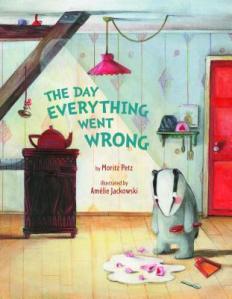
When Badger wakes up one morning, he decides that he is only going to do things that he enjoys that day. But as he tries to get out of bed, he knocks over his lamp. Still in a good mood, he sits down to breakfast and his cup falls off the table and breaks. After breakfast, he can’t find his colored pencils. When he tries to spend time in his yard, he trips on a shovel and falls down, hurting his knee. He decides that the day is really rotten and heads off to see his friends. As he visits them, each one is having a bad day. Badger manages to help each of them feel better about their day, fixing what he can. But he still isn’t having a great day himself when he heads back home to find all of his friends there to make his day better in return.

This Swiss import has a gentleness that permeates the entire picture book. Though Badger is having a very bad day, readers will know that it’s all going to be alright just from the tone of the book. Young readers will recognize things that frustrate them in their own days, toys not working right, being unable to find things, and breaking things accidentally. Badger does not react in anger at any of this, feeling more sad and disappointed as his great day changes to a rotten one. The example that helping others will help your own day improve is definitely something worth reading about.

Jackowski’s illustrations add to the gentle nature of the book. Badger’s home is filled with touches that make it warm and comfortable. The tea kettle is steaming, toast is right within reach, a garden is right outside the door, and there’s a ladder to reach a high branch. Heading out to see the other animals, they all have homes that are personalized but have that same sense of small details.

A book about bad moods and bad days but also how to brighten your day back up again. Appropriate for ages 3-5.

Reviewed from library copy.

Review: Orion and the Dark by Emma Yarlett

Orion and the Dark by Emma Yarlett

Orion and the Dark by Emma Yarlett (InfoSoup)

Orion is scared of a lot of things thanks to his big imagination, but the thing that he is most frightened of is the dark. He hates bedtime and spends the night watching for monsters and listening for scary noises. One night, he is so upset that he shouts at the dark to just go away! That’s when the Dark outside his window changed and became alive. It entered his room and Orion cautiously greeted him. Then the Dark invited Orion along on an adventure. First, the two explored the darkest and most frightening parts of Orion’s house together and it turned out that those places were a lot of fun. They faced the scary sounds in the darkness together and found out that they weren’t that frightening after all. Finally, they headed out into the darkest place of all, the night sky and there Orion discovered that not only wasn’t he scared of the Dark anymore, but they had become the best of friends.

Yarlett has written a dynamic picture book that does a lot to soothe fear of the dark. First, it turns the dark into a character who is warm, friendly and filled with stars. He’s also rounded and rather like a sparkling stuffed animal. There is certainly nothing to fear there. Then as they explore the dark places and noises together, readers and Orion realize that there is nothing to be afraid of there either. The ending of the book as they fly up into the night is magical and marvelous, offering another way to see the night.

The illustrations are done with plenty of humor. The paper switches as Orion thinks of things or plans to lined paper that makes it more like a school assignment. His ideas also show up in childlike crayon, including the fierce monsters that he imagines are in the closet. A couple of the pages have Dark’s arm as part of them, moving the arm makes the Dark shake hands with Orion, and really allows the Dark to greet the reader too.

Lovely illustrations that embrace the darkness of night combine with strong storytelling in this picture book that will have everyone wishing they too could make friends with the Dark. Appropriate for ages 3-5.

Reviewed from library copy.

Review: The Day the Crayons Came Home by Drew Daywalt

Day the Crayons Came Home by Drew Daywalt

The Day the Crayons Came Home by Drew Daywalt, illustrated by Oliver Jeffers (InfoSoup)

Released August 18, 2015.

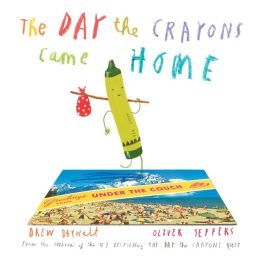
In this companion to the very popular The Day the Crayons Quit, Duncan receives several postcards in the mail, all sent from his crayons, this times ones that have been forgotten, left behind or run away. There is Maroon Crayon who was lost in the couch, broken in half and saved by Paperclip. There is Pea Green, who is aware that no one likes his color so he’s run away to see the world and renamed himself Esteban. Neon Red Crayon has been left behind on vacation and undertakes a long and arduous journey back home, getting his geography all mixed up along the way. There are crayons that melted together in the sun, ones that were eaten and puked up by the dog, ones stuck in sharpeners, left behind in basements, and put in the dryer. All of the crayons want to return home and Duncan has just the solution for them, no matter what condition they are in.

This second picture book about Duncan’s crayons has the same fabulous sense of humor as the first one. The crayons all have their own unique personalities. While the book moves from one crayon to the next in general, a couple of them return several times during the story. So readers get to see what happens when Esteban heads out into the world and also get to adventure along with Neon Red as he makes his long trek homeward. The entire book is merry and funny, filled with puns and jokes. Even the crayons in the worst condition are done with plenty of humor.

The illustrations by Jeffers add to the fun. Make sure to take the glow-in-the-dark crayon page into a dark room to see it glow. Jeffers’ asides by the crayons are wry and silly, creating small conversations outside of the postcard format.  As always, Jeffers’ illustrations are a treat with lots of personality, even with the characters being crayons.

A winning companion book for a popular read, this book is sure to please fans of the first and to find new fans who will happily discover both books. Appropriate for ages 4-6.

Reviewed from ARC received from Penguin Young Readers.

Review: Ask Me by Bernard Waber

Ask Me by Bernard Waber

Ask Me by Bernard Waber, illustrated by Suzy Lee (InfoSoup)

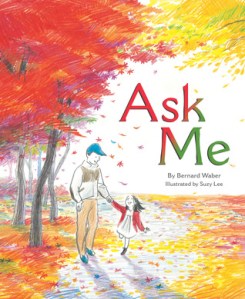
A little girl and her father take a walk through their neighborhood. Along the way, the girl asks her father to ask her questions like “Ask me what I like?” and he does, question after question. She finds a lot of nature along the walk to enjoy, from frogs to geese in the air and in the water, bugs, beetles, and flowers. She asks him to ask if she likes ice cream cones and they both happily walk away with cones after she announces how much she loves them. The two talk about trips they have taken together, favorite colors like the red balloon, stories, birds, and much more. Once back home, it’s time to think about her upcoming birthday and then time for bed.

Waber adeptly creates a realistic relationship between father and daughter here on the page. The use of her questions is particularly clever as it gives the book a repeating structure that feels natural and unforced. Parents will also recognize the way children want to be asked questions and have them answered. It is very effective to have this sort of relationship where the girl is saying what she wants out of their conversation and the father is happily agreeing. The entire day spent together is blissful and lovely and is entirely about their relationship with one another. Gorgeously structured and written.

Lee’s art is done in pencil. It dances along with gentle colors until suddenly fall bursts on the page. The deep rich colors don’t seem like pencil until you see the drawing lines on the page. The illustrations celebrate the closeness of this father and his daughter, playing with perspectives and celebrating their day outside in nature together.

Gorgeous illustrations and writing combine into one special picture book that is a dazzling book to share aloud. Appropriate for ages 4-6.

Reviewed from library copy.