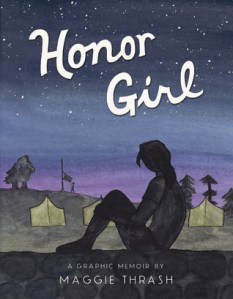
Review: Honor Girl by Maggie Thrash

Honor Girl by Maggie Thrash

Honor Girl by Maggie Thrash

Released September 8, 2015.

Maggie attends the same summer camp that her mother did and her grandmother did. Camp Bellflower for Girls is one of the oldest camps in the South, and nothing has changed there since it was founded in 1922. Maggie spends her summer with friends she made there previous years. She hates the tether she has to wear to keep herself from sleepwalking at night and she’s really into the Backstreet Boys. Maggie lies the rifle range and finds herself getting better at shooting at least when she can stop herself from thinking too much. That gets a lot harder when she notices Erin, a counselor in the younger girls’ camp. Maggie struggles with her feelings for Erin and though she tries to disguise what she is feeling, other girls at camp notice. Some are supportive while others think that it is very wrong. As Maggie’s summer plays out, she finds ways to deal with the pressure of the rifle range, an angry rival, and also to explore her sexuality.

Thrash’s memoir is told with a broad humor about Christian summer camp and how it feels to be a girl different from most of the others there. At the same time, the humor is never pointed and the girls around Maggie are supportive most of the time and in their own ways. Some want to protect Maggie from her crush, others want to just tease. Yet there is no hate here, which is very refreshing. Thrash also does a nice job of allowing a crush to play out, naturally and tantalizingly. Their feelings for one another are clear even as they themselves feel confused by them. The result is a book about the confusion of being a teen, the tensions of both friendships and attractions with the added dimension of being a lesbian. It is a beautifully done memoir.

Thrash’s book is in full color, but the advanced copy I received is in black and white only. Even with that limited color palette, the illustrations are clear and clever. The characters are unique on the page, which is not easy to do with a camp full of teen girls. Each has a distinguishing feature and it all works so that heroine, her crush, her rival, her friend and others are easily recognized. Throughout the entire book, a river of humor carries through and that same humor is evident in the illustrations. This is a book that could have been heavy and still is emotionally charged. The humor helps that be bearable and makes the book a great read.

A strong and important graphic memoir, this book belongs in every public library graphic novel collection for teens who will enjoy meeting such a strong protagonist. Appropriate for ages 12-14.

Reviewed from ARC received from Candlewick Press.
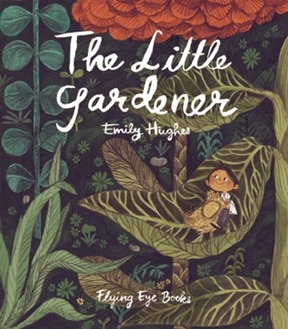
Review: The Little Gardner by Emily Hughes

The Little Gardener by Emily Hughes

The Little Gardener by Emily Hughes

The gardener loves his garden and he works hard in it, but he’s not that good at gardening. He feels often that he is too small for the job. He does manage to grow one tall red flower that gives him energy and hope. After working so hard, he knows that if something doesn’t change he will soon be out of food, out of a home, and no longer able to live in the garden he loves so much. He falls asleep, exhausted after making a wish that something will happen. Someone notices his flower in the garden and start to work. As the gardener sleeps, the people work on the garden, transforming it into flowers rather than weeds. The little gardener’s flower inspired them to make a change and in turn their work allowed him to live on as the gardener in the place he adores.

Told very simply, this picture book from the author of Wild is about a truly tiny gardener who is smaller than the weeds that he is battling. The writing is simple with a wonderful tone, very understated with the illustrations bringing the real truth to the reader. At the same time, there is a sense of wonder throughout the text that speaks to the power of wishes, the joy of being in just the right place for yourself, and the pleasure of a simple life.

Hughes’ illustrations are phenomenal. She captures the wildness of the weeds, the beauty of a single red flower rising above them, and then the bounty of a newly planted garden. She also captures the size of the little gardener, showing him to be almost fairy-like in his size, dwarfed and protected by the plants around him. That size allows Hughes to focus closely on the plants, creating a jungle out of the garden.

Beautifully illustrated and with a lovely look at a little life well lived, this picture book would be a great addition to gardening story times. Appropriate for ages 3-5.

Reviewed from digital galley received from Flying Eye Books.

Review: Binny in Secret by Hilary McKay

Binny in Secret by Hilary McKay

Binny in Secret by Hilary McKay (InfoSoup)

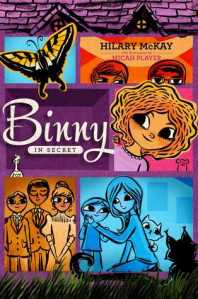
This second book in the series about Binny is another charmer. Binny has to start school in her new town now that summer is over. She doesn’t know anyone at all and the only child she has met she managed to knock into and spoil her mother’s birthday gifts while Binny was pursuing a butterfly. When a storm hits their small town, Binny and her family find that the roof of their house has caved in and they have to move to a rental house out in the country. At school, Binny is mercilessly bullied by the girl she knocked into and her friends. They call her “grockle” and make fun of the way she talks and acts. Binny finds herself taking solace in her family, helping her little brother James with his chickens. Then one of the chickens is taken by a “jagular” and Binny discovers a paw print that might lead her to figure out the puzzle of what animal took the hen. Tied together with Binny’s story is that of Clarry, a girl who lived in the house during World War I and who found herself drawn to the natural world in the same way that Binny does. It may just take the two of them together to solve the mysteries that Binny has discovered.

McKay has such a way of writing. It exudes warmth and humor. It’s rather like the cinnamon cake that appears in this book, something to be both savored and lingered over, but also one to be devoured with delight. If I could leave the house with a book like this tucked in my pocket to munch on each day, I’d be very happy indeed. The dual story lines of Binny and Clarry work particularly well. Clarry too is an intriguing character, a girl interested in an education in a time when that simply wasn’t done. Readers find out fairly soon in the book that Clarry lived to be 100 years old, but there are questions about how long others in her story lived which add to the mysteries of the book.

McKay creates characters who are their own people. There is Binny who is complicated both in the ones she loves and her own interests. She finds things on the fly and feels deeply about everything. Her younger brother James is also a delight. His way of greeting people, his vague general statements, his inquisitive nature. They all combine to one little boy with a huge personality. Clem, Binny’s older sister, has depths that are hinted at but not yet revealed. All of the characters are robust and personable. Those who seem one way upon first meeting them develop into intriguing full characters by the end of the book, and even the adults are treated this way.

Another wonderful read by the incredible Hilary McKay. I can’t wait to see what Binny gets up to next! Appropriate for ages 8-11.

Reviewed from copy received from Margaret K. McElderry Books.

Review: Wait by Antoinette Portis

Wait by Antoinette Portis

Wait by Antoinette Portis (InfoSoup)

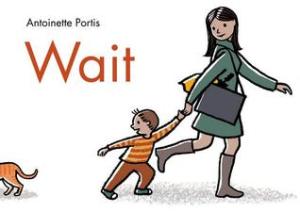
As a boy and his mother move through an urban setting rushing to get on the train, the little boy just wants to slow down and look at things. There are ducks to feed, an ice cream truck to linger near, a butterfly to try to touch, and much more. Each little item has the boy saying “wait” while the mother says “hurry.” It’s a dance that parents will immediately recognize. A rain storm has them hurrying to put on a raincoat. Just as the pair are about to catch their train successfully though, the rain ends and there is a rainbow that stops them both and has them waiting together.

This very simple book has only two words throughout: wait and hurry. It’s one of those books that will allow very young children to try to read it to themselves once they can identify the two words. Children and parents alike will also see their own morning rush in the book. While they may not catch a train, they will have to wear coats, try to get ice cream, and see neat animals almost every morning themselves.

Portis’ illustrations are friendly and large. Done with thick black lines with lots of texture using charcoal, pencil and ink, the illustrations perfectly capture the tug of slowing down with the need to hurry. The urban setting is done in the friendliest of ways and the various distractions are too. These are the merry things that slow toddlers and young children to a crawl even as time ticks away.

Toddlers will love this book about how important it is to stop and see the rainbows, the ducks, the butterflies, and everything else! Appropriate for ages 1-3.

Reviewed from copy received from Roaring Brook Press.

Review: Leo: A Ghost Story by Mac Barnett

Leo a Ghost Story by Mac Barnett

Leo: A Ghost Story by Mac Barnett, illustrated by Christian Robinson

Released August 25, 2015.

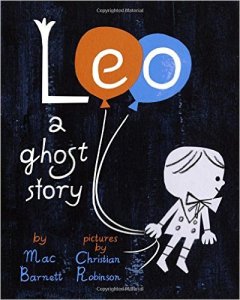
Leo has lived for a long time alone in his house. Most people can’t see Leo, because he’s a ghost, but if you are reading this book you are one of the special people who can see Leo. When a new family moves into the house, Leo tries to be welcoming by bringing them tea, but the family is frightened of the floating tray. After hearing how much they dislike him because he’s a ghost, Leo leaves his house and roams the city. He is invisible to everyone until he meets Jane, a little girl with a lot of imaginary friends. She thinks that Leo is just another of them and since Leo was so hated because he was a ghost, he doesn’t correct her. The two of them have a grand time playing together and she even gives him a sheet and pillow to sleep by his side. Leo is so happy that he can’t sleep. So he heads downstairs and that’s where he meets the robber who has entered Jane’s house. But what is an invisible ghost to do to stop a robber?

Barnett immediately invites readers into his world by allowing them to suddenly “see” Leo with the first page turn. It creates a real connection with the story and makes Leo all the more tangible to the reader. Barnett excels at creating a simple story but one that has strong implications to real life running throughout. This is a delight of a light ghost story, but it is also about acceptance, honesty and embracing who you really are.

Robinson’s illustrations are light hearted. Her art is done with acrylics and construction paper. Leo himself is see-through and rendered in what looks like crayon, making him very childlike and welcoming. While Leo is pale or completely transparent, the others are all rendered in deep blue construction paper except for the pale-skinned thief.

A book about acceptance and the power of a strong imagination, this picture book will be a welcome addition to Halloween story times. Appropriate for ages 4-6.

Reviewed from copy received from Chronicle Books.

Review: The Moon Is Going to Addy’s House by Ida Pearle

The Moon Is Going to Addy's House by Ida Pearle

The Moon Is Going to Addy’s House by Ida Pearle (InfoSoup)

When Addy’s play date is finished, she is taken home in a car by her father and mother. Her little sister is along for the ride too and the moon shines outside of their windows. It is sometimes high in the sky, other times low under a bridge. It follows them over a bridge, through the hills. It is sometimes so close that you would think you could catch it in your hands. The moon goes all the way to their home with them, waiting outside during their bath and then celebrates along with Addy during her nighttime dance. It’s even there when she finally goes to bed.

Pearle has written a poem to the moon, celebrating the way that it shines on all children from up above. She captures the way that the moon seems to shift positions as you drive, the joy of open windows and wind, and the peek-a-boo that the moon plays with clouds and objects. The text is simple and poetic, creating a mood of joy and universal pleasure in heading home at night.

The illustrations here are stunningly beautiful. Done in cut-paper collage, they are astonishing. Pearle captures the feel of a dog’s fur, the play of moonlight across large buildings, the deep purple of the night as it arrives. She also changes the color of the moon as the journey continues, allowing it to take over the final pages with its splendor.

This moonlit book is gorgeous and just right for a bedtime read. Appropriate for ages 3-5.

Reviewed from copy received from Dial Books.

Review: On the Shoulder of a Giant by Neil Christopher

On the Shoulder of a Giant by Neil Christopher

On the Shoulder of a Giant by Neil Christopher, illustrated by James Nelson (InfoSoup)

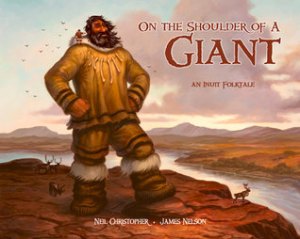
Based on a traditional Inuit folktale, this picture book shows what happens when a massive giant takes an interest in a small human. Inukpak was big even for a giant. When he walked across the land, he could easily step over rivers and wade the deepest lakes. He could cross the Arctic on foot in only a few days, fishing for whales along the coasts. Then one day he met a hunter, whom he mistook for a little child. Before the hunter knew what has happening, Inukpak had adoped him as a son and placed him on his shoulder. In just a few steps, they were so far from the hunter’s home that he didn’t know how to return. As Inukpak got them dinner in the form of a huge whale, he almost drowned the hunter just from the huge waves that splashed as he walked in the water. When a polar bear attacks the hunter, Inukpak just laughs and tosses it away. In time, the two became good friends, the giant and the hunter.

The stage is set very nicely for this story with an introduction that explains what stories the book is based on and how the author came to know so much about Arctic folklore. The pages after the story expand the topic of Arctic giants even further with explanations of different kinds of giants. The storyline is not as linear as European tales, allowing readers to get a sense of the giant and a different rhythm of storytelling at the same time. The huge and kind giant is full of appeal thanks to his huge sense of humor and the merry way he approaches life in the Arctic.

Nelson’s illustrations are playful and jolly as well. They show the various areas of the Arctic from the seashore to the more inland areas. The size difference between the giant and the human is kept fairly consistent throughout the book, This giant is much larger than most and that adds to the appeal as well. The natural landscapes of the book are thoughtfully done as are the various animals. The lifelike depictions of these elements make the giant all the more believable.

One huge giant and one little man create a great story together and one that can nicely be shared aloud. Appropriate for ages 5-8.

Reviewed from library copy.

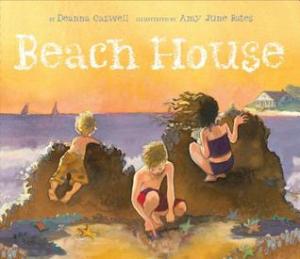
Review: Beach House by Deanna Caswell

Beach House by Deanna Caswell

Beach House by Deanna Caswell, illustrated by Amy June Bates (InfoSoup)

A family is headed to a beach house after waiting a year for summer to return. When they arrive it’s not time for the beach yet. The car has to be unloaded and things have to be unpacked. The kids make their beds, but can’t stop looking out the window at the waves and the beach. Then chores are done and it’s time to go! The family heads out to the beach where they spend the day in the water, building sandcastles, clam digging, chasing crabs and much more. In the evening, they have a campfire and roast hotdogs before heading inside for baths and bed. And one last moonlit look at the beach before falling asleep.

Caswell captures the beach and the sun and the water and sand in her rhyming couplets. It could be a sea, it could be a lake, it’s all about the experience of being near water and playing in waves. A day spent with family soaking in the sun and then being together still when the day is done. Families who have spent time together near the water will all recognize their days of sun and waves on these pages.

The illustrations shine with golden sand and dancing water. They are filled with the movement of the breeze at the beach, with the joy of the sun and the connection with family. One can almost smell the campfire smoke in the air or the ocean salt. The pictures here sing with freedom and long days spent together. The washes of watercolor that make the waves and the sky create a sense of timeless ease on the page.

A book of family connection and love that brings the glory of a beach vacation right off the page. Appropriate for ages 3-5.

Reviewed from copy received from Chronicle Books.

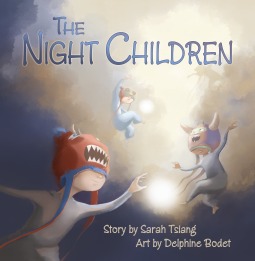
Review: The Night Children by Sarah Tsiang

Night Children by Sarah Tsiang

The Night Children by Sarah Tsiang, illustrated by Delphine Bodet

When night starts to come and replace daytime, you should run home quickly before the night children come out. They wear the shadows and chase the fireflies. They are the ones who etch the frost on your windows into delicate designs. They can be carried on the wind high above the rooftops and disappear when you try to glimpse them out your window. They scatter leaves on the yards and stretch webs across the doorways. They are the ones who steal parts of the moon each night too. But you, you awake at dawn just as they are disappearing. And you bring the light of the day with you. If you try hard too, you will see the last of the night children as you head off to school.

Tsiang’s prose here reads like poetry. She uses such strong imagery throughout that she creates a nighttime world filled with magical moments. In her gathering darkness “light spills in puddles on the pavement” and the leaves the night children scatter are “like toys on the lawn.” Each page has some special phrasing on it that adds to the wonder of this book. The writing is rich and surprising, just like the night itself.

Bodet’s illustrations take Tsiang’s imagery and brings it fully alive. The art is filled with a play of light and dark. The puddles of light glow on the pavement as actual puddles catch the last of the sun’s rays. Stolen pieces of the moon glow in small hands as the night children dance across the roof with their prize. When the day comes, the light is warm and bright, glowing on the page and filled with bright color. The night colors contrast with that, more rich and deep and mysterious.

A poetic and lovely book, this is a luminous bedtime story. Appropriate for ages 3-5.

Reviewed from digital galley received from Annick Press and Netgalley.