Review: Dory and the Real True Friend by Abby Hanlon

Dory and the Real True Friend
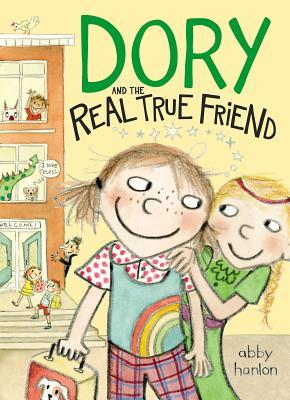
This is the second book featuring Dory, better known as Rascal by her family. In this book, Dory is headed to school. Her older siblings insist that she leave her best friend, Mary, who happens to be a monster that only Dory can see, at home. Dory agrees, since Mary had caused so much trouble at school the year before. Dory is going to try instead to be a regular girl and not get into trouble, but that’s not very easy when a new adventure comes her way. She also meets a girl in her class who appears to be a princess and talks about the castle she lives in and her pet dragon. Her siblings don’t believe that Rosabelle isn’t imaginary though. As Dory figures out that this may be a new real friend, thanks to their shared huge imaginations, she may also need help rescuing Mr. Nuggy, her fairy godmother, from the clutches of Mrs. Gobble Gracker.
I adored the first book in this series thanks to its embracing of a character who is wonderfully quirky and entirely unique. Dory is a girl with a huge imagination and also one who does not bow to social conventions easily. From wearing her nightgown all of the time at home to packing salami for lunch and then eating it like cookies, Dory does what makes her happy and doesn’t care for what others think. That is tested when she tries to befriend Rosabelle and while Dory works to make friends she still doesn’t change herself for it. Instead the two create a great synergy of imaginative play together where fairy godmothers with beards, evil sharp toothed women, dragons, monsters, and knights fight an amazing battle.
The illustrations are in the same style as the first book, drawn as if Dory herself was doing them as she tells her story. The entire book bursts with energy and funny moments. I particularly enjoyed seeing favorite characters from the first book return and the consistency of Dory’s imaginative play. While Dory may be entering a new year in school, all of the wild characters she invented in the first book are back in the second.
Fans of the first book will love this second one. Dory is exactly who I’d love as a friend! Appropriate for ages 6-8.
Reviewed from copy received from Dial Books.
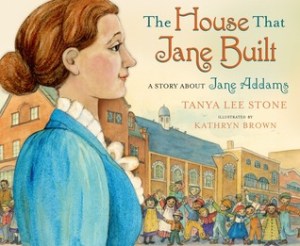
Review: The House That Jane Built by Tanya Lee Stone

House That Jane Built by Tanya Lee Stone

The House That Jane Built: A Story about Jane Addams by Tanya Lee Stone, illustrated by Kathryn Brown

Jane Addams was a girl born into comfort and wealth, but even as a child she noticed that not everyone lived like that. In a time when most women were not educated, Addams went to Seminary. When traveling with her friends in Europe she saw real poverty and then also saw a unique solution in London that she brought home with her. In Chicago, she started the first settlement house, a huge house that worked to help the poor right in the most destitute part of town. Hull House helped the poor find jobs and offered them resources. Addams also created a public bath which helped convince the city that more public baths were needed. She also found a way to have children play safely by creating the first public playground. Children were often home alone as their parents worked long hours, so she created before and after school programs for them to attend and even had evening classes for older students who had to work during the day. By the 1920s, Hull House as serving 9000 people a week! It had grown to several buildings and was the precursor to community centers.

Jane Addams was a remarkable woman. While this picture book biography looks specifically at Hull House, she also was active in the peace movement and labeled by the FBI as “the most dangerous woman in America.” In 1931, she became the first American woman to win the Nobel Peace Prize. She wrote hundreds of articles and eleven books, she worked for women’s suffrage, and was a founding member of both the ACLU and the NAACP. At the turn of the century she was one of the most famous women in the world. The beauty of her story is that she saw a need and met it with her own tenacity and resources. She asked others to contribute, but did not step back and just fund the efforts, instead keeping on working and living right in that part of Chicago. Her story is a message of hope and a tale of a life well lived in service to others.

Brown’s illustrations depict the neighborhood around Hull House in all of its gritty color. Laundry flies in the breeze, litter fills the alleys, and children are in patched clothes and often barefoot. Through both the illustrations and the text, readers will see the kindness of Jane Addams shining on the page. Her gentleness shows as does her determination to make a difference.

This biography is a glimpse of an incredible woman whose legacy lives on in the United States and will serve as inspiration for those children looking to make a difference in the world around them. Appropriate for ages 6-9.

Reviewed from copy received from Henry Holt and Co.

Review: Delicate Monsters by Stephanie Kuehn

Delicate Monsters by Stephanie Kuehn

Delicate Monsters by Stephanie Kuehn (InfoSoup)

Sadie has to return to her family home and public high school after being kicked out of her third boarding school in four years. Sadie can’t seem to keep out of trouble. It could be that she doesn’t care about anything much at all, and definitely not how other people feel. Though she is intrigued to see a boy she knew in her childhood again. Emerson has a deep crush on May, a girl that he lusts after longingly. When Sadie arrives back though, trouble follows and she witnesses Emerson do something that could ruin him entirely. Meanwhile Emerson’s younger brother Miles is struggling too. He has seizures and when he has one, he can see the future. He’s just had a vision of a dark future for himself and he shares that with Sadie. Now the three of them are entwined in a brutal future of their own making and possibly one they can’t escape, because Miles’ visions always come true.

Kuehn has written a very unique book here. First, she does not try to make any of these characters ones that you relate to easily or particularly like. In fact, they are all rather detestable. From the rich girl who doesn’t feel emotions about others to the two brothers who are filled with a powerful mix of self hatred and violence. The themes here are quite mature with sex scenes as well as violence. It is a book that is haunting and frightening and compulsively readable.

Kuehn has carefully set the scene for trouble with a mix of wealth and poverty that makes for sparks between characters but also destructive flames that will harm and hurt. She adds to that a vineyard where the three main characters spent a critical summer together and a series of reveals about the characters that are very disturbing. That slow peeling of the characters in front of the reader creates a blazing book that is a great read. The ending (which I will not spoil) will frustrate some readers and leave others very satisfied. For me, it was the perfect ending for a book like this.

A genre-bending read, this teen novel is part thriller, part mystery and entirely gripping. Appropriate for ages 16-18.

Reviewed from digital galley received from St. Martin’s Griffin and Edelweiss.

Review: George by Alex Gino

George by Alex Gino

George by Alex Gino

Released August 25, 2015.

George was born with the body of a boy but knows that she is really a girl. Her fourth grade classroom is doing a production of Charlotte’s Web and George wants to be Charlotte more than anything. But when she tries out for Charlotte instead of a boy’s part, George’s teacher stops her. George is offered the role of Wilbur, but that is not the character she wants to be since she’s not a boy! As George struggles with the bullies in her class, she also finds allies who embrace her gender. Once her best friend knows about her being transgender, she and George come up with a plan that will let George appear on stage as Charlotte after all. It will also let everyone know exactly who she is.

This book is so crucial. As the mother of a transgender teen, I know that she considered herself a girl from a very young age. Books like this will help young transgender children start to figure out what they are feeling inside and realize that they are not alone. The book focuses on a fourth grader, but trans children of all elementary ages will love this look at their struggles. I also must admit that I cried on page one. Gino does something I have not seen in other books about trans kids. He uses George’s given name combined with the gender pronouns she identifies with. That alone is so powerful and so important and so poignant. Another important moment comes later in the book when George’s best friend is helping her dress as a girl for the first time in public. Gino changes George’s name to her chosen female one once that happens. Another subtle but powerful statement about identity.

George herself is a beautiful protagonist. She represents so much of the struggle of trans kids and yet her own youth doesn’t get lost in the message. George is resilient, funny, and strong. I love the process of George’s mother in coming to terms with her daughter being transgender. It is so real, the denial, the rejection, and eventually the acceptance and importantly, looking for additional help. I also appreciated the school principal being the one who understands trans issues and offers a haven for George in the future. Another important piece in supporting trans kids in our communities.

Important and life-saving for some children, this book demonstrates the acceptance that trans kids need and the power of family and friendship. Appropriate for ages 8-11.

Reviewed from ARC received from Scholastic Press.

Review: The Tea Party in the Woods by Akiko Miyakoshi

Tea Party in the Woods by Akiko Miyakoshi

The Tea Party in the Woods by Akiko Miyakoshi

Released August 1, 2015.

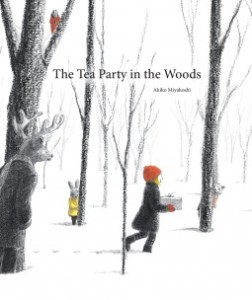
Snow has fallen and Kikko wants to help her father clear her grandmother’s walk. He has already left but forgot to take the pie for her grandmother, so Kikko follows his footprints through the snow. She can see him ahead of her when she falls and crushes the pie. Still, she picks it all back up and continues on her way. But her father is heading into a huge building that Kikko has never seen before. As she approaches, she looks in the window and sees that the man she has been following is actually a bear in a coat. A little lamb comes up to her and asks her inside to join the tea party. Kikko is the only human there in a room filled with forest creatures. She quickly is welcomed to their tea party and spends a splendid time with them. When the time comes to continue on her way to her grandmother’s house, the animals replace the crushed pie with one made from different pieces of their own pies. Kikko is soon at her grandmother’s house where they are clearly delighted with the unusual pie.

Miyakoshi has created a story that is pure magic. She takes the traditional Little Riding Hood story of a girl heading through the woods to her grandmother’s house and turns it upside down in a most pleasant and unusual way. Once readers see that she is with wild animals, they will expect the story to take a darker turn. Instead they will discover a book that gets ever friendlier and more welcoming, a book filled with the warmth of new-found friends.

The illustrations are done with touches of color brightening the charcoal and pencil illustrations. Kikko is set apart immediately with her bright yellow hair and red hat and mittens. She is a burst of color against the white and the darkness. The illustrations of the animals are particularly effective. They are realistic and yet the animals are dressed in human attire, making it a lovely and whimsical book.

Gentle and friendly, this twist on Little Red Riding Hood is enchanting. Appropriate for ages 4-6.

Reviewed from copy received from Kids Can Press.

Review: The Wren and the Sparrow by J Patrick Lewis

Wren and the Sparrow by J Patrick Lewis

The Wren and the Sparrow by J. Patrick Lewis, illustrated by Yevgenia Nayberg (InfoSoup)

This Holocaust story tells of an old man who weaved carpets on a loom and spent his evening singing to a hurdy-gurdy. His student, the Sparrow, learned at his side. The town in Poland was dark and dismal, all of its trees harvested for kindling. Food and clothes were rationed and even the music was starting to disappear. One day music was removed from the village as soldiers arrived to gather all of the musical instruments and take them away. Everyone had to give up their instruments, but the old man sang one final song before he put his hurdy-gurdy on the pile. And he would not stop singing, even as he was dragged away. That night, the Sparrow returned and took the hurdy-gurdy from the pile and hid it away. Then she too disappeared. It was found years later with a note that spoke of the bravery of both the Wren and the Sparrow and the importance of music in keeping spirits alive in dark times.

Based on the musicians who played in the Lodz Ghetto, a place that housed 230,000 Jewish people in 1940. Only 1000 survived the Holocaust that followed. Music was a part of their life and that celebration of music as a way of expressing feelings that could not be voiced is very clear in this picture book. Lewis writes with intense beauty in this book, the strong feelings showing in his sentences such as “The town shriveled up like a rose without rain.” And the image of “the gift of music soon dwindled to a sigh.” The entire book sings with prose like this, adding its own music to the story.

The illustrations by Nayberg, a native of Ukraine, show the darkness of the times. The illustrations swim with the colors of war, khaki ground and the gray of despair. When the instrument and music are present though, there is a glow and a warmth that shines in the illustration visually capturing the impact of the music on people around.

This allegorical tale captures the impact of the Nazi regime in Poland and elsewhere, offering a lesson about the power of music to carry hope in the darkest of times. Appropriate for ages 5-7.

Reviewed from copy received from Kar-Ben.

Review: The Night World by Mordicai Gerstein

Night World by Mordicai Gerstein

The Night World by Mordicai Gerstein (InfoSoup)

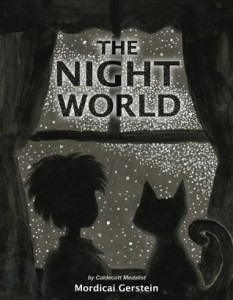
In the middle of the night darkness, a boy is woken by his cat who clearly wants to go outside. She leads him out of his room, through the dark house where everyone is asleep, even the fish. Then the cat speaks, saying that it is coming and it’s almost here. The two go outside where the grass is dewy, the air is warm, and the sky is filled stars. He can only see shadows everywhere. Some seem to be flowers and others seem to be animals who are also out at night, a deer, an owl, a porcupine and more. The birds start to call about it almost being here and slowly through the trees comes a glow. Dawn arrives. The animals depart off to sleep. And color floods away the shadows as the day shines into a glorious morning.

Gerstein has written a radiant picture book. He combines a mystery of what the cat is talking about that lengthens and deepens as the story unfolds. As the boy stands outside in the summer moments before dawn, there is a feeling of safety thanks to the animals gathered around him to witness the dawn too. There is immense pleasure is seeing the sun rise and that is captured vividly on these pages. From the hush and quiet splendor of the darkness to the dazzle of the day, this picture book is a perfect way to celebrate nature and each new start.

The illustrations are paramount here and they are immensely lovely. The dark pages in particular which are lit by the barest of lights, the deep blacks and greys of night are allowed to show their richness. The eyes of boy and cat light the darkness alone until outside where the stars in the sky join them as well, shining high above them. And the dawn that breaks so slowly over the horizon, first a glow and then becoming a full day with clouds, pastel colors and light.

A celebration of dawn, this picture book may just have early birds waking up to see the light break over their own dewy yards. Appropriate for ages 3-5.

Reviewed from library copy.

Review: Rufus the Writer by Elizabeth Bram

Rufus the Writer by Elizabeth Bram

Rufus the Writer by Elizabeth Bram, illustrated by Chuck Groenink (InfoSoup)

Released July 14, 2015.

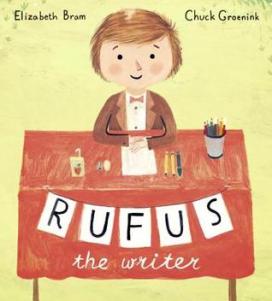
One summer Rufus decides not to have his regular lemonade stand. Instead he will do a story stand! So he gets all set up wtih plenty of paper, pencils, pens and markers. When Millie and her little brother Walter stop at the stand, Rufus agrees to write them a story in exchange for a special shell from the beach. The story is about Walter’s favorite color. Sandy stops by with a box of kittens and even though they are free, Rufus writes a story in exchange for the black kitten, a story about cats. Rufus is reminded that his little sister’s birthday is tomorrow and he knows that a story will be the best present. Sara stops by and asks for a story about buttons, so Rufus agrees in exchange for whatever Sara thinks it should be worth. All of his customers pick up their stories at the same time and sit right down to read and enjoy them.

This smart blend of lemonade stand and creativity makes for a book premise that is very engaging and fun. Particularly pleasant is the lack of focus on money as payment and instead allowing a warm and friendly bartering system in exchange for Rufus’ stories. The values make sense, paid in kittens, shells and flowers. Also great is the way that Rufus’ stories are each designed specifically for that reader, with their favorite color or via the subject matter. The stories are engaging and fun, just brief enough to give a flavor and not slow the main storyline down.

Groenink’s illustrations are done in gouache, acrylics and pencils with Adobe Photoshop. They are warm and bright, showing a friendly neighborhood with plenty of ethnic diversity in Rufus’ customers. They have a playful feel with the trees around Rufus’ stand done in a whimsical way and various woods animals peeking at what is going on. The illustrations in Rufus’ stories are drawn with fine details and show the coloring lines. They have the same quality and feel of the other pictures but also have a distinct style of their own.

A celebration of creativity and writing, this book may inspire children to find their own variations on lemonade stands or even try their hand at writing and illustrating their own stories. Appropriate for ages 4-6.

Reviewed from digital galley received from Schwartz & Wade and Edelweiss.

Review: The Curious World of Calpurnia Tate by Jacqueline Kelly

Curious World of Calpurnia Tate by Jacqueline Kelly

The Curious World of Calpurnia Tate by Jacqueline Kelly (InfoSoup)

Callie returns in triumphant fashion in this second Calpurnia Tate book following the Newbery Honor-winning first novel. Calpurnia continues to study science and nature at her grandfather’s side. Together they begin to dissect worms and insects, moving upwards towards vertebrates. Callie develops several scientific devices to measure latitude and barometric pressure. When the barometric pressure drops seriously low and an unusual gull shows up in the yard, Granddaddy heads to the telegraph office to sound the alarm for coastal areas, but there is little to do in places like Galveston Texas where tens of thousands of lives are lost. Meanwhile, Callie’s brother Travis is continuing to bring home stray animals like armadillos and raccoon, leaving Callie to help hide the evidence. Their cousin who survived the hurricane in Galveston comes to live with them, moving into Callie’s room and bearing secrets of her own. Through it all, Callie struggles with the expectations for girls around the turn of the century, trying to find a way forward towards education rather than marriage.

Kelly writes of science in a way that will have any reader eager to start looking at the writings of Charles Darwin, reading about health issues of cows and horses, dissecting their own grasshoppers, and heading outside to find the North Star. She turns it all into an adventure, filled with outdoor excursions, smelly animals, and rivers to explore. At the same time, it is also a look at the expectations of a girl from a good family and the difference between her future and that of her brothers. Callie’s struggle with this inequity speaks to her courage and her tenacity, two parts of her character that are evident throughout the book. This dual nature of the novel adds lots of depth to the story, allowing fans of nature and fans or strong heroines a shared novel to rejoice about.

Kelly’s characters are wonderfully well rounded. Callie is not perfect and is far more interesting and human for that. She is not patient, hates to play the piano and sew, and speaks up at times that would be unseemly. At the same time she is wonderfully wild, brazen at times, and heroic at others. She stands by those who support her and thwarts those who oppose her. She cunningly uses people’s self interests to promote her own and is constantly learning from those around her. Even the secondary characters are well drawn and have depth. From Granddaddy to Callie’s mother to her cousin Aggie, all can surprise because they are crafted as full human beings.

This romping novel is a fitting and fabulous follow-up to the first. Appropriate for ages 8-12.

Reviewed from copy received from Henry Holt and Co.