Review: I Don’t Like Koala by Sean Ferrell

I Don't Like Koala by Sean Ferrell

I Don’t Like Koala by Sean Ferrell, illustrated by Charles Santoso

When Adam opens his gift and discovers Koala inside, he is not pleased. After all, Koala is “the most terrible terrible.” He has bright yellow eyes that follow Adam around the room. So Adam decides that he must get rid of Koala, but it’s not that easy. Every night Adam puts Koala away in different places all over the house and happily goes to be alone. But when he wakes up, Koala is right there on his pillow, every morning. His parents think that he loves Koala, even though Adam tells them that he hates Koala. Then comes the day that Koala seems to have eaten Adams snack! So Adam hikes up into the forest and leaves Koala there. But Koala is waiting for him at home when he returns. One night though, frightening things loom in the dark and Koala is right there to protect Adam and make him feel safe. But someone else might just be being freaked out by Koala too.

Ferrell captures the creepiness and the appeal of strange stuffed animals. He creates a horror vibe that is just right for young readers with the way that Koala appears in bed in the morning and can’t be left behind anywhere. It’s a funny riff on scary movies, something that some special stuffed animals can evoke with ease. The parents don’t understand or step in to protect their son in the story at all, adding to that eerie feeling throughout that makes the book such fun.

Santoso creates the ultimate creepy stuffed animal in Koala, a strange beast who readers will also grow to love as the book progresses. The expressions on Adam’s face are priceless as he tries to explain why he hates Koala so very much and when he discovers Koala’s return again and again. The use of dark colors for both Koala and Adam unite them as a pair in the book even as Adam struggles to be separate. Santoso’s illustrations continue the dark eerie feel of the story.

An exceptionally dark picture book, this book is great fun and reads aloud well. Share it with children ready for a little fright with their stuffed animals. Appropriate for ages 4-6.

Reviewed from copy received from Atheneum Books for Young Readers.

Review: Sidewalk Flowers by JonArno Lawson

sidewalk flowers

Sidewalk Flowers by JoArno Lawson, illustrated by Sydney Smith

As she heads home with her father who is distracted by his cell phone call, a little girl dressed in vibrant red picks wild flowers. Along the way, she takes a moment to smell each of them, creating a bouquet of bright colored blooms. The flowers grow unnoticed by the others on the street in this urban setting, but the little girl spots them all growing out of sidewalk cracks. When the girl and her father reach the park, she notices a dead bird on the sidewalk and leaves some of the flowers there with the bird. A man sleeping on a park bench is given a sprig too. Then she decorates the collar of a friendly dog with more flowers. As they reach home, the little girl gives each of her family members flowers, leaving a trail of them on their hair and heads. The final flower is used to decorate her own hair at the very end.

This wordless picture book is immensely lovely. The story arc really works well and has moments of sophistication that create a vibrant urban world for this girl to live within. As she gathers the flowers, other beautiful parts of the city that would have been overlooked too light up with color or are captured in small moments. From the display of bright fruits in the market to the pigeons on the street, each small piece adds together so that readers “see” the beauty of the city along with the young protagonist.

The art is expressive and lovely. The city is shown in black and white against which the red girl pops like a bright ruby. Portions of the city are done in color, like flowered dresses and the small flowers that the girl gathers too. Then when the girl starts sharing her flowers, the entire world becomes colorful and bright. It is a dynamic shift in the middle of the book, showing the power of generosity and community.

Subtle and powerful, this picture book celebrates seeing the beauty in everyday life and sharing it with others. Appropriate for ages 3-5.

Reviewed from library copy.

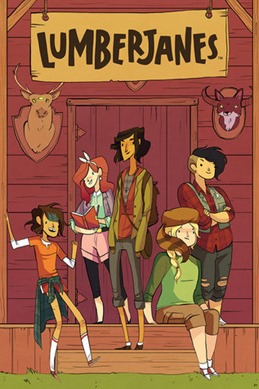
Review: Lumberjanes by Noelle Stevenson

lumberjanes

Lumberjanes by Noelle Stevenson, Grace Ellis, and illustrated by Brooke Allen

The Lumberjane scout camp is for “hardcore lady types” who celebrate “Friendship to the max!” Five friends are spending their summer together here and they are in for unexpected adventures as they earn their badges. When they head out to get their nighttime badge, they encounter the first of the supernatural monsters, a pack of three-eyed wolves. Luckily the friends, Jo, April, Mal, Molly and Ripley, are also elite fighters so they manage to defeat the wolves. Back at camp, their counselor marches them to the office for discipline, but the head of the camp seems more intrigued than surprised by their find. As the summer progresses, the girls face hipster yetis, polite boy campers with a dark side, stone statues that come to life, and plenty of traps. Summer camp has never been this full of wild creatures and epic battles, all done by a group of amazing girls.

I first heard about how wonderful this comic book was when it was not yet a graphic novel, and I am so thrilled that the first four comics have been turned into this novel that is perfect for libraries. I had high expectations for this comic and was still dazzled by it and rather twitchy to get my hands on the next one. The characters are phenomenally well done, each girl having her own distinct personality and style. Add in the delight of finding a budding lesbian love story and it’s pure magic. I love kick-ass heroines, and this series has FIVE to fall for.

The art is well done too with its own vibe. It has the friendly feel of a Telgemeier combined with more edge that make the battle scenes really work. There is plenty of action and humor to make the book race along. I love the addition of extra art at the end done in a variety of styles. It invites fans of the characters to draw them and create their own stories about these great girls.

This is a graphic novel to devour in one sitting and immediately turn to the beginning and start again. Pure girl-power perfection. Appropriate for ages 12-16.

Reviewed from library copy.

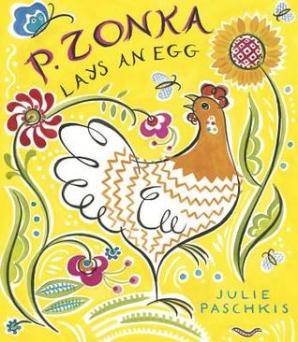
Review: P. Zonka Lays an Egg by Julie Paschkis

p zonka lays an egg

P. Zonka Lays an Egg by Julie Paschkis

P. Zonka isn’t like the other chickens on the farm. The other chickens lay eggs each and every day, but P. Zonka never lays a single egg. She’s busy walking around the farm noticing nature and the beauty of flowers and moss. The other hens call her lazy, but she doesn’t pay them any mind. Finally, after they cluck at her for a long time, P. Zonka agrees to try laying an egg. After clucking and delays, she lays an egg that isn’t anything like the brown and white eggs the other hens lay. P. Zonka’s egg is spectacular and shows in colors and design all of the beautiful things she has been seeing in nature. P. Zonka’s eggs are art, pure and simple.

Paschkis takes her inspiration from Ukrainian eggs designed with bright colors and intricate designs. A Ukrainian decorated egg is called a pysanka, giving P. Zonka her unique name. The story is written with the rhythm and structure of a traditional folktale. The complaining hens and rooster create the chorus of the book, the repetitive feature. This more formal structure contrasts wonderfully with P. Zonka’s daydreaming and wandering. Those parts of the book are filled with her descriptive words and the pacing shifts and changes.

Paschkis carries her Ukrainian inspiration directly into the art in the book, filling it with the colors and shapes of traditional art. The bright yellows, deep reds, clear blues and crisp greens echo the traditional art as do the sweeping lines and free flowing plants. Yet this is distinctly modern too with the lines having a looser feel and the animals feeling more life like.

This book is a winning blend of traditional and modern, folktale and new story. Appropriate for ages 4-6.

Reviewed from library copy.

Review: Ballet Cat: The Totally Secret Secret by Bob Shea

ballet cat

Ballet Cat: The Totally Secret Secret by Bob Shea

Released May 5, 2015.

Ballet Cat and Sparkles the Pony want to play together, but first they have to decide what to play. Sparkles has lots of ideas, like doing crafts, playing checkers and selling lemonade, but none of them work when Ballet Cat wants to be able to spin and leap and twirl. Very reluctantly, Sparkles offers to play ballet with her instead and Ballet Cat jumps at the opportunity. Sparkles though is not having a very good time. When Ballet Cat asks him what is wrong, Sparkles doesn’t want to say in case she won’t be friends with him any longer. Ballet Cat though has her own secret that she doesn’t want to tell Sparkles either. It will take one very brave pair of friends to share these secrets.

Shea has created a new series for beginning readers that is sure to appeal. Ballet Cat and Sparkles fill the page with humor that is broad but also wry and clever. It’s the perfect mix for young children navigating their own friendships. The best parts are when the characters are at odds with one another and when they state the obvious. It’s writing that reads as if small children were saying it without ever putting them down.

The art is pure Shea, dynamic and colorful. It is filled with action and activity and emotions too. Shea excels at showing emotions on his characters that are done strongly enough that small children will be able to understand immediately how a character is feeling. Sparkles in particular emotes clearly on the page, his body language and expressions showing exactly how he feels.

A strong new beginning reader series about friendship that is perfect for Elephant and Piggie fans. Appropriate for ages 3-5.

Reviewed from digital galley received from Disney-Hyperion and Netgalley.

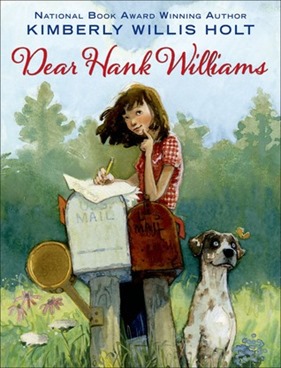
Review: Dear Hank Williams by Kimberly Willis Holt

dear hank williams

Dear Hank Williams by Kimberly Willis Holt

Tate’s class has been told that they are doing a pen pal project and they can either be assigned pen pals or pick them. Tate has just the right person to write to, Hank Williams, who is an emerging star in 1948. Tate tells him all about her life in Rippling Creek, Louisiana where she lives with her Uncle Jolly, Aunt Patty Cake and her little brother Frog. At first, Tate tells Hank Williams that her parents are well known and gone because of their work, her father as a photographer and her mother in the movies. But as she continues to write to them, she reveals the truth of her family life where her father has disappeared and her mother is doing time in jail. There is one final secret that Tate can’t face at all and it will take all of her courage to admit to it.

Holt writes a story of a girl who has concocted a life of dreams for herself. Tate is unfailingly positive about many things. Even when she talks about her mother being in prison, she focuses on the fact that her mother is in an elite singing group while there. Her life with her uncle and aunt is stable and lovely, filled with small moments that demonstrate their love for her, like finding a way to hear her mother sing on the radio and discovering just the right dog at just the right time.  Holt gives Tate all the time she needs to face her different truths. And the result is surprising and tender.

Tate is a marvelous character. She is quickly proven untrustworthy as she admits early in the novel to lying about her mother and father. Yet there is something so down-to-earth about her too that readers will somehow trust her despite all of this. Perhaps it is the details of her life that make that work, and the way that she hides truths even from herself. It is a delicate balance and one that Holt does very well.

Young readers will love this book for its heart and the beautiful spark of its main character. Appropriate for ages 8-11.

Reviewed from copy received from Henry Holt and Co.

Review: Sweep Up the Sun by Helen Frost

sweep up the sun

Sweep Up the Sun by Helen Frost and Rick Lieder (InfoSoup)

The pair who created Step Gently Out return with another gorgeous book connecting young readers to nature. This picture book focuses on birds and flight, using the metaphor to encourage young people to “fly” themselves and spread their own wings in life. The poem at the heart of the book is simple and lovely, creating a sense of wonder and opportunity. The photographs dynamically capture eleven species of birds in flight and in their natural habitats. There are wide-mouthed babies in the nest and incredible pictures of birds in full flight, like the one on the cover. This is a book that inspires both in words and images.

Frost is a gifted poet who has written novels in verse for older readers as well as picture books for younger readers. Her words here create a positive feeling of strength for the reader, showing them what is possible. At the same time, her poem is also beautifully written, creating imagery that is tangible and that will make sense for children. One of my favorites is that wings are “stitching earth to sky with invisible thread.”

Lieder’s photographs are simply stunning. He has captured birds in poses that are dramatic and amazing, leaving plenty of dappled light and green on the page for the poetry to shine next to his images. I found myself leaning into the book to look even more closely at the structure of wing and feather on the page.

I hope there will be more collaboration between these two since their first two books are so noteworthy. This vibrant picture book will be at home equally in units on birds and poetry. Appropriate for ages 5-8.

Reviewed from library copy.

Review: The World in a Second by Isabel Minhos Martins

world in a second

The World in a Second by Isabel Minhos Martins, illustrated by Bernardo Carvalho (InfoSoup)

This picture book explores time and the way that things happen all at once across the world. Small moments are captured from various countries: an elevator stuck in New York City, a horn honks in traffic in Mexico, a volcano erupts, a boy learns to balance on his bike. One after another these snapshots of time are happening all at once and yet also form a lovely series of events that are all entirely human and show how interrelated our world actually is.

The concept is at once immensely simple and also incredibly complex, the understanding that your own life is just one of many being lived at the very same time. Martins embraces that duality in the book, capturing those universal moments but also showing the diversity around the world. A guide at the end of the book includes a map of where the various events take place all at the same time. There is a distinct wonder to the book, a feeling that the world is both larger and smaller than it had seemed to be a second before.

Carvalho’s illustrations are bold and graphic. He uses thick black lines to create scenes that are active and beautiful. One page contrasts with the next, showing diverse people and settings. The result is a feeling of moving clearly from one place to the next with each turn of the page, from lush jungles to concrete settings, from bright sunlight to clouded evening.

Perfect to start discussions about time and place and even time zones, this picture book allows children to think in a bigger way about their world, diversity and their own place. Appropriate for ages 4-7.

Reviewed from copy received from Enchanted Lion Books.

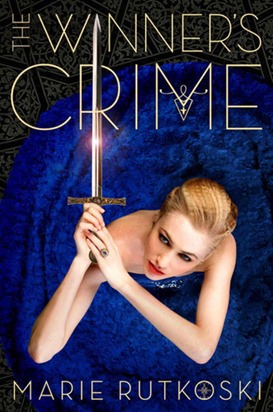
Review: The Winner’s Crime by Marie Rutkoski

winners crime

The Winner’s Crime by Marie Rutkoski (InfoSoup)

This second book in The Winner’s Trilogy continues the story of Kestrel and Arin. In a strategic choice, Kestrel has given herself into an engagement to the prince of Valoria, never revealing to Arin that she did so to save him and his country from destruction. Now Kestrel is in Valoria, being treated like a princess, but her heart is still with Arin. The emperor is impressed with his son’s new fiancé, and works to hone her into his pawn. But Kestrel has her own political plans that include continuing to try to help Arin from her new position. At the same time, she works to keep Arin at a distance so that he never finds out the sacrifice she is making. But this fragile set up cannot be maintained forever, something must give, and it may end in complete destruction for them all.

Rutkoski’s second book keeps the political thrills of the first and continues to stir in romance and deception. As with the first, the reader and Kestrel really don’t know who they can trust or even if they can trust anyone at all. As with any second book in a series, this book is as much a bridge to a conclusion as anything. Rutkoski plays nicely with pacing throughout the book, allowing things to maddeningly slow for the reader as Kestrel is caught in a trap of her own making. She picks the pace up at the end as tension mounts, creating a book that is captivating to read.

Kestrel is one strong female protagonist. She works against the entire society she lives in to try to set her own course and to be in charge of her own destiny, even if her heart calls for her to do something else. Arin too is a finely drawn character, a romantic figure who is also thoughtful and while he may realize that Kestrel is not telling him the truth cannot force her to give up her game. It’s a dance of two people against an empire, embroidered in romance and dazzling with political intrigue.

This strong second book in this series will have readers desperate to read the third and final book to find out what happens next. Appropriate for ages 14-17.

Reviewed from copy received from Farrar Straus and Giroux.