Review: Cuckoo Song by Frances Hardinge

cuckoo song

Cuckoo Song by Frances Hardinge

Triss wakes up feeling very strange, surrounded by her worried parents and a doctor. As she starts to feel better, she struggles to recognize even family members and her own home. Everything seems strange, even herself. At night, Triss finds herself ravenously hungry and eating windfall rotting apples off of the ground outside. Her younger sister Pen is terrified of her and her parents are worried. Cutting their vacation short, the family returns home but Triss doesn’t get any better. She does start to investigate other strange things happening at their home. There’s a desk drawer filled with letters from her dead brother that seem to be written after his death. There’s Pen making calls on the phone that leave no trace with the operator. Triss follows Pen to a strange movie theater where she discovers a man called The Architect who has made a dark deal with Pen with promises to save her family. Triss has to piece together her own role in what is happening to her family and see what she can do to save them all.

Hardinge writes with such strength and beauty. Her prose is lush and exquisite even in her descriptions. She manages to tell readers about the setting with details that expose the horrors happening right below the surface, the result is unsettling, eerie and gorgeous. Here is how she describes The Grimmer, a waterway that Triss was rescued from at the beginning of the book:

With every step the Grimmer grew closer and clearer, black as perdition and narrow as a half-closed eye…Over its waters the willows drooped their long hair, bucking in the gusts as if with sobs. Against the dark surface she could make out the white waterlily buds, like small hands reaching up from beneath the surface.

Readers know immediately that they are in a horror book, one that nods towards gothic but also stands firmly in faerie land too. At the heart of the book is Triss, a sickly girl with a younger sister who despises her. She focuses mostly on her own hunger, her own desires, but as things reveal themselves so does Triss’ real character and she grows into a gutsy and selfless heroine. The transformation is less about Triss changing and more about revealing what was already within her but hidden. It’s a book of slow reveals, layers being removed, truth being exposed. And it is vicious, dangerous and treacherous to the extreme. In other words, it’s a dazzling dark read.

Wild, terrible and hauntingly beautiful, this children’s fantasy novel is a delight thanks to its dark heart and strikingly unique heroine. Appropriate for ages 10-13.

Reviewed from ARC received from Amulet Books.

Review: Feet Go to Sleep by Barbara Bottner

Feet Go to Sleep by Barbara Bottner

Feet Go to Sleep by Barbara Bottner, illustrated by Maggie Smith

In a house on the beach, Fiona doesn’t want to go to sleep. She’s had such an amazing day that she doesn’t want it to end! But she is just a little tired after all that they’ve done. As she climbs into bed, she starts with her toes, telling them to go to sleep. She tells her feet next, remembering how they loved stomping in the waves. Then come her knees that had held her strong on the sand as she build a castle. Her legs are the next to go to sleep, after spending the day running. Her tummy ate lots of berries during the day and goes to sleep too. Fiona works her way all the way up to her ears, eyes and mouth, until finally her mind is quiet enough to sleep.

With a proven technique, Bottner demonstrates a way that children can calm themselves at bedtime by both taking control of their body and mind but also celebrating the day that they have had. The book shows the technique clearly rather that teaching it to the adult separately. This approach to bedtime is simple and calming, creating moments where child and parent can share what they found joy in during their busy day. Fiona’s mother stays with her for most of the process, but leaves as Fiona finishes on her own, shutting her ears and eyes to the activity around her and drifting gracefully off to sleep.

Smith’s illustrations use an inset image to show in the large portion of the picture the grand and sunny day that Fiona has experienced and then in a smaller and darker image Fiona putting a body part to sleep that matches the activity of the larger picture. The book shines with the joy of a beach vacation captured in all of its wild colors and sun. Yet at the same time it is an immensely soothing book with its focus on quiet and calm.

A bedtime book that just might result in actual sleep! This picture book shows a different way for parents to approach bedtime wiggles. Appropriate for ages 3-5.

Reviewed from digital copy received from Edelweiss and Knopf Books for Young Readers.

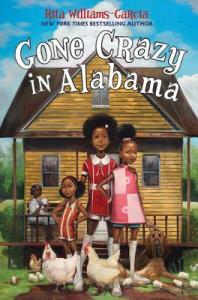
Review: Gone Crazy in Alabama by Rita Williams-Garcia

Gone Crazy in Alabama by Rita Williams Garcia

Gone Crazy in Alabama by Rita Williams-Garcia (InfoSoup)

The third and final book in the Gaither Sisters trilogy is just as delightful as the first two. Delphine, Vonetta and Fern travel south to Alabama to spend the summer with their grandmother and great-grandmother, Big Ma and Ma Charles. After living in Brooklyn, they are surprised at how slow life is in the country with no stores to visit and little to do to pass the time. Their cousin JimmyTrotter lives on the other side of the creek with Miss Trotter who is the half sister of Ma Charles. But the two sisters don’t speak at all except in messages that the children carry back and forth across the creek. The Gaither sisters learn about their extended family and all of the sorts of people that are part of their heritage, including Native Americans and white people. Delphine is just as hard on Vonetta as she always is, but it may be too much when Vonetta runs away from home. When tragedy strikes, it is up to Delphine to rethink the way that she interacts with her sisters, even when they drive her crazy.

Throughout the trilogy, Williams-Garcia has used these books to offer young readers a glimpse at the lives of African-American people in different parts of the country as well as the discrimination they face. This third book celebrates the various parts of African-American history, including some lesser known pieces like Native Americans owning and selling slaves. Here we also see the KKK and the mixed heritage of some of the more hateful people in a community.

Rippling through these more serious parts of the book are the personalities of all of the characters from the three sisters at its heart to their extended family. There are moments of hilarity mixed into it, creating a book that is a pleasure to read but also has a solidity to it thanks to its clear ties to real history. The dynamics of the sisters and their families is also captured in a realistic and loving way. Themes such as forgiveness, anger and family commitments are all part of this gorgeous read.

Readers who loved the first two books will adore this southern country ending to the series, though we will all mourn not being able to join these three sisters in more adventures. Appropriate for ages 9-12.

Reviewed from library copy.

Review: Unusual Chickens for the Exceptional Poultry Farmer by Kelly Jones

unusual chickens for the exceptional poultry farmer

Unusual Chickens for the Exceptional Poultry Farmer by Kelly Jones, illustrated by Katie Kath (InfoSoup)

Released May 12, 2015.

Sophie has just moved to a farm they inherited from her great-uncle. Sophie’s father hunts for a job while her mother shuts herself in a room to write articles in order to pay the bills. Sophie’s father also works on the farm, trying to figure out how to care for the grapes and how to start the tractor. Sophie discovers a flyer in the barn about exceptional chickens from Redwood Farm Supply. She wants to start raising chickens herself and starts to write letters not only to Redwood Farm Supply, but to her dead Great-Uncle Jim and her deceased Abuelita. Soon Sophie discovers a small house on the farm and then a little white chicken with a grumpy attitude appears. Sophie has a chicken of her own! But a lady shows up and wants to steal the chicken just as Sophie is realizing that this is definitely one of those “exceptional” chickens from Redwood Farm Supply. It is up to Sophie to keep her chicken safe from the chicken thief and also discover what happened to the rest of her great-uncle’s flock of amazing birds.

Jones has inventively mixed magical realism with farming and chickens in this children’s novel. Sophie mentions several times in the book that there are not many other brown-skinned people around their new home. Then her letters to her Abuelita show her own Hispanic heritage in a way that is natural and organic. The book is rich with the wonder of figuring out how to care for all chickens, but it also tingles with the mystery of Redwood Farm Supply, who Agnes actually is, and why she can’t type well at all. Then when the amazing chickens arrive in the story, it’s a treat to see each breed of bird explained but also how their natural traits are heightened into super powers.

Sophie is a great main character. She’s a girl who is not afraid of the hard and dirty work of a farm and caring for chickens. She is lonely and isolated in their new home, partly due to her absent but also helicopter parents who over protect her. While there is plenty of magic in the book, the story also has down-to-earth elements that keep it grounded, including the slow process of making new friends, the pressures of a family low on money, and the satisfaction of hard work paying off.

A delightful mix of magical chickens and farm life, this book will appeal to fantasy readers but also to kids wanting more realistic fiction too. Appropriate for ages 9-12.

Reviewed from digital galley received from Knopf Books for Young Readers and Edelweiss.

Review: This Is Sadie by Sara O’Leary

This Is Sadie by Sara OLeary

This Is Sadie by Sara O’Leary, illustrated by Julie Morstad

Released May 12, 2015.

Sadie can take a cardboard box and make it into a ship where she looks for land, but not too hard. She can sail all the way around her room before breakfast. Sadie loves to spend time with her friends, whether in real life or in books. She has pretended to be all sorts of things from mermaids to wild boys raised by wolves. She can be Alice in Wonderland or a hero on a horse. She can even have wings, almost invisible ones but they can still take her flying. She fills her days with imagination, play and reading. What could be better?

O’Leary captures the wonder of a child’s imagination in this gorgeous picture book. Right from the beginning the tone is light and playful, inviting the reader to see the world as Sadie does. Perhaps they have wings too? Adults do not appear in the book at all, giving the entire story to Sadie and her imagination. They are referred to in passing, but that’s about it. The book whirls with ideas, all gathered together from heroes to wings to undersea adventures, we are riding along with Sadie in each of her imaginary places. It’s a confectionery of creativity.

Morstad’s illustrations are done in gouache and watercolor. They fully embrace the worlds that Sadie envisions, bringing them into full color vibrancy on the page. The book changes from the imaginative worlds to Sadie’s room and reality, but each are just as winningly portrayed as the other. Her room has lovely touches like a mushroom lamp, beds for stuffed animals, and a chair piled high with books.

An invitation to come and play is clear in this imaginative picture book that will dazzle readers. Appropriate for ages 3-5.

Reviewed from digital galley received from NetGalley and Tundra Books.

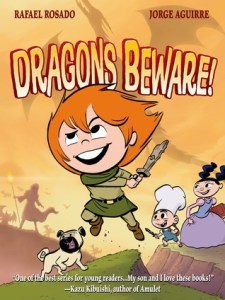
Review: Dragons Beware! by Jorge Aguirre

Dragons Beware by Jorge Aguirre

Dragons Beware! by Jorge Aguirre, illustrated by Rafael Rosado

Released May 12, 2015.

Join Claudette on her second quest as a warrior. This time it is Claudette’s father who heads out alone into battle, attempting to get his sword back from the dragon who swallowed it along with his legs and one of his arms. But Claudette is determined not to be left behind in town and heads off with just her dog with her. Her best friend Marie and her little brother Gaston join her a little later. Together they are all captured by the evil wizard Grombach and his army of stone gargoyles. Grombach has encased the entire town army in amber, using his ability to turn things to stone. When he is distracted by the Apple Hag, the children rescue people along with the Apple Hag who in turn is the one who finds the Gaston could be a magic user. The children continue on toward to dragon’s lair, managing to sneak past the dragon’s offspring and deep within the mountain. There they discover Claudette’s father trapped by the dragon and set out to rescue him. But it will take more than the power of the sword and fighting to get them out alive.

I adore Claudette, a girl who wants to be a warrior and never shrinks away from any battle no matter how outnumbered she is. She is entirely herself, proud to be the girl she is. At the same time, I love that she has Marie as her counterpoint. Marie is a girl who loves pretty dresses and worries about her hair, but she too heads into battle in her own distinct way, this time with diplomacy. Then there is Gaston, the boy who loves to cook but also wants to make his father proud so he’s working on warrior skills like creating swords. He’s not very good at it.

These three protagonists make this book a marvelous adventure. It is filled with their large personalities, laugh-out-loud funny puns and one-liners, and lots and lots of adventure, danger and battles. Claudette’s father fights despite being in a wheelchair and characters of all colors appear in the story. This is a celebration of diversity on the page thanks to the art by Rosado which ranges from completely silly to blazing fight scenes.

A very strong female protagonist is the center of these books and she will thrill children with her bravery. Appropriate for ages 8-11.

Reviewed from digital galley received from Edelweiss and First Second.

Review: Challenger Deep by Neal Shusterman

challenger deep

Challenger Deep by Neal Shusterman (InfoSoup)

The Captain is always watching, constantly there, even before the ship. Caden knows the Captain well and knows enough to both respect and fear him. As he spends more time on the ship, he also gets close to the parrot who is working to plot against the Captain and bring Caden onto his side. But at times the ship fades away and reality comes back to Caden. He realizes that he’s pushing friends away and becoming more and more alone in his life. He’s always been popular and had plenty of friends but his new oddness and the strange way his mind is working keeps them at a distance. As the ship approaches the deepest part of the ocean, others join the crew, teens who have their own roles on the ship, those who navigate and those who look into the future. As Caden begins to get the treatment he needs for the voices in his head, these are revealed as the other patients around him. Caden has to journey across the dark sea alone, figure out who is on his side, and hopefully come out the other side alive. It’s a journey through a mind that is fighting an internal chemical battle against itself but it is also a journey of brilliance and beauty.

Shusterman writes from experience about the impact a mentally-ill teen can have on a family. His own son battles mental illness and the illustrations throughout the novel are ones that his son did as he got treatment. The book is raw and stunning in its depiction of the vivid world that schizophrenia can create, the voices making sense in this alternate reality of captains, parrots, ships and crewmen. There are moments of breathtaking clarity, where the deception is swept clear and the reader sees what had been clouded before. It is in these moments that the power of mental illness is striking and blazing bright. And then the clouds descend again and the fiction takes over the brain.

Shusterman writes a brave story here, one that doesn’t try to explain the fictions of the mind, but instead allows readers to ride the waves of paranoia and delusion along with Caden. Caden himself is a character that is so caught up in the throes of mental illness that one realizes that the battle all along has been for himself and his own survival. Shusterman plays with perspective, changing the narration from first person to second person and back again. It’s disarming and wild, something that readers may not notice at first, except as a strange jarring that slowly builds. It’s a very smart use of perspective, creating its own jittery feel for the reader.

A journey through mental illness, this book for teens speaks to the hope that treatment brings but also the hard work that it takes to leave the world of the mind behind and enter reality again. Appropriate for ages 13-16.

Reviewed from digital galley received from Edelweiss and HarperCollins.

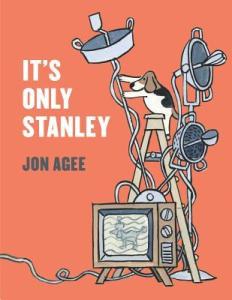
Review: It’s Only Stanley by Jon Agee

Its Only Stanley by Jon Agee

It’s Only Stanley by Jon Agee (InfoSoup)

Something odd is happening tonight in the Wimbledon house. There are mysterious noises. The first noise is Stanley the dog howling at the moon. But then new noises start. The clanking noise is Stanley fixing the oil tank in the basement. A little later, the funky smell that makes the cat ill turns out to be Stanley cooking catfish stew in the kitchen. The buzzing noise is Stanley fixing the family’s old TV in the living room. Splashing noises are Stanley fixing the plumbing. Each noise wakes up the human family and the father has to head out to see what is happening. But just as everyone is starting to get very cranky from loss of sleep, something happens that shows exactly what Stanley has actually been up to all night.

Agee is a master at creating understated books that have a distinctive feel about them. Here he takes a strong matter-of-fact tone and uses it to add to the silliness of the entire book. Told in natural-feeling rhyme, the book has a buoyant tone that makes it great fun to share aloud. Throughout the book the father heads out each time without much emotion and returns to report that it is just Stanley and what the dog is up to. The oblivious family heads back to bed only to be awoken again and again. This builds wonderful tension until it’s released with a literal bang.

Agee’s art is done in his unique style with flat color and thick black lines. Throughout, readers will be able to watch for clues as to what Stanley is actually up to and readers who are paying close attention will figure it out before the family does. Even those children who don’t piece together the clues will want to re-read the story to notice them. Also keep an eye on the cat who seems to always get into the worst of it as the story progresses.

Not a bedtime story despite being set at night, this picture book is strikingly funny and has a grand warped feeling throughout. Appropriate for ages 4-6.

Reviewed from copy received from Dial Books.

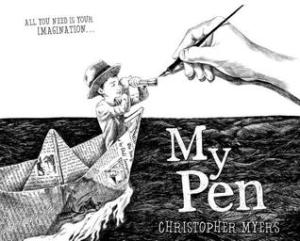
Review: My Pen by Christopher Myers

my pen

My Pen by Christopher Myers (InfoSoup)

A new picture book from an award-winning illustrator which shows the power of art in a child’s life. Using powerful sketches, the book talks about the freedom and self-esteem that comes from creating art. Myers also speaks to the importance of imagination and creativity, showing an elephant in a teacup and the protagonist riding a dinosaur. He plays with different perspectives and plays the simplicity of ink and pen art against the complexity of world problems that art also speaks to. Even mistakes and errors are embraced along the way, showing children that the goal is not perfection but the experience of creation.

Beautifully written and illustrated, this picture book is a compelling look at creativity and art. The words in the book demonstrate the various aspects of art, showing a playfulness throughout but also allowing moments of gravity and seriousness as well. The book ends with an encouragement to the reader to pick up a pen and see what worlds they discover inside it.

The real focus of this picture book is the art, which is incredibly beautiful. Done in pen, of course, the art is detailed and distinctive. The boy’s face is expressive throughout, as he takes imaginary travels and as he responds to making mistakes on the page. Thanks to the creative subject, one is never sure what is going to be revealed on the next page. With art of this quality, it’s a delight to turn the pages and discover each new image.

Share this with art teachers or in units that encourage creativity. Then have pens ready for children to create their own art on the page, blots and all. Appropriate for ages 4-6.

Reviewed from library copy.