Review: Sweetest Kulu by Celina Kalluk

sweetest kulu

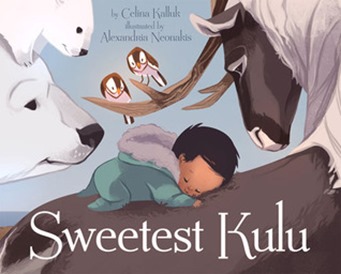
Sweetest Kulu by Celina Kalluk, illustrated by Alexandria Neonakis

Kulu has just been born and is being welcomed by the world.  Kulu is Inuit and as the world comes to welcome the baby, traditional Inuit beliefs are shown in the story.  It is the Arctic summer, so the first to welcome Kulu is Smiling Sun, who stays bright all through the night.  The Wind arrives and teaches Kulu the importance of listening closely.  Then the animals start arriving.  These are not your normal animals, but ones that are specifically from the Arctic and of importance to the Inuit.  With each animal comes a blessing:  the Snow Bunting reminds Kulu to always believe in himself, Fox tells Kulu to get out of bed as soon as you wake and to help anyone who needs it.  The entire book sings with a connection to nature, to this specific region of the earth, and for the love of a baby.

Kalluk, who is an Inuit throat singer, has beautifully captured the values of her people in this picture book.  It is done so organically and naturally that many will not realize that this is more than a sweet picture book.  The fact that it also weaves in traditions and values of the Inuit makes the book all the more special and noteworthy.  Kalluk writes very lyrically, creating moments for each of the animals that are unique to them which keeps the book from becoming repetitious.

The illustrations have a lovely cartoon quality to them, one can almost see them leaping to life from the page.  The large animals dwarf little Kulu by their bulk, but the tenderness they all feel for this tiny baby shines on the page.  There is a respect between human and animal that is warm and tangible too.

A gorgeous and meaningful book welcoming a baby to the world, this picture book is unique and special.  Appropriate for ages 1-3.

Reviewed from ARC received from Inhabit and Myrick Marketing.
Review: And Two Boys Booed by Judith Viorst

and two boys booed

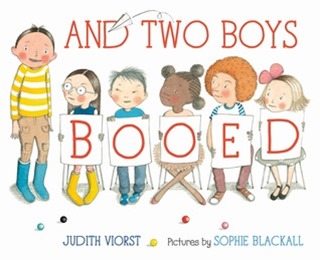
And Two Boys Booed by Judith Viorst, illustrated by Sophie Blackall

From the author of Alexander and the Terrible, Horrible, No Good, Very Bad Day comes a new book all about overcoming stage fright.  A boy is performing in a talent show and knows that he is ready to sing his song because he’s been practicing and practicing it.  Plus, he also has on his lucky blue books and his pants with lots of pockets.  He is very confident until the other five children start performing their acts.  Then his mood changes, even though he still says that is he fine.  The story uses repetition that mirrors the child’s internal dialogue about his lucky pants, the pockets, and how much he has practiced, adding another line about each child’s performance and it all leading up to his.  When his turn finally comes, he is almost unable to stand up, much alone sing and two boys boo him from the crowd.  But in a final burst of determination, the boy stands and his brain starts to make sense again, and he sings.  And two boys booed, but the rest of the children cheered!

Viorst takes a universal fear of both children and adults and turns it into a very engaging picture book.  I love the modern setting of the book paired with the timeless use of a story that repeats again and again, building through the story.  It matches the nerves that the boy is feeling and creates a wonderful tension as each new person gets up to perform.  Adding in the booing children is brilliant, because that is what most of us fear, the negative reaction of the crowd.  But in the book that happens, the boy faces it and continues his performance. 

Blackall’s illustrations clearly show the boy’s emotions even as he bravely continues to repeat to himself that it is all OK.  He looks directly at the reader, conveying his surprise at feeling nervous and pulling his striped shirt higher and higher in an attempt to hide.  Blackall has incorporated a lift-the-flap component into her illustrations allowing us to peek into the boy’s pocket and at the end of the book the effect is used to propel the entire story forward in a creative way.

A smart and very human picture book about performance, nervousness and overcoming it all.  This would be a perfect book to share with children about to do a show.  Appropriate for ages 5-7.

Reviewed from copy received from Farrar, Straus and Giroux.

Review: The Unfinished Life of Addison Stone by Adele Griffin

unfinished life of addison stone

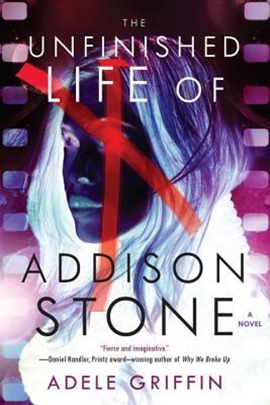
The Unfinished Life of Addison Stone by Adele Griffin

A unique and blazing novel of the life and death of a young artist, this novel for teens brilliantly captures the rise and fall of a legend.  Even as a little girl, Addison was a gifted artist who impressed teachers and won contests.  As she grew into a teenager, her family life grew more complicated and her mental health more fragile.  Addison began to hear voices, particularly a young woman named Ida who was a ghost in her grandparent’s home.  But Ida would not let go of Addison, even when she returned home and Addison was eventually hospitalized and treated for schizophrenia.  Through it all though, Addison created art, art good enough to get her noticed in a city like New York where she moved after high school.  Addison had “it” that combination of charisma and talent that quickly got her noticed.  It got her an agent, rich boyfriends, friends in the art world, and moved her further into chaos.  But in the end, the question is what killed her?  Which of her boyfriends took her life as she created a final work of art? 

This piece of fiction is stupendous.  It reads so realistically that one might even begin to search Addison’s name of Google to see more of her work or watch the video of her swinging on the chandelier.  The use of photographs is brilliant.  Weaving Addison firmly into the story through art and photos.  The art is also a fascinating component.  Meant to be worthy of attention from the biggest galleries in the world, the art is luminous on the page, and bravely done.  It forms a short lifetime of work, showing in a way that words could not the talent that was lost.

Griffin uses a structure of interviews with those who knew Addison.  This includes her parents, her friends from high school, boy friends, art critics, and many more.  Done any other way, this book would not have worked.  Written with such skill, the interviews are elegantly done, never taking a straight look at Addison, but instead a wonderful wandering one that is typical of documentaries.  It also works because we get to see Addison through other characters’ eyes, through the lenses of love, envy, desire.  In the end the different voices create a death chorus for Addison, sung in a beautiful harmony.

Wow, just wow.  This is an incredible work of fiction where the author captures just the right tone and format to take fiction to a new level and create reality fiction in a new and amazing way.  Appropriate for ages 15-18.

Reviewed from library copy.

Review: Chik Chak Shabbat by Mara Rockliff

chik chak shabbat

Chik Chak Shabbat by Mara Rockliff, illustrated by Kyrsten Brooker

Every Saturday, the residents of one apartment building spend the day smelling marvelous smells drifting down from the 5th floor.  And every Saturday evening, everyone gathers on the 5th floor for Goldie’s cholent, a traditional Jewish stew.  But then one Saturday, there was no wonderful smell and when little Lali Omar went up the stairs, she found that Goldie was too sick to get the cholent cooking and it was too late to start the slow-cooking stew.  All is not lost though, as the neighbors look through their own pantries and refrigerators and create a Saturday meal that is not cholent but has many of the same ingredients incorporated into foods from their own personal heritages.  There is Korean barley tea, tomato pizza, potato curry, and beans and rice. 

Rockliff’s Shabbat tale is an amazingly diverse story.  While it follows Jewish traditions in the beginning, including Goldie sharing memories as a little girl of Shabbat with her extended family, the magic comes when Goldie gets ill.  Not only does the reader quickly realize how important this shared meal and time is for the entire building, but suddenly the heritage of each person is shown through their food.  It’s a clever way to show community and diversity in a single situation.

Brooker’s illustrations combine cut paper art with rich thick paint.  The result is the same winning combination of dishes served at the community Shabbat table.  The different textures and colors come together to be something more than their individual parts, creating a dynamic world.

Celebrating community, this book shows how diverse people can come together in friendship and harmony to save the day.  Appropriate for ages 4-6.

Reviewed from library copy.

Review: I Am Jazz by Jessica Herthel

i am jazz

I Am Jazz by Jessica Herthel & Jazz Jennings, illustrated by Shelagh McNicholas

Told in the first person, Jazz explains to readers her favorite things like the color pink, dancing, singing, makeup and mermaids.  She talks about her best friends Samantha and Casey and what they do together.  Then Jazz talks about how she is different than the girls she is friends with.  Jazz was born a boy but has a girl brain.  She explains that she is transgender and then talks about how she has been this way since she was a very little child.  Readers will see her family come to terms with Jazz being transgender and the support she got from them and the school she attends.  The end touches on bullying, but that is not the focus of this book.  It is a positive and personal look at being a transgender child.

Written by Herthel and Jazz herself, this book takes the right tone about the subject from the first page.  First, it establishes firmly that Jazz is a girl.  It is only after that that readers are told that she is transgender.  That topic is handled in a very matter-of-fact way and the book does not delve into issues of genitals, hormones or treatments of any kind.  It is kept right at the correct level so that this can be used with children who are transgender themselves or have a transgender sibling or classmate. 

McNicholas’ illustrations keep Jazz merrily feminine throughout.  When depicting Jazz as a little boy as a younger child, the illustrations manage without anything overt to show how out-of-place Jazz feels in those clothes and that hair.  It is gently framed, but clear in the pictures that Jazz is much happier living as a girl.

A great pick for classrooms or schools with transgender children, this is also a book that parents will appreciate having at their library.  Appropriate for ages 4-7.

Reviewed from copy received from Dial.

Review: The Storm Whale by Benji Davies

storm whale

The Storm Whale by Benji Davies

Noi lives with his father in a house by the sea with six cats.  Every day, his father goes out fishing, leaving Noi alone all day long.  One day, after a big storm, Noi sees something out on the beach.  It’s a baby whale.  Noi knows it will not live long without water, so he takes the whale home and puts it in the bathtub.  He spends time with the whale, telling it stories.  But he also worries that his father will be angry when he finds a whale in the house.  So Noi tries to keep the whale a secret from his father, but it doesn’t last for long.  A whale is a big secret to keep in a small family.  Together, the two of them return the whale to the sea, but not before they each learn something about one another and how to move forward as a stronger family.

Davies manages to tell a profound story using minimal words.  The text in the book mainly explains the action that is happening.  It does not offer insight into the emotions of the characters.  That is a large part of the power of this book.  So much goes unsaid but is clear to the reader.  Noi’s loneliness is shown rather than told.  Him lingering by the window as his father leaves, the fact that he brings the whale home across a stretch of beach rather than pushing him back into the nearby water.  Even the father’s reaction is shown this way, allowing the emotions to be realized rather than explained.

The illustrations tell much of the story here, but again in a quiet and frank manner.  The emotions are not broadcast from the character’s faces but from their situations and their body language.  It’s a brave way to tell a story about a father and son reconnecting with one another.

Adeptly conceived and powerful, this picture book speaks to loneliness and family, and would be great as a discussion book for young children about emotions.  Appropriate for ages 3-5.

Reviewed from copy received from Henry Holt and Co.

Review: Draw! by Raúl Colón

draw

Draw! by Raúl Colón

In this wordless picture book, Colón recreates his love of drawing as a child and the way that it could take him to new places.  Here a boy is sitting on his bed looking at a book about Africa.  He sets the book aside and picks up his drawing pad and a pencil.  Soon readers can see the images in his head as he puts them on paper.  The boy is transported directly to Africa, setting up his drawing easel in front of each of the different animals of Africa.  The elephant is first and after seeing his picture gives the boy a ride to met the zebras.  The book moves from one animal to the next, the boy changing how he approaches them according to what animal it is.  Until finally a group of monkeys make a picture of the boy.  Readers and the boy return to his bedroom, now littered with all of the drawings of the animals.

This book nicely captures without using any words at all the transformative power of art and creativity.  It beautifully shows how art can transport you to a different place and time, moving you into the flow of creating a work.  It also demonstrates how inspiration can strike and the flow of creativity can overtake you in the best possible way.

Colón’s illustrations are done in pen, ink, watercolors and pencil.  They move from line drawings with pastel tones of real life to a more lush and rich color and style when we are inside the boy’s imagination.  Colón uses lines on these more colorful pages to give texture and movement to the image.  They are illustrations that invite you to walk right into them.

Imagination, creativity and art come together in this book to transport readers right into Africa.  Now it’s time to get out your own pencils and see where they will take you.  Appropriate for ages 4-6.

Reviewed from copy received from Simon & Schuster.

Review: Rabbi Benjamin’s Buttons by Alice B. McGinty

rabbi benjamins buttons

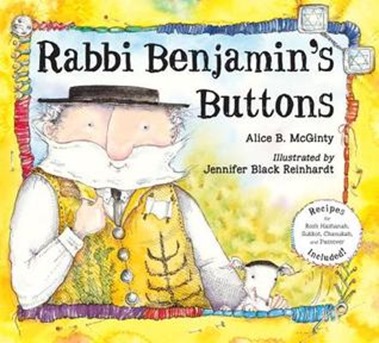
Rabbi Benjamin’s Buttons by Alice B. McGinty, illustrated by Jennifer Black Reinhardt

In the fall, the congregation gave Rabbi Benjamin a vest in honor of the new year.  It was yellow with four bright silver buttons down the front and it was a perfect fit.  Rabbi Benjamin wore his vest to celebrate Rosh Hashanah, which also involved a lot of food.  Each family offered their own special food for the holiday, and Rabbi Benjamin’s vest was a lot tighter by the end.  During Sukkot, Rabbi visited each of the families and again had lots of food and his vest grew even tighter.  Until on the last day of Sukkot, one of the silver buttons popped right off his vest.  Chanukah came and Rabbi Benjamin ate lots of latke, and he lost a second silver button.  Spring came along with Passover, and the rabbi lost the last two buttons that had tried to stretch across his growing belly.  He was very upset about how he had ruined his special vest.  So he changed a few things.  He got out and moved more along with his congregation.  And when he tried on the vest for Rosh Hashanah, it was far too big to wear.  But don’t worry, Rabbi Benjamin had a loving congregation ready to help him again.

This book has a wonderful radiance about it.  The heart of the book is really the love felt between the congregation and Rabbi Benjamin.  He is unfailingly kind and giving as are they, perhaps a bit too giving when it comes to the food!  At the same time, the story is a smart and very enjoyable way for readers to learn about the various Jewish holidays throughout the year and the traditions associated with them.  The book has an index of the holidays at the end, including recipes for each holiday.  There is also a glossary of Jewish words.

Reinhardt’s illustrations also capture the loving community on the page.  Rabbi Benjamin almost glows on each page, not only due to his shining yellow vest but also with his popping and vibrant personality.  The diverse ethnicities of the congregation is also appreciated.

A cheery look at Jewish holidays and the bounty of friendship and community, this book will be appreciated by people of all faiths.  Appropriate for ages 4-6.

Reviewed from library copy.

Review: Wildlife by Fiona Wood

wildlife

Wildlife by Fiona Wood

Set in Australia, this teen novel features the first person voices of two sixteen-year-old girls experiencing a semester in a school wilderness camp.  Sib has been in this school for a long time, so it surprises everyone, including herself, when she is selected as a model for a billboard and modeling campaign.  Suddenly instead of ignoring her, everyone is paying attention to her.  That includes Ben Capaldi, the cutest and most popular boy in school.  Sib has no idea how to deal with this new interest, but her best friend is very willing to guide her, perhaps too willing.  Lou is a new girl in school and is recovering from the loss of her boyfriend in an accident a year ago.  She has no interest in joining into school life or making new friends.  Instead she wants to be left alone, connect with her old friends, grieve and try to figure a way out of her extra counseling sessions.  But even as she walls herself away from the others at school, she finds herself getting drawn into the drama and life happening around her.  This story of two very different and equally compelling young women dives deep into romance, sexuality and friendship.

Wood has made recent news through her frank depiction of teen female sexuality.  This book stands out clearly with its positive but also nuanced and honest look at one girl’s first sexual experience.  With moments of humor throughout, the sex is shown with lots of heat, tons of desire, and then reality as well.  In the end, the character decides what is right for her, not what is right for all teens, but there is no shaming, no despair, no regret, just decisions going forward.  This is sex as teen girls experience it, done with intelligence and care.

The reason the sex in the book works so well is that Wood has created two main characters who are themselves intelligent, caring and fascinating.  Sib is dealing with suddenly breaking the role that she had been cast in, and being thrust into popularity for something that she sees no value in, modeling.  It’s a deft combination of feminism and pop culture.  She also has a manipulative best friend, a character who is beautifully drawn and one that readers will adore to dislike.  Lou too is a complex character with her grief but also her growing interest in those around her.  Her internal voice is wonderfully wry and funny, showing a spirit and intensity well before she reveals it to the world around her. 

Set in a clever parent-free wilderness setting, this book is smart, funny and just what fans of Rainbow Rowell are looking for.  Appropriate for ages 14-18.

Reviewed from library copy.