Review: Sleep Tight, Little Bear by Britta Teckentrup

sleep tight little bear

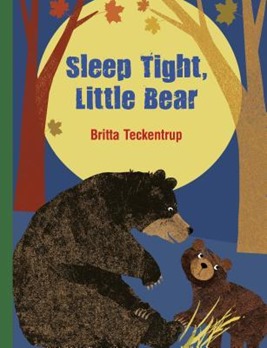
Sleep Tight, Little Bear by Britta Teckentrup

Winter is coming and Little Bear and Mommy Bear have been getting their den ready for the cold weather.  Soon it will be time for them to hibernate for the winter and wake up again when the warmth of spring comes.  Little Bear is excited about hibernating, but before he and his mother go to sleep, he has to say goodbye to all of his friends.  Little Bear goes to each animal, wishing them a good winter and they all wish him a good sleep and promising to watch over him as he rests.  As they return to their den, the snow is starting to fall and the winds are blowing cold.  Inside their den, it is warm and cozy and Little Bear is fast asleep before he can even finish saying goodnight to his mother.

First published in Germany, Teckentrup’s picture book celebrates community and diversity without ever using those words on the page.  It is clear throughout the entire book that the bear family is beloved in the woods.  While some of the animals, like Owl, are not so friendly, the others are warmly affectionate to Little Bear.  Many of the animals speak about watching over and taking care of the bears as they hibernate.  They also speak about how different the bears are from them and sometimes briefly say what they will do in the winter.  The messages are subtle and woven into this story about animals.

The illustrations are a strong mix of textured trees and animals and more simple elements that allow the textures to stand out on the page.  One of the first pages in the book shows the entire forest as well as the animals that the bears will be visiting before they hibernate.  It’s almost a map to the story and offer a peek into what will come.

A book about a friendly community of animals, this picture book is perfect for reading on chilly autumn evenings and ideal for a bedtime read.  It will also be a welcome addition to seasonal story times and units on hibernation.  Appropriate for ages 3-5.

Reviewed from e-galley received from NorthSouth and NetGalley.
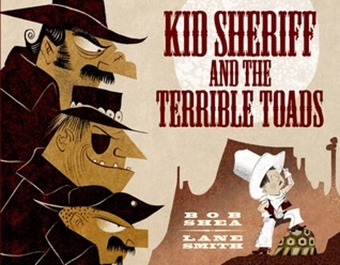
Review: Kid Sheriff and the Terrible Toads by Bob Shea

kid sheriff and the terrible toads

Kid Sheriff and the Terrible Toads by Bob Shea, illustrated by Lane Smith

The Toad brothers have taken over Drywater Gulch and are causing no end of trouble.  But then a new sheriff arrives in town, a kid in a white suit riding a tortoise.  He doesn’t have many skills with guns and has an early bedtime, but he does know all about dinosaurs.  He is hired on the spot.  And that’s right when the Toad brothers blow up the bank, rob the stagecoach, and jump someone’s gold claim.  The sheriff is quick to point out how each of the escapades involved dinosaurs, T-Rex and velociraptors.  It seems that the crimes will never be solved by this young sheriff, but soon his paleontological plans turn out to be just what was needed to capture some human bandits.

Shea clearly has great fun creating these characters, this town and this world of dinosaurs mixed with the Wild West.  He plays with language throughout, creating wonderful moments where the new sheriff rides – very slowly – into town on his tortoise.  Just the way the Toad brothers are introduced early in the book will show how fun this book is to read aloud:  “Why, those Toad brothers would steal your gold, kiss your cattle, and insult your chili.  Hootin’, hollarin’, and cussin’ all the while.”  You can’t read that without a drawl and huge grin.

Smith’s illustrations are equally fun.  Using a palette of browns, blacks and tans, he creates the world of Drywater Gulch on the page.  There is a great sandiness and grit to the illustrations, and he also plays with perspective and fascinating rock formations of the desert.  The wild characters are placed in this world, popping on the page against the gritty backgrounds.

A great read aloud, this picture book is silliness through and through with a western twang.  Appropriate for ages 4-7.

Reviewed from copy received from Roaring Brook Press.

Review: Ben Franklin’s Big Splash by Barb Rosenstock

ben franklins big splash

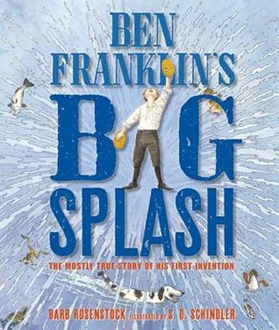
Ben Franklin’s Big Splash: The Mostly True Story of His First Invention by Barb Rosenstock, illustrated by S. D. Schindler

Ben Franklin grew up the son of a soap maker and loved to spend his free time on summer days swimming in the river near his home.  In the time of his childhood, people just did not swim or wash regularly because they thought it would make you sick, so Ben was considered rather odd for the amount of time he spent in the water.  As he swam, Ben started to wonder why it was that fish swim so much better than he could.  And so Ben starts to come up with inventions that would help him swim like a fish.  First, he made swim fins for his hands out of wood and they did make him much faster, but they also made his wrists sore and tired.  The next invention was swim sandals, but they didn’t improve things much since they slid off his feet.  But Ben was not a quitter and so he took each defeat as a way to improve his idea.  After all, he was a scientist through and through.

Rosenstock sets just the right playful and rather silly tone with this biographical picture book.  She includes plenty of details about the society in the 1700s and how it was different from our modern one.  Using different fonts and repeating words, she also emphasizes the importance of trial and error in science and solving problems.  She also ties in the fact that this is how science works and how scientists learn things, along with a healthy dose of dedication and resolve.

The illustrations by Schindler are marvelous, cleverly covering up the more private parts of the naked swimming boy with splashes and waves.  They have a light-hearted quality to them and also a visual lightness that makes the book even funnier as they swim across the page.

A book to inspire children to try to solve problems they discover, this is a fresh and summery look at a boy genius at play.  Appropriate for ages 5-8.

Reviewed from library copy.

Review: Gabriel Finley & the Raven’s Riddle by George Hagen

gabriel finley and the ravens riddle

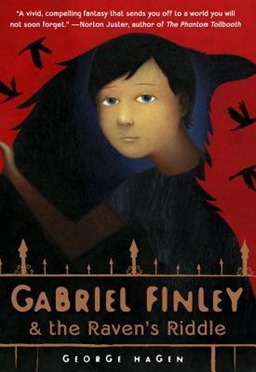
Gabriel Finley & the Raven’s Riddle by George Hagen

Gabriel is a 12-year-old who loves riddles, he collects them and loves puzzling over them, just like his father did.  But his father has disappeared, leaving Gabriel behind in the care of his loving aunt.  Outside the house, Gabriel is unaware of the raven’s nest and the little raven growing up in it.  Paladin is a special raven though, one that is destined to have a magical bond with Gabriel, but only if he can survive the attacks upon him.  Owls hunt ravens for food, but worse are the valravens, creatures who serve Corax, a half-man, half-raven.  As Gabriel learns more about his father and his family’s special relationship with ravens, he is drawn into a quest that will lead him and his friends into the underground world of Aviopolis to confront Corax and save his father.

Inventive and unique, this middle-grade fantasy novel is something special.  Gabriel is an interesting protagonist, cautious with the friends he makes and living in a world where magic is suddenly part of his life.  He adapts quickly but believably to what is happening and responds with bravery but also curiosity.  He and his friends have a variety of skills, and they all nicely come into play during their adventures.  There are other characters who may be friends or not, they are written with a wonderful ambiguity that is allowed to be unresolved for a long time, adding richness to the tale.

Hagen has added a lot of depth to her novel with his creation of a raven society where they test one another to see if they are valravens with riddles.  Valravens don’t care for humor, so they are easily identified opposed to the merry ravens.  Much to my delight, it is revealed later in the book that owls love puns.  So the book is filled with wordplay, a grand element of the plot.

A vibrant mix of riddles, adventure and animal tale, this book is definitely one worth discovering.  Appropriate for ages 9-12.

Reviewed from copy received from Schwartz & Wade.

Review: The Cat, the Dog, Little Red, the Exploding Eggs, the Wolf, and Grandma by Diane and Christyan Fox

the cat the dog little red the exploding eggs

The Cat, the Dog, Little Red, the Exploding Eggs, the Wolf, and Grandma by Diane and Christyan Fox

Cat is sitting and reading Little Red Riding Hood when Dog walks up.  Cat starts to explain the story of a little girl who wears a red cape, and then Dog interjects that he loves books about superheroes and asks about what powers Little Red has!  Cat tries to explain that it’s not that kind of book, but Dog continues to find new ways to tie in superpowers:  maybe a kindness ray, or a flying basket, or exploding eggs!  Then Dog tries to find ways to make the Wolf into a super villain.  Why doesn’t the Wolf just eat Little Red in the forest?  Why doesn’t he do more bad things and be a real super villain?  But as the dramatic ending of the real story arrives, it is Dog who thinks that the story might have gone a bit too far.

Perfect to read aloud, this picture book is written entirely as a dialogue between Cat and Dog with the occasional page from the Little Red Riding Hood story added in.  The debates between the two characters about the book are hilariously written.  Though very funny, Dog makes some valid points about the story line of the traditional tale and his superhero version would be great reading too.  The authors make the two voices of the characters clearly distinct from one another, something that takes skill when writing dialogue alone.

Done in black and white line drawings on white backgrounds, the loose feel of the illustrations suit the silly story perfectly.  Occasional bursts of color draw readers into the story being told and the cover of the Little Red Riding Hood book pops with red on the page. 

Funny and clever, children who know the original story will be delighted with this new twist on the tale.  Appropriate for ages 4-6.

Reviewed from library copy.

Review: Nest by Esther Ehrlich

nest

Nest by Esther Ehrlich

11-year-old Chirp has grown up in the 1970s exploring the coasts and woods of Cape Cod and particularly watching the birds and learning all she can about them.  Her home life has been stable and warm, but now things are shifting.  Her dancer mother is no longer able to dance because of the pain in her leg.  She’s also having balance problems.  The family tries to continue as normal but when her mother is diagnosed with MS, it throws her mother’s mental state into chaos.  Unable to deal with the diagnosis, her mother falls into a deep depression.  Through it all, Chirp is slowly making friends with the boy who lives in her neighborhood, someone she had always feared in the past.  As their friendship grows, her family falls further and further into distress while Chirp fights to keep her own personal equilibrium.  Unable to cope any longer, Chirp and her new friend form a desperate plan.

Ehrlich captures a family both on the brink of crisis and then moving fully into complete dysfunction.  Through it all, the characters react as humans rather than stereotypes.  Readers will be caught up in the turbulence of these lives, the hope as things seem to improve, and the devastation as they continue to fail.  Ehrlich guides the story with a steady hand, allowing the characters to come to life on the page and react as honestly as they can.  She also makes sure that this is shown through Chirp’s point of view, something that both protects young readers but also allows the sudden changes to be even more powerful.

Chirp and her humor and unique point of view keep this book from sliding too far into tragedy.  She is inventive, creative and has her own passions for birds and nature that crop up throughout the book.  Joey, her new friend, has a complicated family life and also a spirit all his own.  He is a male character we rarely see in books, a boy who turns away from becoming a bully to become a friend, all on his own without adult intervention.  Her family is complexly drawn too, from the older sister who wants to escape to a different family to her father who is desperate to keep his family together and continues to be loving in the most difficult of times.

Written with a strong new voice, this debut novel is filled with rich characters who come together just to survive.  Appropriate for ages 9-12.

Reviewed from copy received from Random House Children’s Books.

Review: Bluebird by Lindsey Yankey

bluebird

Bluebird by Lindsey Yankey

Bluebird has never flown without the company of her friend, the wind.  She just can’t bring herself to try to fly without the wind’s help, so she sets off on a quest to find the wind before she flies.  There was no wind blowing the seeds off the dandelions, no wind lifting the kite to the sky, no wind rippling the willow leaves.  Heading into the city, Bluebird found that the newspaper pages weren’t being blown by the wind at all and even a balloon was being moved by a child rather than the wind.  Bluebird decided to look higher, but even from above the flags were drooping on the flagpoles and the sailboats were not racing.  Bluebird landed on a roof and wished deeply for her friend to return, and that’s when she noticed that she’d been flying for some time without the wind to help her! 

Yankey’s text captures both the wishing for what the wind does every day and also how things are without the wind blowing.  The contrast between what Bluebird knows the wind does and how things are when they are still is wonderfully written with simplicity and grace.  The entire book has a jaunty brisk pace that will remind readers of a good stiff wind blowing along the pages and moving the story along.

The illustrations in this picture book set it apart.  They are an amazing mix of collage, pencil, ink, block print and paint.  The result is a richness of styles that zing on the page next to one another and create a world that is unique.  Somehow those divergent components form a cohesion feel on the page that is mesmerizing.

A perfect read for a breezy day, this book will invite everyone to find the confidence to fly.  Appropriate for ages 3-5.

Reviewed from library copy.

Review: Tiny Creatures by Nicola Davies

tiny creatures

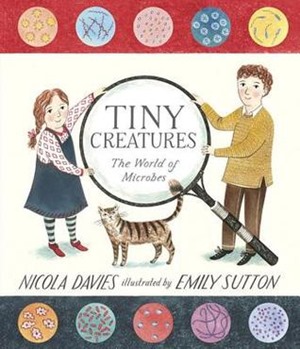
Tiny Creatures: The World of Microbes by Nicola Davies, illustrated by Emily Sutton

There are tiny creatures all around us that do the most amazing things!  Microbes are too small to be seen by the human eye, but look through a microscope and you enter a world of them.  There are microbes like viruses that cause diseases or colds.  And there are others that are very good for our health and turn milk into yogurt and compost into dirt.  Microbes may be very small but their impact on our world and our lives is very big.  This book shows the huge impact they have and how much we need to appreciate them.

Davies has written very engagingly about microbes in this book.  When talking about something like microbes, the numbers can get too large to understand, but Davies nicely ties these huge numbers to others that make sense.  She shows how quickly a microbe can reproduce using the page of the book.  The entire book is cleverly done, exposing the facts about microbes in a friendly and approachable way.

The illustrations by Sutton show both the microbes and their effect on the world.  The pages with the tiny microbes are fascinating as one gets to see the different types up close.  The illustrations have a friendly charm about them that makes the subject matter even more fun to read.

A great book on microbes, this will encourage children to pick up a microscope and learn even more about these tiny little creatures.  Appropriate for ages 6-9.

Reviewed from library copy.

Review: Red Pencil by Andrea Davis Pinkney

red pencil

The Red Pencil by Andrea Davis Pinkney, illustrated by Shane W. Evans

Amira is an artist who spends her free time drawing with sharp sticks in the dirt.  She has just turned twelve and is now old enough to wear a toob.  Amira longs to go to school, but her mother doesn’t believe that girls should go to school.  So Amira stays on the family farm with her parents and younger sister who was born with misshapen legs.  Then the peace is shattered when their farm is attacked and Amira’s beloved father is killed.  Now they must leave their farm behind and head to a refugee camp where people are crowded into a small space and hunger is constant.  But when Amira is given a red pencil, her mind once again is able to escape into her art and she starts to once again dream of a different future and how to get there.

Set in Sudan, this verse novel is filled with power, wrenching written.  The brutality of the attack is captured clearly on the page as is the shock of loss that continues to ripple and tear at the small family remaining.  Pinkney captures grief on the page, writing with a clarity and beauty that is stark at times and layered and subtle at others.  Her verse speaks to the power of dreams to lift people out of where they are trapped and make a difference. 

From waves of wheat on the page to the family together, Evans’ illustrations support the powerful verse.  As the tone of the poems shift, so does his art which moves from playful to dramatic along with the text.  My favorite images capture small pieces of life, little glimpses of what makes a home and a day.

An impressive novel in verse, this book offers a strong survivor of a protagonist who uses art as a force to lift herself.  Appropriate for ages 9-12.

Reviewed from e-galley received from Little, Brown Books for Young Readers and Edelweiss.