Review: Sequoia by Tony Johnston

sequoia

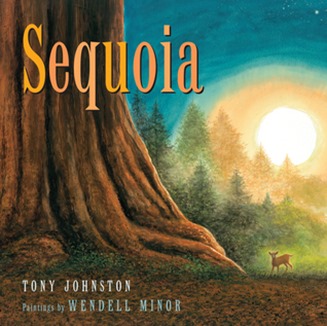
Sequoia by Tony Johnston, illustrated by Wendell Minor

This is a poem about Sequoia, a giant and ancient tree and how he lives through the year.  As the seasons change, Sequoia opens his arms and gathers different things to him.  He gathers owls to him in the springtime when he is cloaked in green.  When fires come in the heat of summer, he gathers flames to him.  As the birds fly away in the autumn, he gathers one last crow.  In the winter, he gathers snow.  He also listens quietly and deeply to the nature around him and shares stories that he has gathered over time with the smaller cedars.  This picture book is a celebration of ancient trees and this one sequoia in particular.

Johnston uses repetition very skillfully in his poem.  It is enough of a structure to allow children to have something to lean on when reading, but the poem is also free too.  It’s a strong mix of structure and freedom that is perfect for a tree poem.  As the seasons change, children will see nature change as well.  There is a joy to this work, a dedication to preservation of trees like this, and a thrill in the wildness of nature.  Johnston uses gorgeous imagery throughout that further ties the wild to this tree and how he feels.

Minor’s illustrations are exceptional.  They carry the beauty of the verse to new heights as readers get to see the glory of this single sequoia standing so tall above everything else.  Yet Minor also makes sure that Sequoia is part of the nature around him.  The light is beautiful in these images streaming through the trees in beams, bright dawn on other pages, and the softness of twilight at others. 

A wild and beautiful poetic celebration of a tree, this book is less about the facts of sequoia trees and more about the experience of one.  Appropriate for ages 4-6.

Reviewed from copy received from Roaring Brook Press.

Review: The Farmer and the Clown by Marla Frazee

farmer and the clown

The Farmer and the Clown by Marla Frazee

In a wordless picture book, Frazee captures what happens when a young clown falls off of a circus train and is rescued by a lonely farmer.  The desolate and flat landscape is unbroken until the bright circus train passes.  The farmer is clearly reluctant to take in the bright little smiling clown, but he does anyway, taking him by the hand back to his tiny house.  There, the two of them sit together, share a meal and eventually wash up and the clown washes off his face paint.  Now it is the little clown who is worried and sad, his smile removed with the water.  The farmer sits with him as he tries to fall asleep.  Along with the light of dawn, the farmer starts to cheer up the little clown with silly faces and antics.  Soon the two are living a mix of their two lives:  eggs are gathered and juggled, hard work is shared, and the two head out on a picnic together.  While on the picnic, they hear a train coming and it is the circus train filled with clowns.  But somehow, the ending is not sad as the little clown returns to his family and the farmer returns to his farm, both changed forever.

I’m not sure how Frazee manages to convey so much in a wordless format.  She uses symbolism, like the face paint for removing barriers, the connection of the characters through held hands, and their very different hats being removed and shared and eventually exchanged.  It’s lovely and heartfelt and very special. 

I’ve seen this book on a lot of people’s top book lists for the year, and I completely agree.  It’s a gem of a book that has such depths to explore.  The wordless format might imply a simple story, but here readers will find subtlety about friendship, caring for others, and building connections. 

A masterpiece of wordless storytelling, this is a radiant picture book made to be shared.  Appropriate for ages 2-6.

Reviewed from copy received from Beach Lane Books.

Review: The Right Word by Jen Bryant

right word

The Right Word: Roget and His Thesaurus by Jen Bryant, illustrated by Melissa Sweet

The incredible and award-winning team of Bryant and Sweet return with a picture book biography of Peter Roget.  The book looks deeply into his childhood as a boy who grew up moving around a lot in Switzerland.  He found that books stayed good friends through the many moves he made.  Roget was also a boy who enjoyed making lists, lists about all sorts of things:  Latin words, elements, weather and words for things in the garden.  As a teenager, he spent time silent and alone outside, making lists of birds and insects.  Then one day, he realized that it would be great to have a book that listed all the different words to choose from, and his idea of a thesaurus was born.  But it would take many years of hard work to come to fruition.

Bryant’s text has just the right amount of information about Roget and his life.  She wisely chooses to focus on his interest in lists as a child and how that grew into the thesaurus as Roget himself grew up.  This natural progression of interest from youth to adult is something that children will enjoy seeing in both Roget and in their own lives.  Bryant’s Author’s Note at the end of the book speaks to all of the research that goes into writing a biography for young children and the inspiration she herself found in Roget.

As always, the illustrations by Sweet are a highlight of the book.  Here, as she explains in her Illustrator’s Note at the end of the book, she has incorporated the Latin words that Roget used in his notebooks.  The other words that she weaves into her art are found in the first edition of his thesaurus.  Her art incorporates different papers, watercolors, and objects.  There is one page where it feels like it pops off the page, a book that contains words, creatures, plants and ideas.  Simply amazing art.

A noteworthy addition to the already impressive shelves of Bryant and Sweet, this is one that belongs in every library and in the hands of all young wordsmiths.  Appropriate for ages 7-10.

Reviewed from copy received from Eerdmans Books for Young Readers.

Four Merry Christmas Books

It’s a great year for Christmas books, and I have four top choices for your holiday reading pleasure:

first christmas

The First Christmas by Jan Pienkowski

With text from the King James version of the Bible, this picture book tells the nativity story with stateliness and words that will be familiar to many.  The great joy of the book is the silhouette illustrations by Pienkowski who has created images that glow on the page.  She combines her black silhouettes with colors that shift and seem to be lit from behind.  Her detailed cut paper art is awe-inspiring and adds just the right touch of wonder to the story of the birth of Jesus.  Recommended for all ages. 

Reviewed from e-galley received from Knopf Books for Young Readers and Edelweiss.

manger

Manger selected by Lee Bennett Hopkins, illustrated by Helen Cann

On Christmas Eve at midnight the animals are given the gift of being able to speak.  The poems in this book tell what each of the animals would say during the nativity about what they witnessed and how they contributed.  Hopkins has compiled a collections of poems from a dozen poets.  The collection ranges in styles and lengths but is also cohesive and the differences in the poems creates a variety that adds freshness. 

Cann’s illustrations are lovely with rich colors and fine details.  They show the animals clearly and also the wonder of the nativity on each page whether they are fish, fowl or mammal.  The poems range from very serious approaches to ones that are gently humorous but they are all done with great respect and honor the reason Christmas exists.  Appropriate for ages 5-9.

Reviewed from copy received from Eerdmans.

santa clauses

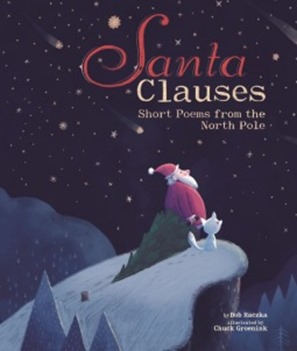
Santa Clauses: Short Poems from the North Pole by Bob Raczka, illustrated by Chuck Groenink

Santa tells his own story of Christmas in these 25 short haiku poems that offer a glimpse into what goes into making Christmas happen.  From the joy of snow to the seasonal chores like fixing Christmas lights, readers will see their own holiday preparations in Santa’s world too.  But there are also things that are just in Santa’s world like the many letters from children, hard-working elves, reading stories to the reindeer and finally flying off to deliver presents. 

These poems are cleverly done, often showing the beauty of the winter season just as much as they are celebrating the Christmas holiday.  The mix of natural beauty with Christmas makes the book rich and a holiday treat to share.  The illustrations too show the wonder of nature on the page alongside the bustle of the holiday season.  It is the quiet snowy scenes and the small special moments that make the strongest impressions both in poem and art.  Appropriate for ages 4-8.

Reviewed from library copy.

12 days of christmas

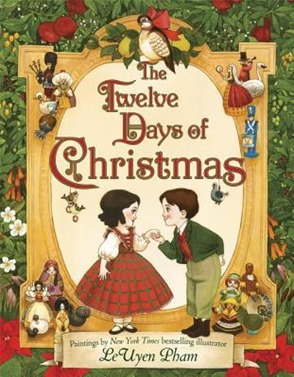
The Twelve Days of Christmas illustrated by LeUyen Pham

The traditional holiday carol is told in a warm new rendition with illustrations that are traditional but also very funny.  The carol is unaltered in this picture book that shows what happens as the various gifts arrive.  Though in the first pages it seems to be a book that will stack and pile the huge number of gifts on each page, this book is more subtle about things and therefore more successful.  Instead it is a delightful mix of diversity, different cultures and the joy of the season.  It turns out this is a modern and fresh take on the carol sure to spread joy.  Appropriate for ages 4-9.

Reviewed from e-galley received from Doubleday Books for Young Readers and Edelweiss.

Review: The Categorical Universe of Candice Phee

categorical universe of candice phee

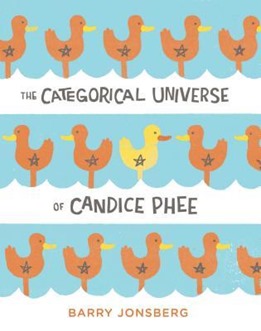
The Categorical Universe of Candice Phee by Barry Jonsberg

This Australian award winner is the story of 12-year-old Candice who is completing a school project that is supposed to be a paragraph for each letter of the alphabet that reveals something about her.  But Candice can’t keep it to one paragraph, so she begins to do chapters for each letter and the words she chooses for each letter are unexpected too.  As she writes, Candice is telling the story of her family and her pet fish.  She worries about her family falling apart, since her mother is still grieving the loss of Candice’s baby sister Sky to Sudden Infant Death Syndrome.  Her father is working on software in his spare time to prove that he can be as successful as his brother, Rich Uncle Brian, or flying his toy plane.  Either way, both parents are self-absorbed rather than paying attention to Candice.  She also doesn’t have any friends, until an unusual boy comes to school, a boy who believes that he’s traveled to another dimension and spends his time trying to get back home by falling out of a tree.  It seems to Candice that it’s up to her to fix a lot of what’s wrong, but how can she?

Jonsberg has crafted a unique character in Candice.  She may or may not be on the autism spectrum, but it is clear that she is different from the others in her grade and that they know it.  Yet Candice functions fully, just in her own way.  She loves her family, makes connections with others, and cares deeply about what is happening around her.  She just does it in her own way, one that makes sense and that shows just how smart she is. 

The book is wonderfully funny, with situations that are almost slapstick at times and others that are cleverly worked.  The scene where Candice forces herself to get on her uncle’s boat to talk about the problems between him and her father is classic nausea humor that is done to perfection.  Yet the book has plenty of depth too, with the deep depression that her mother has fallen into and even a little romance.

Strong writing keeps this complex book from tangling into knots and a strong protagonist gives it a unique and smart voice.   A great Australian import that is ideal for middle grade readers. 

Reviewed from e-galley received from Chronicle Books and Edelweiss.

Review: Viva Frida by Yuyi Morales

viva frida

Viva Frida by Yuyi Morales

Frida Kahlo is one of the most celebrated female artists in the world.  This picture book is less a biography and more a celebration of her life and art on the page.  Written in brief sentences, the book shows her unique perspective on the world.  It pays homage to the rich love she had in her life, her pet monkey, and all of the inspiration she found around her.  In a world that needs more diverse picture books, this is one worth celebrating.

The book is told entirely in short sentences from Frida Kahlo’s point of view.  Cleverly done, the sentences are done in English and Spanish, the Spanish almost a bright floral note next to the black English words.  It is the illustrations here that are exceptional.  Morales is known for her paintings but her she chooses a different medium entirely.  Kahlo is shown as a doll and the illustrations are photographs of that doll as she moves through her day.  Kahlo retains her distinctive single brow as well as her signature beauty. 

Using a doll in this way plays directly against the blonde bombshell beauty of Barbie.  With the same plastic structure, this Frida Kahlo doll with her black hair, warm brown skin and intelligent eyes shows a much richer form of beauty.  The images are cleverly photographed, showing Kahlo from different and interesting angles and moving into a dream sequence where the illustrations turn to paintings. 

A dynamite addition to any library, this is a necessary purchase that speaks to why diverse picture books are needed for all children.  Appropriate for ages 4-6.

Reviewed from copy received from Roaring Brook Press.

Review: My Heart Is Laughing by Rose Lagercrantz

my heart is laughing

My Heart Is Laughing by Rose Lagercrantz, illustrated by Eva Eriksson

Dani has always been happy, but now that her best friend has moved away to another city, she is unhappy sometimes too.  But Dani tries not to think about being unhappy.  Dani didn’t know anyone in her class when she started school, but now she does.  When two girls in her class both get a crush on the same boy and ask him who likes best, they are amazed when he shows that he’s much more likely to like Dani.  Dani tried to keep being friendly with the girls, but neither of them wanted anything to do with her.  Dani sat by herself at lunch, but she didn’t mind because she just thought about all of the fun she had visiting her best friend.  But then her teacher moved her between the two girls, and Dani was cruelly pinched by them.  Dani finally had enough, and reacted by squirting them (and then the teacher accidentally) with sauce.  Now it is up to Dani to tell the truth about what happened and to figure out how to find happiness without her best friend at her side.

This is the second book featuring Dani, following My Happy Life, which tells the story of how Dani met her best friend and then how she had to move away.  In this second book, the focus is on bullying and the author does a great job with it.  As the situation escalates, Dani remains apart from the situation for awhile, then finds herself right in the middle of it.  I appreciate that Dani is not faultless in the situation in her reaction, but also that she reacts humanly and believably to the situation. 

Set in Sweden, the stories have a universal appeal but also are clearly not set in the United States.  This is a gentle introduction to the subtle cultural differences and a great way to start a discussion about how people are both the same and different in other cultures. 

Fans of the first book will love the next in Dani’s adventures.  This will also find an audience as a read-aloud for teachers wishing to discuss bullying with elementary students.  Appropriate for ages 7-9.

Reviewed from e-galley received from Gecko Press and NetGalley.

Review: Colors of the Wind by J. L. Powers

Layout 1

Colors of the Wind: The Story of Blind Artist and Champion Runner George Mendoza by J.L. Powers, illustrated by George Mendoza and Hayley Morgan-Sanders

George loved to move, so he decided to be a basketball player.  Then one day the world outside looked red to him and he started to see other colorful squiggles in the air and suffer from constant headaches.  The doctor told him that he was going blind, but George didn’t lose all of his sight, instead he continued to see bright colors and flashing lights.  He had to stop playing basketball because he could no longer see the basket.  Eventually, George took up running, mostly because it made him so tired that he could forget being blind.  He could run very fast, so fast that he went to the Olympics, twice.  But George continued to see a world of colors that no one else could see.  It wasn’t until a friend was killed that he started to ask himself why he was there, and George started to talk about being blind to groups and also to paint the world that he sees.

A truly inspirational story, Mendoza is an example of someone being incredible resilient in the face of a life-changing disability.  The fact that he began to run after losing his sight is amazing and also inspiring.  But it is his visions and his art that shine on the page, a world painted in colors that only he can see.  The process of George becoming an artist is shown in all of its slow progression which also gives the sense that there is time to find your path, time to be the person you are meant to be.

Seeing his paintings on the page is immensely powerful.  They are bold and bright, done in thick lines.  They have a voice to them that shouts on the page and they tell the story of what George sees more clearly than any words can. 

Highly recommended, this picture book biography is a powerful tale of resilience and overcoming barriers.  Appropriate for ages 7-10.

Reviewed from pdf received from J.L. Powers.

Review: Mr. Ferris and His Wheel by Kathryn Gibbs Davis

mr ferris and his wheel

Mr. Ferris and His Wheel by Kathryn Gibbs Davis, illustrated by Gilbert Ford

After the Eiffel Tower stunned World’s Fair visitors in 1889, it was up to Chicago to impress people at their 1893 World’s Fair.  So a nationwide contest was announced, but unfortunately many of the designs were just slightly-modified Eiffel Towers, so all of them were rejected.  George Ferris was an American engineer who had already designed big bridges, tunnels and roads across the nation.  He had an idea for a structure that would not just rival the stature of the Eiffel Tower, but would also move and be able to be ridden.  The judges of the contest reluctantly agreed to let him try, but would not offer him a penny of funding.  Ferris managed to find a few wealthy investors to help him and construction began on the huge project of creating a delicate wheel that would be strong enough to turn filled with people.  The tale of the building and invention of this now iconic ride is rich with suspense and the delight of accomplishment.

Davis has written a very successful picture book biography on George Ferris and his delight of an invention.  Occasionally in the text, there are sections in smaller font that offer more details and information.  It is all fascinating and those sections will be enjoyed as much as the main text.  Davis clearly explains differences between today and the late 1800s, such as the lack of Internet to carry ideas.  The story has plenty of dangers, lots of action and the ever-present danger of failure to carry it forward and make it enjoyable reading.

Ford’s illustrations are filled with rich, deep colors that capture different times of day.  They are a winning mix of straight, firm lines and hand-drawn characters and structures.  The play of the two on the page makes for illustrations that are eye-catching and that draw you into the story and the time period.

This is a particularly strong picture book biography that children will pick up thanks to the everlasting appeal of the Ferris Wheel.  Appropriate for ages 7-10.

Reviewed from library copy.