Review: Count on the Subway by Paul Dubois Jacobs

count on the subway

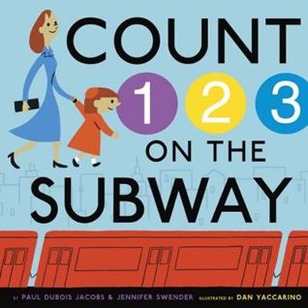
Count on the Subway by Paul Dubois Jacobs and Jennifer Swender, illustrated by Dan Yaccarino

Told in a bouncy rhyme, this picture book counts its way through a trip on the New York City subway.  It starts with a mother and daughter heading down the steps into the subway and counting their one MetroCard.  They go down 2 flights and catch the 3.  Onward the story goes, merrily counting the turnstiles, the people, seats and stops.  Once the book reaches ten, it counts its way right back down again, ending when the pair climb there way up into the one and only Union Station. 

The rhyme here is completely infectious.  It bounces along, skips and dances.  It appears effortless and free and is very readable.  In fact, it is hard not to read it aloud.  The illustrations by Yaccarino show the main characters in full color while the others are one solid color and a black outline or just a colored outline.  It makes for a book that is bright and bold. 

Perfectly paced and brightly rhythmic, this counting book will be enjoyed by all sorts of children, not just the ones who have taken a subway before.  Appropriate for ages 2-4.

Reviewed from copy received from Random House Children’s Books.

My Favorite Thing about Zita the Spacegirl

Zita-BlogTourBanner

When I opened the box that contained The Return of Zita the Spacegirl, I squealed and jumped around (a little bit, ok a lot) and my youngest son arrived to investigate.  He is 12 years old and has loved Zita for years.  The first Zita book traveled around with him for some time.  It was one of those beloved books that went into every school bag, rode on any long car ride, and was tucked under his arm just in case he got bored.  Upon seeing the new book, he immediately pounced, pulled it out of my hands and made to dash off with it.  But no, I had a review to write and he could not have it.  I nestled it onto my book table and went to do laundry.

I was gone a few minutes and came back into the room to see my older child, now 17 years old, getting ready to curl up with the new Zita book that I thought I had secured!  I once again wrestled it out of eager hands (something that feels so wrong as a librarian but fine as a book lover) and told them that they had to wait until my review was finished to read it.

So that is my favorite thing.  My favorite thing is the eagerness that this book series creates in readers.  Everyone knows that Zita will have a great adventure, that there will be plenty of humor, cute and strange creatures, lots of danger, and even some old friends.  It is the type of series that spans from childhood to teen years, cool enough to carry around proudly and beloved enough to curl up with at bedtime even at age 17.

I too have adored Zita the Spacegirl from the very first book.  Now the final book in the series is coming out and  I am both saddened to see Zita coming to an end and also heartened to have a great series end with such a terrific book.

I will spoil nothing for you here.  Suffice it to say that both of my children found it worth the wait to read it as did I.  After all, Zita is one amazing heroine who solves problems both on her own and with her friends.  This is girl power at its best! 

And I can’t wait to see what Ben Hatke does next, can you?

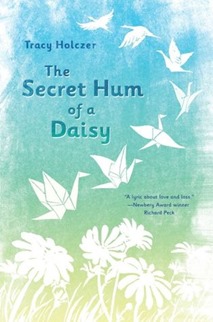
Review: The Secret Hum of a Daisy by Tracy Holczer

secret hum of a daisy

The Secret Hum of a Daisy by Tracy Holczer

Grace can’t stand being near the river, because that’s where she found her mother’s body.  It was right after they had argued about moving once again.  Grace wanted to stay where she finally felt at home, but her mother wanted to move again.  Now Grace has been sent to live with her mother’s mother, a grandmother she has never known.  She only wants to return to the family she and her mother had been staying with last, but she has to come up with a plan to escape.  In the meantime, Grace starts to find clues to a treasure hunt, similar to the ones her mother did for her every time they moved to a new town.  Is it her mother creating a final path for her daughter to find a home?  Or could it be that Grace is just seeing patterns where there are none?

Holczer shows great depth and richness in this her first book.  In this character-driven novel, she excels at the relationships she builds between her vividly drawn characters.   Grace is a character in search of a place to call home, but unable to see a home when it is right in front of her and unable to register the love being shown her.  She is complicated in a very organic way, her reactions honest and true.  The same is true of the grandmother character who radiates frankness but also regret for what happened over the years with her daughter.  She is a very complex adult character, particularly for a book for middle grade students. 

Holczer’s writing itself is straight-forward, allowing a sturdy framework for these character to relate to each other within.  The writing rings with confidence and Holczer asks deep questions about death, what dead people can communicate to the living, and what makes a family.  The answers are not simple and are not easily arrived at.  They come about very naturally and one must wait to see what the truths are and where the characters will arrive in this beautifully paced novel.

Rich, organic and special, this middle grade novel offers us all a view of what a second chance at family can be.  Appropriate for ages 9-12.

Reviewed from copy received from Penguin.

Review: Under the Freedom Tree by Susan

under the freedom tree

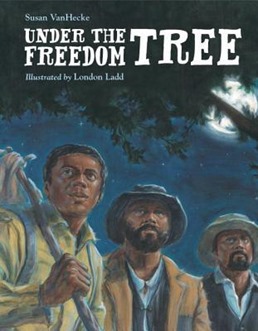
Under the Freedom Tree by Susan VanHecke, illustrated by London Ladd

Told in free verse, this picture book is the story of how the first contraband camp formed during the Civil War.  It all started with three runaway slaves who escaped across a river to a Union-held fort.  Though the Confederate Army tried to demand their return, the general at the fort declared them “contraband of war” and offered them protection and a place to live.  The three were quickly joined by a flood of people crossing the line into Union territory and they began to build a home for themselves near the fort.  The freedom tree is the Emancipation Oak which stood witness to the events that unfolded, including the Emancipation Proclamation, which set all of the residents of the camp free.

VanHecke’s verse is loose and beautiful.  She captures the danger the slaves faced in crossing the Confederate line, the risks they took asking for shelter, and the clever solution found by the general.  She offers an author’s note in prose to give more historical context to the camp and the Emancipation Oak. 

Ladd’s illustrations are lush and detailed.  His paintings capture the hope of emancipation, the darkness of escape by water and night, and the beauty of the oak.  The illustrations clearly honor the first three men who escaped to the fort, showing them as they wait for the judgment of whether they must return to slavery or not. 

A little-known part of the history of the Civil War, this book in verse pays homage to the courage of the men who created the contraband camp.  Appropriate for ages 6-10.

Reviewed from copy received from Charlesbridge.

Review: How to Cheer Up Dad by Fred Koehler

how to cheer up dad

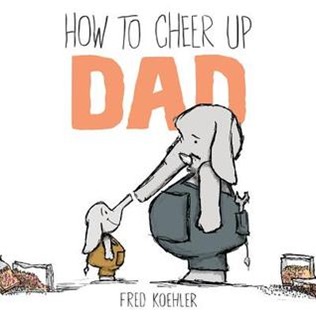
How to Cheer Up Dad by Fred Koehler

Little Jumbo’s dad is having a very bad day, but Little Jumbo can’t figure out why.  When Little Jumbo spits his raisins at the ceiling, his dad should have remembered not to put them in his oatmeal since Little Jumbo doesn’t like them.  His dad also should have remembered that Little Jumbo doesn’t like his brown overalls, but he didn’t so Little Jumbo ran out of the house naked.  Little Jumbo had to figure out how to cheer up dad, especially after getting a time out when it seemed like Dad needed one himself.  So Little Jumbo sets out to make the perfect cheering-up afternoon with Dad, and it works.  Maybe.

Koehler tells one story with his words and another in the pictures.  This makes for great fun especially with his dead-on sense of timing for humor.  The story is told in Little Jumbo’s voice, but the images show the point of view of the father quite clearly and the mishaps that Little Jumbo has all morning long.  The blissful afternoon together makes this book a little deeper and less madcap, much to the book’s credit.  But the final twist at the end brings the laughter right back again.

Koehler’s art will appeal to fans of Mo Willems with its clear lines, silly humor and a strong relationship between the two characters.  Little Jumbo and his father are two charming characters who related together with a mix of frustration and love. 

Filled with laughs, this is sure to cheer up bedtime at any house but particularly if shared by a dad.  Appropriate for ages 4-6.

Reviewed from copy received from Dial.

Review: Hi, Koo! by Jon J. Muth

hi koo

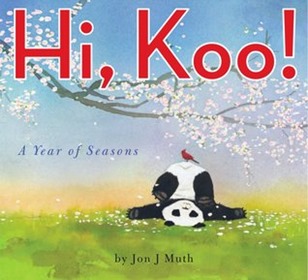
Hi, Koo!: A Year of Seasons by Jon J. Muth

Join Koo, a panda, on an exploration of the seasons through haiku poems.  The book begins with fall and haikus about fall leaves, wind, and rain.  Winter comes next with poetry about snow and ice.  Spring is bridged into with a glimpse of crocuses and then grass, insects, and birds.  Summer arrives with fireflies, flowers and water.  In 26 poems, this is a lovely celebration of the small things that make each season special.

Muth has created haikus that are beautifully written.  They capture small moments in time and also point to the larger importance of these moments.  They continue Muth’s Buddhist focus in his picture books, offering children a way to see these times of mindfulness as important and worthy of exploration. 

Muth’s watercolor illustrations have a wonderful spirit to them.  The palette changes colors as the seasons change with spring bouncing in green especially after the white cold of winter.  He captures the seasons so well that your attitude changes with each season as well.

A stellar collection of haiku, this book will invite young readers to see nature and seasons in a fresh new way.  Appropriate for ages 5-9.

Reviewed from copy received from Scholastic.

Review: Firefly July selected by Paul B. Janeczko

firefly july

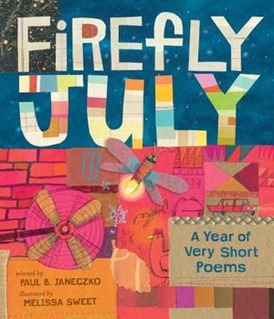
Firefly July: A Year of Very Short Poems selected by Paul B. Janeczko, illustrated by Melissa Sweet

There are just over thirty poems in this collection and as promised in the title, all of them are very short.  These short poems though each have power and perfection in just a few words, offering insight into the way that language can be edited and played with to make it speak much more than the few words on the page.  Readers will find poems that are well-known mixed with others that are delightful new surprises.  Through it all, there is a feeling of joy that comes from the page and from the words as well as a pleasure of traveling the seasons through poetry.

Thanks to the brevity of all of these poems, this is a very child-friendly book to introduce children to poetry.  Their condensed format also gives them a lot of power and bang per word, which makes them easy to discuss with children.  Readers will also want to try their hands at creating short poems and are sure to quickly realize that while they read easily, they are very difficult to create.  That makes this book all the more impressive with its high level of quality of poem and a perfect level of accessibility for youth.

Sweet’s illustrations frame the poems into one cohesive unit.  They celebrate the small things, like these poems and their themes, looking at leaves, butterflies, fog and lots of other bits of nature.  Her work is playful and yet not too light, bringing depth into each image.

A beautiful collection of short poems, this belongs in every library and would make a perfect way to start every day with a poem.  Appropriate for ages 4-8.

Reviewed from library copy.

Review: Goodnight Songs by Margaret Wise Brown

goodnight songs

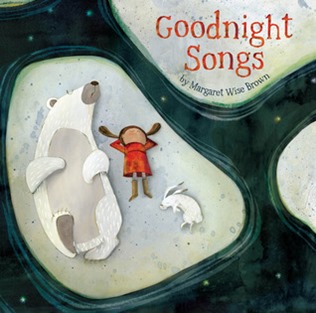
Goodnight Songs by Margaret Wise Brown

A new collection of previously unpublished poems from the master Margaret Wise Brown are illustrated here by twelve different illustrators.  According to the introduction by Amy Gary, the editor of the Margaret Wise Brown Estate, these poems were part of a trunk of unpublished manuscripts that Margaret’s sister had in her barn.  They reflect the interest that Margaret developed towards the end of her life in creating music for children.  The book is accompanied by a music CD that brings the poems into song.  This book is just as enjoyable as a song book or a poetry book, make sure to try it out both ways!

Brown’s poems are simple and lovely.  Some of them read like nursery rhymes with plenty of repetition of phrase and style.  Others are a bit looser but still musical even as words.  She created small worlds in each song, offering lovely gems of moments in each one.  I have a handful of top favorites from the book:  “The Mouse’s Prayer” which is a beautiful wintry poem, “Wooden Town” that evokes a childhood joy of creating a little world of blocks, and “The Secret Song” which is a question and answer poem that is quiet and lonely.

The twelve illustrators make up some of the top illustrators in today’s picture books.  There is a great pleasure in turning the page and seeing an entirely different feel with the next poem.  Some are bright and sunny, others deep colored like the night, and still others filled with snow.  The styles reflect each of the illustrators and as a whole the book works extremely well, giving each poem a distinct note of its own on the page.

A top pick for children’s poetry, these songs are a dazzling collection from a very talented writer.  Appropriate for ages 5-8.

Reviewed from library copy.

Review: Fly Away by Patricia MacLachlan

fly away

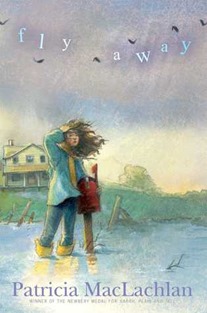
Fly Away by Patricia MacLachlan

Every year Lucy and her family head to North Dakota to help Aunt Frankie on her farm.  This year the farm is being threatened by a flood, and they are heading to the farm even though Frankie told them it was dangerous.  On the way, Lucy’s family stops and camps, listens to opera, and sings.  But Lucy can’t sing at all and she knows it.  Her little brother is a different story, no one else believes Lucy but Teddy can sing perfectly and even talks a bit, though he refuses to do so except with Lucy.  Though she can’t sing, Lucy loves to write and she is trying to create a poem to prove to her father that a poem can be just as nice as a cow.  Her father had dreamed of being a poet himself, but became a farmer instead.  As the family gets to North Dakota, they face a dangerous river and Lucy has to find her own strength to save her little brother.

Told in a strong and clear voice, this novel invites readers into a family that is pure joy to spend time with.  All of the family members have their own specific gifts and quirks, they communicate effortlessly with one another, and the entire book feels like you have entered someone’s home and are spending time with them.  MacLachlan creates dialogue that feels real, but even more so she has created characters that are alive and honest on the page.

Thanks to the larger font and short chapters, this book will be welcoming for newer readers who may be trying their first chapter book without pictures.  The warmth of the characters, the riveting danger of the river, and the thrilling ending will keep young readers fascinated until the end.  This is also a great pick for sharing aloud with an elementary class.

MacLachlan has created a simple book that contains bountiful riches in setting, character and voice.  It is a stellar read.  Appropriate for ages 6-8.

Reviewed from copy received from Margaret K. McElderry Books.