Review: Elizabeth, Queen of the Seas by Lynne Cox

elizabeth queen of the seas

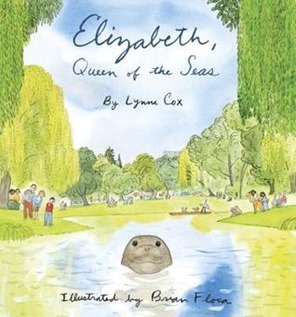
Elizabeth, Queen of the Seas by Lynne Cox, illustrated by Brian Floca

This is the true story of Elizabeth, an elephant seal, who decided she wanted to live in the warm waters of the Avon River near the city of Christchurch in New Zealand.  People are happy to have Elizabeth in the river, often spending time watching her swim.  Then Elizabeth decides that her favorite place to sun is the middle of a two-lane road.  It is flat and warm and perfect, except for the dangers of the cars to both Elizabeth and the people.  So Elizabeth is towed out to sea, to live with the other elephant seals.  But Elizabeth returns.  She is removed to the sea over and over again, each time taking her farther away from Christchurch.  But she still finds her way back to those warm river waters. 

Cox, a famous long-distance, open-water swimmer, has written her first children’s book here.  One would never know that it is her first.  She writes with a grace and simplicity that make her book entirely readable but also poetic too.  She incorporates imagery that will help children understand Elizabeth better: “Moving up the soft shore like a giant inchworm.”  She also uses descriptive language to draw contrasts between the waters in the river and those in the cold sea. 

Floca, winner of the 2014 Caldecott Medal, uses his fine-line drawings to show the merry spirit of Elizabeth both when she is in the warm river waters and upon her amazing returns after being towed away.  Floca’s illustrations of Elizabeth on the warm road and her surprise but lack of alarm when the cars approach are beautifully done. 

A winning story that tells the story of one unique elephant seal and the town that she decided was her home.  Appropriate for ages 5-7.

Reviewed from copy received from Random House Children’s Books.
Review: We Were Liars by E. Lockhart

we were liars

We Were Liars by E. Lockhart

Cady has been spending her summers on the family’s private island for her entire life.  She and her two cousins Johnny and Mirren were joined by Gat, a boy who became almost a cousin but also so much more for Cady.  The foursome call themselves The Liars, and during the summers were inseparable but barely contacted one another during the rest of the year.  But then one summer it all changed and now Cady can’t remember what happened.  She was found bedraggled and wet on the beach of the island, alone.  Now she suffers from amnesia and migraines, spending days in bed in severe pain.  But she is determined to find out what happened, even if the other three refuse to contact her any more, so she returns to the island.

Lockhart has created a mystery and thriller that is written like modern poetry.  She plays with construction in her novel, dancing between verse and prose masterfully.  This disjointed approach to construction also speaks to the way the entire novel is deconstructed and put back together again.  The book moves in time, flashing forward and backward, yet is never confusing.  Still, readers will be caught in this sparkling web, unable to piece together the mystery until Lockhart is ready for the reveal.  And she does it with great style and technique.

With such a character-driven book, the depiction of the characters is of paramount importance.  Lockhart excels in all of her books in creating characters who are real people, human and flawed.  She does the same here, creating in Cady a very complicated character that readers have to put together as a puzzle until it clicks together in the end.  The other supporting characters are equally well rendered.  Even the parental figures who seem stereotypical at first reveal surprising depth as the story continues.

Superbly crafted and brilliantly written, this book is one of the best of the year.  Get your hands on it now!  Appropriate for ages 15-18.

Reviewed from digital galley received from Delacorte Press and Edelweiss.

Review: The Patchwork Torah by Allison Ofanansky

patchwork torah

The Patchwork Torah by Allison Ofanansky, illustrated by Elsa Oriol

David’s grandfather was a scribe.   He had been asked by the rabbi to write a new Torah for their synagogue because the old one was fading.  David watched his grandfather work for a year on the new Torah and then store it away, explaining that a Torah is not something to be thrown out.  Years later, as David was learning to be a scribe from his grandfather, a couple came to them bringing a Torah that they had hidden from the Nazis.  It was badly water damaged and his grandfather tucked that Torah away too in the hopes of working on it someday.  David grew up to be a scribe and inherited his grandfather’s cabinet with the two scrolls inside.  One day, the rabbi called and told him that there had been a fire in the synagogue and the Torah was damaged.  That scroll too was put away.  Finally, Katrina hit New Orleans and a Torah was rescued but damaged too.  David suddenly had an idea and worked for months to take the four scrolls and patch them together into one complete Torah that would be unlike any other.

Ofanansky builds this story slowly and steadily.  Each Torah comes into the book with a full story and history.  Each is unique and ruined in some way, but worthy of being rescued and reused.  It is the ultimate in recycling.  The book also pays homage to the long history of scribes who care for and create Torah, showing the dedication that it takes to learn the art and skill. 

The art by Oriol has a quiet nature too.  The paintings are suffused in yellow light and warmth.  Even the days of the tragedies that happen to the people and the Torah are light-filled and hope filled. 

A quiet and powerful story about renewal and reuse, this book speaks across religions to the importance of hard work and resilience.  Appropriate for ages 6-9.

Reviewed from library copy.

Review: The 26-Story Treehouse by Andy Griffiths

26 story treehouse

The 26-Story Treehouse by Andy Griffiths, illustrated by Terry Denton

This sequel to The 13-Story Treehouse tells the story of each of the main characters and how they all met.  Most of it’s even true!  But it’s not that straight forward either because emergencies keep happening, like the sharks in the treehouse’s shark pool eating Terry’s underpants and getting very sick.  Thank goodness that Jill can come over and try to have them feeling snappy again soon.  Then of course no story is complete without a villain and Captain Woodenhead, the evil pirate makes a great one.  Set aside your disbelief heading in, because this rollicking and very funny book will have you believing in plenty of nonsense by the end!

After the first book, I knew there would be more adventures of Terry and Andy, but I hadn’t expected double the number of floors on the treehouse!  This book is more of the merry adventures of Terry, Andy and Jill.  The flying cats return and many other favorites from the first book make an appearance, but this is a fresh story too, perfect for fans to get even more of the humor and silliness of the series. 

Looking for a new series for Wimpy Kid fans, this one has illustrations that break up the text, a similar amount of funniness, and plenty of gross outs too.  Appropriate for ages 8-12.

Reviewed from copy received from Feiwel & Friends.

Review: Eerie Dearies by Rebecca Chaperon

eerie dearies

Eerie Dearies: 26 Ways to Miss School by Rebecca Chaperon

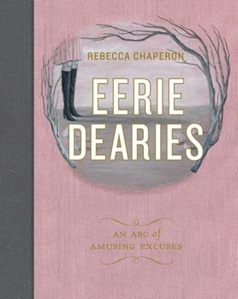
Don’t expect your sunshiny ABC book here!  Instead you get to enter a creepy world where each letter of the alphabet is paired with a way to miss school.  Just to make sure you know what you are getting into, the book begins with A is for Astral Projection paired with a picture of a girl floating off the page.  The images are haunted and dark, yet with a quirky sense of humor as well.  The book goes on with the alphabet with C is for Contagious, K is for Kidnapping, and M is for Mononucleosis.  It all ends with Z is for Zombie Apocalypse. 

This book certainly is not for everyone.  But for those kids who enjoy a shiver along with their ABCs, this is a perfect picture book.  I was one of those strange kids myself and would have adored this picture book as a child.  The art is creepy, showing children without heads and clearly hearkening back to Edward Gorey and gothic horror.  Yet there is no blood on any of the pages, so it’s not graphic in any way.

This book will work well around Halloween, but thanks to its sense of humor will please haunted children throughout the year.  Appropriate for ages 6 and up.

Reviewed from library copy.

Review: Abuelo by Arthur Dorros

abuelo

Abuelo by Arthur Dorros, illustrated by Raul Colon

A boy and his grandfather spend time together riding horses and camping.  They have adventures outdoors losing the trail and even facing a mountain lion.  His grandfather taught him to stand strong like a tree.  Then one day the boy moved with his family to the city, leaving his grandfather behind.  The city was very different.  The stars were hard to see, but they were the same stars.  The boy learned to use what his grandfather taught him in the countryside.  He even stood up to a bully on the first day of school, standing strong as a tree.

Told in graceful free verse, this book reads quickly rather like a brisk horseback ride.  Completely controlled and peppered with Spanish, the book evokes the freedom of the countryside and also the lessons of strength being taught across generations. 

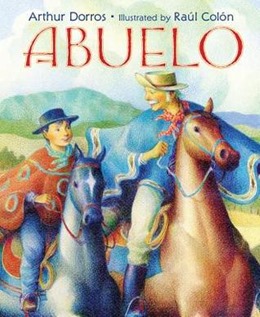
Colon’s illustrations evoke the differences between the country and the city.  The open freedom of the countryside is contrasted against the constraints of the city, yet the sky ranges wide above both and there is freedom when riding your bike just as when riding your horse. 

Free verse mingles with the freedom of the range in this multi-generational title, a perfect masculine accompaniment to Dorros’ Abuela.  Appropriate for ages 4-6.

Reviewed from copy received from HarperCollins.

Review: Galapagos George by Jean Craighead George

galapagos george

Galapagos George by Jean Craighead George, illustrated by Wendell Minor

A story of evolution and extinction, this picture book explores the incredible life of the famous Lonesome George a tortoise who was the last of his kind.  The book begins by explaining how a million years ago a tortoise was driven from South America and carried to the island of San Cristobal near the equator.  There she laid eggs, used her long neck to reach food, and passed on her genetics.  Thousands of years later, all of the turtles looked different with long necks and shells that curved back to give their necks more room.  When humans discovered the Galapagos Islands, they quickly decimated the turtle population which dwindled down to only a few thousand from the hundreds of thousands that had lived there.  A hundred years later, the giant tortoise population had reduced even further, so that one lone turtle remained.  He was moved to the Charles Darwin Research Station and protected but no other turtle of the species was ever found.

George creates a vivid story of the power of evolution in our world and the effects of humans on animal species.  She steadily shows how weather forces and natural disasters impact animals as well, moving them from place to place and changing their habitats.  As the animals change slowly, George keeps the text clear and factual, making for a book that moves quickly and is filled with fascinating scientific information.

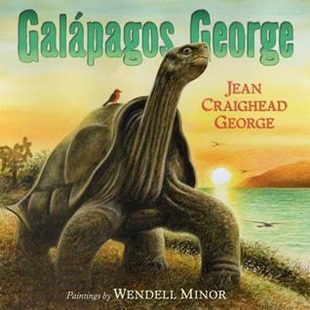
Minor’s illustrations are lush and lovely.  They are filled with the light of sun, bursting on the horizon in tropical colors.  He also shows the barren landscape of the Galapagos clearly and the frank regard of a tortoise looking right at the reader.  There is a sense of loneliness for much of the book both when the book is about the first tortoise and then later when there is one left.  That connection between the two lone turtles is made clearly in the illustrations.

Fascinating, distressing and yet ultimately hopeful, this nonfiction picture book will work well in science classrooms as well as library collections.  Appropriate for ages 6-9.

Reviewed from copy received from HarperCollins.

Review: The Mermaid and the Shoe by K.G. Campbell

mermaid and the shoe

The Mermaid and the Shoe by K.G. Campbell

King Neptune’s 50 daughters are all special and talented in their own ways.  All except for Minnow who tries to be like her sisters, but only manages to ask lots and lots of questions about things.  Minnow did not fit in with her sisters at all, often drifting alone on her own.  Then one day, she found a remarkable object in the water, a red shoe.  She tried asking her sisters what it was for, but none of them knew, so Minnow headed out to answer her own questions and find out what the red object was for.  Minnow swam closer and closer to shore, discovering answers to some of her other questions like why crabs don’t have fins.  Then she found out exactly what shoes were for and headed home to tell the others.  In the end, Minnow not only discovers the answers she is looking for, but she discovers exactly what her special talent is too.

Campbell, author of the uproarious Lester’s Dreadful Sweaters, returns with a quieter book that shows the same sort of depth as the first.  This book beautifully wrestles with deep questions about one’s purpose in life and how to remain true to oneself rather than give in to external pressure.  Disney’s The Little Mermaid comes to mind throughout the story, but in the end this is a unique mermaid story that holds up well against the Disney version.

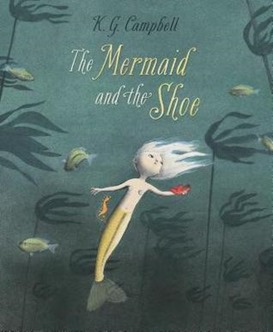
The illustrations are rather haunting.  They pair the darkness of the deep water with a near glowing brightness of the mermaids.  The mermaids have drifting white-blonde hair that moves with the currents, fish tails that look like real fish, and small seashells to cover their chests. 

Beautiful, quiet and deep like the ocean, this book will find readers in Little Mermaid fans who may just have found a new favorite mermaid to adore.  Appropriate for ages 4-6.

Reviewed from copy received from Kids Can Press.

Review: The Night Gardener by Jonathan Auxier

night gardener

The Night Gardener by Jonathan Auxier

A book sure to create some shivers, this is a thrilling gothic horror book for children.  Molly and Kip are two Irish children abandoned by their parents as their family fled to England due to the Great Irish Potato Famine.  No one will hire Molly as a servant until a man hires them to work for his family at their isolated and decrepit mansion.  It quickly becomes apparent that things are not what they seem in this family.  Molly finds a painting done of the family a year earlier, and they have changed considerably with their hair turning black and dull to their skin losing all color.  Perhaps it has something to do with the locked green door in the house, a door that Molly yearns to find out what is behind.   But opening that door unleashes a terrible force, one that answers your wants but destroys you in the process.  How can two children stand up to a centuries old curse?

Auxier’s storytelling skill is incredible.  He weaves a world of darkness, creeping misery and despair so cleverly that readers will feel the chill on their skin before it reaches their thoughts.  The children are steadily drawn into the strangeness surrounding the house and family, succumbing to the temptation of safety, the illusion of a home, and not seeing the proof around them of what is happening.  For the reader, this is a book that steadily builds and builds as the tension mounts and the nights get more frightening.  It is a wonderfully creepy read, one that simply can’t be put down.

The themes of the book are beautifully crafted.  The book speaks to the importance of love and family, but even more so it is about what happens when greed becomes consuming, literally.  It also is about the power of storytelling and stories, the way that they can teach, terrify and soothe.  And finally about the terror when a story comes to life right in front of you. 

An extraordinary horror novel for children, this book will be enjoyed by young readers but maybe not right before bed.  Appropriate for ages 10-13.

Reviewed from ARC received from Amulet.