I Can Make a Train Noise by Michael Emberley

Cover image for I Can Make a Train Noise.

I Can Make a Train Noise by Michael Emberley and Marie-Louise Fitzpatrick (9780823444960)

A little girl enters a crowded cafe with her family, insisting that she can make a train noise. As they take off their coats and sit at a table, the little girl continues to state that she can make a train noise, and that she will do it NOW! Jumping down from her chair, her imagination takes over as all of the customers form a line and quickly transform into passengers on a train. The train moves through a city formed from kitchen utensils, ketchup and mustard. It makes its way out in realistic oceanside settings and mountains with prairies. As the train slows to a stop, readers return to the bustling restaurant where everyone is talking about trains now.

This picture book is written in very simple lines, repeating “I can make a train noise” and “Now!” again and again. Using simple punctuation to slow the lines down or speed them up, the rhythm the repeating lines make is captivating and very impactful. This is a picture book that is ideal to share aloud and then share it again with the group joining in with the repeating lines. It’s a book that begs to be done aloud.

The illustrations are a large part of the success of this book. Given the simplicity of the text, they carry the weight of the story and the little girl’s imagination. I love the nod to In the Night Kitchen with the city made of condiments and kitchen gear. The transformation of cafe to train is joyous and fun, with everyone happily going along for the ride together. The speech bubbles in the cafe scenes are very effective and done only in images.

A grand ride on a little girl’s imagination. Appropriate for ages 2-4.

Reviewed from copy provided by Neal Porter Books.
New in Town by Kevin Cornell

Cover image for New in Town.

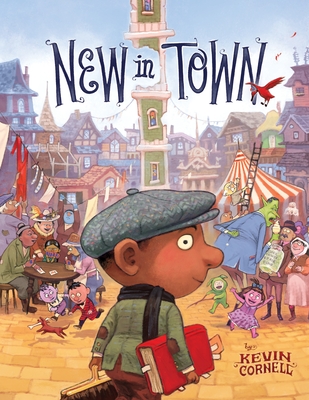
New in Town by Kevin Cornell (9780374306090)

One morning, the residents of Puddletrunk woke up to discover that their bridge had collapsed. It certainly wasn’t the first time. They were lucky to have Mortimer Gulch, who had built and replaced over 200 bridges for the town. Mr. Gulch said it was the termites again and they’d just all have to donate to replace the bridge again. He was willing to accept jewelry and cash. But the new traveling clock repairman refused to pay, instead saying he would pay by fixing the clock tower for free. So bridge #272 began construction! Everyone worked hard to build it while Mr. Gulch orated, drummed and motivated them. Then they ran out of wood, but the clock repairman had some. When he refused to share his wood with Mr. Gulch, lest it get eaten by termites, readers soon find out exactly what has been happening to the bridges. But the traveling clock repairman just may have understood it all along.

Cornell has created an atmospheric picture book of an isolated town built in a marvelously ramshackle way on a small circle of land surrounded by a pit. Readers will immediately know that Mr. Gulch is a bad guy, but they won’t quite understand how bad until it is revealed that bridges (and clock towers) are simply delicious. The quiet and reserved repairman has a plan of his own that results in a wonderfully satisfying ending, neatly solving the bridge problem in a permanent way.

Cornell’s illustrations are a delight. They play with light and dark, filling with ominous shadows. The ramshackle town is full of small details as are the people in town. The ending works particularly well because of the art, showing the height of the tower, how precarious it looks, and the rather sad wooden bridge that connects them to the world. Even the font used for the book is unusual and interesting, swirling with promise of a fantastic tale.

A great villain, quiet hero and one doozy of a solution come together to make this fantasy picture book pure joy. Appropriate for ages 4-6.

Reviewed from e-galley provided by Farrar, Straus and Giroux.

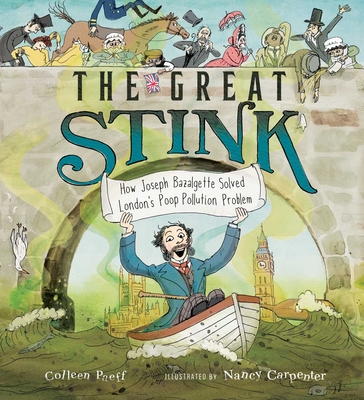
The Great Stink by Colleen Paeff

Cover image for The Great Stink.

The Great Stink: How Joseph Bazalgette Solved London’s Poop Pollution Problem by Colleen Paeff, illustrated by Nancy Carpenter (9781534449299)

It was 1858 and the Thames River in London smelled terrible. The problem was that the river was full of poop. The problem had started in 1500, when the sewers were emptied by men who shoveled them out at night. But the population kept on growing. By 1919, there were many more people in London and flush toilets are growing in popularity, but there is no way to get rid of all of the human feces, so some people connected their homes directly to the sewer, sending it all to the river. Cholera epidemics started killing thousands of people, but cholera is blamed on smelly air rather than polluted water, so they kept happening. In 1856, Bazalgette submits a plan to create large sewer pipes to take the sewage away from the river. His plan is finally approved in 1858 after a very hot summer causes the smell to get even worse.

Told with a merry tone, this book embraces the stink of history and shows how one man can change the lives of so many, rescuing them from disease and death. Paeff packs a lot of history into this picture book, making it all readable and fascinating through her use of historical quotes combined with a focused pared down version of what happened. Her writing is engaging and interesting, offering lots of information without ever overwhelming the story itself.

Carpenter’s art is just as stinky as can be. She captures the sewage entering the Thames, the miasma of stench coming off the river in the heat, and the grossness of dumped chamber pots. Against that unclean setting, a small baby is born and becomes an engineer who creates grand tunnels where the air is clear once again. Add in the macabre face of cholera and you have a book that is hard to look away from.

Fascinating, stinky and delightful. Appropriate for ages 6-9.

Reviewed from e-galley provided by Margaret K. McElderry Books.

Jukebox by Nidhi Chanani

Cover of Jukebox.

Jukebox by Nidhi Chanani (9781250156365)

When Shaheen can’t find her father anywhere, she and her cousin Tannaz try to figure out where he might have gone. They check out the vintage record store he loves, but it’s closed and the owner is nowhere to be found either. The two girls decide to break into the store and discover an unplugged jukebox. When they play one of her father’s favorite records, the jukebox takes them back in time to when the songs were being performed at a concert. At the end of the record, they are taken back to their regular lives. As the girls work to figure out why Shaheen’s father hasn’t returned, they also learn that there is a cost to time travel and one that they may have to risk to save him from the past where he is trapped.

This graphic novel for middle grades is a wonderful mixture of music and time travel. The various songs that they time travel with feature well-known musicians and then are artfully combined with social justice moments in history. The story centers on the two Indian-American protagonists who are different from one another but willing work together to solve the mystery. With a look at race and civil rights, the two girls traverse time learning a lot along the way.

The art is fresh and colorful. Using a time travel visual as well as record covers, it has a clear distinction between the modern part of the story and the historical events the girls witness.

A groovy graphic novel worth a spin. Appropriate for ages 9-12.

Reviewed from library copy.

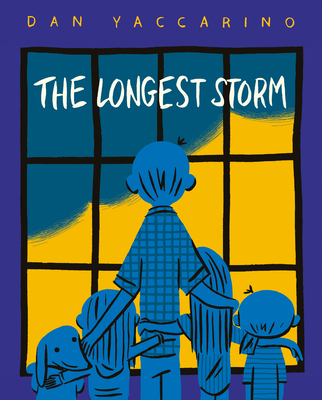
The Longest Storm by Dan Yaccarino

Cover image for The Longest Storm.

The Longest Storm by Dan Yaccarino (9781662650475)

This picture book explores the Covid lockdown in a creative and open way that also allows it to speak to other times of darkness that families experience. Covid is shown as a storm that hits and is unlike any other storm, one that forces you to be inside for an unknown length of time. The family struggles with their new time together in a house, going from feeling strange to people getting angry and staying apart from one another. That’s when the storm rumbled and lightning struck, knocking the power out. One candle lit against the darkness brought the family together. The next morning felt different with pancakes and board games and a new way forward even though they were still caught in the storm. Then one day, the sun came out again. It was possible to go outside and start cleaning up.

As I mentioned, this picture book speaks deeply to a variety of dark times felt by a family. The family goes through a complete grief cycle on the page, allowing the book to be about the loss of a parent just as easily as it is about Covid. It’s a beautiful accomplishment of writing, speaking to the universal rather than the specific and allowing us all to see the grieving process as part of Covid too.

Yaccarino often does light-hearted titles, but this one has a lot of emotions that flow across the page. He uses color and expressions to convey many emotions from the anger of being together to the loneliness of being together but separate to the relief of finding joy in one another once more.

A powerful look at Covid and loss that will speak to all of us. Appropriate for ages 4-7.

Survivor Tree by Marcie Colleen

Cover image for Survivor Tree.

Survivor Tree by Marcie Colleen, illustrated by Aaron Becker (9780316487672)

On a bustling street in New York City, a small tree grew along the tall steel buildings. It was there for almost thirty years, marking the seasons. Then one September day, there were explosions and buildings fell to rubble, crushing and burning the tree. The tree was found in the wreckage with a few green leaves and taken far away to fresh soil. For several seasons, the tree stayed bare, then one day blossoms and buds arrived. For ten years, the tree grew there until it was time to return home. Home to a newly empty sky, where people stopped and wept, and where the tree with its burns and scars offered a way to bridge past to present.

This picture book is based on the true story of the tree that survived the terrorist attacks on September 11th, 2001. Through seasons of bustling city streets to the attack itself to seasons of healing afterwards, the tree shows an inspiring resilience for us all. Using delicate prose, the author writes of the beauty of the tree even when people were not stopping to notice it. The survival of the tree is told with a gentle admiration for its very survival.

Becker beautifully captures the New York City setting of the tree as it changes from before the attack and afterwards. He offers not just a story of the tree itself but an accompanying story in the illustrations about a family growing up alongside the tree and then there loss and memories after the attack. It is this subtle human connection of people to the tree that add much to the book.

A haunting and beautiful look at 9/11 and the tree that survived it and continues to inspire. Appropriate for ages 5-8.

Reviewed from e-galley provided by Little, Brown and Company.

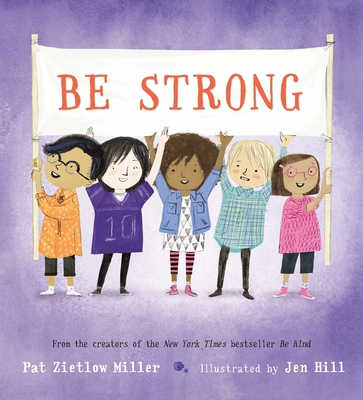
Be Strong by Pat Zietlow Miller

Cover image for Be Strong.

Be Strong by Pat Zietlow Miller, illustrated by Jen Hill (9781250221117)

Being strong doesn’t just mean that you can make it to the top of the climbing wall in gym like Cayla. The young narrator has been told by her family that being strong will get you through life when hard times hit. But some days she can’t even lift her heavy backpack. So she asks her father how she can be strong. He tells her that strength is showing up like when they help people who have lost their homes. Her mother says strength is speaking up, like when her mother worked to get a crossing guard at a busy street. Her grandmother says it means not giving up, like her starting to run. So the girl figures out what the means for her, how she can help those around her, how she can speak up and change the way things work, and how if she keeps on trying she can reach her goals both on her own and with some help.

Miller cleverly plays against the stereotypical definition of strength early in this picture book. She shows that yes, physical strength is definitely strength and then proceeds through the rest of the book to show the other aspects of strength, including resilience, determination, speaking up, setting goals, and asking for help. Miller’s text is simple and reads aloud well. She nicely walks young readers through what strength is, allowing them to see it both in themselves and others.

Hill’s illustrations show a diverse cast of characters in an urban setting. The young narrator is Black and her community of classmates and others are a variety of races and religions. The illustrations are bright and friendly, inviting readers into a world where children can make a difference.

A vibrant look at strength and community. Appropriate for ages 3-5.

Reviewed from e-galley provided by Roaring Brook Press.

Fast Pitch by Nic Stone

Cover image for Fast Pitch.

Fast Pitch by Nic Stone (9781984893017)

Shenice is the captain of the first girls softball team in the league that is entirely girls of color. There’s a lot of pressure on her to perform and to play the role of captain, inspiring others with her belief that they can not only win that single game, but also win the entire championship. As Shenice and the rest of the team put up with microaggressions and outright racism from other teams and their communities, she finds out the reason that her grandfather left professional baseball. Shenice meets her great-uncle Jack, a man savvy enough to not speak about this in front of her parents, but also elderly enough that getting the full story takes some time and effort. As her grandfather’s history is revealed, Shenice realizes that she might have a chance to clear her grandfather’s name for a crime he didn’t commit, and the reason he was pushed out of baseball entirely. Now she just has to keep focused on both finding the proof and also leading her team to victory. It may be too much for one person to handle!

Stone has created a book that speaks at once to both modern racism and then to systemic racism and its impact on Black people in the past and today. This is done in a personal way, so that readers experience the racism that Shenice and her friends are shown at their games. The clever use of family history will lead readers and the characters to explore the past and how it serves as a lens for what is also happening today.

The characters in this book are particularly well drawn. Shenice herself is determined, passionate and skilled. Uncle Jack is fabulous, funny and sly. Then there is the team, the one that stands by their captain, even getting into some trouble along the way as they all work to solve the mystery together.

Game on! Appropriate for ages 9-12.

Reviewed from e-galley provided by Crown Books for Young Readers.

A Bunch of Board Books

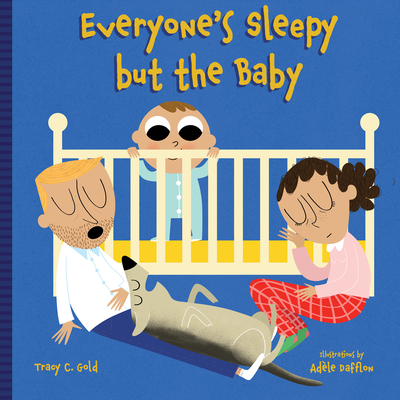
Cover for Everyone's Sleepy but the Baby
Cover for Everyone’s Sleepy but the Baby.

Everyone’s Sleepy but the Baby by Tracy C. Gold, illustrated by Adele Dafflon (9781641704403)

This honest portrayal of bedtime with a baby may be soothing to parents as much as to the baby it’s being read to. In rhyming text, this board book explores getting a non-sleepy child to bed. The rhymes are fun and manage to be silly while still being able to be read softly and quietly as a bedtime process. The illustrations show the very tired parents trying to get their little one to sleep. In the end, everyone is sleepy. Maybe even your child too!

Cover for My Heart Beats
Cover for My Heart Beats.

My Heart Beats by Rina Singh (9781459825680)

This board book is full of love for children and shares the thump of a heart beat in different languages. Told in rhymes, the languages are explained on the final pages of the book. They include Japanese, Italian, Swedish, Korean, French, and Urdu. The photographs in the book are full of smiling children infants through toddlers, interacting with an adult in their life. The result is a hug of a board book sure to make everyone smile.

Cover for New House
Cover image for New House.

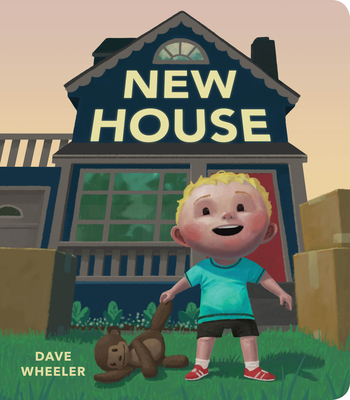
New House by Dave Wheeler (9780593224922)

Very few board books explore moving from the point of view of a toddler. This clever board book fills that gap very nicely. Told in just a few words on each page, the toddler explores his new home. It has a new door, new staircase, new carpet, and new tub. When night comes it has new dark and new shadows until he is reminded that a lot of the same things came along with them, including his parents, blanket, monkey and night light. The illustrations share a story of messiness, bath and bedtime that is sure to enchant little ones who may be making a move themselves.

Cover for The Night Is Deep and Wide
Cover image for The Night Is Deep and Wide.

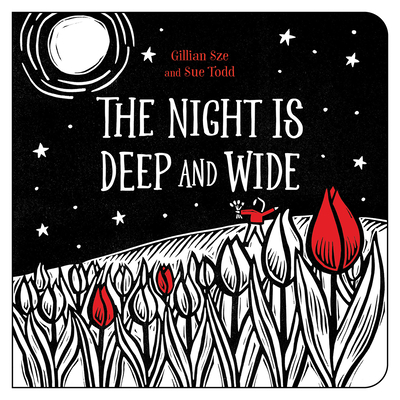
The Night Is Deep and Wide by Gillian Sze, illustrated by Sue Todd (9781459824812)

A gorgeous bedtime board book, this book uses repeating imagery and lines to soothe little ones to sleep. The structure here is more complex than most board books, written as an Italian villanelle. The cyclic pattern of the book, repeats phrases like “Moonlight falls on eyes that close” and “tulips close, row by row.” The illustrations show a child exploring their nighttime world as the tulips close around them, the songbirds curl up, and a hush settles over everything as the moonlight shines. The illustrations are equally stunning, with a woodblock feel and clever use of pops of color.

All reviewed from library copies.