Review: Cruel Beauty by Rosamund Hodge

cruel beauty

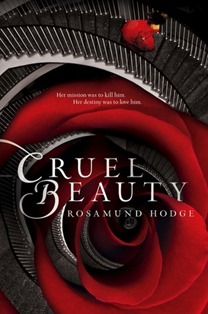
Cruel Beauty by Rosamund Hodge

A stunningly inventive retelling of Beauty and the Beast, this debut novel turns the entire tale around over and over again.  Born into a world captured under a paper sky, Nyx has been promised as a bride to their demon ruler since she was born.  Her father promised tribute when he made a deal with the demon, so Nyx is to be sacrificed.  But her sacrifice is not to be without results, so she has been trained to kill her demon husband.  On her seventeenth birthday, she is sent to live with her new husband whom she has never met in his incredible castle.  She is not expecting to be beguiled by her new husband or by his silent shadow that serves him.  But once in the realm of her husband things are different, answers are not as clear, and even the questions shift and change just like the rooms and doors in the castle.  Nyx must figure out how she can save not only her family and her world but whether her newfound love can be saved too.

I was amazed when I discovered that this is a debut novel.  The writing has a polish and steadiness that would not lead one to believe that when reading.  Hodge has managed to take the foundation of the Beauty and the Beast storyline but then transform it, writing her own original world on top of it yet never quite leaving the original too far behind.  It is a critical balance in reworking familiar stories, and Hodge manages it admirably.  She turns it into something wilder, more frightening and just as beautiful.

Nyx is a wonderful protagonist.  I love how prickly she is, how feisty and fiery.  She can stand right up to a demon and match wits with him.  Yet she is also entirely human, torn by the fact her father chose to sacrifice her, awash with a mix of love and hate for her twin sister, and at times overcome with the situation she finds herself in.  Hodge allows these opposite forces to linger, building the tension and not resolving it until the end. 

Dramatic, romantic and completely beguiling, this retelling of Beauty and the Beast will get teen hearts racing even as the world twists and turns changing the story.  Appropriate for ages 14-17.

Reviewed from digital galley received from Edelweiss and Balzer + Bray.

Review: And We Stay by Jenny Hubbard

and we stay

And We Stay by Jenny Hubbard

Emily has been sent to a private board school in Amherst so that she doesn’t have to face all of the questions at her public high school.  Her boyfriend, Paul, brought a gun to school.  Emily is sure that Paul never meant to hurt her, though he did threaten her with the gun.  She is also sure that he never planned to kill himself with it, though that is what he did.  At her private school, she doesn’t quite fit in.  She doesn’t wear the right shoes and her reluctance to talk about what happened and why she is there mid-term doesn’t lead others to get closer to her.  Emily finds herself more and more interested in Emily Dickinson whose home is in Amherst.  She starts writing poems herself, putting her grief and confusion on the page in poems that she plans to never share with anyone.  But as the days go by, she becomes closer with her room mate and other girls on campus, including one of the teachers.  It is now up to Emily to figure out how much she is willing to share of her own role in Paul’s death.

Hubbard’s writing is crystalline and brilliant.  She captures the stunned nature of sudden loss with clarity and understanding.  Emily could easily have become and inaccessible character to readers as well since she is prickly and shut down.  Instead though, Hubbard creates a space around Emily for readers to understand her and feel her pain.

A large part of this is through her poems which honor Dickinson, follow her structure and voice closely at times, and other times reveal Emily’s soul in brief lines that shine.  These poems serve as islands in a sea of pain and grief.  They are concrete and dazzlingly good.  They are bright with hope as one can see in each one Emily moving forward toward the future after putting her pain on the page. 

Beautiful writing, a strong heroine, and plenty of poetry make this a very unique and exceptional book about loss and suicide.  Appropriate for ages 14-16.

Reviewed from digital galley received from Edelweiss and NetGalley.

Review: Poem-Mobiles by J. Patrick Lewis and Douglas Florian

poem mobiles


Poem-Mobiles: Crazy Car Poems by J. Patrick Lewis and Douglas Florian, illustrated by Jeremy Holmes

This collaboration between two masters of children’s poetry will transport you to new and different places.  Filled with cars that are amazing and wild, the humor-filled poems will delight.  Visit the times of the dinosaurs, underwater driving, cars made of paper or shoes.  Even cars made from bathtubs and bugs.  The poetry flows fast and furious, a perfect pace for young car enthusiasts who may be surprised at how much they enjoy poems.

Lewis and Florian write with a single hand here, the poems flowing naturally from one to the other, the styles of each forming one cohesive whole.  They use humor to great effect both in the titles of the poems and throughout, delighting with puns and word play.  The poems are also very brief, perfect for young readers to enjoy or even memorize.

The art by Holmes plays up the humor in the poems.  His busy active style has lots of motion and zany combinations.  The dinosaur car looks like it could reach right off the page and grab you, the ocean page will have you floating along merrily, and the blueprint style of the contents page sets the tone early.

Perfect poems to share aloud with a class, this one may get lost in poetry collections but marketed correctly should zoom off of library shelves.  Beep beep!

Reviewed from copy received from Random House Children’s Books.

Review: Henny by Elizabeth Rose Stanton

henny


Henny by Elizabeth Rose Stanton

Henny was born just a little different than all of the other chickens.  She was born with arms instead of wings!  Henny liked her arms sometimes like when they flapped when she ran.  Other times, she didn’t like her arms.  Sometimes she liked being different and other times it made her feel sad and lonely.  Henny had to worry about different things than other chickens like gloves or mittens.  She tried to fit in with the other chickens, but she was always different no matter what she did.  Then one day, she caught a falling egg and started to see how many ways she could use her arms and hands.

Stanton has captured exactly what it feels like to be distinctly different from others and the transformation that can occur when you realize the good parts of being unique.  The text of the book is simple.  She uses humor throughout the book to make sure the spirit stays light, even during Henny’s darker moments of doubt.

The watercolor illustrations are also quite funny.  I particularly love the image of Henny running with her arms flapping behind her and that being one of Henny’s favorite things about her arms.  By the end of the book, you are almost surprised to see other chickens with wings since the arms suit Henny perfectly.

A great pick to start discussions about being different, the light touch here keeps the subject approachable.  Appropriate for ages 4-6.

Reviewed from copy received from Simon & Schuster Books for Young Readers.

Review: Max Makes a Cake by Michelle Edwards

max makes a cake

Max Makes a Cake by Michelle Edwards, illustrated by Charles Santoso

Max was growing up, he could dress himself, almost tie his shoes, and he knew the Four Questions for Passover in Hebrew and English.  It was his mother’s birthday and he wanted to make her a cake.  But when his little sister started to cry and Max’s dad took her for her nap.  Max waited and waited for his dad to come back to bake the cake, but his sister just kept waking up and crying.  So Max decided to make some frosting to help.  It turned out very nicely, a mix of jam and cream cheese.  Max knew that to bake a cake, he had to wait for his father.  But then he had a great idea, one perfect for Passover.

Edwards has written a story that organically incorporates Passover and its meaning.  She shows a warm and loving Jewish family with a father who takes expert care of his children.  Max’s clever solution to the cake is nicely foreshadowed in the book but is also a wonderful surprise solution that readers will not see coming.  It is also a pleasure to see a picture book about a child who solves a problem himself with creativity.

Santoso’s art conveys the same warmth as the text.  He uses humor throughout in his images, with a cheery note.  His depictions of Max are particularly well done as he solves the problem but not without a little mess.

Clever and creative, this is a welcome addition to public library’s Passover collections as well as a great choice for birthday story times.  Appropriate for ages 4-6.

Reviewed from digital copy received from Edelweiss and Random House.

Review: Why We Took the Car by Wolfgang Herrndorf

why we took the car


Why We Took the Car by Wolfgang Herrndorf

Originally published in Germany, this is a gorgeous coming-of-age story that is dark and immensely funny.  It is the story of Mike who just doesn’t fit in.  He’s considered one of the most boring people in his school, ignored entirely by girls and laughed at when he reads his writing out loud.  He’s not even invited to the best party of the year though everyone else is.  Everyone but Andre, better known as Tschick, who comes to school drunk, looks like he’s been fighting, and wears outdated clothes.  Tschick and Mike have absolutely nothing in common, but when Tschick shows up unexpectedly in a stolen car when Mike has been left home alone for an extended time, they head on a road trip that no one will ever forget.

Winner of several awards in Germany, this book is much more than a standard teen road trip book.  What could have been cardboard stereotype characters instead blossom in the hands of Herrndorf to become much more complex and intriguing.  They get more and more interesting as the book progresses, steadily revealing themselves to one another and to the reader.  It turns out that Mike is far from boring in any way and Tschick is far from any sort of stereotype.

Readers know from the beginning how the road trip ends, but the joy is in getting to that point.  I guarantee it is not a straight line!  The setting of modern Germany is one that many teens may not have explored, especially through the eyes of native Germans.  The translation is done very well, leaving it particularly European, but also making it flow for English speakers.

I am usually not a fan of road trip stories, but this is definitely one trip worth taking.  Funny with a lightness but also depth, this is a wonderful teen read.  Appropriate for ages 14-16.

Reviewed from digital galley received from Arthur A. Levine Books and NetGalley.

Review: Gobble You Up! by Sunita

gobble you up


Gobble You Up! by Sunita, text by Gita Wolf

Based on a Rajasthani folktale, this picture book is a work of art.  Jackal’s best friend is Crane, but then one day he was too lazy to hunt for food.  Jackal challenged Crane to catch twelve fish all at once.  Crane managed to do the feat, and then Jackal quickly gobbled down all twelve fish.  Crane protested and then Jackal ate Crane too.  Tortoise witnessed this, so Jackal had to eat Tortoise as well.  Squirrel dared Jackal to eat him too, and Jackal managed.  One by one, more animals get eaten and Jackal’s belly stretches and stretches.  The elephant was more difficult to swallow, though Jackal managed.  Then Jackal got very thirsty from eating all of those animals one after another.  And you will just have to read the book to see how it all ends!

The first thing that you notice about this book is that it feels different in your hands.  It has a different weight, a different balance.  It smells different.  The pages have a texture to them and the ink has body on the page that your fingers can feel.  Inside, the story is told rapidly and with wonderful sounds and reactions.  This is a story that comes from an oral tradition and you can hear it as you read it aloud.  It flows and moves.  If you are a librarian who does storytelling, get your hands on this book.

Sunita’s art is the center of the book.  Called Mandna, this art form is practiced only by women and taught from mother to daughter.  It is used to decorate the mud walls of homes and done without brushes.  The art is beautiful, richly detailed and unique.  Make sure to read the information at the end of the book for more facts about the art and how the book was made.

Unique and lovely, this is a rich folktale from a region of India that will delight and amaze.  Appropriate for ages 4-8.

Reviewed from library copy.

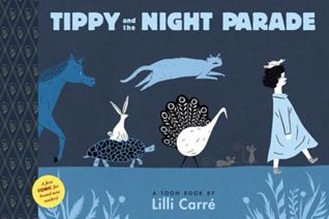
Review: Tippy and the Night Parade by Lilli Carre

tippy and the night parade

Tippy and the Night Parade by Lilli Carre

Released February 11, 2014.

In the morning when she wakes up, Tippy’s room is a complete mess.  But all Tippy remembers is falling asleep, how did this all happen?  The next night, she goes to bed as usual after cleaning up her room.  And then readers get to see exactly what happens when Tippy goes sleepwalking along a pier, across the garden, hopping on lily pads, lost in the fog and trees, down a hole, into the desert, up a mountain and back down to her window.  Just to wake up the next morning again without knowing what happened.

Carre lets her images tell the majority of the story in her debut graphic novel.  And the images are a smart mix of modern with a vintage flair.  They have a flatness to them that adds a quirky quality to the book.  They also have a great sense of humor as the parade builds in length and more animals are included.  My particular favorite is the rotund bear.  And what a parade it is, sharp-eyed readers will enjoy looking at the mess in her room and matching the animals that had joined her walk back home.

Funny and quirky, this parade is one worth marching along with.  Appropriate for ages 4-6.

Reviewed from copy received from Toon Books.

Review: Junkyard by Mike Austin

junkyard

Junkyard by Mike Austin

Two huge robots are in a junkyard where there is garbage that goes on for miles.  Then the robots start munching, eating cards, buses, planes and more.  They devour trains, chains, tires, and bicycles.  They drink paste, goo and toxic waste.  Then the story changes and the robots clean up the few things that are left behind, just one little stack.  And it’s time for something new.  The robots dig holes in the ground and plant trees and flowers.  They build a playground and dig out a lake.  They have gardens and dirt piles.  And now what once was a junkyard is a place just for you!

Done in a romping rhyme, this picture book has the appeal of huge robots and destruction.  I must admit that I was completely disarmed by the change of tone in the book when the robots changed from destruction to creation.  It was a striking choice to make in the book and one that will increase its appeal.

Austin’s art is vibrant and colorful.  He uses deep colors that are rich and pop against the white background.  The robots are friendly even as they devour planes and buses.  With the rhyme, the entire book has a playful feel that makes it work well.

A celebration of robots, destruction and making something of nothing, this is a bright and fun joy of a book.  Appropriate for ages 3-5.

Reviewed from copy received from Beach Lane Books.