Review: Love Monster by Rachel Bright

love monster

Love Monster by Rachel Bright

Love Monster lives in a world filled with soft and cuddly pastel animals and everyone loves them.  But no one loves a red, googly-eyed monster who isn’t so cute.  So Love Monster decides to head out and see if he can find someone who will love him despite not being cuddly.  Love Monster searches and searches for someone like this.  He even thinks he’s found them, but then discovers that he has not.  He’s just about to give up, but learns some things are worth working hard to find.

Bright does an admirable job of creating a book that has a very large message without it consuming the story too much.  She uses a narrator voice that is strong and individual which helps keep the book from becoming to sweet as well.  Love Monster is a great character, primarily because he isn’t a complainer and refuses to just settle for a life alone.

Bright’s art is bight and large.  Love Monster pops against each pastel page with the pages getting darker colored as the story progresses.  Finally, night has fallen and the stars come out in a black sky and Love Monster pops there too.

Monsters and love, sounds like a great Valentine’s Day book for little monsters.  Appropriate for ages 3-5.

Reviewed from copy received from Farrar, Straus and Giroux.
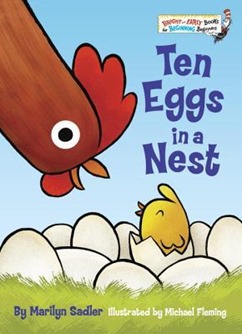
Review: Ten Eggs in a Nest by Marilyn Sadler

ten eggs in a nest

Ten Eggs in a Nest by Marilyn Sadler, illustrated by Michael Fleming

Released January 28, 2014.

Gwen the Hen laid eggs and Red Rooster was very excited to be a father.  Gwen refused to let him count the eggs before they hatched because it was bad luck.  So Red just had to wait.  When one egg hatched, he marched off to the market to buy the new chick one worm.  But when he returned home, there were two more new chicks!  He hurried back to the market after adding 1+2.  Then when he returned there were three more chicks.  1+2+3=6 newly hatched chicks and off Red hurried.  I bet you can guess what happened next!

This beginning reader nicely mixes counting and addition into the story.  Young readers will enjoy the bustling pace of the book and the tension of what Red will find upon his return to the nest.  The entire book has a warmth and sense of community that is tangible.  Simple text includes lots of numbers and remains simple for new readers throughout.

Fleming’s art is cartoon-like and very child friendly.  The colors pop on the white backgrounds, especially Red who is really a rainbow of colors including orange, purple and blue.  The oval chicks are bouncy and cute as can be. 

To sum it up, this is a great “addition” to new reader collections.  Appropriate for ages 4-6.

Reviewed from digital galley received from Edelweiss and Random House.

Review: Brimsby’s Hats by Andrew Prahin

brimsbys hats

Brimsby’s Hats by Andrew Prahin

Brimsby was a hat maker and he had a quiet life.  He had a best friend and they had wonderful conversations together over a marvelous cup of tea.  But then his friend decided that he wanted to be a ship captain and left for the sea.  Brimsby’s life changed suddenly and he was all alone.  He set out on a walk when he was feeling particularly lonely and came upon a tree full of birds trying to remove snow from their nests and keep warm.  Brimsby thought they would make marvelous friends, but the birds were too busy working to talk with him.  Brimsby headed back home after dark all alone and sat in his dark home and thought.  Can a lonely hat maker figure out how to make new friends?

This story has such a complete feel to it.  Unlike other stories about friendship that can become trite, this one has nuance and balance.  Prahin creates a central character who is believable and understandable.  He also builds the book around a universal theme.  Then he takes a different approach to the solution of finding new friends that is completely surprising and satisfying.

His art is equally pleasing with its rich colors playing against pastels.  There is a lightness to the illustrations and also a great quirky feel to them that matches the story well.  He uses perspectives and dark and light to reveal just how lonely Brimsby becomes after his friend leaves.

A thoughtful and creative look at friendship that is entirely exceptional and perfect for a wintry day.  Appropriate for ages 4-6.

Reviewed from copy received from Simon & Schuster.

Review: Defy by Sara B. Larson

defy

Defy by Sara B. Larson

This debut YA novel is a mix of romance and fantasy.  In a jungle kingdom with a cruel ruler, Alexa and her twin brother survive the murder of their parents.  Alexa has been raised by her father to fight, something very unusual for a girl in their society.  This lets her disguise herself as a boy and avoid being taken to a rape house and used by the king’s soldiers.  She becomes one of the best fighters in the prince’s guard.  But the prince is aloof and cold to everyone, never showing any interest in becoming a ruler.  Alexa finds herself guarding the prince personally after an attempt on his life.  Then she is taken hostage along with the prince and another of his guard.  She finds herself drawn to the man the prince is behind his cold exterior and also drawn to the other guard, a man she has known for years.  But how will they ever accept her as a girl when they have only known her as a man? 

Larson has created a very compelling world here.  The jungle setting is refreshing as is the kingdom ruled by fear and cruelty.  The pacing is fast, almost breakneck, making it a very riveting read.  Larson’s characters are complex as well.  In particular, the prince himself is very well drawn as a mysterious figure that is constantly revealing new aspects.  The ending is satisfying with a build up that adds to the tension.

At the same time, the book does suffer from some debut mistakes.  Alexa is constantly losing consciousness throughout the book.  She is tough as nails, except for her skull.  Then she seems to recover from long blackout periods with few ill effects.  The rape house aspect of the kingdom was not necessary for the story at all.  I hope that it becomes vital in the rest of the series, because otherwise it was a poor choice to be included.  When Alexa’s real sex is revealed, it is very anticlimactic.  For something that was seen to be life or death, the result is lukewarm at best.

While it does suffer from some plot issues, readers who enjoy fantasy mixed with romance will enjoy this new series.  Appropriate for ages 14-16.

Reviewed from digital galley received from NetGalley and Scholastic.

Review: A Book of Babies by Il Sung Na

book of babies

A Book of Babies by Il Sung Na

A duck takes readers on a tour of different sorts of animal babies.  The duck heads around the world, visiting baby lions, baby lizards, baby polar bears, and baby kangaroos among many others.   A trait of each baby is mentioned to distinguish them.  Baby zebras walk right away.  Fish are born with lots of brothers and sisters.  Seahorse fathers carry their babies in a pouch.  These small details add up to a kaleidoscope of different animals and offer lots of opportunities for parents to talk more about each animals as they share the book.

This author of The Book of Sleep always fills her books with rich illustrations.  Here her gentle poem carries the duck from one place to the next, but it is the illustrations that make this such a special gem.  Done in mixed media, they feature a variety of textured papers that become ice bergs, tree trunks and even the sky.  He manages to make colors that seem to emit light, glowing on the page. 

Perfect for toddler bedtimes, this book is radiant with baby animals.  Appropriate for ages 1-3.

Reviewed from copy received from Random House Children’s Books.

Review: Henri’s Scissors by Jeanette Winter

henris scissors

Henri’s Scissors by Jeanette Winter

When Henri-Emile Matisse was a young boy, he longed to make art the way his mother did. So he drew as much as he could and then painted after receiving paints as a gift.  But when he was on old man, he had to remain in bed or a wheelchair and didn’t have the energy or ability to paint.  As he recovered, Matisse started to draw and then picked up a pair of scissors and started cutting paper.  Matisse started a second phase of his art career with assistants who painted pages for him to cut from, dreams of the shapes to cut out, and surrounded by the bright colors of his art.  He created a garden that he could visit right from his bed. 

Winter starts with Matisse as a boy finding art and quickly moves the book to his paper cutting phase in the latter part of his life.  For a picture book biography, the text is very simple yet conveys his great attachment and gift for creating art.  It also speaks to the creative process and trying new things that fit with life’s limitations. 

Winter fills her book with bright colors both in Matisse’s art itself but also as the backgrounds to her images.  When Matisse is without art, the book becomes dark yet star-filled.  As he returns to creating pieces, the book lightens and blossoms visually.

A very successful picture book biography, this book will be welcome in elementary and preschool art classes.  Appropriate for ages 4-6.

Reviewed from copy received from Beach Lane Books.

Review: 1000 Things about Holland by Jesse Goossens

holland 1000 things about holland 

Holland and 1000 Things about Holland by Jesse Goossens and Charlotte Dematons

Breathtakingly lovely, this is a unique way to approach explaining a country to children.  There are two volumes in this set and they must be read together but how you do that is up to you.  One volume, Holland, is all images of Holland showing different scenes and parts of the nation and culture.  The illustrations are large, two-page spreads filled with small details.  In the second volume, the details in the illustrations are explained.  Pulling out various elements of the images, many things are revealed from favorite foods to festivals to children’s book characters.  There are paragraphs on each element so that readers truly start to understand Holland. 

This book would not work in the same way without this format.  Taking the time to linger on images makes for almost a journey to Holland as if you are gazing out a window and taking it all in.  Then when you begin to wonder about something, you can turn to your guidebook and see what it is with wonderful details.  But it is that first immersion visually that makes the entire set work so well and be so compelling. 

A wondrous visit to Holland, this book set demonstrates why innovation in children’s book making is so important.  Appropriate for ages 8-12.

Reviewed from copies received from Myrick Marketing & Media.

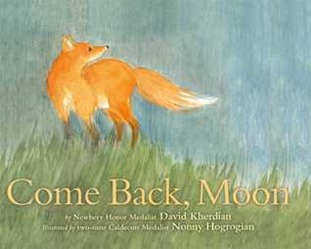
Review: Come Back, Moon by David Kherdian

come back moon

Come Back, Moon by David Kherdian, illustrated by Nonny Hogrogian

In this quiet book, Bear blames the moon for not being able to fall asleep.  So he pulls it out of the sky.  Fox notices that the moon is gone and so do Skunk, Opossum and Raccoon.  Crow asks Fox why he doesn’t know where the moon is, since he’s so clever.  So Fox takes them all to talk to Owl who is wise.  Owl knows where the moon is, since he saw Bear take it.  So they head off to retrieve the moon from Bear.  But how will they get it away from him?

This book has a wonderfully clear and simple story line that makes it ideal to use with toddlers.  It also has a deep quiet to it that will work for good bedtime or naptime reading.  Kherdian uses repetition throughout the story, having the different animals share ideas and echo back decisions. 

Hogrogian’s art also has that simple style.  She has wonderful images like the one on the cover that speak to the darkness and loss of the moon.  Her animals are realistically depicted and appear against white or tan backgrounds with few details. 

There is a place for quiet books for small children and this one has just enough activity to keep it moving too.  It would make a great board book.  Appropriate for ages 1-3.

Reviewed from copy received from Beach Lane Books.

Review: Wild by Emily Hughes

wild

Wild by Emily Hughes

When the baby girl was found in the woods by the animals, the entire woods took her in.  Bird taught her to talk.  Bear taught her to fish.  Fox taught her how to play.  Everything was good, until she met some people in the woods.  They took her home with them.  A famous psychiatrist took her in and tried to make her civilized.  They combed her hair, tried to teach her to speak, frowned at her table manners and didn’t appreciate the way she played.  Everything they did was wrong.  The girl was not happy at all.  But then one day, she found her wild once more. 

Told only in brief sentences, Hughes lets her art tell much of the story here.  And what a glorious story it is.  It’s the story of a child perfectly at home in the wild and with the animals.  She doesn’t long for society or civilization in any way.  She’s the opposite of many classic book characters like Curious George.  She rejects the rules and substitutes her own.

The art has a wonderful wild quality as well.  It is lush and filled with details.  The woods have a flowing green that is mesmerizing.  Once the humans enter the story, things become more angular and rigid.  The return to the woods is beautiful and completely satisfying. 

Hughes has tapped into what every child dreams of, living in the woods with the animals and thriving.  Everyone who reads this will want to be wild themselves.  Appropriate for ages 3-5.

Reviewed from library copy.