Review: Winter Is for Snow by Robert Neubecker

winter is for snow

Winter Is for Snow by Robert Neubecker

A brother and sister have very different reactions to the newly fallen snow outside.  The boy opens the curtains and quickly announces that “Winter is for snow!”  But his younger sister is not convinced.  The boy tries and tries to explain how wonderful winter can be, but she remains grumpy.  She does get on her coat, books, hat, mittens and more to head outside though, still protesting about how it is too cold outside and she’d rather watch TV.  Once the two reach the sledding hill, her resistance is starting to crumble and she puts her tongue out to catch some snowflakes.  Back home warm in front of the fire, it is now her turn to talk about how amazing winter and snow are. 

Written in clever rhymes, the book also has a wonderful rhythm to it that makes it great fun to read aloud.  The entire book is written in the dialogue of the two children as they go back and forth about winter.  The little boy has so many examples of why winter is incredible, including ones from the Arctic, sledding and skating, snowmen, and holidays.  It is a wonderful, jolly take on winter that we don’t see enough.

Neubecker’s illustrations are simple and large, perfect for sharing with a group.  The two children have bright orange hair, and more colors come in when the outdoors is shown.  I love that winter outside is more than blues and whites, it is filled with the colors of a community celebrating snow themselves.

This is a great book to share for a non-holiday winter story time with its rhyming text and exuberant love of snow.  Appropriate for ages 2-5.

Reviewed from library copy.

Review: Africa Is My Home by Monica Edinger

africa is my home

Africa Is My Home: A Child of the Amistad by Monica Edinger, illustrated by Robert Byrd

Based on a real person from history, this fictionalized account is told through the eyes of Margru, one of the few children aboard the Amistad.  Due to a famine in Mendeland, West Africa, Margru’s father was forced to pawn her out to feed the rest of the family.  From there, Margru is taken captive and put upon a slave ship with many other people heading for a plantation in the Caribbean.  But on the journey, the captive men rebelled against their captors and took over the ship, attempting to sail it back to Africa.  Deceived by the ship’s navigator, they landed in Long Island, NY and the adults were put on trial.  The children were kept as witnesses to the crimes aboard the ship.  Margru longed for her African homeland but also ended up learning not only to read but graduating from college as a teacher.  This is Margru’s story of fear, bravery, slavery, captivity and freedom.

Edinger beautifully captures this famous moment in history from Margru’s point of view.  The use of the first person perspective makes the book read as easily as fiction, but throughout the reader can also feel the weight of the historical research behind the story.   The use of historical information throughout the book is very helpful and combined with that first person view it is a book that is compelling reading with a heroine who is equally fascinating.

Byrd’s art is stunning.  He uses moves gracefully between historically-accurate images that capture important historical moments to more stylized pictures that flow with lines and dream of Africa.  He starkly contrasts the worlds of the greens of Africa and the cold, formality of the United States. 

Beautifully written and illustrated, this book gives a first-person account of the Amistad, looking beyond the revolt into the trial and what happened to one little girl caught in history.  Appropriate for ages 8-10.

Reviewed from library copy.

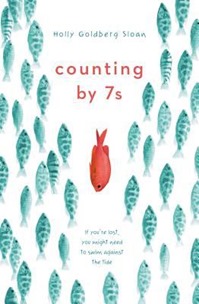
Review: Counting by 7s by Holly Goldberg Sloan

counting by 7s

Counting by 7s by Holly Goldberg Sloan

Willow Chance didn’t fit in well at her elementary school, so she is attending a middle school across town which none of her previous classmates will be attending.  But Willow is just not made to fit in with others.  She does fine with her adoptive parents who are accepting of her obsession with gardening and medical conditions as long as she doesn’t tell them everything since that would make them worry.  And one of the things she doesn’t tell them is that the middle school thinks that she cheated on a major standardized test because she got a perfect score.  So she is sent to counseling though Dell, the school counselor has no idea what to do to help her.  Two siblings who also go to see Dell have their own ideas though and that is how Willow comes to be out driving with Dell and the others when she finds out that her parents have been killed in a car accident.  Now Willow has lost her parents, her home, her garden and her will to explore.  This is a story that is about community, building your family one person at a time, and the wonder of what having people in your life that care can do.  It is the story of the amazing Willow Chase.

Sloan’s writing verges on verse at times with its short lines, lined up neatly and speaking profoundly and honestly.  It is writing that examines and explores but also moves the story forward at speed.  It is imminently readable with plenty of white space and few if any dense paragraphs of text.  Rather it has a wonderful lightness about it, even when describing tragedy.  And this book is filled with loss and grief that is handled with a gentle depth.  Yet it is also a book filled with joy and overcoming odds and inspiration. 

Sloan creates not just one incredible character in this novel but an entire group of them.  At first the book seems disjointed with the various perspectives shown, since we get to see things not only from Willow’s point of view, from the other teens, but also from the adults as well.  But those disparate parts come together in a way that a book from just Willow’s point of view never could have.  They add an understanding of Willow’s appeal to others that would not have been possible without it.

This is a tragic story with an indomitable heroine that will leave you smiling through the tears.  Appropriate for ages 9-12.

Reviewed from library copy.

Review: Year of the Jungle by Suzanne Collins

year of the jungle

Year of the Jungle by Suzanne Collins, illustrated by James Proimos

Collins, author of The Hunger Games series, takes on a completely different writing challenge in this autobiographical picture book.  Suzy’s father is sent to fight in Vietnam when she is a little girl.  He will be gone for a year, but Suzy isn’t sure exactly how long a year is.  At first, her father sends lots of friendly postcards, but over time they change.  He even mixes up her birthday with her sister’s something he would never have done if he was home.  The the postcards stop altogether and Suzy catches a glimpse of the war on TV.  She starts to forget what her father looks like and is scared of many things.  Then suddenly, her father is home.  But he doesn’t look the same and doesn’t act quite the same either.

This book is so timely for children dealing with deployments in their own family.  Collins writes directly from her childhood persona, delving right into the fears that haunt children, the loss of control and the lack of contact.  It is her writing that makes this book work, her honesty about her emotions and the frankness with which she grapples with the challenges of having a parent fighting overseas.

Proimos’ illustrations are cartoony and rough.  The most successful are double-spreads that take on Suzy’s fears directly, placing them on a black landscape that is filled with tanks, animals, helicopters, and more.  They emanate danger and contrast directly with the more colorful other pages.

Though the book is about Vietnam, it has a universal message for children left behind worried about a deployed parent.  Timely and honest, this is a book that belongs in every public library.  Appropriate for ages 6-9.

Reviewed from copy received from Scholastic Press.

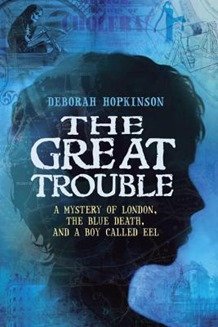
Review: The Great Trouble by Deborah Hopkinson

great trouble

The Great Trouble: A Mystery of London, the Blue Death, and a Boy Called Eel by Deborah Hopkinson

Things have been a lot worse for Eel in the past, he now has a place off of the streets where he can sleep safely and he only goes to the River Thames to dig for things to sell to make ends meet.  He has serious responsibilities that he keeps entirely private.  It helps that he faked his own death to get Fisheye Bill Tyler off of his trail.  But Eel still keeps his street smarts and listens, so he knows that Fisheye is back after him.  Then in the summer of 1854, his entire world turns upside down and the Great Trouble begins as the Blue Death of cholera comes right into his neighborhood in London.  Everyone knows that it is spread through the air, but one doctor, that Eel does small chores for, thinks differently.  Now it is up to Eel to help the doctor prove that it is the water that carries the disease before hundreds more die.

Celebrating the visionary Dr. John Snow on the 200th anniversary of his birth, this book successfully mixes historical fact with historical fiction resulting in a dynamic book with engaging characters.  At the outset of the book, Hopkinson takes care to make sure that readers understand what living in poverty and parentless was like in Victorian England.  She shows the filth, the danger, the loneliness and the skill that it took to survive. 

Eel is a wonderful protagonist.  He is incredibly smart, driven to help those he cares for, and a mixture of brave and desperate, something that keeps him at the center of this medical mystery.  Hopkinson does a great job of keeping all of her characters true to the time period, offering no modern sensibilities into the equation, but presenting it just as it would have been. 

This is a dark and thrilling novel that will not let you escape until the epidemic is over and the mystery solved.  Appropriate for ages 9-12.

Reviewed from copy received from Random House Children’s Books.

Review: Battle Bunny by Jon Scieszka and Mac Barnett

battle bunny

Battle Bunny by Jon Scieszka and Mac Barnett, illustrated by Matthew Myers

Gran Gran has given Alex a very saccharine sweet birthday book filled with bunnies as a gift.  But Alex is clearly not a fan of the original book since he takes his pencil and makes lots of changes so that it’s a book that he wants to read.  Birthday Bunny is turned into Battle Bunny, complete with helmet, utility belt and walkie talkie.  His goal is to unleash his evil plan on the forest and the world that only a boy named Alex can prevent.  Expect danger, cut-down trees, epic battles and much more as Alex tries to defeat the evil that is Battle Bunny!

Told and drawn in layers, this book is something very special. First you have the rather sickly sweet story underneath that celebrates Birthday Bunny’s birthday with lots of dancing and balloons.  It’s silly, friendly and pure sugar.  Over the top of that comes the brilliance of the writing of Scieszka and Barnett who manage by changing a few words in every sentence to make an entirely different story.  Most sentences just have a few words changed, but others towards the end are more edited to really let the story flow.  It works so well that one can forget the words underneath until you eye snags on one and you just have to read a bit of the silly story that has been edited. 

Myers’ art is equally successful.  He takes a dance scene and deftly turns it into an epic battle but one where you can still see the dancing underneath.  On some pages little comics are added in the white space so that more story can be told.  The cutesy nature of the underlying story is captured in his illustrations and one can feel the glee with which he reworked them just as a little boy would.

These three gifted book creators truly channeled their inner children to create this book.  It is funny, smart and immensely creative.  Appropriate for ages 4-7.

Reviewed from copy received from Simon & Schuster Books for Young Readers.

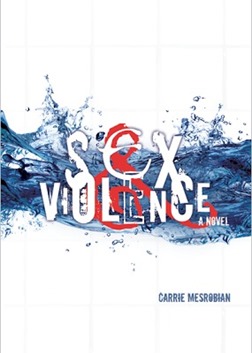
Review: Sex & Violence by Carrie Mesrobian

sex and violence

Sex & Violence by Carrie Mesrobian

Evan had always been the new kid at school, but he found advantages to that.  In each new school, he knew just which girls would be the ones to say “yes” and have sex with him.  That all changes when he picks the wrong girl at a private school in North Carolina and ends up savagely beaten in a boys’ restroom.  Evan’s father, who has been absent physically and emotionally since his mother’s death when he was a child, moves them to a lakeside cabin in Pearl Lake, Minnesota.  As his body starts to heal and scars start to form, Evan also has to deal with the damage to his mind.  He can no longer take showers because they evoke the same terror as the attack.  And even sex is so mixed with guilt and fear that it holds little appeal.  Pearl Lake is quiet but also filled with teens who know everything about one another but nothing about Evan, and that’s just the way he likes it.  Or is it?

This novel looks deep into what happens psychologically after a physical trauma.  Mesrobian handles dark issues with a certain tenderness, yet never shies away from the trauma itself.  While details of the attack are shared in snippets throughout the novel, they are not lingered over and sensationalized.  This is far more a book about a boy who survives and grows, combined with the agonies of change along the way. 

Evan is a wonderfully flawed protagonist.  The book begins just before the attack but with a prologue that foreshadows what is going to happen.  Evan is entirely detestable at this stage, a boy who screws girls just for fun, feeling little to no connection with them emotionally.  He convinces himself he is right about the way he is treating Collette.  Then early in the book, the attack comes, and Evan is transformed in a matter of pages into a character worthy of sympathy.  This sort of complexity runs throughout the novel which provides no easy answers but lots to think about.

Another great character is Baker.  She is a smart senior who is sexually active and even describes herself as sexually aggressive.  She and Evan almost immediately form a friendship that deepens over the summer.  She stands as one of the most honest and beautifully written teen girls I have read in a long time.  I love that she is not scared of expressing her sexuality, that her life doesn’t fall apart because of it, and that she is still feminine, smart and kind.  Amazing characterization!

This novel asks tough questions, changes underneath you, demands that you think and never gives concrete answers to the questions it asks.  Beautifully written, complex and brilliant.  Appropriate for ages 16-18.

Reviewed from library copy.

Review: Little Fish by Ramsey Beyer

little fish

Little Fish: A Memoir from a Different Kind of Year by Ramsey Beyer

This graphic novel takes real journals, collages, lists and drawings to show the author’s transitional first year of college.  Ramsey grew up in very small Paw Paw, Michigan.  She was an artist from a young age and worked very hard at it, earning a spot in one of the top art schools in the country.  This meant moving to Baltimore and making new friends for the first time since she was a young child.  It also meant that she would no longer be the best artist around, she would be challenged as an artist in her classes, and she would have to find her own way in this new setting.  Beyer’s novel shows the difficulties and triumphs of a freshman year of college, and is sure to encourage other little fish to try their luck in the big city.

Beyer’s use of her own personal real-life work that comes directly from that time in her life makes this entire novel work.  It carries a weight that it would not have without that honest voice of youth at its core.  The mixed media format also makes the entire book compulsively readable.  Since you never know what is on the next page or what format it might be in, there is a constant desire to find out more and read longer.

Beyer’s art is done entirely in black and white in the book.  She plays with light and dark throughout, capturing both the loneliness of the first days at college and also the dynamic friendships and love interests that come later.  Her work is humorous and yet poignant.

This is a very strong, dynamic look at the first year of college.  Teens will enjoy looking into their own future plans with a little laughter and lots of optimism.  Appropriate for ages 13-16.

Reviewed from library copy.

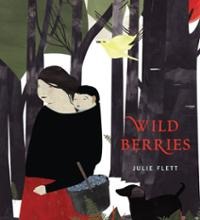
Review: Wild Berries by Julie Flett

wild-berries

Wild Berries by Julie Flett

Clarence has gone berry picking with his grandmother since he was a baby.  Now he is big enough to carry his own bucket as they walk and sing.  The two of them pick the berries, Grandma looking for the sweet ones and Clarence for the bigger, sour ones that pop.  They pick the berries and eat the berries.  Then Clarence looks around the woods and sees different insects, spiders, and a fox.  It is time to go home, they say thank you and walk back home together.

This book weaves Cree into the story, separating the words out and providing pronunciation information at the end of the book.  Even these few Cree words evoke a different feeling, a new rhythm that is powerful.  Flett tells a very simple story here about going out to pick berries in the forest.  Yet it is a timeless story, one the embraces wildlife, the environment, and giving thanks for the bounty of nature. 

Flett’s art is a beautiful mix of cut paper collage, texture and painting.  She manages to show the depth of the woods without darkness.  She uses bright colors that pop on Grandma’s red skirt and the red sun in the sky.  The grass is drawn in individual blades and the tree bark varies from paper art to marker lines.  Put together, it is a rich and beautiful book.

Simple, powerful and honest, this picture book celebrates Cree and nature together.  Appropriate for ages 2-4.

Reviewed from library copy.