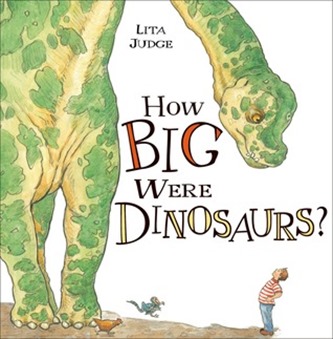
Review: How Big Were Dinosaurs? by Lita Judge

how big were dinosaurs

How Big Were Dinosaurs? by Lita Judge

Whenever you think of dinosaurs, they are like the one on the cover of the book.  Huge, green and either placid plant eaters or ferocious meat eaters.  This nonfiction picture book takes a look at dinosaurs that are quite different.  There is the microraptor who is the size of a chicken.  The long-named Leaellynasaura stood as tall as an emperor penguin and lived in that same climate.  Of course there were bigger dinosaurs too.  The akylosaurus stood as tall as an SUV.  There were dinosaurs with huge claws that ate plants, ones with armor and still others with odd parts of the body that no one understands yet. 

Judge carefully chooses her dinosaurs in this book.  Understanding that the littlest dinosaurs lack the vibrant punch of the huge ones, the book quickly changes to the more imposing creatures.  She shares just enough about each dinosaur to make the book readable.  In fact, this is one nonfiction picture book about dinosaurs that could be shared at a storytime or aloud in a unit.  Judge packs lots of fascinating facts into the book.  It ends with the science behind figuring out what dinosaurs used to look like and a fold-out page with all of the dinosaurs in the book shown next to each other with lots of numbers and facts.

Judge’s playful illustrations are great fun.  Throughout the book, she uses humans to show the scale of the dinosaurs as well as other animals.  The humans don’t just stand next to the dinosaurs, they interact and react to them.  I particularly enjoyed the image of the woman batting at a dinosaur with a broom.  It’s those little touches of humor that suit this book so well.

Readable, fun and filled with science, this book on dinosaurs will be a welcome addition to those crowded shelves.  Appropriate for ages 4-7.

Reviewed from copy received from Roaring Brook Press.
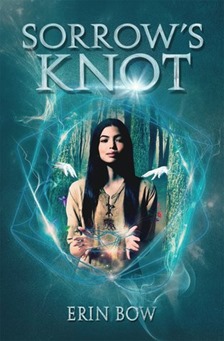
Review: Sorrow’s Knot by Erin Bow

sorrows knot

Sorrow’s Knot by Erin Bow

The dead live in every shadow.  There are small dead and larger dead, but they are all dangerous.  That’s why the women of the Shadowed People have binders, members of their tribe who are able to use knotted string to turn the dead away and even destroy them.  Otter is a binder, daughter of Willow, one of the strongest binders ever.  As she spends the last of her childhood playing with her two best friends, Cricket and Kestrel, she is almost entirely carefree.  Then Cricket is attacked by one of the dead, and suddenly life is not so simple.  The wards around the town seem weaker, and Willow is slowly becoming insane as her power to bind turns inside out.  As one of the strongest dead, a White Hand, stalks the village, Otter’s must find her own role not only as binder but as a woman of the Shadowed People.

This is the second YA book by Bow and it is a stunner.  First, you have the fact that it is entirely unique.  It’s a horror novel set in the distant past and populated by aboriginal tribes.  The entire world that Bow has created is well developed and manages to be familiar yet profoundly different from anything you have read of before.  Then you have the characters, who are strong and amazing.  There is Otter, the brave and proud girl who transforms into a woman before your eyes, but not before facing the horrors that are plaguing her world.  Kestrel, the ranger, who is also brave but loves deeply and ferociously too.  And Cricket, the storyteller, quick-witted and one of the few boys in the village of women. 

It is Bow’s writing that really sings throughout the novel.  It is her writing that shows us the world she has built, lets us love these characters so deeply, and allows us understand the danger and horror as well.  Here is a quote from page four, early in the book, that shows her skill in creating a place:

So Otter was born, and so she came to girlhood, among Shadowed People, the free women of the forest, in the embrace of mountains so old they were soft-backed, so dark with pine that they were black in summer.  A river came out of those mountains, young and quick, shallow and bone-cold.  Where it washed into a low meadow, the people had cleared the birch saplings and scrub pines and built a stronghold of sunlight.

Her voice is that of a story teller, filled with rhythm and intention.  She captures the setting she has created in just the style of her writing.

Unique and amazing, this book offers a fresh take on horror and an incredible teen heroine who faces death in many ways.  Appropriate for ages 13-16.

Reviewed from ARC received from Arthur A. Levine Books.

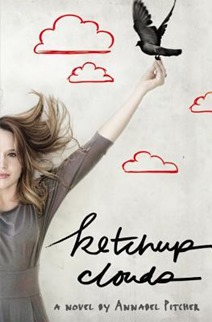
Review: Ketchup Clouds by Annabel Pitcher

ketchup clouds

Ketchup Clouds by Annabel Pitcher

Zoe stays up late at night and writes to her pen pal, a Texas death row prisoner who murdered his wife.  He is the only one with whom she can share her dark secret:  she too killed someone.  Zoe slowly reveals her story, including her own role in a boy’s death and living with the aftermath of having done it.  Zoe’s story is one of being drawn to two boys, using one against the other, and the startling result of her betrayal.  It is a story of love that is beyond the expected, first romance that is tortured but desperately real, and the wounds left behind that are impossible to heal.

Pitcher, author of My Sister Lives on the Mantelpiece, has returned with a beautifully written second novel.  She lays bare Zoe as a character, giving her the space to reveal herself in all of her remorse and conflict.  Here is one of my favorite passages in the book:

I’d do anything to forget.  Anything.  Eat the spider or stand naked on top of the shed or do math homework every day for the rest of my life.  Whatever it took to wipe my brain clean like you can with computers, pressing a button to delete the images and the words and the lies.

But perhaps what Pitches does best in this novel is to build tension and doubt.  Throughout the book until the final reveal, readers do not know which of the boys died.  Pitcher writes in a way that lets readers fall for both of them for different reasons, so that either one’s death is a grand tragedy and something to destroy lives. 

This is a book that is burning and compelling.  It is a book that is beautifully honest, vibrantly written.  This is Zoe’s heart on a page in all of its wounds and glory.  Appropriate for ages 14-17.

Reviewed from digital copy received from Little, Brown Books for Young Readers and Edelweiss.

Review: Parrots Over Puerto Rico by Susan L. Roth

parrots over puerto rico

Parrots Over Puerto Rico by Susan L. Roth and Cindy Trumbore

This exceptional nonfiction picture book tells the story of the Puerto Rican parrot.  It is a bird that has flown over Puerto Rico for millions of years but almost became extinct in the 1960s.  The book tells of the changes that came to Puerto Rico and its environment thanks to settlers, wars, hunting, and foreign invasive species.  Forests began to disappear too, so the parrots were limited to living in just one place.  By 1967, only 24 parrots lived in Puerto Rico.  With them almost extinct, people started trying to save the parrots.  The book tells the story of rescued parrots, storms and the dedicated scientists who figured out how to save this species from disappearing entirely.

Roth and Trumbore tell this story deftly.  They focus on what was almost lost, a sky crowded with these blue and green birds.  The book explores the history of Puerto Rico, tying it closely and innately into the story of the parrots themselves.  The entire book is fascinating and becomes even more compelling when the story turns to the rescue efforts.  Small victories such as saving a young parrot’s wings are celebrated, while the larger effort is also looked at in detail. 

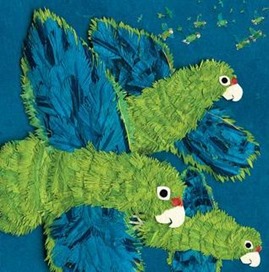
Roth’s collages are exquisite.  She captures the beauty of the birds, as you can see from the cover image above, but also the beauty of Puerto Rico itself with all of its lush greens.  The book is beautifully designed as well.

A dazzling nonfiction book that will be welcome in classroom discussions and units about conservation and environment.  Appropriate for ages 7-9.

Reviewed from digital copy received from Lee & Low and Edelweiss.

Review: Snowcial by Chelsea Prince

snowcial

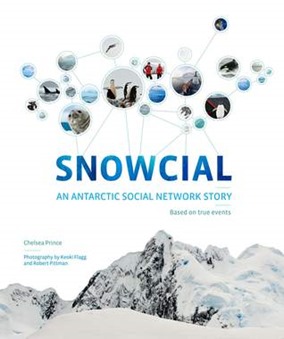
Snowcial: An Antarctic Social Network Story by Chelsea Prince, photography by Keoki Flagg and Robert Pittman

This nonfiction book follows the journey of a family to visit the Antarctic Peninsula.  They travel aboard an icebreaker ship that has an ice breaking hull but sails only in warmer temperatures.  Along the way, the children in the family, Anna and Rory explore the ship.  They watch the different birds that follow the ship and find out information on their habitat and how they survive out at sea.  Soon they are seeing icebergs, glaciers and lots of snow and ice.  They also get to visit places where penguins and seals live.  They even spot some killer whales hunting in the ocean.  A mix of science and exploration, this book invites readers along on a journey to an icy world that is full of life.

Price sets just the right tone with her book.  She writes with a merry voice, one that invites children reading the book to learn right alongside her and her characters.  Throughout the book there is a sense of adventure and a strong tie to information and science.  This is a book that teaches in an easy and welcoming way.

While Price sets the tone, the incredible photography from Flagg and Pittman truly capture the setting.  Their close ups of wounded penguins, hunted seals, and the activity of a penguin colony truly allow readers to see Antarctica up close.  Their photography is visually beautiful but also a way to learn more about this incredible place.

Brilliant science nonfiction, join the journey to Antarctica with this gorgeous book.  Appropriate for ages 7-9.

Reviewed from copy received from Chelsea Print and Publishing.

Review: Freakboy by Kristin Elizabeth Clark

freakboy

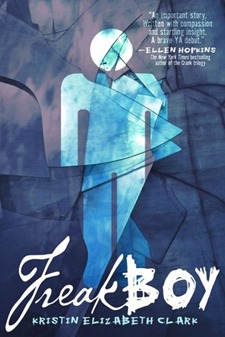
Freakboy by Kristin Elizabeth Clark

On the surface, Brendan has it all together.  He has a hot girlfriend, he wrestles on the high school team, and he has a great younger sister who adores him.  It is under the surface that Brendan struggles, because he feels like a boy inside sometimes and other times like his entire body is wrong and that he is a girl.  As Brendan’s life spirals, he meets Angel, a transgendered teen who now lives as a girl.  The two bond over video game playing, carefully stepping around the larger issues for a long time.  But Brendan’s spiral turns darker and more destructive and having one understanding friend may not be enough to save him from himself and his despair.

Told entirely in verse, this book captures the world of a teen experiencing a different gender than the one he was born with.  The story is told in three voices:  Brendan, his girlfriend Vanessa, and Angel.  In this way, readers get to see not only Brendan’s personal story and evolution, but also the way that it impacts people he loves.  Angel serves as a vision of a possible future that is positive and yet complicated. 

Clark doesn’t shy away from anything in this book.  Sex and sexuality are discussed frankly and with beautiful details that add radiance and wonder.  She also does not make things easy.  Gender is shown in all of its complexity and as a full spectrum.  One brilliant character is Vanessa, a girl who is a high school wrestler but also one that is flirtatious and womanly.  Readers may not realize it at first, because Clark handles it gently, but Vanessa speaks to her own form of gender expression.

A powerful blazing novel that gives insight into teens struggling with gender variance and also offers a book where those teens can see themselves and a way forward.  Appropriate for ages 14-18.

Reviewed from copy received from Farrar, Straus and Giroux.

Review: The Story of Fish & Snail by Deborah Freedman

story of fish and snail

The Story of Fish & Snail by Deborah Freedman

This is the story of Fish and Snail who were great friends.  Every day, Snail would wait for Fish to return with a new story.  This time, Fish returned with a great story, one so wonderful that Fish wanted to show Snail instead of tell about it.  But Snail doesn’t want to leave the book they are in.  Snail wants to stay right there and play kittens instead of pirates.  The two start to argue and finally Fish declares that it is THE END and leaves the book.  Snail was so sad.  This was not the way the story was meant to end.  So Snail leans farther outside of the page and sees Fish in a watery book below.  Will Snail leave his safe book and dare to tumble down to the other ocean below?  Will Fish return with more stories?

Freedman captures a story-within-a-story here with her setting of two characters living not just in one picture book but many.  It is the story of two opposite characters who still manage to be friends, most of the time.  There is the sedentary Snail who longs for the stories but not the real adventure.  Then there is the irrepressible Fish who jumps and leaps literally off of the page.  The pair make for a balanced friendship but also one with plenty of room for misunderstanding too.  Their conversation and fight are written strongly and honestly.

Freedman’s art is gorgeous.  Readers will recognize her as the author and illustrator of Blue Chicken.  She uses similar splash effects in her art here.  The blues are gorgeously green and filled with light.  When Fish swims the bubbles take on a stronger form as Freedman lets the watercolor dapple the page.  There is one beautiful image of Snail looking down to the other book that plays with perspective cleverly.

I’ve heard Caldecott rumblings for this one and with its playful yet artistic illustrations, I’d love to see that.  In the end though, it’s also a great story about friendship, books and being willing to take risks.  Appropriate for ages 3-5.

Reviewed from copy received from Viking.

Review: A Single Pebble by Bonnie Christensen

single pebble

A Single Pebble by Bonnie Christensen

Mei wished that she could travel to the market with her father, but she had to stay behind and care for their silk worms.  So Mei gave her father a jade pebble to take along and give to a child at the end of the Silk Road.  Though her father was only traveling part of the road, Mei was sure that her pebble could go all the way to the end.  Mei’s father gave the pebble to a traveling monk who was heading further west on the road.  The monk in turn gave the pebble and his flute to a young man who was going even farther west.  And so the pebble headed west from hand to hand and other objects joined it in a collection from “a girl in the land where the sun rises.”  Finally, after many hands and many people had cared for the pebble, it reached the hands of a young pirate who returned home to his family.  His son in Italy received that pebble at the same time that Mei got a piece of blue glass that their city in Italy specialized in.

Set in the 9th century, this book pays homage to the various peoples and communities, nationalities and religions along the Silk Road.  Readers will get a great sense of the length of this trading route thanks to Christensen’s story that makes it very concrete and connected.  The book also celebrates a good story, where the gifts multiply and all because the story surrounding them becomes more and more compelling as the pebble moves farther from home. 

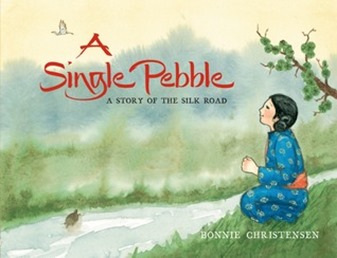
Christensen’s art changes throughout the book.  The early pages are softened by the watercolor river and hazy trees in the backgrounds.  Moving further into the book, the images become more crisp and clear as the desert takes over the story.  The softness returns in Italy again with a different light than the one in China.  It is all delicately done and evokes both a connection between the two places but also real differences too.

A rousing journey of a book, this story is a celebration of the Silk Road.  Appropriate for ages 5-7.

Reviewed from copy received from Roaring Brook Press.
Review: Fraidyzoo by Thyra Heder

fraidyzoo

Fraidyzoo by Thyra Heder

It’s the perfect day to go to the zoo and the whole family is excited.  Well, maybe not the whole family.  Little T certainly is not, in fact she is frightened of the zoo.  But she can’t remember what in the zoo scares her.  So her family set out to find out what might be scaring her.  They start out at the beginning of the alphabet and acting out the animals.  It’s not alligator, bat or camel.  As they go on, the costumes they use become more and more elaborate and they all help act them out with plenty of laughter and silliness.  They make it all the way to zebras and still Little T can’t remember why she is scared of the zoo.  So they decide to go the next day.  But there is something very frightening at the zoo, and her older sister might just find it a little too scary.

Heder does a superb job here of creating costumes out of boxes and ropes that look like they just might work in real life.  As the costumes grow more and more outrageous and complex, they also get more beautiful.  Along the way, Heder does not name any of the animals being portrayed, so the book has a guessing-game element to it as well.  The ending is funny and satisfying.

Heder’s art really is the majority of the story here.  The text is almost secondary to the full-page images that gallop and dash across the page.  They are filled with motion, color and smiles.  This is art that will inspire children to play with boxes and rope.  Expect your living room to be strewn with cardboard and ideas.

Creative and a joy to read, this is much more fun than any visit I’ve had to the zoo.  Appropriate for ages 3-5.

Reviewed from copy received from Abrams Books for Young Readers.