Review: The Children Who Loved Books by Peter Carnavas

children who loved books

The Children Who Loved Books by Peter Carnavas

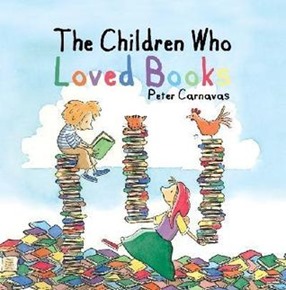
This celebration of reading and books features a family that depends on their books for all sorts of things.  Lucy and Angus’ family is poor without a TV or a car, but they find everything they really need in books.  But there can be too much of a good thing as they find out when their little trailer home just won’t hold any more.  So they get rid of all of the books and clear out their tiny home.  But things aren’t the same.  The books that had taken up so much space also made the space between the family members smaller.  Then one day, a book falls out of Lucy’s backpack and the magic of reading happens all over again.

There is no move to hide that this book is purely about the joy of books in one’s life and the positive impact that reading together can have on a family.  Carnavas lets his message stand strong, which has positive and negative results.  A more subtle approach would have been more satisfying, yet the bold message lets you use the book with younger children.

Carnavas’ illustrations are filled with stacks and piles of bright colored books.  The family is clearly poor, but also clearly functional.  The morning after they return to reading, the family is stacked on top of one another in a tiny couch.  The quintessential image of a family coming closer together from reading.

Warm and cheerful, this Australian import will have book lovers smiling.  Appropriate for ages 3-5.

Reviewed from copy received from Kane Miller Publishing.
Review: My Basmati Bat Mitzvah by Paula J. Freedman

my basmati bat mitzvah

My Basmati Bat Mitzvah by Paula J. Freedman

Tara’s father is Jewish and her mother is East Indian, so Tara has mixed feelings about her upcoming bat mitzvah.  Some of the kids in her Hebrew class even wonder if she is actually Jewish at all.  Tara though is more concerned with whether she actually believes in God and if she doesn’t, does that mean that she can’t have a bat mitzvah?  She also worries about what celebrating this side of her family says to the other side.  So Tara decides to make sure that both sides of her family are represented by wearing a family sari that had been passed down for generations.  Unfortunately though, the sari is accidentally burned and Tara has to figure out how to tell her mother about it.  But that’s not the only complexity in Tara’s life.  Her best friend Rebecca seems to be spending more time with another girl, someone that Tara doesn’t get along with.  Her other best friend Ben-o seems interested in being more than friends sometimes but other times spends a lot of time with another girl.  It’s up to Tara to navigate all of the confusion and make her bat mitzvah her own.

Freedman very successfully tells the story of a young woman dealing with two distinct family heritages.  Happily, she doesn’t feel the need to build heightened angst about it, allowing Tara’s personal doubts to really drive this part of the story.  Her family around her does not have the same feelings, sharing holidays with one another and enjoying the same foods, most of the time. 

The book has a lightness of tone that makes the book very enjoyable.  Freedman explores bullying with a perfect touch, but less successfully explores the underlying issues.  Tara is a strong heroine who is far from perfect.  She has a temper, responds physically at times, and can be too self-absorbed to really see what is happening with her friends.

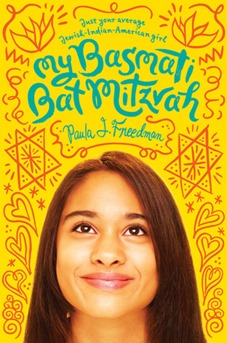
Hurrah for a book with a brown-skinned girl right on the cover that explores her multicultural heritage in such a straight-forward way!  Appropriate for ages 11-13.

Reviewed from ARC received from Amulet Books.

Review: Musk Ox Counts by Erin Cabatingan

musk ox counts

Musk Ox Counts by Erin Cabatingan, illustrated by Matthew Myers

The characters from A is for Musk Ox return for a counting book this time.  A counting book should be fairly straight forward, it’s counting after all.  But Musk Ox has different ideas.  Must to Zebra’s dismay, he doesn’t even make it to number one at the beginning of the book to be counted as one Musk Ox.  Instead he is on the page with 2 yaks.  Musk Ox offers to fix the problem on the page for number one, but still messes up the 2 yaks page.  Zebra is beside himself and a sulky Musk Ox heads back to page one on his own.  But he doesn’t stay there for long!  Expect plenty of counting chaos throughout the book though there is also some easy addition thrown in too. 

I enjoyed this book almost as much as the first one.  This one has the joy of returning to two engaging characters.  As with the first, you never know what is going to happen on the next page, making it very engaging reading.  Cabatingan writes the two characters with zingy dialogue and the book is a must for reading aloud. 

Myers’ illustrations add to the zany book.  He manages to keep crowded pages from being confusing as the number mount.  He also uses the effect of Musk Ox and Zebra peeking through from other pages very nicely. 

The result is a counting book worth sharing aloud to a group of preschoolers, and there aren’t many counting books that you can say that about!  Appropriate for ages 3-5.

Reviewed from copy received from Roaring Brook Press.

Review: March by John Lewis

march

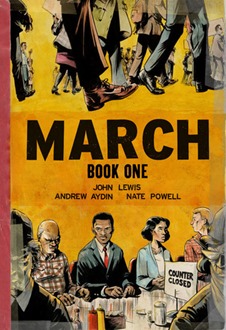
March: Book One by John Lewis and Andrew Aydin, illustrated by Nate Powell

This is the first book in a planned series of graphic novels that follow the life of Congressman John Lewis and his work in the civil rights struggle.  This first book opens with President Obama’s inauguration day and then flashes back to critical points throughout Lewis’ life.  It tells the story of his connection to animals on the farm, particularly chickens.  It also shows him as a young minister and his determination to stay in school and then to attend college.  Readers get to witness the violence of the opposition to the Civil Rights Movement including many pivotal moments in history like the sit-ins at Nashville lunch counters. 

This is one powerful graphic novel.  The writing is sterling and strong.  It shines with an honest portrayal of historical events from someone who did not just witness them, but fought the battles personally.  The book clearly explains the world of the 1950s and 1960s, making sure that modern readers understand the dangers of the times and the differences.  It is both a historical book but also one that is important for modern teens to understand how far we have come and how far we have to go.

Powell’s art is stellar.  It is stirring art that evokes history with a fresh eye.  He creatively uses light and dark, playing with words across it at times, other times allowing the darkness to take control.  There is a sense of witnessing history throughout the book in both the words and the art. 

An impressive graphic novel for teens, this book shines light on the Civil Rights Movement.  Appropriate for ages 12-15.

Reviewed from library copy.

Review: The Invisible Boy by Trudy Ludwig

invisible boy

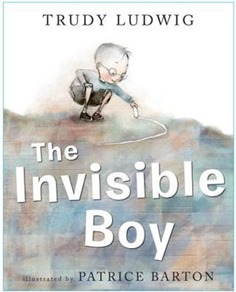
The Invisible Boy by Trudy Ludwig, illustrated by Patrice Barton

Brian is invisible.  His teacher never notices him in the classroom.  He doesn’t take up much space.  He never gets picked when kids choose kickball teams.  He isn’t invited to any parties.  Brian spends his time drawing dragons, pirates, aliens and superheroes.  Then Justin joins Brian’s class.  Justin uses chopsticks at lunch and eats different food than everyone else.  The other kids laugh at him and Brian feels happy being invisible.  Brian leaves Justin a drawing that says that Justin’s food looked yummy.  Justin talks with Brian about his art, but is quickly called away to play games with the others.  When a chance comes for them to work together on a class project, Brian starts to feel a lot more visible.

Ludwig paints a vivid picture of an isolated child here.  The true success on these pages is the capturing of very subtle forms of bullying rather than the overt type seen in so many picture books.  This is the type that involves exclusion from the group rather than physical violence.  Ludwig not only captures it, she also shows just how damaging being alone can be for a child.  At the same time, Brian is bright and creative and willing to connect.  Ludwig also shows how a single child can make a difference and bring someone who is invisible into the group.

Barton’s illustrations have a beautiful softness to them.  She incorporates paper art in her digitally painted work adding another dimension.  Brian starts out almost transparent and only done in pencil with no color at all.  As he starts to reach out to others, color comes to him and eventually he is just as fully colored as everyone else.  This visual transformation nicely captures what is happening emotionally.

A superb book about bullying and exclusion, this can be used to start discussions in a classroom or with a single child.  Appropriate for ages 4-6.

Reviewed from copy received from Random House Children’s Books.

Review: Line 135 by Germano Zullo

line 135

Line 135 by Germano Zullo, illustrated by Albertine

The duo that created Little Bird have returned with another lovely and fanciful story.  A little girl travels by train to her grandmother’s house.  The train starts out in the towering city and we are told at the beginning that her grandmother lives in the country.  The train travels from crowded cityscapes into more residential areas.  The little girl talks about all of the traveling she wants to do when she gets older.  As the pages turn, the landscape changes and eventually becomes very odd.  Flowers grow as tall as the train, strange creatures stand near a pond, then the pond itself looks very much like a beast of some sort and readers will know that they are on a surprising trip too.

Imported from Switzerland, this book starts out as a quiet thoughtful book about being comfortable living in both the city and the country and a love of travel.  Zullo’s text never changes from that musing tone, but it does speak to the right of a child to have opinions about how they want to live their lives. 

The girl’s dreams and imagination come to life in the illustrations.  The train is the sole zip of color on each page, while the surroundings are entirely in black and white fine-lined drawings.  They are detailed and lovely and the change from reality to dream world is done slowly and with deft pacing. 

This is a book that makes you want to start back at the beginning the minute you finish it so that you can see even more in the drawings.  Appropriate for ages 3-5.

Reviewed from library copy.

Review: All the Truth That’s in Me by Julie Berry

all the truth thats in me

All the Truth That’s in Me by Julie Berry

Judith has returned to her family and her small Puritan town after being missing for two years but she is unable to speak because her tongue has been cut out.  Without speech, the entire community ignores Judith and treats her as if she is less than a person.  Her own mother reviles her, never saying her name and ordering her around as “you” instead.  In her silence, Judith has many secrets that she keeps close.  She sees everything and moves through the town as if she is a ghost.  But inside herself, Judith is smart, caring and dutiful.  When her mother refuses to hear her attempts at speech, Judith stops trying altogether.  When the boy she loves takes another as a fiancé, Judith is only kind to the girl.  Secrets though have a way of getting out and one dangerous secret may just be able to save their community.

The first thing I have to say is that the cover is lovely but very misleading.  This is a book set in an unnamed historical setting and the cover reads entirely modern.  Reading the book I was astonished to find it was historical fiction and kept turning back to the cover in confusion.  The paperback cover is no better since it also conveys a modern feel. 

With the cover aside, this is one incredible read.  One might think the lack of real historical context would be an issue, but it works well here.  The focus is on the people rather than the setting, though the world of Puritanical thought is an important element throughout.  The book is a real mystery novel with the questions of what really happened to Judith swirling throughout the book.  The reveal is tantalizingly written, making for one compelling novel.

Berry writes with a lyrical voice throughout, capturing the loneliness and longing of Judith.  The beauty of the writing serves as a way for readers to see the thoughts of Judith and understand that she is rich with thinking inside.  Berry is also masterful at pacing and how she reveals the details.  It is entirely on her terms and readers may guess what is coming but can never be sure until it is revealed.  It is a book where the ending is crucial, exciting and immensely satisfying.

A great pick to book talk for teens, the premise of this historical novel should be more than enough to get teens to pick it up.  The writing and the mystery will keep them reading.  Appropriate for ages 14-17.

Reviewed from library copy.

Review: My Blue Is Happy by Jessica Young

my blue is happy

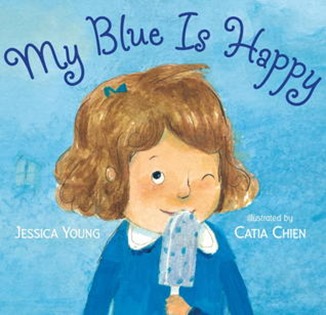
My Blue Is Happy by Jessica Young, illustrated by Catia Chien

Colors can be seen in many different ways and the little girl in this picture book tends to see them very differently than her family and friends.  Her sister says that blue is sad, but for her blue is happy like favorite jeans or the swimming pool.  Her mother says yellow is cheery, but for her yellow is worried like a wilting flower.  Her father says brown is ordinary, but it is also the color of chocolate syrup so it’s special too.  Useful for color identifying, this book takes it a level deeper to the feelings that colors evoke in each of us.

Young has created something of a poem here in her prose.  She uses a format with repetitive structures, each new person and their reactions to colors a stanza and also a set of pages.  Within this strong format, the exploration of feelings is done with a confidence that will allow young readers to voice their own.  Young takes unusual reactions to colors and makes them concrete with her examples too. 

Chien’s illustrations have a wonderful softness to them that frees the imagination.  Filled with the color that is being discussed, the illustrations celebrate each color and invite thoughts from children listening to the book. 

A lovely take on colors, this picture book will lead to plenty of discussion and would be a great jumping off point for craft and art projects.  Appropriate for ages 4-5.

Reviewed from library copy.

Review: A Moose That Says Moo by Jennifer Hamburg

moose that says moo

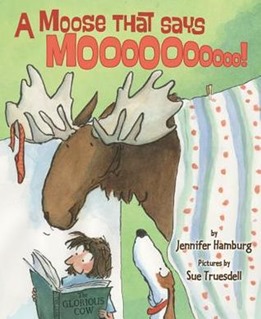
A Moose That Says Moo! by Jennifer Hamburg, illustrated by Sue Truesdell

Sitting near the laundry drying on the line, a little girl is reading books about animals.  She starts to think about having a zoo of her very own and what sorts of animals it would have.  It’s guaranteed that no other zoo has animals like hers!  There is a moose that says “moo,” bears that drive cars, tigers that swing in the trees, and sharks that read books.  At night, the animals have a big pillow fight that turns into one silly brawl with awakened goats, tap-dancing pigs that startle easily, tripping turtles, and even groundhogs that protest.  It will take one smart young girl to get everything put back together again even in this imaginary zoo.

Written in a rollicking rhyme, this book really celebrates the ridiculous and the silly.  Hamburg manages to create zoo animals with wild qualities that make the book a surprise on each page.  The result is a book that dances on the edge of losing control, but the firm hand Hamburg takes with the rhyme and rhythm keeps it within control and makes for a book that begs to be shared aloud.

Truesdell does an amazing job of managing to take all of the wild chaotic silliness of the book and turn it into illustrations that help it all make sense.  At the same time, she too revels in the silliness on the page and adds to it with small touches like a reading shark accidentally eating a book, the offer of many tissues to a sneezing tiger, and goggled bears in cars. 

Pure silliness, this book could merrily be wedged into many storytime themes.  Use it as a finisher since even antsy children will sit still for this wild ride.  Appropriate for ages 3-5.

Reviewed from copy received from Farrar, Straus and Giroux.