Review: Max and the Tag-Along Moon

max and the tag along moon

Max and the Tag-Along Moon by Floyd Cooper

When it’s time for Max to head home from his Granpa’s house, Max is very sad.  But his grandfather reassures him by saying “That ol’ moon will always shine for you…on and on!”  All the way home in the car, Max watches the moon as it travels along with them.  When they get home though, the moon has disappeared and Max once again feels sad and misses his grandfather.  As Max is alone in his bed that night, he looks out at the dark night with no moon.  As he watches, the moon returns from behind the clouds and Max once again feels connected to his Granpa. 

Cooper takes a very simple story of grandfather and grandson and makes it memorable with his amazing illustrations.  The story resonates with the connection of the two main characters and their love for one another.  The symbol of the moon and its light connecting them makes the book luminous and almost magical.  I appreciate a children’s picture book that is not just about an African-American child and family, but one that shows a loving male figure.

A large part of that magic are the illustrations that glow with the white-gold light of the moon.  Cooper plays with light and dark throughout the book.  Even on the pages without the moon shining, there are sources of light and shadow that are expressive and lovely. 

A strong African-American family is celebrated in this picture book that would add another level to any moon-centered storytime.  Appropriate for ages 4-6.

Reviewed from copy received from Philomel Books.

Review: Serafina’s Promise by Ann E. Burg

seraphinas promise

Serafina’s Promise by Ann E. Burg

The author of All the Broken Pieces returns with a new verse novel.  Serafina lives with her mother and father in Haiti.  She and her best friend dream of becoming doctors in order to help save people like her baby brother who died.  But Serafina’s family cannot afford for her to even attend school.  Instead she has to work hard to help her mother who is pregnant with another baby.  Serafina carries water for her family, empties chamber pots, sweeps the floor, and keeps the family fire burning.Her father is one of the lucky ones who has a steady job in the nearby city that he walks to every day.  There is no extra money for anything though, even with his work.  When a large storm comes, their small village is ruined and Serafina’s family moves to higher ground.  It is there that Serafina’s dreams start to come true with her new garden and the money it brings.  Then the earthquake strikes.

Burg tells a gripping story of  a young girl with huge dreams living in abject poverty.  Her family is strong and loving, just unable to lift themselves out of the poverty that surrounds them everywhere.  Burg shares small details of life in Haiti, nicely weaving them into the poetry so that it is revealed in a rich and natural way.  The Creole language is also used throughout the book, offering a rhythm and sound that enlivens the entire setting.

Serafina is a well-developed character.  Many of the poems show her own inner feelings in all of their complex beauty.  She is not a perfect character, sometimes showing stubbornness and jealousy, but that just makes her all the more compellingly human.  And the verse throughout the book is lovely, evocative and very effective.  Readers will know that the earthquake is coming and that also creates a tension that makes the book riveting.

This is a powerful look at the Haitian earthquake through the eyes of one extraordinary young woman.  Appropriate for ages 10-13.

Reviewed from ARC received from Scholastic.

Review: Kenta and the Big Wave by Ruth Ohi

kenta and the big wave

Kenta and the Big Wave by Ruth Ohi

When the tsunami sirens sounded, Kenta headed up the big hill to the school just as he had practiced.  But along the way, he lost hold of his soccer ball and it rolled down the hill.  Kenta’s parents were already at the school and when they returned to their house, it was ruined.  They had to sleep in the school gym and search in the rubble for things to salvage.  But Kenta’s soccer ball had been carried off by the water.  Kenta tried making a soccer ball from scraps but it didn’t work well.  Meanwhile, his ball was being carried by the ocean until it reached another country.  Would it ever find its way back to Kenta?

Ohi has written a very simple but compelling look at surviving a natural disaster.  Her focus on a single beloved possession works particularly well.  I also appreciated that it was not a doll or a stuffed animal but rather something that older children can relate to.  It was also a good choice to not have Kenta and his family in direct peril and survive.  The safe status of everything but the ball and other material objects makes it easier for the ball to be important and mean more.

Ohi’s illustrations are filled with color.  The yellows of the grass pop against the blues of the ocean.  Kenta wears a bright red hoodie and stands out on each page.  The time the ball spends in the ocean is particularly lovely and quiet compared to the mess of the town.

Based on true accounts of objects appearing in other countries after the tsunami in Japan, this book celebrates the connection people can have without ever having met.  Appropriate for ages 4-6.

Reviewed from copy received from Annick Press.

Review: From Norvelt to Nowhere by Jack Gantos

from norvelt to nowhere

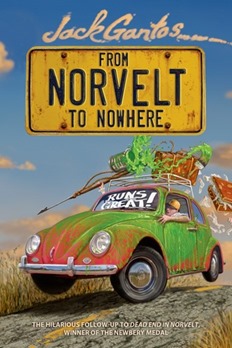
From Norvelt to Nowhere by Jack Gantos

Halloween has come to Norvelt right at the height of the Cuban Missile Crisis.  Jack dresses up as the local serial killer to trick or treat, but no one finds him funny.  Even Jack loses his sense of humor when another old lady is killed right in front of him from a poisoned cookie.  Miss Volker, the last surviving original Norvelt woman, takes the murder very personally since the serial killer had been killing in order to marry her.  She is intent on revenge and takes Jack along with her on a cross-country journey to settle the issue once and for all.  But all may not be as simple as it seems as Jack finds himself with plenty of potential killers riding on the same train with them. 

Gantos won the Newbery Medal with the first Norvelt book and it was spectacular.  This book is more of a bumpy ride.  There are moments where Gantos reaches the same smart mix of serious heartfelt writing and humorous situations.  Then it can drag a bit as historical lessons are shared.  But the good thing is that those good parts outnumber the slowdowns and the humor still shines.

A large part of what makes the book work are the characters of Jack and Miss Volker.  This wonderful pairing adds to the fast pacing of the novel, move the story forward and are a pleasure to spend time with.  The book tends to slow when Miss Volker is more quiet and contained.  When she is unleashed, the story is exceptional. 

Fans of the first book will want to read the second and I’m happy to travel along with Jack and Miss Volker anytime.  Appropriate for ages 10-13.

Reviewed from copy received from Farrar, Straus & Giroux.

Review: Night Sounds by Javier Sobrino

night sounds

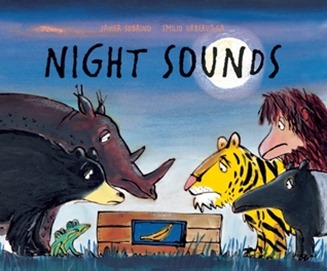
Night Sounds by Javier Sobrino, illustrated by Emilio Urberuaga

When the animals of the rain forest head to sleep, they are awakened by noises coming from a box.  The sound just goes on and on, “Wuaah, wuaah, wuaaah.”  Something is crying and won’t be easily comforted.  The animals do try to get it to be quiet, offering a blanket, water, and a doll.  But the crying only stops for a little while and then starts up again and again.  Finally Tiger heads off to find the mother.  Then the identity of the crier is revealed finally but there is more crying to come in a clever twist at the end.

Translated from the original Spanish, Sobrino does a great job of keeping readers guessing about the identity of who is crying in the box.  As each new sets of cries starts, their sounds change slightly and add variety to the book.  The structure of the book is based on repetition with some changes along the way.  It makes for a book that will work well for very small children but also has plenty of surprises for older preschoolers as well.

Urberuaga’s illustrations are filled with deep, rich colors.  They evoke the night beautifully and the animals sleepy eyes and lack of smiles show how very tired they are.  The reveal is cleverly done without any real visual hints, allowing it to be a complete surprise.

Great fun, this book could be made into reader’s theater with younger children and will also make a great bedtime story as long as a blanket, water and doll are provided ahead of time.  Appropriate for ages 2-5.

Reviewed from library copy.

Review: Little Red Writing by Joan Holub

little red writing

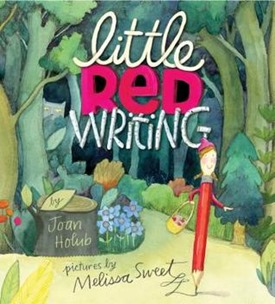
Little Red Writing by Joan Holub, illustrated by Melissa Sweet

This is a fresh version of Little Red Riding Hood.  Here Little Red is a pencil and her assignment in school is to write a story, even though it can be quite dangerous.  Her teacher gives her a basket of words to use in case of an emergency, but also warns her to stick to her basic story so that she doesn’t get lost.  Little Red starts writing but soon tries to add more excitement to her story.  Before she knows it, she has bounced right off of the page and into a forest.  It’s a forest full of description, but that’s also something that can bog down a story.  Little Red has to use a word from her basket to get free.  More perils follow with sentences that run on, abandoned punctuation, and a growling voice and twirly tail that lead right to the principal’s office.  It is up to Little Red to both be a hero and finish her story.

Holub has written a very engaging new version of Little Red Riding Hood.  She successfully ties in tips on writing, not allowing them to force her to leave the basic story path.  Her writing is entirely engaging, the format of the story writing works well and she weaves the classic elements of the tale into this one so that it is different but still recognizable. 

Sweet’s illustrations are done in her signature combination of cut paper and drawings.  Her bright colors add much to the liveliness of the book.  She uses the cut paper to good effect throughout, allowing them to set aside important parts of the book as well as using fonts of various styles to really make the book stand out. 

A great pick for writing units, this is one of the best changed-up Red Riding Hoods that I’ve seen.  Appropriate for ages 4-6.

Reviewed from copy received from Chronicle Books.

Review: Mr. Wuffles by David Wiesner

mr wuffles

Mr. Wuffles by David Wiesner

The masterful Wiesner returns with another near-wordless picture book.  Mr. Wuffles is a cat who disdains most of the toys his master gets him.  Then one object gets his attention, a little metallic spaceship.  But this is not a toy!  It is filled with tiny aliens who are battered by being flung around by Mr. Wuffles.  Their equipment is damaged and they have to leave their ship and head out looking for help.  But Mr. Wuffles is close behind them and who can the aliens turn to for aid? 

This is a magnificent picture book that turns from a normal cat picture book into something much more interesting.  Wiesner has created a book that bridges genres effortlessly.  He also has created a wordless picture book that never seems to be missing them.  His story flows organically and is never forced.  It has touches of humor throughout especially where Mr. Wuffles himself is concerned.  I particularly enjoy the rows of untouched toys with price tags still attached that he walks past. 

Wiesner’s art is as strong as ever.  He pays attention to details both in the human home and later when the aliens arrive.  The juxtaposition of the aliens with the insects of the home is particularly well done.  The addition of cave paintings as communication is a delight.

Beautiful and funny this is a wordless masterpiece.  Appropriate for ages 4-6.

Reviewed from library copy.

Review: Flora & Ulysses by Kate DiCamillo

flora and ulysses

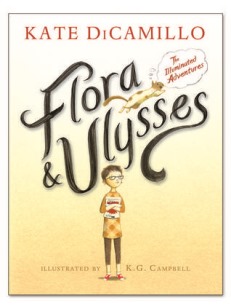
Flora & Ulysses by Kate DiCamillo, illustrated by K. G. Campbell

Flora is a self-proclaimed cynic who hated romance but loved comic books.  It was the sound of the new vacuum cleaner that interrupted her superhero reading and she made it to the window in time to see her mother swept right off her feet by the power of the vacuum cleaner.  Then the vacuum headed straight for a squirrel.  The squirrel didn’t see it coming, but Flora did and she raced down to see if he could be saved.  The squirrel survived, a lot more bald than he had been, and was now named Ulysses.  Flora knew just what to do, since she spent a lot of time also reading the comic Terrible Things Can Happen to You!  This new friendship between girl and squirrel was made even more special by the superhero powers that Ulysses developed after his accident.  But life is not simple for a superhero squirrel and his human sidekick as they quickly find out.

DiCamillo has created yet another incredible read.  She manages to write such very different and distinct books from one another, making each one a delight and a surprise to pick up and open.  Here she manages to create a superhero book that will appeal to both fans of comics and non-fans.  I personally appreciate a book that has a female protagonist who loves comics.  The addition of a furry creature as a main character is also wonderful.  Ulysses manages to be both a full-fledged character but also remain primarily an animal.  All of this speaks to the skill of the writer and her ability to create honest characters even from absurd and hilarious situations.

Interspersed throughout the book are comic panels that tell some of the story.  The book begins with one of these introducing the vacuum cleaner and Flora’s parents.  Done in black and white, the comic panels are very funny and add just the right tribute to comics.

A great read-aloud, this unlikely superhero pair are sure to fly off the shelves.  Appropriate for ages 8-12.

Reviewed from library copy.

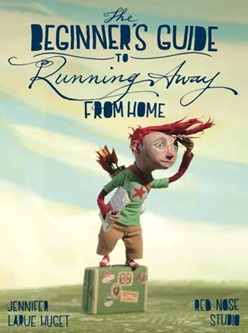
Review: The Beginner’s Guide to Running Away from Home by Jennifer Larue Huget

beginners guide to running away

The Beginner’s Guide to Running Away from Home by Jennifer Larue Huget, illustrated by Red Nose Studio

This book is a humorous look at running away from home done in the format of an instructional booklet on how exactly to run away.  First you have to find a reason for running away, perhaps a new baby, or your older brother can stay up later than you, or your mother threw away your candy wrapper collection.  Then you have to pack, make sure to take plenty of snacks including gum, that way you won’t need a toothbrush.  Then comes the farewell note.  Make it sad enough that your parents will cry when they find it.  Now you need to figure out where to live.  Keep walking until you can’t see your house anymore, then stop for a snack.  And think about living in the park forever, or if living with a friend would be better than at home.  But don’t think about what you like about your family at all or you might find yourself running back home.

Huget’s tone is perfect in her text.  She manages to be humorous about the situation but also not dismissive of the feelings that the child has.  Her wording works very nicely aloud, making this a book that is best shared and giggled at together.

Red Nose Studio, the illustrators of Here Comes the Garbage Barge, continue with their signature 3-D figures.  They use perspective very cleverly here, offering different levels of focus that show speed and point the eye to where they want you to look first.  The result are illustrations that are unique and dynamic.

Thanks to the humor and the illustrations, this is a book about running away that is worth seeking out.  Appropriate for ages 4-6.

Reviewed from copy received from Random House Children’s Books.