The Dire Days of Willowweep Manor by Shaenon K. Garrity

Cover image for The Dire Days of Willowweep Manor.

The Dire Days of Willowweep Manor by Shaenon K. Garrity, illustrated by Christopher Baldwin (9781534460874)

Haley loves Gothic romances and has turned in four English papers on Wuthering Heights. So when she sees someone drowning in the river, she knows just what to do. After rescuing the drowning man, Haley awakens to find herself in Willowweep, a manor filled with characters who are Gothic novel tropes. There is the housekeeper who looms and lurks, the three brooding brothers, and even a ghost who haunts the manor. But there is more happening in Willowweep. The external features of the manor hide the fact that this is a pocket universe, created to keep two larger universes from colliding: a universe full of evil and Earth. Willowweep’s defenses are beginning to crack and crumble, allowing the evil to enter the Gothic world. It is up to Haley to figure out how to use her deep knowledge of Gothic novels to stop the evil invasion.

This uproariously funny graphic novel plays beautifully upon Gothic tropes. Haley serves as the voice of the reader, exclaiming as each new trope becomes apparent. The twist of being in a decaying pocket universe works really well with the Gothic overlay. The clockwork style of the universe’s inner workings are a delight as is the solution worked out in the ending. Add in that all beings must stay in the Gothic style, and the evil monk who arrives is perfection. It’s all a very funny yet great adventure with a well-read smart heroine at its center.

The illustrations are a delight as well, leaning into the Gothic elements like the looming housekeeper, the ghost only Haley can see, and the three brothers. The green glowing eyes of those taken in by the evil add to the marvelous joy of the book.

A delight of a graphic novel that mixes Gothic and science fiction into something new and wonderful. Appropriate for ages 12-16.

Reviewed from copy provided by McElderry Books.
The First Blade of Sweetgrass by Suzanne Greenlaw and Gabriel Frey

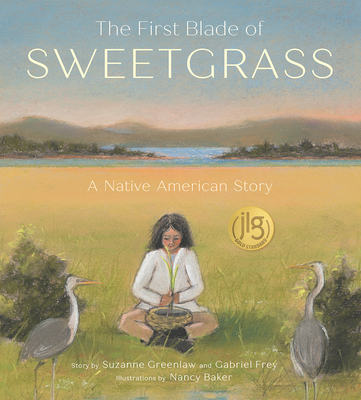
Cover image for The First Blade of Sweetgrass.

The First Blade of Sweetgrass by Suzanne Greenlaw and Gabriel Frey, illustrated by Nancy Baker (9780884487609)

Musqon accompanies her grandmother to the salt marsh where they are going to pick sweetgrass. The salt marsh is where the river meets the ocean. Her grandmother explains that she helped her own grandmother pick sweetgrass as a girl to weave into baskets and use in ceremonies. To Musqon, all of the grasses look the same, so her grandmother shows her what to look for to find sweetgrass among all the other grasses. She explains that they never pick the first blade of sweetgrass that they see, to make sure that sweetgrass continues to the next generation. When her grandmother tells her that sweetgrass has a shiny green tassel and blades with a purple stem and that it is easy to pick, Musqon is confident she can find it on her own. It isn’t until Musqon takes her time, thinks about what she is there to do, and really sees the salt marsh that she can find sweetgrass herself.

Written by a citizen of the Houlton Band of Maliseet Indians and a citizen of the Passamaquoddy Nation, this picture book is a gentle story of Native traditions shared with a new generation. The text of the book shares Passamaquoddy-Maliseet words in the dialogue of the characters. It takes the time, slowing us all down, to explain the importance of sweetgrass and how to find it. The moment when Musqon takes her own time and gives herself space is beautifully created.

Baker learned about sweetgrass for this book also the landscape in which it grows. She shows a delicacy with both in her illustrations, celebrating sweetgrass itself and also showing the beautiful landscape where the river meets the ocean.

A rich and vital look at sweetgrass and heritage. Appropriate for ages 4-7.

Reviewed from e-galley provided by Tilbury House.

Ergo by Alexis Deacon

Cover image for Ergo.

Ergo by Alexis Deacon, illustrated by Viviane Schwarz (9781536217803)

This philosophical picture book explores one chick’s world. Ergo wakes up not realizing she is inside an egg and thinks that she has discovered her entire world. She has eyes to see, toes that wiggle, wings that flap, a beak to peck and legs that kick. Perhaps, she thinks, she is the world and she had found everything. That’s when she discovers the wall of the egg around her. She pushes the wall, rolls the egg over, and realizes that she can move the entire world! That’s when she feels the bumps coming from outside the egg and realizes that she is not the entire world. Now she must decide whether to leap (or peck) her way into the unknown or stay safe in her small universe of the egg.

Deacon and Schwarz follow I Am Henry Finch with this picture book that plays with Plato. The book works on multiple levels, allowing adults to recognize the philosophy while also really working well as a picture book for young children that asks big questions about our world and our place within the universe. The use of the little chick and an egg serve a clever purpose here. Ergo asks the big questions while the simple style of the writing supports the ideas being shared.

The illustrations are simple and bold. Done in a sunshine yellow, Ergo fills the page. Often surrounded by a cool blue-gray, the illustrations show Ergo and her world, egg-sized and then larger.

Clever and inquisitive, this book will egg on children’s thinking about the world. Appropriate for ages 2-6.

Reviewed from copy provided by Candlewick Press.

I Am the Subway by Kim Hyo-eun

Cover image for I Am the Subway.

I Am the Subway by Kim Hyo-eun, translated by Deborah Smith (9781950354658)

Told from the point of view of the Seoul subway itself, this picture book takes readers deep into the city and introduces them to the various people who use the subway. With a steady ba-dum ba-dum, the subway rattles and rumbles over its tracks reaching stop after stop. At each stop a different character enters the story, from the business man running to make his train to a mother with two children who is also late to a man who repairs shoes for a living to a student so tired she is almost falling asleep. Each person offers their story, glimpses of their past and plans. As the train car fills up, the light shines in showing the beauty of each person and their journey.

This Korean import is beautifully written with a dazzling combination of simple prose that moves to a poem for each of the people entering the train. The poems are set apart from the prose, offering a full story of that person in just a few lines. The bustling urban setting is brought to a personal level as each human is highlighted and given space to shine. There is space here for transformation in each person’s life, the subway used as a huge metaphor for life and growth.

The illustrations are done in ink and watercolor. The humans are shown as more faceless at first but as they are introduced to the reader, they are shown in brighter colors in the crowd rather than the gray people around them. Each person’s story and poem are shown with the bright colors from the bluest of sea water to the bustle of the city itself.

A gorgeous celebration of Seoul and its people. Appropriate for ages 4-7.

Reviewed from copy provided by Scribble.

Six Crimson Cranes by Elizabeth Lim

Cover image for Six Crimson Cranes.

Six Crimson Cranes by Elizabeth Lim (9780593300916)

Shiori is the only princess of Kiata, a land where magic is forbidden. She lives in the palace with her six older brothers, her father the emperor and his consort, her stepmother. None of them know that Shiori has magic of her own, but her stepmother, who is also a sorceress, discovers it. Shiori meets a dragon in the waters when she almost drowns, soon becoming friends and learning more about her magical powers with his help. But when Shiori followers her stepmother into her snake-filled garden, her stepmother banishes her and her brothers. Shiori is cursed with having to wear a bowl on her head that covers most of her features and being unable to utter a sound without killing one of her brothers. Her six brothers are turned into cranes by day and human by night. Shiori must find a way to reunite with her brothers and break the curse before her stepmother takes over the empire. But things may not be as simple as Shiori first thinks, and certainly meeting her betrothed while unable to speak was never in her plans.

An impossible book to summarize in any way that conveys it fully, this novel is a wonderful interwoven net of The Wild Swans and other folk tales. The world building here is so masterful where the magic makes sense, the curses bind and force the story forward, and there are layers of the empire, magical and human to explore. The setting of Kiata offers extensive forests, an icy northern castle, long stretches of sea, and mountains of magic and demons.

Against that setting, Lim offers readers characters who change and grow as the novel progresses. The most changed is Shiori, who steadily learns about herself and her betrothed, thinking deeply about who she once was and who she has become due her stepmother’s curse. The romance is slow and steadily builds in a way that is organic and lovely. Readers will love the secondary characters too. Plus the villains themselves are complicated and add to the twists and turns of the novel.

A great fantasy full of magic and curses. Appropriate for ages 13-17.

Reviewed from library copy.

Yes & No by Elisha Cooper

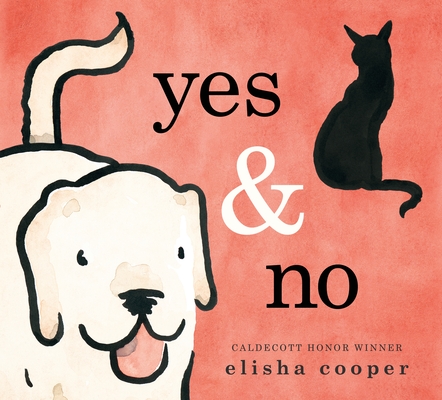
Cover image for Yes & No.

Yes & No by Elisha Cooper (9781250257338)

A dog and a cat live together. In the morning, the dog is ready for anything while the cat wakes up more slowly and with a touch of grumpiness. The dog wants breakfast, while the cat isn’t hungry. The dog helps clean up, and the cat walks off. The dog wants to play while the cat avoids him. Their owner sends them outside to play together. The dog is full of delight and eagerness, exploring the backyard with enthusiasm while the cat naps on a tree branch. Finally sent off even further, they head out together and find a common spot to sit and look at the world while sniffing the breeze. Called to come back in, now it’s the dog who doesn’t want to go back inside, doesn’t want to have a bath, or head to bed. It’s the cat who brings the blanket back and gets the dog ready to sleep. But the cat may have other ideas too.

Told in the voices of the cat, dog and their owner, this picture book is marvelously understated. The voices of each character are distinct from one another with the imperious cat, the eager dog, and the owner who’d just like a little peace. The text reads aloud beautifully, since it is solely the voices of the characters with no narration at all.

The art is classic Cooper, telling a story in deft and clever lines. The cat is an elegant black figure against the white background while the dog almost bursts from the page, often looking right at the reader and looking for fun.

A grand picture book of opposites who are the best of friends. Appropriate for ages 3-5.

Reviewed from e-galley provided by Macmillan Children’s Publishing Group.

Blog Anniversary!

Image from Adi Goldstein: https://unsplash.com/@adigold1.

I’ve been book blogging in my little corner of the Internet for 18 years now! Thank you all so much for being here, for reading and for sharing your love of reading and books for youth. May your year be filled with access to vaccinations, great reads and wonderful library visits.

Josephine Against the Sea by Shakirah Bourne

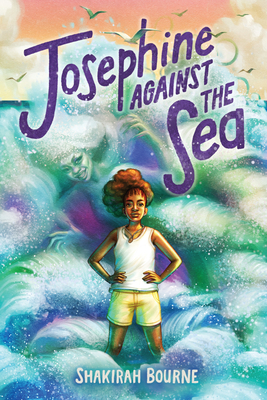
Cover image for Josephine Against the Sea.

Josephine Against the Sea by Shakirah Bourne (9781338642087)

After her mother’s death, Josephine knows that she wants to keep her Daddy’s attention on her. So she manages to chase off any woman looking to be his new girlfriend, using pranks and fish guts. Her father used to love watching cricket matches with her on the weekends, and she is desperate to get him back to doing that again. When one of her pranks goes wrong though, she is forced to use the money she’d been saving to take him to a real match in person to pay for the damages. Josephine also loves to play cricket herself, but at her school only boys play. After being disappointed about the team, Josephine also finds that her father has a new girlfriend. But Mariss isn’t like the other women and doesn’t scare off easily. As strange things start to happen around Mariss, Josephine realizes that she be very different from everyone else and may not even be human!

Full of Caribbean magic, this novel starts out as a story about the loss of a mother and steadily turns into a fantasy about a sea monster who is both kind and vengeful. The author’s own Bajan heritage is reflected throughout the book in the lilt of the dialogue. She also shares Caribbean folktales about a variety of beings and creatures.

Josephine is a grand protagonist. She is hot headed and determined to get what she wants, something that causes both problems and also creates opportunities. She is also willing to reconsider and learn from others, including members of her community and her best friend. Mariss is a complicated villain and monster, which is great to see in a children’s book. She is a mix of kindness and control, a being who wants humans to belong to her and who will destroy them if they don’t obey.

A book of Black girl magic and monsters. Appropriate for ages 9-12.

Reviewed from ARC provided by Scholastic.

A Song of Frutas by Margarita Engle

Cover image for A Song of Frutas.

A Song of Frutas by Margarita Engle, illustrated by Sara Palacios (9781534444898)

A little girl tells of visiting her Abuelo in Cuba. When she is there, she helps him sell fruit from his small cart on the street. Together they sing the names of the fruits they have for sale, walking in beat to the song and shaking their hands like maracas. Their voices reach up the tall buildings around them and some people purchase fruit using a basket they lower down on a rope. There are other vendors on the street shouting or singing about their wares too, and that’s when Abuelo has to sing even louder to be heard. It’s most special to visit Abuelo at the new year when everyone wants to purchase 12 grapes per person to have good luck when they eat them at midnight. If only visiting Cuba was simpler and they could go more often!

Engle is an award-winning author of books for all ages of children. This picture book uses a mix of English and Spanish called Spanglish that is used both in the United States and Cuba. The songs that the girl and her grandfather sing together are done in rhyme while the rest of the picture book displays Engle’s skills with verse in a different way. Her paragraphs of free verse still play with rhythm and form, inviting readers to experience Cuba and their lively street vendors.

Palacios’ illustrations are bright and merry. They show the dynamic urban Cuban street scene that is full of colorful buildings and equally colorful people. The illustrations share that same inherent happiness as the words.

Bright and energetic, this picture book offers a glimpse of Cuba. Appropriate for ages 4-6.

Reviewed from e-galley provided by Atheneum Books for Young Readers.