Review: The Dark by Lemony Snicket

dark

The Dark by Lemony Snicket, illustrated by Jon Klassen

Laszlo is scared of the dark.  You know, that darkness that is always there, hiding in corners and behind the shower curtain, and especially the dark that lives down in the basement.  At night the dark would spread around the entire old creaky house and all of its staircases, but in the day it retreated to the basement.  Laszlo would visit the dark every morning, from the top of the steps into the black basement.  He would say hi, thinking that maybe then the dark wouldn’t feel the need to visit him in his room at night anymore.  But that didn’t work, the dark still came at night.  Luckily Laszlo slept with a flashlight on his pillow and a nightlight on the wall, so the dark stayed away.  That is until one night when his nightlight burned out and the dark started talking to Laszlo.

I can’t think of a stronger author and illustrator match than this one.  Snicket turns on the creep factor in this book in a way that will have children leaning in closer, cuddling tighter, and listening to every single word.  There are the noises of the house, the scary basement, and the series of staircases.  But mostly there is the darkness itself, a second character in the book and written about with almost poetic phrasing.  This is one beautifully written book.

Klassen plays so much with light and shadow here.  He uses the darkness beautifully as both a frame for his images but also as the thick lines of objects.  Then there are the pictures of the cool daylight and the fierce warmth of the nightlight that burns almost like a flame.  This is one beautifully illustrated book.

One of my favorite picture books of the year, this book reads aloud perfectly, the tension growing and growing until it’s almost explosive.  One can almost hear the dark chuckling along.  Appropriate for ages 4-6.

Reviewed from library copy.

Review: Little Cub by Olivier Dunrea

little cub

Little Cub by Olivier Dunrea

The author of the Gossie books returns with this companion book to Old Bear and His Cub that explains the way that Old Bear and Little Cub met.  Little Cub lived all alone near the forest with ono one to take care of him.  He was often hungry and slept alone and cold outside.  Old Bear lived alone too.  He had plenty to eat and a warm place to live, but no one to share it with.  Then one day, Old Bear heard odd noises coming from a pile of rocks.  It was Little Cub, trying to sleep curled into a ball.  It was Old Bear who named him Little Cub and Old Bear who took him home, gave him food, tucked him into a warm bed, and promised to teach him how to fish.  And it was Little Cub who filled up that empty bed so that neither of them had to be alone any more.

This is such a warm story.  Showing the way that Little Cub and Old Bear came together to be a family is honey rich.  Dunrea takes him time showing the parallels between the two bears’ lonely lives.  Though they are different in age, in being able to care for themselves, they are alike at heart and searching for something new. 

Dunrea’s writing is simple but also cheery.  Though it explores a child alone in the cold wilderness, one doesn’t worry because there is a sense of safety throughout.  Children will understand the hunger and chill and also that level of joy that is clear.  A large part of this are the illustrations that show blustery winds but also have the security and solidity of Old Bear right there too.  He is the hope for Little Cub, one that radiates across the pages.

Fans of Dunrea will enjoy this new series and those who read the first in the series will cheer to see Old Bear and Little Cub return.  Appropriate for ages 3-5.

Reviewed from copy received from Philomel.

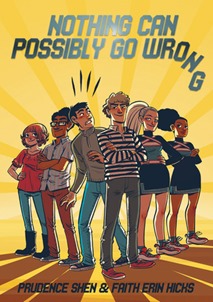
Review: Nothing Can Possibly Go Wrong by Prudence Shen

nothing can possibly go wrong

Nothing Can Possibly Go Wrong by Prudence Shen and Faith Erin Hicks

Released May 7, 2013.

Nate and Charlie are friends, but mostly it’s about sharing a ride to school.  Then when the cheerleaders threaten Nate’s robotics competition, Charlie is caught up in the middle of the conflict.  Nate decides to run for Student Body President and Charlie’s cheerleader ex-girlfriend forces him to run against Nate.  Things quickly get out of control in this jocks against the geeks sort of storyline that ends with both groups stripped of their school funding.  Now the only way forward is to work together to fund and build a robot that can win the robot death match.  And of course, just like with all plans, nothing can possibly go wrong.

The storyline could have been cliché, but it steps away from that fairly quickly and into much more intriguing collaborative efforts.  Shen and Hicks have created a great gang of characters here.  Nate is laid back and really the normal one of the group.  Charlie is alpha-geek, neurotic, ballsy and intellectual.  Mix in the cheerleaders who are clearly at the top of the popular food chain, and this is regular high school on steroids.  While some of the characters are left as stereotypes, Charlie and Nate are well developed and interesting. 

The art is hip and fun.  Done in black and white, the images play up the funny moments beautifully and often the dance of words and image is sheer perfection.  It’s hard to believe that it was done by two people rather than just one.

Geeks and jocks alike will enjoy this one, after all who doesn’t love to see a robot death match!  Appropriate for ages 13-15.

Reviewed from copy received from First Second.

Review: Betty Bunny Didn’t Do It by Michael B. Kaplan

betty bunny didnt do it

Betty Bunny Didn’t Do It by Michael B. Kaplan, illustrated by Stephane Jorisch

I’m a Betty Bunny fan, since I enjoy protagonists in children’s books who have a feel of being a real kid.  Betty Bunny in this third book in the series breaks a lamp when her siblings refuse to play with her.  When she is asked about it, she blames it on the Tooth Fairy.  Betty Bunny thinks this works so very well that she’s surprised it hadn’t occurred to her to try it before.  But things quickly unravel when her mother asks if she’s telling the truth.  Betty admits to telling an “honest lie” and is sent to her room.  Later, when a vase is broken, everyone in the family automatically blames Betty Bunny, but she really didn’t do it this time! 

Betty Bunny is precocious for a four year old.  I enjoy the way that Kaplan explains what Betty is thinking about her new ideas.  Also, the family dynamics ring very honest with older siblings unwilling to play but all too willing to offer witty advice. 

Jorisch’s illustrations have a great modern vibe to them.  The bunny family is active and they dynamic lives appear clearly on the page.  This has the trademark style of the earlier books with zingy writing and a naughty but quite charming little bunny at the center.

Fans of the earlier books in the series will find more to love here.  This series is not for every reader or family as some will find the naughtiness less funny and more problematic.  Appropriate for ages 4-6.

Reviewed from copy received from Dial Books.

Review: Busy-Busy Little Chick by Janice N. Harrington

busy busy little chick

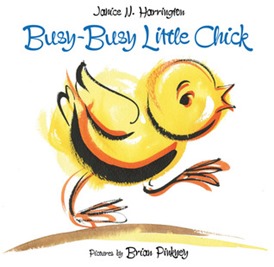
Busy-Busy Little Chick by Janice N. Harrington, illustrated by Brian Pinkney

Mama Nsoso and her chicks needed a new home.  They spent each night shivering and cold in their dark, damp nest.  So Mama Nsoso said that tomorrow they would start work on their new home.  But the first day, Mama Nsoso found worms to eat and decided to eat rather than build a house.  The family shivered through another night.  The next day there were crickets to eat and no work was done.  Except by Little Chick who set out to gather grasses and mud to create their new home.  His hard work resulted in a fine new home for them, and then he was off finding himself some delicious bugs to eat. 

Harrington writes like a storyteller.  Her words flow beautifully when shared aloud.  She has reworked a classic fable from the Nkundo people of Central Africa and throughout has woven in Lunkundo words from their language.  She has also added lots of sounds to the book, so there are wonderful patterns that emerge as the hen and her chicks move through their day.  She clearly enjoys wordplay and creating rhymes and rhythms, all of which make for a great book to share aloud.

Pinkney’s art is large and bold, filled with warm yellows and oranges.  He has created images of the hen and her little family isolated and floating in cold blues.  They are brilliant orange, evoking the warmth of family and shelter.  His art is simple but filled with moving lines and playfulness with white space. 

A great pick for spring story times, don’t be chicken to share this one.  Appropriate for ages 4-7.

Reviewed from copy received from Farrar, Straus and Giroux.

Review: Dark Triumph by Robin LaFevers

dark triumph

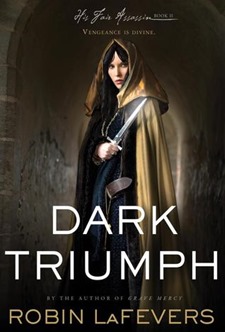
Dark Triumph by Robin LaFevers

Sybella has been forced to return to her family after fleeing to the convent for safety.  There she learned the art of assassination, but nothing prepared her for returning to the family that abused her for years.  Now she has to play the dutiful daughter while waiting to see if the marque of Death will appear on her father’s body.  She has been promised the right to personally murder him.  Around Sybella, politics are being played out.  Loyal to the Duchess, unlike the rest of her family, Sybella is able to send a message to warn them and turn the result of a battle.  When the convent orders her to rescue a valuable prisoner from under her father’s nose, Sybella risks losing her entire protective disguise.  She doesn’t realize that she risks losing her heart as well.

I adored the first in the Fair Assassin series and looked forward to this second book.  The heroine in this book is Sybella rather than Ismae.  While the first book was awhirl in the politics of 15th century Brittany, this one is much more about a person and her own personal history.  Sybella is a compelling and rich character.  As the abuse she suffered is slowly revealed, readers will discover more and more about the incredible strength of this girl turned killer. 

Sybella also questions her own loyalties and ties to Mortain, the God of Death.  She wonders whether the convent may be wrong about things or if perhaps she herself has overstepped and lost the God’s favor.  These questions of faith against the dark stain of familial abuse add to the depth of the novel.  As with the first book, there is a passionate romance that rings true and honest.  Sybella slowly falls in love, so gradually that she doesn’t notice until she is fully intoxicated with it.  It is beautiful and glorious, especially as she is accepted as she admits the entire truth about her life.

A killer book, this is a strong sophomore book in a riveting series.  Not for the faint of heart, this book has abuse, murder and true tragedies in its pages.  Appropriate for ages 16-18.

Reviewed from library copy.

Review: Follow Follow by Marilyn Singer

follow follow

Follow Follow by Marilyn Singer, illustrated by Josee Masse

This is the second book of reverso poems by Singer, following her amazing Mirror Mirror.  In a form she invented, Singer tells the stories of fairy tales using a poem and then reversing the lines and changing the punctuation to tell the other side of the story.  The result are brain teasing poems that illuminate the darkness inherent in the tales themselves.  This group of poems includes stories that may not be familiar to readers, so the index of stories at the end of the book will be welcome.

As with her first book, some of the reversos work better than others.  Here my favorites are The Little Mermaid, Thumbelina, and The Tortoise and the Hare.  All of the poems have a wonderful cleverness and wit to them, making them all infinitely readable and a great deal of fun.  This is a celebration of poetry, fairy tales and word play all wrapped into one delight.

Masse’s illustrations are done on wood, giving them a wonderful texture that is reminiscent of tapestries and medieval images.  Her use of jewel tones evokes that period even more.  All of the images are also double-sided, showing both sides of the poem in one united image.

Perfect for fans of fairy tales, this clever and delicious book will have them seeking out the unfamiliar tales to read them in full.  Appropriate for ages 7-9.

Reviewed from copy received from Dial Books.

Review: The Market Bowl by Jim Averbeck

market bowl

The Market Bowl by Jim Averbeck

Mama Cecile taught Yoyo to make bitterleaf stew, the same stew they sold at the market.  But Yoyo thought that the entire process took too long, so she took some shortcuts herself.  Then she snuck her batch of stew along with them to the market.  Mama Cecile warned Yoyo that they must always accept a fair price for their stew, otherwise Brother Coin, the Great Spirit of the Market, would remove his blessing from their bowl.  After selling all of Mama Cecile’s stew, there was still one customer left, so Yoyo pulled out her own stew and tried to sell that.  But she rejected his small offer for her stew.  Thunder rolled and through the next days, no one came to their staff at the market.  Now it was up to Yoyo to fix what she had done.  That would take traveling to see Brother Coin in person.

Set in modern-day Cameroon, this story skillfully blends folk elements as it talks about the culture as well.  The book will make a great read aloud thanks to the ease of the language used and the natural rhythm of the storytelling.  It would also be a great candidate for storytelling for those reasons too.

Averbeck’s art has a strong modern edge to it.  He shows the gorgeous textiles that people wear.  Additionally, he uses textures and patterns to create other objects as well, such as the shanty houses and details of interior scenes.

A modern-day folk tale, this is a rich glimpse into Cameroon.  The book ends with a recipe for bitterleaf stew too!  Appropriate for ages 4-6.

Reviewed from copy received from Charlesbridge.

Review: Obsidian Mirror by Catherine Fisher

obsidian mirror

Obsidian Mirror by Catherine Fisher

The author of Incarceron has returned with the start of another series.  This is the story of Jake whose father has disappeared.  Jake knows his father is dead and blames one person, Venn, the idiosyncratic wealthy man who was his father’s best friend and is Jake’s godfather.  So Jake gets himself expelled from his posh Swiss boarding school and sent back to Venn’s home in England.  When he gets there, he learns about the mirror that allows people to travel through time.  He also finds out that his father is not dead, but lost in time.  At Venn’s house, others are arriving.  There is a girl from the future with a tie to the mirror, a man from the past who used to own the mirror before it was stolen from him, and a boy tied to the Faerie World and living long past he should have died.  All of them have purposes for the mirror, but not everyone will succeed in their dreams.

Fisher is a consummate world builder.  Here she has created a decaying but splendid abbey that is located on the border of a vast woods.  It is a lonely and wild place, perfect for experiments with time since it seems to be timeless itself.  Readers are also invited into a faerie world and on journeys through time where honest depictions of the past offer real insight into places like Victorian England.  The mirror is the hub of this complex book, with everyone’s lives revolving around controlling and using it. 

Fisher also excels at creating complex characters and she has several in this book.  Jake himself is not completely likeable except in his devotion to his father.  Everyone has their own personal agendas and reasons for acting.  Because she creates characters who have an opportunity to really show how complex they are, the book does slow at times.  Yet it is this attention to detail and character that makes her books so intriguingly rich.

Get this in the hands of teens who loved Incarceron.  They will enjoy the twists of time travel and revel in the striking characters and vibrant world building.  Appropriate for ages 13-16.

Reviewed from ARC received from Dial Books.