Review: Round Is a Tortilla by Roseanne Greenfield Thong

round is a tortilla

Round Is a Tortilla: A Book of Shapes by Roseanne Greenfield Thong, illustrated by John Parra

Explore shapes with two young members of a Mexican-American family.  The book begins with circles as they are seen in nests, bells, and food.  Readers will also get to find squares, rectangles, triangles, ovals, and stars.  Spanish words are sprinkled throughout the book and engagingly explained within the context.  There is also a glossary at the end of the book to help.  This is an engaging look at shapes with a charming Mexican vibe.

Done in rhyming couplets, the book has a strong lilting rhythm and reads aloud easily.  The writing is strong and never suffers from the structure of the rhymes.  Thong invites us into their home where we are made to feel welcome throughout the book.  It is a warmly written book about shapes that has an additional dimension with the Spanish words.

Parra’s illustrations have a wonderful texture to them, often looking like traditional art and aging painted walls.  They add even more warmth and character to this already rich book.

This is an enjoyable and simple look at shapes and Spanish that invites the reader to learn and to try new words.  Appropriate for ages 2-4.

Reviewed from copy received from Chronicle Books.

Review: The Longest Night by Laurel Snyder

longest night

The Longest Night: A Passover Story by Laurel Snyder, illustrated by Catia Chien

This Passover picture book tells the story of the Exodus from the point of view of a young slave girl.  Readers first get a sense of the harsh environment and difficult lives of the Jewish people: the heat, the hard labor, the slavery.  Then come the plagues, one after another.  Finally there is the Exodus itself, the thrill and fear of fleeing in the darkness.  And finally, the miracle of the sea splitting in two, giving them safe passage away from Egypt. 

Written in rhyme, Snyder has created a book filled with rhythm and a story that moves swiftly along through the different parts of the Exodus.  Her choice of telling the story from the point of view of a child makes the story all the more personal and dramatic. 

Chien’s illustrations are just as dramatic with their deep color palette.  Especially moving are the natural moments, when the little girl finds openness and freedom in the world around her, though she can’t find it personally.  At these moments, the sky is huge and beautiful, but quickly the grit and sand return. 

A powerful and lovely exploration of the Old Testament tale of the Exodus given a fresh and personal aspect.  Appropriate for ages 5-7.

Reviewed from copy received from Schwartz & Wade.

Review: Lucky Ducklings by Eva Moore

lucky ducklings

Lucky Ducklings by Eva Moore, illustrated by Nancy Carpenter

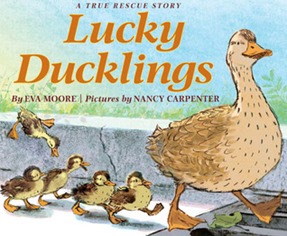
Based on a true story, this book follows the walk of a mother duck and her small ducklings.  They follow her out of the pond, through the grass of the park, and into town.  They ate a bite from the overflowing garbage can and then headed off the curb and over a storm drain.  But while Mama Duck made it over the grate with no problems, her ducklings fell through one by one.  It could have been a sad ending to the story, but it wasn’t!  The people who saw it happened called for help.  It took firemen and someone with a winch on their truck to save all of the ducklings. 

Moore has created a story that has a real appeal.  It is the story of tiny ducklings that at first seems very sweet, then takes a very dangerous turn.  Throughout, she tells the readers that that could have been the end of the story, but it wasn’t.  Using this device, she creates both drama and also the assurance that thing will be alright in the end.  Her writing has repetition that makes it perfect for very young children.  The environmental message is subtle but profound.

Carpenter’s ducks seem to be drawn with a nod to McCloskey’s Make Way for Ducklings.  The book feels vintage with the small town coming together to save this small family of ducks.  Carpenter celebrates both the natural setting and also the people themselves.  Her use of separated images that form one larger image to name the little ducklings works particularly well. 

Ideal for a duckling story time and perfect for spring, read this one alongside Make Way for Ducklings.  Appropriate for ages 3-5.

Reviewed from copy received from Orchard Books.

Review: Odd Duck by Cecil Castellucci

odd duck

Odd Duck by Cecil Castellucci and Sara Varon

Theodora was a very busy duck.  She exercised every day, she swam laps in the pond (with a teacup on her head), she ran her errands every afternoon, she rode her bike rather than flying, and in the evening she quietly watched the stars.  She had the perfect life of routine and quiet until a strange duck moved in next door.  Chad was not like Theodora.  He was an artist who made sculptures out of found objects, he colored his feathers, and he liked dancing and swimming in a wild fashion.  When fall came and the other ducks flew south, Theodora and Chad were the only two left.  Over the winter, they became fast friends.  But when someone implied that one of them as an “odd duck” the question became which of them they were talking about.

Castellucci beautifully tells the story of a duck who is obviously unique and then another duck who is unique as well.  Readers will at first think that it is about accepting others who are different from you, but the author has something deeper in mind here.  It’s about also accepting that you yourself are the odd duck.  As we all know we are!

Varon’s illustrations have wonderful small touches.  Make sure you check out the titles on her books, since they are good for an additional chuckle.  Her characters are winning and cheery, both so very comfortable in their own skin. 

Fun, buoyant and with plenty of depth, this children’s graphic novel should fly off the shelves just like a normal duck.  Appropriate for ages 6-9.

Reviewed from copy received from First Second.

Review: Stardines by Jack Prelutsky

stardines

Stardines: Swim High across the Sky and Other Poems by Jack Prelutsky, illustrated by Carin Berger

This poetry book takes the wit of Prelutsky and combines it with equally amazing illustrations.  Prelutsky tells of unusual creatures in his poems here.  He writes of creatures who are a mix of animal and inanimate objects.  For example, there are the Slobsters who are very messy lobsters who love being crude and dirty.  There are Plandas who are pandas that sit around and make elaborate plans but never do anything.  Tattlesnakes are snakes who are nosy and always tattling on others.  This menagerie of incredible creatures will be enjoyed by children who love puns and humor.

Prelutsky excels at creating poetry that both of interest to children but will also make them stretch their vocabulary a bit.  He throws in words like “slovenly,” “pretension” and even “lachrymose.”  Thanks to his rhythm and rhymes, these words slide by almost effortlessly and usually the definition can be figured out in the context.  He also has woven puns and humor into all of the poems, nicely creating creatures that speak more to the human condition than to the animal. 

It is Berger’s art that really makes this book an incredible read.  Thanks to her dioramas that show the creatures in collages and boxes, the book is a true exploration of the intriguing.  She has deftly incorporated pins and labels that make the illustrations look like lab specimens, but without hampering all of the action in the images by pinning down the animals themselves. 

Thrilling illustrations and superb children’s poetry create a poetry book that is wild, funny and a delight to read.  Appropriate for ages 7-10.

Reviewed from copy received from Greenwillow Books.

Review: The Highway Rat by Julia Donaldson

highway rat

The Highway Rat by Julia Donaldson, illustrated by Axel Scheffler

The creators of The Gruffalo return for an uproarious version of a beloved poem.  Beware, for the Highway Rat is coming and he’s out to steal everyone’s snacks.  He rides along with food dropping out of his saddlebags, accosting poor travelers at sword point, demanding their goodies.  He steals clover from a rabbit who has nothing else, a leaf from some ants, even hay from his own horse.  Eventually though, the Highway Rat meets his match in a juicy-looking duck who directs him into a cave where the echo seems to promise food.  Then the Highway Rat rides no more.

I love a good riff on a traditional poem, and this one is very clever.  Those familiar with The Highwayman by Alfred Noyes will particularly enjoy the play Donaldson makes with its form.  She incorporates familiar phrasing like “And the Highway Rat went riding – riding –riding – riding along the highway.”  Somehow her other words which are quite different from the poem have a similar rhythm and evoke the poem effortlessly.

Scheffler’s illustrations have a wonderful bold quality to them.  The Highway Rat is truly a bad guy and his naughtiness is clearly shown in his actions and his aspect.  His googly-eyed horse is a pleasure, almost always making eye-contact with the reader and sharing the joke of this evil rat riding on his back.  The rich colors of the landscape add a depth to the illustrations that is very welcome.

The tale of an evil highwayman (or rat) makes for a great read.  Add in strong illustrations and the play on a well-known poem, and you have picture book magic.  Appropriate for ages 4-6.

Reviewed from copy received from Arthur A. Levine Books.

Review: Who Put the Cookies in the Cookie Jar? by George Shannon

who put the cookies in the cookie jar

Who Put the Cookies in the Cookie Jar? by George Shannon, illustrated by Julie Paschkis

Lots of hands can take the cookie from the cookie jar, but even more are involved in getting the cookies there in the first place.  There are the hands that mix the dough and put it on the cookie sheet.  Then there are the ones that made the cookie sheet and oven mitts too.  Hands feed and milk the cow that makes the milk. Hands churn the butter.  Hands plant and harvest the wheat.  Hands feed and gather the eggs.  Many hands doing important work, make that cookie arrive in the cookie jar.

This is a great spin on a traditional song.  I’d pair it with the more traditional version in a program to get kids to see it from both sides.  Shannon celebrates all of the hard work that goes into things that we take for granted.  He focuses on their efforts but also on all of us being part of a larger global community that really matters. 

Paschkis’ illustrations have a warm feel to them.  They hearken back to more traditional images yet depict a modern and multicultural world.  Their bright colors really make the book pop and will work well with a large group.

Perfect for a cookie story time, I’d advise having some cookies to share when reading this and other cookie books.  Yum!  Appropriate for ages 2-4.

Reviewed from copy received from Henry Holt & Company.

Review: Jinx by Sage Blackwood

jinx

Jinx by Sage Blackwood

Raised in the Urwald, Jinx knows that no matter what you never leave the path through the woods.  So when his stepfather decides to get rid of Jinx, they leave the path.  That’s when Jinx meets Simon, a wizard who agrees to take Jinx from his stepfather rather than letting him die in the woods.  Jinx moves in with Simon, who makes incredibly delicious food and has only one rule, never go into certain rooms.  Jinx has his own sort of magic: he is able to see people’s emotions as colorful clouds above their heads.  He can also talk with the trees of the Urwald.  But Simon does not believe he can actually do either.  Living with a wizard brings Jinx into touch with other sorts of magic and soon he is learning about that magic too, though he doesn’t seem to be any good at it.  Life is cozy and as good as Jinx has ever had, but it can’t stay that way.  Jinx soon wants to explore the Urwald himself, which leads to all sorts of amazing adventures and deadly dangers.

Blackwood has truly invented her own fantasy world here.  While she borrows from classic fantasies for some of her creatures: vampires, werewolves, wizards, and trolls, she has created her own rules for their world.  By creating the Urwald, a living woods that takes knowing the laws to survive for any length of time, she has effectively created a smaller world inside a larger one.  There are glimpses of the other parts of the world that are tantalizing.  It’s a complex world that she has created, which makes it all the more delightful to explore.

In Jinx, Blackwood has created what seems to be a very simple character.  Jinx grows throughout the novel not just in his age but in his perspective.  At first he is just happy to have somewhere warm with good food, but quickly he becomes intrigued with the magic around him.  Readers will immediately understand the Jinx is special thanks to his unique vision of emotions, but as they grow to know him more, they will discover he is just as complicated as the world he lives in.

Blackwood has written an impressive fantasy novel for middle grade readers that is both dazzling and dangerous.   Appropriate for ages 11-13.

Reviewed from library copy.

Review: The Matchbox Diary by Paul Fleischman

matchbox diary

The Matchbox Diary by Paul Fleischman, illustrated by Bagram Ibatoulline

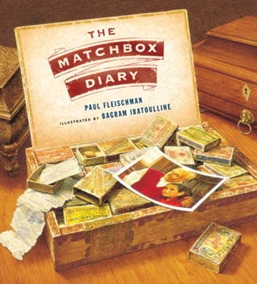
A great-grandfather shares his life’s story with his great-granddaughter who picks out a cigar box filled with matchboxes to find out more about.  He has been collecting matchboxes that are filled with small items documenting his life, a diary of objects.  They tell of his poor childhood in Italy where he’d be given an olive pit to suck on to make him less hungry.  There is a picture of his father who went to work in America and sent money home.  His story then turns into one of an immigrant with a trip to the port and then aboard a large ship.  He tells of arriving at Ellis Island, of the terror of possibly being denied entrance, and the eventual reunion with his father.  The entire family, including the children, worked to earn enough money to survive.  Life became better and he learned to read until he started in the printing industry and opened a bookstore. 

Fleischman writes of the tentative relationship of a young child and her great-grandfather who are just getting to know one another for the first time.  This is a story filled with small gems, treasures of stories that the two of them explore side by side.  The small matchboxes are a wonderful device to add surprise and delight to the story.  Fleischman has created an entire picture book told only in dialogue, making it a pleasure but challenge to read aloud. 

Ibatoulline’s illustrations are precise and detailed.  The matchboxes are shown up close and just opened, as if the reader had been the one exploring them.  The stories are shown in sepia tones with modern day in full color.  They are filled with a beautiful warmth in both cases.

A distinguished picture book, this is a brilliant combination of historical story and vivid illustrations.  Appropriate for ages 6-9.

Reviewed from library copy.