Review: Brief Thief by Michael Escoffier

brief thief

Brief Thief by Michael Escoffier, illustrated by Kris Di Giacomo

An import from France, this picture book has a wonderful quirkiness.  It is the story of Leon, a lizard, who is having a lovely morning, eating breakfast, sitting in the sun, and then he has to go to the bathroom.  But after he goes poo, he discovers that he’s out of toilet paper.   He looks around, but only sees prickly leaves and messy grass.  Until he discovers pair of old underpants hanging on a nearby branch.  They are full of holes anyway, so he uses them to wipe and tosses them away.  But that’s when a loud voice, his conscience, starts to talk to him and tells him to clean them up and hang them up to dry.  In the end, his conscience turns out to be something else entirely and the grand twist of the tale adds to the merriment of the book.

Escoffier is a popular author in France and this book marks his debut into the American market.  His humor is spot on for young readers who will adore the idea of what this lizard does for toilet paper.  They will not see the ending coming, since it is fresh and completely surprising.  In the end, the twist will delight readers even more than the original joke. 

Di Giacomo is the illustrator of My Dad Is Big & Strong, BUT… and I am very pleased to see another of her picture books come to English translation.  Her art is a fabulous blend of paint, crayon, fine lines and texture.  She uses blots of color as the leaves, something that is surprising but works very well. 

Share this with all of those children who love something a little naughty in their picture books.  If you share it with a group, you will most likely be asked to read it over again.  Also, expect riotous reactions to the humor.  Appropriate for ages 3-5.

Reviewed from copy received from Enchanted Lion Books.

Review: When I Was Eight by Christy Jordan-Fenton

when i was eight

When I Was Eight by Christy Jordan-Fenton and Margaret Pokiak-Fenton, illustrated by Gabrielle Grimard

This is a lovely new picture book version of Fatty Legs that will share Olemaun’s story with younger readers than the original chapter book.  It follows Olemaun from her time with her nomadic family through her attending the “outsider’s school.”  There her hair is chopped short and her warm parka is replaced with thin and scratchy clothing.  Her name is even changed to Margaret.  Margaret wants most to learn to read, but the school is much more interested in getting the children to work hard rather than teaching them.  Margaret has a difficult relationship with one nun in particular who makes a point of humiliating her regularly.  In the end though, Margaret does learn to read all on her own.

This is a story that works really well as a picture book.  I really enjoyed both Fatty Legs and A Stranger at Home that were chapter books, but this younger version simplifies the story and keeps its quiet power.  As with the earlier books, I remain in awe at the strength that it took for Margaret to survive in the school and also the courage it takes to keep on telling her story.

Grimard’s illustrations echo the beauty of the Arctic but also capture the dullness and darkness of the school.  The nun character radiates scorn and anger on every page she appears in.  Margaret is shown usually isolated, but also as radiant in her resiliency.

A powerful look at residential schools on Native populations, this picture book version belongs in most libraries.  Appropriate for ages 6-9.

Reviewed from digital galley received from Netgalley and Annick Press.

Review: Wild Boy by Mary Losure

wild boy

Wild Boy: The Real Life of the Savage of Aveyron by Mary Losure, illustrated by Timothy Basil Ering

Losure’s latest is another compelling true story this time focusing on the boy found in the woods in southern France in 1789.  The boy was not a tiny child, but rather a young boy who had obviously been surviving on his own for some time, his body covered in scars.  Quickly, the boy was taken for study and observation, his life curtailed and limited because he always attempted to run away.  There was very little attempt to actually reach him until he was sent to the Institute for Deaf-Mutes where he was put into the care of Dr. Itard.  Itard decided to make the boy, who he named Victor, happy before trying to teach him to speak.  So Victor joined the family of the housekeeper and quickly became attached to them.  But civilizing a wild boy is not simple, as this book shows with historical details, engaging humor, and a narrative that shows an immense empathy for this wild child.

Losure, author of The Fairy Ring, has once again taken a complicated situation and made it understandable for young readers.  Young readers will immediately relate more closely with the intriguing Victor.  Through his eyes and Losure’s exquisite writing, readers understand his ties to nature (Page 72):

But when rain pattered on the roof and everyone else went inside, the wild boy often crept out into the garden, to the tiny, formal reflecting pond that sat among the flower beds.  He would circle the pond several times, then sit by its edge and rock himself back and forth as the rain dimpled the surface of the pond.  He’d gaze into the water, toss in a handful of dead leaves, and watch them drift.

The digital galley I read did not have the completed art available, so I cannot comment on the illustrations.  Throughout the book, Losure makes the Wild Boy come to life as a very unique and resilient boy.  The story is told during his time, through the eyes of those who knew him best, using reports written at the time.  Only in her Author’s Note does Losure speculate on whether Victor was autistic.  There she also notes the importance of Victor on educational attitudes like Montessori.

An engaging, wrenching read that brings history to life in the form on one amazing person.  Appropriate for ages 9-12. 

Reviewed from digital galley received from Netgalley and Candlewick Press.

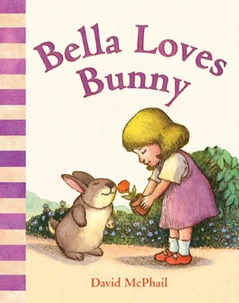
Review: Bella Loves Bunny and Ben Loves Bear by David McPhail

bella loves bunny ben loves bear

Bella Loves Bunny by David McPhail

Ben Loves Bear by David McPhail

A pair of charming board books from veteran author and illustrator McPhail, these casebound books closely echo picture book structure but have sturdy board pages that will stand up to toddler use.  The stories mirror each other, following the child from waking up for a day of play through to bedtime. 

Bella’s story feels more passive than Ben’s, but I think that is because Bunny is not depicted as energetically as Bear is.  Children who have favorite stuffed animals who accompany them throughout their day will find kindred spirits on these pages.  The stuffed animals are living and breathing here, the story filled with a quiet imagination.  As always, McPhail’s illustrations have a wonderful depth of color and fine lines.  They manage to be dreamy but realistic at the same time.

Good additions to library board book collections, these are books that are gentle and joyful.  Appropriate for ages 1-3.

Bella Loves Bunny was received from Abrams for review.  Ben Loves Bear was reviewed from library copy.

Review: Engine Number Ten by Rose Ann Woolpert

Engine Number Ten

Engine Number Ten by Rose Ann Woolpert, illustrated by Jaguar Studio Design

This is the story of how granite was quarried over one hundred years ago in California.  First work was done with mules and small wooden carts.  Then little steam trains were used on the narrow tracks, shuttling back and forth with loads of rock.  Steadily, more steam trains were used until they had ten steam trains and one steam shovel working in the quarry.  Then diesel locomotives started to replace the oldest steam engines until just Number Ten was still working.  The other steam trains had been taken apart and sold.  A new diesel engine was purchased for the quarry, pulling huge loads of granite with ease.  Number Ten was sent off to be scrapped.  But then something happened that changed Number Ten’s fate, a rockslide trapped the diesel engine.  There was only one train that could rescue her:  Number Ten!

Woolpert successfully mixes the true story of the Number Ten engine that now is on display at the Railroad Museum in Sacramento with personified engines that eagerly say “Yes, I Will!”  Her writing is refreshingly clear and playful, allowing the momentum of the true story itself to set a brisk pace. 

The illustrations are a mix of vintage photographs and black and white drawings that are often superimposed upon the photos.  This echoes the story being a mix of history and fiction.  The result is clearly historical but also very friendly.

This is the first book in the “Yes, We Will” series which will continue to tell the stories of the machines and people of Graniterock, a business in northern California.  It’s a good pick for young train enthusiasts or those interested in American history.  Appropriate for ages 4-6.

Reviewed from copy received from the author.

Review: The Lightning Dreamer by Margarita Engle

lightning dreamer

The Lightning Dreamer by Margarita Engle

Margarita Engle, award-winning author of verse novels, continues her stories of Cuba.  In this book, she explores the life of Gertrudis Gomez de Avellaneda, also known as Tula, who becomes a revolutionary Cuban poet.  Raised to be married off to save the family financially, Tula even as a young girl relates more closely with slaves and the books she is reading than with girls of her own age and her own social standing.  As she reads more and more, sheltered by both her younger brother and the nuns at the convent, Tula starts to explore revolutionary ideas about freedom for slaves and for women.  In a country that is not free, Tula herself is not free either and is forced to confront an arranged marriage, the brutality of slavery, and find her own voice.

Engle writes verse novels with such a beauty that they are impossible to put down.  Seemingly light confections of verse, they are actually strong, often angry and always powerful.  Here, Engle captures the way that girls are asked to sacrifice themselves for their families, the importance of education for young women, and the loss of self.  She doesn’t shy away from issues of slavery either.  At it’s heart though, this novel is about the power of words to free people, whether that is Tula herself, her brother or a family slave and friend.

Highly recommended, this is another dazzling and compelling novel from a master poet.  Appropriate for ages 12-15.

Reviewed from digital galley received from NetGalley and Houghton Mifflin Harcourt.

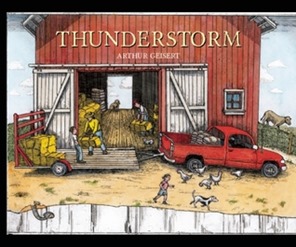
Review: Thunderstorm by Arthur Geisert

thunderstorm

Thunderstorm by Arthur Geisert

Geisert leaves behind his signature little pigs and instead tells the story of a storm rolling through the Midwest.  Follow the course of a red truck filled with sacks and bales of hay as they race the storm to get unloaded in a variety of places.  As the sky darkens, readers also get a glimpse of animal life both above and below ground.  The wind stirs and then roars, a funnel cloud forms and threatens destruction until the wind lowers and the sky clears and it is time to start cleaning up. 

Geisert tells his story with the only words being timestamps below some of the images.  His art is filled with details that make one linger and wonder.  He changes lighting and feeling with tightness of line and colors.  What is most fascinating about the book is that all of the illustrations fit together into one long illustration without any breaks.  It makes me wish that the book unfolded so that I could see it as one long line, but it is very interesting to look at the book in a new way, viewing it differently on a second reading. 

This is a celebration of the power of nature and the way that light changes through the course of a storm.  Geisert mixes in plenty of action and the tension of a family at risk.  Appropriate for ages 4-7.

Reviewed from copy received from Enchanted Lion Books.

Review: A Splash of Red by Jen Bryant

splash of red

A Splash of Red: The Life and Art of Horace Pippin by Jen Bryant, illustrated by Melissa Sweet

Born in 1888, Horace Pippin loved to draw from the time he was a small child.  He would draw on scrap paper using charcoal, he would draw for his friends, and he would even draw on his spelling tests though his teacher did not appreciate that.  As he grew, he had to quit school in 8th grade.  He worked hard with his hands in different ways, but continued to draw and paint.  Then Horace went to war and was wounded in his right arm.  Now he could no longer draw, or so he thought.  He started trying again with a poker and using his other hand to steady himself.  As he grew stronger, he drew more and more.  Eventually, he gained the attention of people like N. C. Wyeth, who helped put together his first art show.  Pippin’s life that was filled with hardships and obstacles serves as inspiration for young artists.

Bryant and Sweet  collaborated before with Caldecott Honor results.  This picture book biography of an important but lesser known African-American artist shows the power of art in one’s life and how it is impossible to stop seeing and communicating the world through art once you begin.  Bryant writes with a solidity that is lovely.  Incorporating Pippin’s own words from letters, she captures the life of this artist and how he came to be recognized for his work.

Sweet too weaves Pippin’s words into her art.  Her use of collage truly builds Pippin’s world before readers’ eyes.  My favorite image in the book is Pippin as a young boy sitting and drawing on piles of papers.  It captures the intensity with which he created art even at such a young age.  This intensity continues through his story to after he is wounded and the determination that is apparent in just his hands. 

Another very successful collaboration of these two masters, this biographical picture book should serve as its own splash of red on every library’s shelves.  Appropriate for ages 6-9.

Reviewed from copy received from Random House Children’s Books.

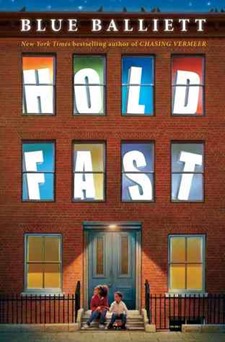
Review: Hold Fast by Blue Balliett

hold fast

Hold Fast by Blue Balliett

Early lives in a warm and loving family.  Her father Dash is a lover of words and word games.  Her mother Sum and little brother Jubie make up the total of four in their family.  But when Dash gets involved in something shady, their loving family becomes three.  Then people raid their home, breaking down the door and they are forced to head to a shelter without knowing where Dash is or how he will find them again in the big city of Chicago.  Early finds she has to be the strong one as her mother begins to falter and her brother is so little.  Shelter life is difficult and it takes Early some time to realize that she is in the middle of a mystery that she can help solve. 

Balliett demonstrates her own love of words and wordplay throughout this novel.  Told in beautiful prose, she writes poetically about the city she loves, the beauty of snow, and the power of family.  She incorporates wordplay through her protagonist, who looks at words the way her father taught her to.  Many times words sound like what they are, points out Balliett, and just reading this book will have readers seeing words in a new way.

Balliett also introduces young readers to the poetry of Langston Hughes.  One of his books is at the heart of not only the mystery of the book but at the heart of the family.  As Hughes muses on dreams and their importance, both Early and the reader are able to see his words and understand them deeply. 

The aspect of the homeless shelter and the difficulties the family and Early face there is an important one.  Balliett is obviously making a point with her book, sometimes too obviously.  There are also some issues with plotting, with the book dragging at points and struggling to move forward.  That aside, the writing is stellar and the characters strong. 

Another fine offering from Balliett, get this one into the hands of her fans.  It will also be great choice for reading aloud in classrooms with its wordplay and strong African-American characters and family.  Appropriate for ages 9-12.

Reviewed from ARC received from Scholastic.