Review: When Thunder Comes by J. Patrick Lewis

when thunder comes

When Thunder Comes: Poems for Civil Rights Leaders by J. Patrick Lewis, illustrated by Jim Burke, R. Gregory Christie, Tonya Engel, John Parra, and Meilo So

These poems celebrate heroes who have fought for civil rights.  Each poem focuses on one person, tells their story in imagery and strength.  Seventeen men and women are on the pages here, people from around the world and from the American Civil Rights Movement.  These are heroes who fought for justice and for equality.  Their stories and these poems are filled with courage, vision and a sense of doing what is right.  They will serve as inspiration for future generations who will have their own civil rights struggles to face.

Lewis has created poems that are both art but also informational.  He offers critical details in understanding what these heroes have been through and what they have accomplished.  At the same time, he reaches the heart of the person through his poetry too, showing the humanity about them as well.

The art in this book of poems was done by five illustrators.  The images range from the bright colors of Chinatown to the darkness of murder in Mississippi.  In every image though, readers see a leader who radiates courage.  The different art styles come together to form a tapestry of that courage.

Strong and powerful, this book of poetry deserves to be shared widely and these names known and understood.  Appropriate for ages 8-12.

Reviewed from copy received from Chronicle Books.

Review: The Bird King by Shaun Tan

bird king

The Bird King: An Artist’s Notebook by Shaun Tan

This book opens the curtain to Tan’s creative process, allowing readers to view art from stories that have not yet been full formed, art from books that have been completed, and beautiful illustrations that may not be stories at all.  The courage this book took to produce is to be applauded.  Allowing readers and other artists to see a process of creativity is raw and soul baring. 

This book is stellar.  One turns the pages slowly, lingering in worlds undreamed of, wondering at ideas, and pausing to allow a particular image to sink in more deeply.  It is a journey, specially designed for a young creative to see that mistakes can be joyous, that creation is messy, and that works in progress are breathtaking.

This is a book to get in the hands of teens who enjoy art and writing, for it is a look at the unformed and the just formed.  It is a book of pure creativity and the creative process.  Beautiful.  Haunting.  Inspiring.  Appropriate for ages 10-18.

Reviewed from copy received from Scholastic.

Review: Have You Seen My New Blue Socks?

have you seen my new blue socks

Have You Seen My New Blue Socks? by Eve Bunting, illustrated by Sergio Ruzzier

Duck has lost his new blue socks.  He searches in his box, but they aren’t there.  He asks his friend Fox who hasn’t seen them either.  Perhaps Ox knows where his socks are?  Ox remembers seeing some socks down by the rocks.  But those socks are purple, not blue socks, and they aren’t new either.  Finally, Duck asks a group of peacocks about his socks.  And they do know where his socks are!  It turns out they are in a most surprising place!

Bunting has written a picture book in rhyme that dances along to a jaunty beat.  The rhymes are merrily done, done in a humorous way.  She makes it all look so easy and effortless, but rhyming picture books are some of the most difficult to do well.  Kudos to Bunting for maintaining the joy in simple rhymes.  Her words read aloud well and are also simple enough for beginning readers to tackle.

Ruzzier’s illustrations are the key to young readers spotting the blue socks which are slowly revealed as the book progresses.  Expect eagle-eyed children to figure out the answer even before the adults.  Ruzzier fills Duck’s world with lots of clutter from starfish to soccer balls to underwear.  Done in ink and watercolor, the colors are bright and add to the surreal nature of the story itself.

Socks lost and then found, rhymes and rhythms, and a delight of a read aloud to share, this book has it all!  Appropriate for ages 3-5.

Reviewed from library copy.

Review: Miss Moore Thought Otherwise by Jan Pinborough

miss moore thought otherwise

Miss Moore Thought Otherwise by Jan Pinborough, illustrated by Debbie Atwell

Annie Carroll Moore grew up in Limerick, Maine in a time when girls were not encouraged to be opinionated but she had her own ideas.  Children in that time were also not allowed in libraries, especially not girls, because reading was not seen as important.  Annie had always loved stories and books and though she thought at one time of being a lawyer like her father, she decided to become a librarian.  She studied in New York City, living alone even though others thought it was dangerous.  Miss Moore became a children’s librarian at the Pratt Free Library, with a room designed just for children.  She had new ideas, of course, like letting children take books home and removing the large “SILENCE” signs from the libraries.  As her new ideas took hold, Miss Moore changed library service for children into what we love today.

Pinborough clearly admires Miss Moore and her gumption and willingness to approach problems with new ideas.  Miss Moore’s life work is detailed here but we also get to see to her personal life and the tragedies that marred it.  Perhaps my favorite piece is the ending, where Miss Moore retires in her own special way, on her own terms.  Don’t miss the author’s note with more information about Miss Moore as well as a couple of photographs of the woman herself.

The illustrations by Atwell have the rustic feel of folk art.  It is colorful, vibrant and lends the entire work a playfulness that is entirely appropriate to the subject. 

A celebration of one woman who changed the face of library service to children around the world, this book will be welcomed by librarians and children alike.  Appropriate for ages 6-8.

Reviewed from library copy.

Review: Grandma and the Great Gourd by Chitra Banerjee Divakaruni

grandma and the great gourd

Grandma and the Great Gourd retold by Chitra Banerjee Divakaruni, illustrated by Susy Pilgrim Waters

This picture book is a retelling of a Bengali folktale.  Grandma was invited by her daughter to visit her on the other side of the jungle.  Before Grandma traveled there, she left the responsibility for her garden and home with her two loyal dogs.  On her way across the jungle, Grandma met a series of hungry animals: a fox, a bear and a tiger.  To each, she explained that she is very thin now, but will be plumper when she returns from seeing her daughter, so they let her go.  Grandma had a good time at her daughter’s home, eating lots of food and visiting.  But eventually, she had to return home to her dogs and her garden.  But how was she to get back?  That’s where the giant gourds in her daughter’s garden came in, and you will just have to read the book to find out how.

Divakaruni has taken a traditional folktale and left it wonderfully traditional.  The story reads like an oral tradition, filled with repetition, small descriptions, and a story that just keeps on rolling forward like a gourd.  She includes noises in the story as well, the khash-khash of lizards slithering over dry leaves, the thup-thup-thup of elephants lumbering on forest paths, and the dhip-dhip of her heartbeat. 

Waters’ illustrations are lush and colorful.  She uses texture and pattern to create a jungle.  The colors range from earthy browns to deep oranges and hot pinks.  The cut paper collages have strong clean lines and add a perfect organic feel to the story.

A great choice for library folk tale collections, this is a story that reads aloud well and has just the right mix of repetition, sound and inventiveness.  Appropriate for ages 4-7.

Reviewed from copy received from Roaring Brook Press.

Review: Maggot Moon by Sally Gardner

maggot moon

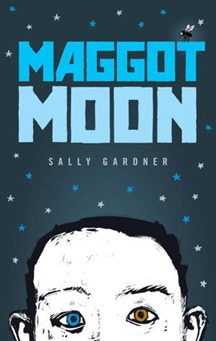
Maggot Moon by Sally Gardner

Standish Treadwell thinks differently than all of the others.  He can’t read and can’t write because the letters move around in front of his eyes, but he does come up with amazing thoughts.  That’s one of the reasons that he and his best friend Hector get along so well.  Hector sees past Standish’s different colored eyes and understands that Standish is really brilliant.  So when Hector disappears, Standish is left alone to be bullied.  It’s all because Hector went to the other side of the wall and saw what was happening there.  It’s a secret that the Motherland doesn’t want anyone to know about, but Standish starts to figure everything out when the Lush family is taken and the Moon Man appears.  This dark, violent novel shows us a bleak future where differences are stomped out but as Standish demonstrates are just as vital as they are today.

This is one of those novels that unfolds as you read it, layered and complex.  Science fiction set in the 1950s, readers will try to figure out where the book is set and how this happened.  Set in a totalitarian regime in what appears to be England where World War II ended very differently, this book is stark and tension filled.  Just the illustrations alone with the fly and the rat mark this as an unusual read. 

What I found most amazing about this book is that we are not just told that Standish thinks differently than others, we are shown it in his narrative voice.  The book is far from linear, journeying almost as a stream of consciousness through the past.  Standish will have readers themselves looking at the world through his eyes and what an accomplishment that is!

This book defies description by genre and really is impossible to summarize well.  Let me just say that it is powerful, brutal and set in bleakness but never far from hope.  Appropriate for ages 15-18.

Reviewed from library copy.

Review: The Passover Lamb by Linda Elovitz Marshall

passover lamb

The Passover Lamb by Linda Elovitz Marshall, illustrated by Tatjana Mai-Wyss

Miriam has been selected to sing the Four Questions at the seder, the special Passover meal, at her grandparent’s house.  She has been practicing over and over again.  When she discovers that Snowball, one of their ewes, is going to have a baby, the family wonders if it will disrupt their Passover plans.  Snowball has her lambs in time, but her third lamb is ignored and she refuses to nurse him.  Miriam is very worried for the little lamb, but also wants to head to the seder and sing her part.  So she comes up with a clever plan to care for the newborn lamb and be able to be with her extended family.  This Passover story is a gentle reminder about compassion and a beautiful introduction to Passover.

Marshall writes with a gentleness that weaves throughout the entire story.  She allows Miriam to really be the center of the story, her family members are important but Miriam is certainly the lead.  She is the one who discovers that the ewe is going to have a baby, bottle feeds the newborn lamb and figures out the solution, all on her own.  This is child-led compassion that comes from a deep and natural place.

Mai-Wyss’ art is done in watercolors. The results are rich and colorful, nicely capturing a small family farm.  Just as with the text, Miriam is often front and center in the illustrations.

A superb book about caring and compassion, this is a strong addition to any public library.  Appropriate for ages 4-6.

Reviewed from copy received from Random House Books for Young Readers.

Review: Snow School by Sandra Markle

snow school

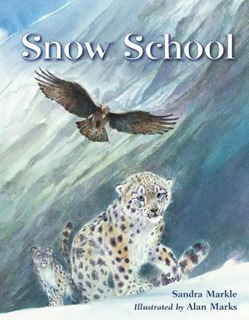
Snow School by Sandra Markle, illustrated by Alan Marks

High in the mountains of Pakistan, two week-old snow leopard cubs snooze in a den waiting for their mother to return.  It’s May and the pair are only a week old.  When the male cub goes outside, he is attacked by a golden eagle and only saved by his mother rescuing him.  As the cubs grow, the practice pouncing one another and then start to eat directly from the game their mother kills.  Their mother teaches them skills they must have to survive in the harsh climate.  They learn to mark their territory, to silently hunt, to be quick, to guard their food, to find shelter when snow comes, and when to retreat.  It is a story of how small cubs grow into strong hunters and how these great and beautiful cats manage to survive in their mountainous and cold habitat.

Markle is the author of over 200 books for children.  In this one she takes on one of the most elusive creatures on earth and shows the strong family bonds and the huge amount of learning these young cats must accomplish to live.  She writes her nonfiction in verse, making it more easily read.  Nicely, as the mother is teaching her cubs, Markle makes sure readers understand the lesson by repeating it neatly at the end of the stanza. 

Marks’ illustrations capture the snow leopards and their beauty and grace.  There are moments of such daring leaps and heart pounding danger that Marks captures with flawless accuracy.  His use of soft watercolors adds to the mystique of these cats and also captures the speed and motion as they hunt. 

Beautiful illustrations and strong text result in a book that will teach children much about the snow leopards and their lives.  Appropriate for ages 7-9.

Reviewed from copy received from Charlesbridge.

Review: The Price of Freedom by Dennis Brindell Fradin

price of freedom

The Price of Freedom: How One Town Stood Up to Slavery by Dennis Brindell Fradin and Judith Bloom Fradin, illustrated by Eric Velasquez

In 1856, John Price and two other slaves escaped to Ohio and freedom.  But the Fugitive Slave Act of 1850 was in effect and even free states were required to allow slave owners to capture escaped slaves anywhere in the United States.  John and his friend Frank spent the winter in Oberlin, Ohio, a hub of Underground Railroad activity.  They decided to stay and not travel to the safety of Canada.  So when a group of slave catchers came to Oberlin specifically hunting for John and Frank, the residents of the city had no legal grounds to help the two men.  When John was captured though, the city rose up against the slave catchers, forcing a showdown that would be one of the defining moments in fueling the Civil War.

Filled with informational facts, this book reads more like a fictional story thanks to its inherent drama.  It begins with John Price’s escape across the ice on stolen horses, continues through the Underground Railroad but the most amazing part is the final showdown, where your heart almost stops with the bravery and daring the Rescuers demonstrate. Fradin offers just the right mix of information and heroism.

Velasquez’s illustrations add to the dramatic feel of the narrative with their deep rich colors, drawn guns and historical details.  There are so many gorgeous night images filled with danger but also with hope.

This is a nonfiction picture book that is sure to inform children about an aspect of slavery that they will not have heard of as well as a tale of what a group of brave citizens can do.  Appropriate for ages 7-9.

Reviewed from library copy.