Review: Bear Has a Story to Tell by Philip C. Stead

bear has a story to tell

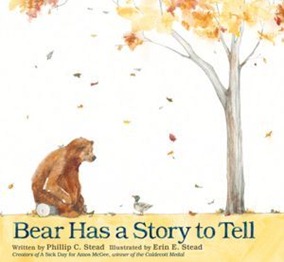
Bear Has a Story to Tell by Philip C. Stead, illustrated by Erin E. Stead

Fall was ending and winter was coming, but before he hibernated, Bear had a story to tell.  Unfortunately, the other animals were too busy to hear the story.  Mouse was gathering seeds and when Bear helped Mouse find lots of seeds, Mouse tunneled underground for the winter.  Duck was getting ready to fly south and all Bear had time to do was check the wind direction for him and say he would miss Duck before he flew off.  Frog too was looking for a warm place to sleep.  Bear helped dig a hole for him to sleep in.  Mole was already way underground and asleep.  So Bear too headed off to sleep.  When spring came, Bear still had a story to share.  Soon his friends were gathered around him to listen, and you will have to read the book to find out what story he shared!

The husband/wife team behind the Caldecott winning A Sick Day for Amos McGee have returned with a book that has a quiet, contemplative beauty that is haunting.  It’s one of those picture books that can be read as a quick bedtime story, but has so much more depth than that.  Bear’s rather lonely start to his hibernation also has a series of close connections to friends.  His spring wake up is filled with a warmth that echoes the seasonal change. 

The writing is gentle and filled with small details that really show the slowing nature of the start of winter.  There is time to count the clouds and look at the color of the leaves, at least for Bear.  The connections between Bear and his many friends are also written with a richness that adds much to the story.  The circular nature of the ending is also an invitation to start the book all over again.  One that readers will be happy to accept. 

Erin Stead’s illustrations have a beautiful delicacy to them.  The rounded shoulders of the very furry Bear show a patience and yet a weight too.  There are moments of celebration, when Bear is rolling in the newly lush grass that are filled with cheer.  It is especially remarkable near the lonely and poignant image of Bear alone as the first snow begins to fall.  Lovely.

It’s the perfect time of year to read this book, ease yourself into the winter months and quietly wish autumn farewell.  Appropriate for ages 4-6.

Reviewed from library copy.

Review: Baby Penguins Everywhere! by Melissa Guion

baby penguins everywhere

Baby Penguins Everywhere! by Melissa Guion

There was a penguin who was all alone on the ice floes.  She liked the quiet, but sometimes it did get lonely. Then one day, she discovered a top hat floating in the water.  Once the hat was on land, out popped a little penguin.  And then another!  The big penguin was very happy and no longer lonely.  But then came another little penguin, and more, and more.  Soon there were many, many little penguins everywhere.  The big penguin was very busy and quite tired.  She knew she just needed on little thing – a moment of quiet and solitude.  But after that, she merrily joined in the fun with all of the other penguins again.

Guion frames her message about the need for quiet and solitude in a way that children will understand.  The big penguin needs a little break, just like their parents sometimes do.  The best part though, is that after that break, they are ready for more fun!  The writing here is simple, making it just right for toddlers.

It is Guion’s art that really shines here.  The delight of the first two little penguins is perfection and then the surprise of turning the page and realizing that they just keep on coming makes the book even more fun.  Guion has her little penguins in constant motion, playfully coming up with new ideas and new toys.  This is much more like a class than a family, so teachers may appreciate using this book as a way to explain their own need for some quiet time too.

A cheerful look at peace and quiet, this book is wonderfully rowdy too.  Appropriate for ages 2-4.

Reviewed from ARC received from author.

Review: Vessel by Sarah Beth Durst

vessel

Vessel by Sarah Beth Durst

When Liyana took her dreamwalk, she found out that she would be a vessel for her goddess to return to the world.  This meant that the Great Drought would end as the goddess Bayla would bring water to their dry wells in the desert.  Liyana worked to make sure that her body was worthy of the goddess, but when she danced the sacred dance, Bayla did not appear.  Left behind by her tribe to die in the desert alone, Liyana met Korbyn, a god inside his vessel.  He explained that five gods were missing, kidnapped by someone.  So Liyana joined Korbyn in traveling to the other nomadic tribes to tell them of their lost gods and save their vessels.  But the journey is dangerous, the tribes unwelcoming, the real enemy unknown, and as they journey, Liyana finds more and more reasons to not want to disappear when her goddess returns.

Durst has a great storytelling skill which is evident in this book.  The storyline is complex with many characters, mortals and gods alike.  Durst keeps the story moving forward at a brisk pace, populating her world with many unique characters.  Even the desert itself is wondrous with its sand wolves, giant worms, and glass sky serpents.  The ecological disaster of a world-wide drought drives the story, creating its own tension and time limits. 

But what Durst does best here is create an amazing heroine.  Liyana is not only worthy to be the vessel for the goddess, but worthy of awe herself.  She is not only strong but very vulnerable.  She is so strong but also rocked by the new emotions of love and lust that she finds awakening.  She is devoted to her goddess but also questions her own role in bringing the goddess to life.  Complex and completely human, Liyana is simply remarkable.

I must highlight here that Liyana is clearly a non-white heroine in the story and happily, the cover reflects that as well.  This is an amazing girl of the desert with skin that is described as burnt cinnamon.

Get this one into the hands of teens who enjoy the strong heroines of writers like Tamora Pierce.  They will love the world building, unique setting, and Liyana herself.  Appropriate for ages 13-16.

Reviewed from copy received from McElderry Books.

Review: Jo MacDonald Had a Garden by Mary Quattlebaum

jo macdonald had a garden

Jo MacDonald Had a Garden by Mary Quattlebaum, illustrated by Laura J. Bryant

Celebrate gardening with this cheery picture book that features Old MacDonald’s granddaughter, Jo MacDonald.  The verses here are set to the same music as the original, except this time it’s all about planting a garden rather than the animals on a farm.  In the garden there is some sun, some soil, a worm, seeds, water, animals, plants, and then food!  Watching the illustrations, children will see the garden take shape and then watch the plants grow until they are ready to be harvested. 

Quattlebaum has cleverly written verses that can be acted out by preschoolers as the book is shared.  At times, the children in the illustrations show the movements that could be done, and at other times they would be easily figured out by a savvy teacher or librarian.  I can see lots of children this spring enjoying planting imaginary gardens all together. 

Bryant’s illustrations have a wonderful sense of detail to them.  Each page has animals to glimpse in the garden, including a cardinal and a butterfly that are on almost every page.  This is a book that children will enjoy looking at and exploring.

Get your voice warmed up and be ready to wiggle like a worm with this new version of Old MacDonald!  Appropriate for ages 2-4.

Reviewed from copy received from Dawn Publications.

Review: Colorful Dreamer by Marjorie Blain Parker

colorful dreamer

Colorful Dreamer: The Story of Artist Henri Matisse by Marjorie Blain Parker, illustrated by Holly Berry

Matisse grew up in a French town that was industrial and gray.  Despite this, he dreamed in bright colors.  He was a boy who did not do well in school, at music, or really at much of anything except dreaming.  Matisse decided to study law in Paris, but he discovered that being a law clerk was very dull, copying legal documents word for word by hand.  Due to the stress, Matisse ended up in a hospital bed for months.  It was there that he started painting to pass the time.  Now he had found exactly what he was good at.  It wasn’t easy, there were times he lacked food and money, but he worked very hard at his art.  Years later, Matisse found himself sick and in bed again in his old age.  He could no longer stand at an easel, so he turned to making cut-out collages, and those pieces turned out to be some of his most celebrated creations.

Parker vividly tells the story of a boy who grew up as a very unlikely artist.  From his colorless surroundings to the fact that he had never discovered his artistic gift, it is amazing that Matisse became what he was.  I appreciate particularly her celebration of the creative and the imaginative.  She also makes sure though that young readers know how much work it took for Matisse to reach success and that it did not come instantaneously.  It’s a book that speaks to everyone having a gift, but also the hard work it takes to achieve it.

Berry’s art plays black-and-white against brilliant color.  The gray world of Matisse’s youth is shown in intricate pencil illustrations, but pales against the radiant color of his dreams and his art.  As the pages turn, Matisse’s world becomes the same colors as the art he creates, demonstrating that he has finally found his place in the world as a whole.

Beautifully illustrated and written as an inspiration to young people looking for their own special place in the world, this is a very special look at a famous artist.  Appropriate for ages 5-8.

Reviewed from copy received from Dial Books.

Review: Live Through This by Mindi Scott

live through this

Live Through This by Mindi Scott

Coley is living a lie.  Her life appears to be perfect on the outside.  She is popular, dances on the school dance team, and has started dating a cute guy in her class.  But that’s just the surface.  After her mother fled an abusive husband in New Zealand, she has since remarried and now has three children with her new husband.  Coley and her brother, Bryan, feel like outsiders sometimes, so many years older than the other children in the family.  And then there is the secret that Coley can’t even admit to herself.  A family member is molesting her at night.  All Coley can do is pretend that it doesn’t happen and just continue to try to live her life.  But it does happen, and it’s getting more and more difficult for Coley to pretend it away.  This is a riveting story about the cost of living a lie and the courage it takes to tell the truth.

Scott’s writing is all the more powerful because of all she leaves out.  Readers know from the very first pages that Coley is being sexually assaulted at night, but Scott doesn’t reveal who it is in her family.  This builds the tension tremendously, making the book impossible to put down until that mystery is solved.  Scott depicts the abuse itself with an unflinching honesty that makes it all the more sinister.

Scott powerfully captures the character of a girl who is working as hard and as fast as she can to stay in denial about what is really happening.  Coley is a complex person, a loving and warm girlfriend and daughter on the surface, but there is so much fear and self-loathing underneath.  Coley also carries a large amount of guilt with her, because of her reaction to the abuse.  Scott does not shy away from the difficult emotions here, while always making sure that readers understand who is truly at fault.

A powerful, wrenching novel for teens that tackles incest and survival.  Appropriate for ages 15-18.

Reviewed from copy received from Simon & Schuster.

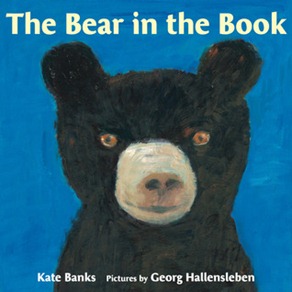
Review: The Bear in the Book by Kate Banks

bear in the book

The Bear in the Book by Kate Banks, illustrated by Georg Hallensleben

A little boy sits in bed reading a book with his mother.  It’s a book about a bear getting ready to sleep for the winter.  The boy and his mother share the story together, talking about the pictures and the bear.  The bear eats and eats, getting ready to hibernate until he finally curls up and falls asleep.  Then the snow comes, and the little boy can almost feel the cold from the page of the book.  He looks closely at the pictures and finds hidden animals in the snowy landscape.  The snow continues and the boy snuggles in closer, the bear sleeps on.  As spring nears, the boy gets sleepy.  Just as the bear is about to wake up, the boy falls asleep for the night.  Now it’s his turn to sleep long and deep in a cozy bed.

This book is pure joy.  It celebrates both the written word and the art of the picture book.  Even more so though, it celebrates the connection built by sharing a book right before bed.  Just as the boy could feel the winter emanating from the page, here you can feel the warmth and coziness.  With my librarian hat on, I am delighted to see a book that models what reading aloud to a small child should look like.  There should be conversations about the pictures, questions and answers about what is happening in the story, looking at the colors on the page, finding hidden animals, and much more activity than simply reading a story aloud. 

Hallensleben’s illustrations have a gorgeous rough texture to them.  The paint is lovely and thick, resulting in rich colors that add to that feeling of warmth and home.  They also bridge the connection between the book and the family reading together, flowing seamlessly back and forth, uniting as an entire story.

Highly recommended, this is a book that will have you curled up and sharing it with your own little one immediately.  Appropriate for ages 3-5.

Reviewed from library copy.

Review: I Have a Dream by Martin Luther King, Jr.

i have a dream

I Have a Dream by Dr. Martin Luther King, Jr., illustrated by Kadir Nelson

The power of Martin Luther King’s words meet the beauty of Nelson’s art in this luminous picture book.  Using lines pulled directly from the latter part of King’s famous I Have a Dream speech, Nelson shows young readers how history was made that day.  From King himself standing before the Lincoln Memorial to the seas of people listening, people of all colors standing side-by-side.  Kadir moves back and forth between capturing the magnificence of King and his speech to images of what the world being dreamed of would look like.  There are beautiful skin tones shown together as well as impressive vistas of the nation.  Pure celebration, this is a picture book that truly captures the heart of King’s speech in a way that children will be able to understand.

Nelson’s art has already won him a Caldecott Honor.  Here he has the courage to take on a famous man at his more memorable moment.  But he doesn’t just show us the history, he illuminates it.  King shines with light, stands with power, and beams with faith.  There is a humanity to him too, somehow Nelson has captured what is beneath the skin too.  Beautifully.

One of my favorite images of the book is the pair of white and black hands joined together.  Against a plain white background, the hands are such a powerful symbol.  Kadir paired those joined hands with a section about faith, so the two joined together become a prayer of their own too. 

This book belongs in every library, both for the historical power of the moment being captured, but also for its exceptional beauty and art.  Appropriate for ages 7-9.

Reviewed from copy received from Schwartz & Wade Books.

Review: Unspoken by Henry Cole

unspoken

Unspoken: A Story from the Underground Railroad by Henry Cole

Every now and then an illustrator takes an amazing risk and it works so beautifully that it’s a masterpiece.  That’s what Cole has done in this remarkable picture book.  Don’t expect to see the bright colors of his work in books like Moosetache or even the more subtle but equally bright And Tango Makes Three.  Instead Cole has turned to the medium of simple paper and pencil to create a book that is wordless and powerful.  It’s the story of a farm girl who discovers a runaway slave in their barn soon after seeing a group of men on horseback.  She is startled and unsure, but over the course of the evening decides to help him.  It is a story of gifts given and also received.

Cole’s delicacy of line and details are notable here.  He keeps the illustrations very child-friendly, but they are also mysterious, shaded in darkness.  He plays with light, as you can see from even the cover image.  These wordless pages build tension and roll like a film before your eyes.  I’m thinking that the skill shown with simple materials and the strength of this book could mean a Caldecott consideration.

This is a profound book that speaks volumes about the importance of personal courage and the difference that one individual can make.  This is not a wordless book for preschoolers.  It’s more appropriate for ages 7-9 who will understand the history better.

Reviewed from library copy.