Review: The Christmas Wombat by Jackie French

christmas wombat

The Christmas Wombat by Jackie French, illustrated by Bruce Whatley

The original Diary of a Wombat returns in all of his carrot-munching glory with a Christmas title.  The book starts in a familiar way with a day spent sleeping, scratching, sleeping again, and eating.  But then, a Christmas ornament bops him on the nose.  The wombat gets rid of them.  Then the wombat meets Santa’s reindeer who also like carrots.  They fight a great battle and the wombat wins and after munching more carrots, curls up on the back of Santa’s sleigh. The wombat meets Santa, discovers snowmen with carrot noses, and continues to eat carrots across the world.  The book ends with the same simplicity as the beginning, and with a well-deserved nap.

French has an exquisite sense of timing in her text.  When I read the first book to my son, it quickly became one of his all-time favorites.  Finding a Christmas book with that same feel and humor to it was a highlight of our holiday season so far.  I enjoy reading the books with an Australian accent, since that’s how a wombat would talk, right?  And they are a delight to share aloud.  The timing of the humor is naturally conveyed in the writing.

Whatley’s illustrations are great.  They show the pride of the wombat, his unwavering courage even when facing much larger animals, and plenty of humor themselves.  With their larger format and white backgrounds, this picture book can merrily be shared with groups of children.

A great pick for a twist on the regular holiday picture books, this one may call for carrots to be shared afterwards.  Carrots…  Carrots… Carrots… Appropriate for ages 3-5.

Reviewed from library copy.

Review: Unwholly by Neal Shusterman

unwholly

Unwholly by Neal Shusterman

Unwind by Shusterman was a single book with an amazing premise: an American society where teens who were too unruly or too burdensome were unwound into parts for others to use.  Fans of the first book will be delighted that Shusterman is turning that single book into a trilogy.  Book two picks up soon after the first.  All your favorite characters who survived the first book are here.  Connor is running the Graveyard, a place of safety for over 700 teens who escaped being unwound.  Risa is at his side, working to keep the teens all healthy.  She’s in a wheelchair, paralyzed from the waist down.  Lev is working with teens to try to keep them from being unwound by their parents, forced by the courts to do this.  But wait, there are new characters too.  There is Starkey, a boy who knows that he is destined for greatness and is sure he could lead better than Connor.  There is Cam, a boy who was manmade from unwound teens, who is sure he is human though others doubt it.  There is Miracolina, raised knowing she is a tithe and will be unwound.  There is Nelson, the cop who was shamed when Connor escaped and who has not stopped chasing him.  There is rewritten history that keeps teens victims.  There is a large corporation working against them.  And that’s just the beginning.

Shusterman does an amazing job here of juggling all sorts of different perspectives while keeping each personality distinct and fascinating.  All of the characters, even the villains, have clear motivations and reasons that they see the world the way that they do.  Some are blinded by faith, others by obsession, and still others by their own view of the world itself.  His character building is well done, especially for such a large cast.

Shusterman continues to point out throughout the book how his concept is not far-fetched.  By using actual newspaper articles that point to teens being vilified, he firmly ties his fantasy world to our own.  The entire premise of the series is fraught with gray areas, ethics on both sides, and straight humanitarianism.  It is in this gray area that Shusterman does his most powerful work.

There are moments where the momentum flags and the pace drags a bit.  But that is a minor complaint and one that would never prevent me from finding out how the entire series ends.  Here’s hoping for another complex and complicated book to complete the set!  Appropriate for ages 15-17.

Reviewed from copy received from Simon & Schuster.

Review: The Revolution of Evelyn Serrano by Sonia Manzano

revolution of evelyn serrano

The Revolution of Evelyn Serrano by Sonia Manzano

It’s the summer of 1969 and garbage is piling up on the streets of Spanish Harlem.  Evelyn, who has changed her name from Rosa, has a new job at the Five and Dime.  It’s a lot better than her job in the family’s bodega.  But that summer is not going to be a normal summer at all.  First, Evelyn’s grandmother arrives, complete with large amounts of stylish clothes, makeup and books in Spanish.  If Evelyn thought she didn’t get along with her mother, that’s doubly true of her mother and her grandmother who seem to be opposites on everything.  One big thing that they disagree about is the Young Lords, young college students who are trying to get the Puerto Ricans in Spanish Harlem to stand up for themselves.  They want to find space for a daycare, a place to serve breakfasts to youth, and a place to hand out clothing.  Evelyn finds herself right in the middle of a revolution, one that her own family can’t agree about. 

Manzano, the actress who played Maria on Sesame Street, has followed up her successful picture book with a book for older readers.  Ideal for middle schoolers, this book addresses family issues that can be far more complicated than just not agreeing about food and clothes.  It also takes on a history that not many readers may know about, a peaceful revolution right in New York City. 

Manzano’s writing is very straight-forward, rarely heading into figurative writing or symbolism.  When she does work with imagery, it is very effective, making one hope that in her next books she writes with more depth.  That is not to say that this book is not effective as it is written.  But it remains more factual and solid.

A strong addition to any collection, this historical fiction novel will both instruct about history and inspire activism.  Appropriate for ages 10-12.

Reviewed from ARC received from Scholastic.

Review: Stephen and the Beetle by Jorge Lujan

stephen and the beetle

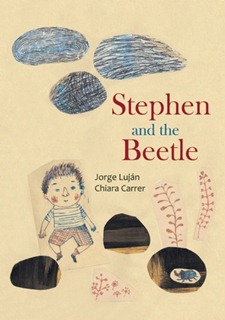
Stephen and the Beetle by Jorge Lujan, illustrated by Chiara Carrer

This very simple story explores philosophical areas while still remaining a picture book that is accessible to very young children.  Stephen was walking in the garden and sees a beetle.  He took off his shoe and was about to smack the beetle.  The beetle continued on its way, unaware of the threat.  Stephen raised his shoe higher, but then started to wonder about what the beetle was doing and where it was walking to.  So Stephen set down his shoe and put his head on the ground.  The beetle came closer, reared back on its back legs and seemed about to attack, but then seemed to think about it and instead just continued on its way.  The parallel pieces of this story make it all the more thought provoking and should get children thinking in a new way about even their smallest decisions during their day.

Lujan’s writing is simple and pure.  He tells the story and what is happening with a straight-forward tone and allows the story itself to create the points of discussion.   The only point where the writing gets complex and lush is when the beetle is about to attack.  Suddenly the tone changes and the rhythm gets wild.  But then, it is back to the simple tone to finish the story.

Carrer’s art is done in mixed media that includes collage, paint, pen, chalk and ink.  She very successfully plays with dark and light images that mirror one another.  The beetle is shown to be just as complex a creature as Stephen himself. 

This is a book that will certainly generate discussion.  There are etchical implications here, the question of impact of our decisions, and the aspect of choice.  And yet, there is also a small boy playing in a yard with a beetle.  It is a perfect example of a small scene that speaks to much larger issues.  Appropriate for ages 5-7.

Reviewed from library copy.

Review: Twelve Kinds of Ice by Ellen Bryan Obed

twelve kinds of ice

Twelve Kinds of Ice by Ellen Bryan Obed, illustrated by Barbara McClintock

Oh my.  There are few books that leave me with tears standing in my eyes at the end, especially books of a spare 64 pages.  This one did. 

I suppose I could leave my review at that, but here are some details for those who need more.  This tightly written and beautifully illustrated small book looks at the twelve kinds of ice that happen in the course of a winter.  It all starts with the first ice which is the thin ice on top of a bucket in the barn that breaks when you touch it.  From there excitement builds as slowly the ice gets thicker and more able to be skated on.  Some ice like field ice and stream ice can be skated on, but it’s tricky.  Garden ice is the ice rink that the Bryan family created in their garden, made by packing the snow very firm and then spraying it with the garden hose.  It is that family skating rink that is really celebrated in the book, showing a strong family and their mutual connection through ice skating.  Even the ice skaters and hockey players get along.  Most of the time!

Obed is telling the story of her own family and their love of skating.  Her writing is so beautiful and strong.  She tells a story with depth and feeling, celebrating winter, ice and the thrill of skating.  Seeing how short the book is, one wonders how she managed to tell so much in so few pages.  Her prose invites us into her family and onto ice skates.  Alongside her, we don’t so much as wobble but instead skim across the ice at her side.  It’s an exhilarating and intensely personal read.

McClintock’s illustrations are entirely black and white in the book.  She captures a timelessness in her images, celebrating the family and natural surroundings.  She also shows the movement of skating and its thrill.

This is a quiet book, one that will need some push to get it into children’s hands.  I can see it being part of anyone’s holiday and also a great gateway to talking about your own memories of childhood and special things your family does together.  Quiet but powerful and immensely satisfying.  Appropriate for ages 6-9.

Reviewed from library copy.

Review: A Is for Musk Ox by Erin Cabatingan

a is for musk ox

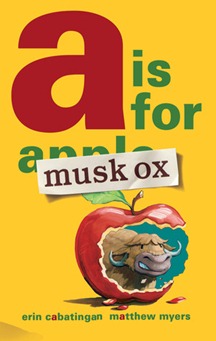
A Is for Musk Ox by Erin Cabatingan, illustrated by Matthew Myers

The story begins right at the cover with Musk Ox chomping on the apple that would have been what “A” stands for.  Instead, he insists that A is really for musk ox.  Zebra argues with him, after all there isn’t even a single letter A in musk ox.  Musk Ox explains using lots of words that start with “A” that musk oxen are Awesome; they live in the Artic and even Alaska.  Turn the page and you will see that B is also for musk ox, rather than baby.  Again, Musk Ox has plenty of explanations for exactly why.  This silliness continues through the book, forming a pattern until you reach the letter M.  And I don’t want to spoil the surprise, but I bet you won’t guess what M stands for.  This zany book is filled with humor, pure cheer and a jolly spirit.

This is not an alphabet book for those first learning their letters.  Instead, children who know how the alphabet works and who are veterans of ABC books will enjoy it most.  They will get the jokes that are being poked at more normal alphabet books as well as the more pointed humor of the storyline.  Cabatingan’s writing, done entirely in dialogue, is a pleasure to read aloud.  It has a natural flow and a great sense of timing.

Myers’ illustrations are simple and quite silly when called for.  The personalities of the two characters come across in their body language. 

A hilarious alphabet book that is guaranteed to get kids giggling.  Appropriate for ages 5-7.

Reviewed from library copy.

Review: The Cavendish Home for Boys and Girls by Claire Legrand

cavendish home

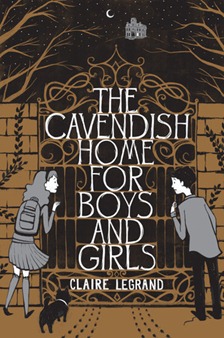
The Cavendish Home for Boys and Girls by Claire Legrand

Victoria has always tried to be the best that she can be with her perfect hair, great grades and neat room.  So when she gets a B in music, she is distraught and refuses to show her parents her report card.  Lawrence, her one and only friend, doesn’t have the same appreciation for perfection.  He’s a musician who is often untidy and has a habit of humming constantly.  As Victoria obsesses about her grades, she starts to notice that strange things are happening around town.  Some of the students at her school have disappeared and no one seems to care.  When Lawrence disappears and his parents are unconcerned, Victoria realizes that there is something horribly wrong.  She knows it must have to do with the Cavendish Home for Boys and Girls, an orphanage which never seems to have any children around.  In Mrs. Cavendish, Victoria finds another person with a will for order and perfection.  In Victoria though, Mrs. Cavendish may have met her match.  As this book turns from mystery to horror, readers will taken on a frightening ride.

From the endpaper that is designed with bugs to the bugs scattered along randomly inside the book, readers will realize that this is a little darker than most mysteries.  It begins as a classic story of a girl who is top of her class and fairly self-centered.  She is likeable despite these faults thanks to her natural inquisitiveness and bravery.  As the book becomes more dark and creepy, Victoria rises to the challenge, turning into a heroine before your eyes.  It’s a credible and impressive transformation.

Legrand slowly builds the tension in the book, creating a story that you can never quite relax into.  A great example of this is on page 83:

Outside, the streets glistened. Storm clouds sat fat, black, and heavy all along the sickly yellow sky. Victoria wondered if they would ever break or if they would just keep spitting bits of rain forever when no one was looking. She tightened her grip on the umbrella beneath her raincoat and tried not to think about how it felt like the trees were watching her.

It’s a book that twists and turns, becoming the unexpected. At several moments, I thought I had figured it out and the doubted that that would be the outcome in a children’s book.  Children will delight though in realizing that Legrand does not shy away from the horrid, the frightening and the disgusting. 

This is a wild ride of a book clothed in a classic mystery disguise.  Get it into the hands of children who enjoy a good shivery read.  It’s perfect for reading at night under the covers, if you are brave enough.  Appropriate for ages 11-13.

Reviewed from copy received from Simon & Schuster.

Review: The Santa Trap by Jonathan Emmett

santa trap

The Santa Trap by Jonathan Emmett, illustrated by Poly Bernatene

Bradley Bartleby was born bad and as he got older, he got even more bad.  Bradley’s parents were immensely rich and gave Bradley everything he wanted because they were scared of him. Every year, Bradley would make an enormous list for Santa Claus but Santa knew about how bad Bradley was and never looked at the list, instead giving him a small token gift of socks.  Even though Bradley’s parents gave him everything he had put on his Christmas list, Bradley hated that Santa himself didn’t give him what he wanted.  So Bradley decided to build a trap for Santa.  He worked on it for a year, until by Christmas Eve his parents had moved out of the house because it was so dangerous.  Now all it would take was Bradley to stay awake and watch the trap work.  But staying up and waiting for Santa on Christmas Eve is notoriously difficult to do.

Emmett has created a holiday picture book with a lot of edge, plenty of weaponry and some pretty spectacular explosions.  This is a holiday book that will appeal to children who feel a bit too old for elves and reindeer.  Happily though, at the heart of the story there really is a Christmas spirit about what the real meaning of Christmas should be.  Emmett though does not let that ruin the fun, delighting in turning Christmas on its ear in this picture book.

The art by Bernatene works so well here.  It has plenty of zing and pop with its bold colors and modern feel.  One just has to look at the cover to know this is not your normal holiday book.  The illustrations were done digitally, adding to the modern feel, but they are also made warmer by brushstrokes showing on the images. 

A dynamic and very funny holiday book that will work particularly well for elementary-aged children who will delight in the weaponry, the trap, and the twist at the end.  Appropriate for ages 4-7.

Reviewed from ARC received from Peachtree Publishers.

Review: Lemonade in Winter by Emily Jenkins

lemonade in winter

Lemonade in Winter by Emily Jenkins, illustrated by G. Brian Karas

Pauline is the one who looks out on a blustery winter day and thinks of running a lemonade stand.  Her little brother John-John immediately thinks it’s a great idea, but her parents are sure it won’t work.  So the kids set out to collect enough money to open their stand.  They dig in the couch, search pockets, and look in their piggy banks.  At the store they spend 24 quarters or six dollars on supplies.  They rush back home to make the lemonade, the limeade and the lemon-limeade and then out onto the street to set up their stand.  But no one comes.  Then they decide to start marketing their stand more, and surprisingly, there is a market for lemonade in the snow.

Jenkins has taken a picture book and inserted math in places that make sense of the story.  This is one book where the math really works, the counting of coins, the discounting of items, and the profits made.  It’s a book that can be read just for the cheery enjoyment of lemonade and snow too.  The writing is clever with the adults constantly warning the children that it won’t work and an ending that is realistic, warm and refreshing.

Karas’ illustrations are done in his signature style.  I enjoyed seeing children with brown skin in a story that is not about their brown skin at all, it’s just the way they look.  Karas’ art is lively and rich with small details.  The careful counting of the quarters at the grocery store is just one example of how he too skillfully melded in the math with the story.

A winning picture book with math at its heart, this is a story that will have you asking for some more lemonade on a winter’s day.  Appropriate for ages 4-6.

Reviewed from copy received from Random House Children’s Books.