Review: Minette’s Feast by Susanna Reich

minettes feast

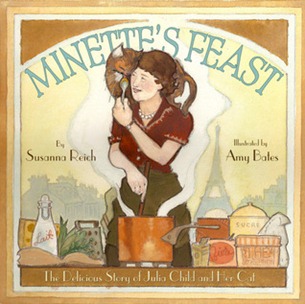
Minette’s Feast: The Delicious Story of Julia Child and Her Cat by Susanna Reich, illustrated by Amy Bates

Minette was most likely the luckiest cat in the world, since she was owned by Julia Child.  Adopted by Julia Child and her husband during their time in Paris, she was just as discerning about her food as her owner was.  She spurned canned food, eating only fresh mice and bird.  Julia would bring home marvelous fish heads just for Minette and also give her leftovers from her cooking.  Still, Minette preferred her own hunted food.  Julia began to cook more and more, taking classes as Le Cordon Bleu.  Minette honed her own hunting skills at the same time, practicing on her toys.  It would take something very special to lure Minette away from the mice.  But then again, her owner was Julia Child who was certainly up to that challenge.

Taking on a famous cook and personality through her finicky cat is a wonderful approach.  We get to see a younger Julia Child, figuring out how to cook French food in her own small kitchen.  We are there to see her arrive in Paris, find her footing in the culture, and then through her learning process until her cooking inspires even her cat to turn away from mice.  It’s a genuine way to approach the subject that has a real child-appeal.

Bates’ illustrations are done in pencil and watercolor.  There is a seriousness and also a playfulness in her illustrations that remind me of Julia herself.  The lanky woman is shown at her full height throughout the book as she is celebrated in both image and text.  Minette appears early in the book, long before Julia adopts her.  It’s a nice touch for sharp-eyed children.

A warm and energetic glimpse of Julia Child that celebrates her on the year of her 100th birthday.  Simply delicious!  Appropriate for ages 6-8.

Reviewed from copy received from Abrams.

Review: Barnum’s Bones by Tracey Fern

barnums bones

Barnum’s Bones: How Barnum Brown Discovered the Most Famous Dinosaur in the World by Tracey Fern, illustrated by Boris Kulikov

Barnum Brown was fascinated with fossils from the time he was a toddler following behind his father’s plow.  His collection got so large, it outgrew his bedroom and he was forced to move out to the laundry house with his finds.  In college, Barnum got to go on digs in the summers of 1894 and 1895 in South Dakota and Wyoming.  Barnum got a reputation for being a great bone hunter, collecting more than 1400 pounds of bones!  The American Museum of Natural History in New York City didn’t have a dinosaur on display, so they hired Barnum to do fossil digs for the museum.  Barnum continued to prove he could find bones, but he never found a new species, even though others were discovering them.  All that changed when he found a huge bone, discovering the first T. Rex.

This book is science and hard work made fascinating and cool.  I appreciated the fact that this is not just a book about Barnum’s great find, but also all of the determination and time that it took to make that find.  Readers travel along with Barnum through the heat and mosquitoes to find bones.  The amazing hauls that he made before finding T. Rex are mind-boggling.  The persona of Barnum is an interesting one too.  His dandy clothes, wearing a fur coat and nice shoes on digs makes for an even more fascinating scientist. 

Kulikov’s illustrations use glowing outlines of the dinosaurs being discussed to show readers the form of the dinosaur.  What could have been a frustrating part of the book becomes all the more intriguing and inviting.  His illustrations are playful, contrasting dusty old-fashioned colors with the bolder colors of the night sky and burning campfires. 

This is a book that will inspire children to search for their own fossils, whether they are as big as a T. Rex or not.  Appropriate for ages 7-9.

Reviewed from library copy.

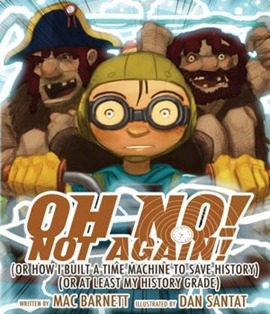
Review: Oh No! Not Again! by Mac Barnett

oh no not again

Oh No! Not Again! (Or How I Built a Time Machine to Save History) (Or at least my history grade) by Mac Barnett, illustrated by Dan Santat

The sequel to Oh No! (Or How My Science Report Destroyed the World) takes on history class.  The female protagonist messes up her perfect score on a history test by missing the first question: In what modern country do we find the oldest prehistoric cave paintings?  So she figures out a simple answer to getting a perfect score: she builds a time machine to change history so that her answer of Belgium is correct.  When she finally reaches the right point in history, she is faced with two Neanderthals who aren’t really interested in creating art.  They’d much rather stick the paintbrushes up their nose or munch on the paint palette.  Spray paint worked even less well.  When our hero heads into the cave to do it herself though, the Neanderthals highjack her time machine.  What’s that going to do to her history grade?

Fans of the first book will enjoy this one as well.  It has the same zany, wild pacing of the first.  This time the romp is through history.  Happily, the book embraces a very simple sort of history to understand, so young readers will be able to get the humor and understand the juxtapositions that make up much of the story. 

Santat brings in physical humor too, giving the book his signature pizzazz and style.  I’m a fan of the color palette that hearkens back to an old film throughout.  It has a grainy texture and then there are the light-colored lines running vertically through the images.  Very school film on reels from my own childhood. 

A clever, funny and wild ride through history from the folks who brought us the robot rampage through science.  Appropriate for ages 6-8.

Reviewed from library copy. 

Review: Hide & Seek by Il Sung Na

hide and seek

Hide & Seek by Il Sung Na

The author of several lovely picture books returns with another beautiful book.  This time readers are part of a game of hide and seek with jungle animals.  Elephant offers to seek while the others hide.  There is a slow count from one to ten as the animals search for places to hide.  Giraffe opts for a tree to hide behind.  Gorilla stands atop Tortoise’s shell like a statue.  Elephant searches for everyone and one-by-one he finds them all, except for Chameleon.  All of the animals finally have to give up and Chameleon reveals himself.  Young readers can search for chameleon throughout the bright illustrations, participating in the game themselves.

The text here is fairly basic, allowing the game to create the pacing and story.  The counting from one to ten creates an effective counting book that is nicely married to a hide and seek game that will challenge young children. 

It is really the art that is special here, glowing with light from within and filled with bright colors.  None of the animals are colored as expected.  The elephant has vibrant ears in red with hearts.  The giraffe is a fiery yellow with red.  Tortoise is a rainbow of pattern and color.  The trees themselves are topped with colorful clouds of leaves.  It all creates a very dynamic and fanciful world.

Colorful counting and a game to play make this a great pick for lap sharing with your favorite toddler or preschooler.  Appropriate for ages 2-4.

Reviewed from copy received from Alfred A. Knopf Books for Young Readers.

Review: Small Bunny’s Blue Blanket by Tatyana Feeney

small bunnys blue blanket

Small Bunny’s Blue Blanket by Tatyana Feeney

Small Bunny did everything with his blue blanket.  He took it everywhere with him.  His blanket helped him read hard words, swing higher on the swings, and paint the best pictures.  But one day, Small Bunny’s mother thinks that Blue Blanket should be washed.  Small Bunny tried to hide, but his mother found him.  So after Small Bunny’s bath, it was Blue Blanket’s turn.  Small Bunny stood and watched the washer for the entire 107 minutes that it took to wash.  Then Blue Blanket had to dry on the line.  Small Bunny’s mother was sure that the blanket was good as new, but Small Bunny did not want a new blanket, he wanted his good old friend back.

There is such charm in this very simple book thanks to the illustrations.  Done in a limited palette of blues and small touches of pink, the minimalist lines give a sense of space and movement.  Somehow this simple rabbit illustration manages to convey deep emotions, including joy, impatience and deep worry.  The sweep of the blanket through the pages adds motion.

The playful illustrations offer a lightness to the book that elevates it nicely.  The writing is simple and basic.  I enjoyed the touch where Small Bunny’s mother told him it would take only a minute for his blanket to be washed and it took 107.  Lovely.  I also enjoyed the fact that this book was not about getting a child to let go of a beloved blanket, but instead just getting it washed.  The ending is satisfying too.

Playful and fun to read, this book will be enjoyed by the preschool audience.  The simple words and illustrations will work well with a toddler story time.  Appropriate for ages 1-3.

Reviewed from copy received from Alfred A. Knopf.

Review: Bird & Squirrel on the Run by James Burks

bird and squirrel on the run

Bird & Squirrel on the Run by James Burks

Bird and Squirrel don’t exactly get along.  Bird just wants to have a good time and never worries about a thing.  Squirrel is obsessive about gathering nuts for the winter and worries constantly.  But when Squirrel’s hoard of nuts is destroyed, the two of them realize they need one another to head south for the winter.  Unfortunately, the cat has a different idea and that is having both Squirrel and Bird for lunch!  This zany graphic novel is filled with twists and turns that will have even the most reluctant readers eagerly turning the pages.

Burks takes two polar-opposite characters and in a brief story manages to bring them together as friends in a very believable way.  Throughout the book, there is silly humor, plenty of puns, and a wonderful sense of camaraderie.  The pacing is particularly well done, with small places to catch your breath before the pursuit continues.  There are always surprises waiting for the characters and the reader too.  It makes the reading all the more fun to get caught up in the unexpected.

In my advanced reader copy, the art was only completed for the first few pages in full color.  From those pages, the colors are deep and bright.  The feeling is nicely autumnal and the bright colors add to the zing of the book.  The art has a classic cartoon feel that will have readers feeling right at home.

Perfect for young reluctant readers looking for graphic novels, this book will find an eager audience.  Appropriate for ages 7-9.

Reviewed from ARC received from Scholastic.

Review: Rocket Writes a Story by Tad Hills

rocket writes a story

Rocket Writes a Story by Tad Hills

This sequel to How Rocket Learned to Read has the same irresistible charm of the first.  While the first book inspired new readers on their way to proficiency, this book will inspire young writers to try their hand at the craft.  Rocket loved books like they were his friends.  He loved words too and used his nose to find new words to add to his collection.  Eventually, Rocket had so many words, he just had to do something with them.  So he decided to write his own story.  But when he was faced with the blank page, he couldn’t think of a thing to write.  The little yellow bird who was his teacher advised him to write about something that inspired him, that excited him.  Now Rocket just needs to find that perfect inspiration for a story.  It just might be much closer than he’d ever have expected.

Hills has taken the wonderful cheer of his original Rocket book and his Duck & Goose stories and transformed it into a book that will lead young authors through the thicket of writing their first story.  This is a shining example of a book that will inspire rather than lecture young artists as they strive to create.  Rocket has a wonderful combination of confidence and openness that makes him a great protagonist.  Children will be happy to learn to write a book alongside Rocket.

The art in the book is done in Hills’ signature style.  It is simple, bright colored, and joyful.  Hills plays with perspective, turns the idea of a classroom inside out, and rejoices in reading and writing. 

A must-have book for all public libraries, this will also find a welcome home in school libraries and classrooms.  Appropriate for ages 4-6.

Reviewed from copy received from Random House Children’s Books.

Review: My Life in Black and White by Natasha Friend

my life in black and white

My Life in Black and White by Natasha Friend

Lexi has always been known as the beautiful girl.  Her sister Ruthie is the smart one.  Her best friend Taylor is the fun one.  But that all changes when Lexi and Taylor go to a high school party.  When Lexi sees her best friend together with her boyfriend, she thinks her world has ended.  But then she is in a car accident and her face goes through the windshield.  Now Lexi has to figure out how to go on after losing the one thing that defined her beyond everything else, her beauty.  Plus she has to face it all without her best friend or her boyfriend by her side.  It’s like she lost everything in one single night, and maybe she did.

Friend excels at honesty in her teen novels.  Lexi starts out as a fairly vain young woman but after her series of disasters, readers are firmly on her side.  It is wonderful to see a book that takes the time to explore the process of grief, anger and finally acceptance so fully.  Lexi is a young woman who is strong, vital and much more than her face.  As the book proceeds, readers see beyond the beauty just as Lexi herself is discovering that there is more to her as well.

The writing here is clear and clean.  Friend explores not just Lexi’s relationship with her friends, but also how her sister is affected and how her parents cope.  There are no easy situations here, her father wants to fix everything and her relationship with her mother completely shatters.  There are sexual situations in this book, making it firmly a teen novel more appropriate for high school audiences.

There is plenty of pain in this novel, plenty of growth, but it is also smart and funny, just like Lexi herself.  Appropriate for ages 16-18.

Review: Martin on the Moon by Martine Audet

martin on the moon

Martin on the Moon by Martine Audet, illustrated by Luc Melanson

Martin has just started school, but as he sits in class, his mind continues to wander.  His teacher reminds him of his cat due to her hair color.  Then he daydreams about the trip he and his mother took to the river and thinks about the water there.  He tries to pay attention, since it is the first day of school, but then his teacher reminds him of a seagull with the way she is moving her arms.  Martin remembers a time when he was out drawing and got to see a bolt of lightning in the sky.  When he shared that it looked like someone coloring outside the lines, his mother wanted to use the image in a poem. Martin then starts thinking about poems and kisses, until his teacher asks him who he’s blowing kisses to. 

Nominated for the Prix TD de littérature canadienne pour l’enfance et la jeunesse in its original French, this book works well translated into English.  The poetic language, the imagery and the creativity of young Martin all work together to create a beautiful unity.  This is a striking example of a picture book whose strength comes from its writing rather than its illustrations.  The writing is powerful, visual and uses imagery that children will easily relate to.  Tying in poetry itself to the story makes it all the more concrete.

Melanson’s illustrations have a soft texture and use a successful mix of vibrant and softer colors.  The illustrations don’t offer much detail, instead being more about color and texture than finer touches. 

Poetic and lovely, this picture book would work well in a unit on imagery or poetry.  I’d also get it into the hands of any young daydreamer.  Appropriate for ages 4-6.

Reviewed from library copy.