Review: It Jes’ Happened by Don Tate

it jes happened

It Jes’ Happened: When Bill Traylor Started to Draw by Don Tate, illustrated by R. Gregory Christie

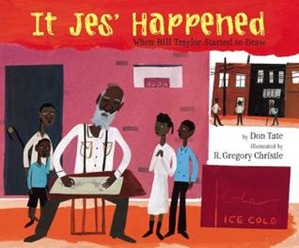
This picture book is a beautiful tribute to a legendary folk artist.  Bill Traylor grew up a slave in Alabama.  Born in 1854, he worked in the fields as a child.  When the slaves were freed at the end of the Civil War, his family stayed on working as sharecroppers on the same land they worked as slaves.  As things happened to him throughout his life, from hunger to parties, Bill Traylor remembered it all.  When he finally left the farm and headed to the big city of Montgomery, it was those memories that he drew and painted.  At age 85, he started drawing and kept on.  He got attention for it too, eventually getting a gallery show in 1940.  Bill Traylor showed his life and his heart through his simple yet powerful art.

Tate does not shy away from truly embracing Traylor in this picture book.  The book has more words than many picture books, but they are necessary to truly recreate both the memories of Bill Traylor and the amazing transformation to artist that happened so late in his life.  The writing is solid and smooth, building a full life before your eyes.

Christie’s art hearkens back to that of Traylor’s in its rough simplicity.  It speaks to the deep colors and the power of plain paint and strong lines.  There is also a wonderful dynamic quality to the art that offers motion and storytelling.

A lovely look at the life of a folk artist, this book is a great example of a picture book biography.  Appropriate for ages 6-9.

Reviewed from library copy.

Review: Legends of Zita the Spacegirl by Ben Hatke

legends of zita

Legends of Zita the Spacegirl by Ben Hatke

Released September 4, 2012.

This is the sequel to the wonderful graphic novel, Zita the Spacegirl.  In this second book, Zita is having to deal with her fame seriously cramping her style.  She can’t go anywhere without security (in the form of the friends she made in the first book.)  So when an opportunity arises, Zita heads away with Mouse for a little time alone.  Little does Zita know, but a discontinued robot who can make herself look like another person, has disguised herself as Zita.  By the time Zita realizes what has happened, Piper and the others have left with her to try to save a planet.  Now Zita has to follow them and steals a spaceship to catch up.  Unfortunately, this makes her a criminal and the Doom Squad are after her.  This is just the beginning of another amazing adventure of Zita the Spacegirl.

Dealing with the negative side of her fame is a wonderful way to open this second book. Add to it the strange robot who can imitate people, the ferocious Doom Squad, and several new friends she makes along the way, and you have another Zita book that is impossible to put down.  Zita is a great protagonist, a fantastic mix of normal girl and heroine.  She has real adventures in space as a young girl, something you don’t often see in children’s graphic novels.  She also solves many of her own problems, not relying on others to save her. 

Hatke’s art is clean and clear and filled with color.  He manages to create characters who project their personalities just through a few facial expressions and their appearance.  His pacing is spot on, carrying the book forward as fast as you can turn the pages.

This series belongs in every public library, offering a great young heroine in graphic novel form.  Appropriate for ages 7-10.

Reviewed from copy received from First Second.

Review: Maya Makes a Mess by Rutu Modan

maya makes a mess

Maya Makes a Mess by Rutu Modan

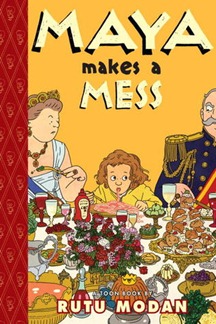
Maya doesn’t eat with very good manners at all.  She likes to eat with her hands, has terrible posture, and doesn’t use a napkin.  Her parents are trying to get her to make less of a mess and her father asks what she would do if she was eating with the queen.  Just then, a knock comes on the door and a royal messenger is there to invite Maya to dine with the queen that night.  Maya arrives via plane to the castle where the queen greets her and she is taken to the dining hall.  There are many people in fancy clothes there and the food is fancy too.  Maya requests (very politely) pasta with ketchup, but then can’t figure out what fork to use.  The gentleman next to her, brushes off her questions and tells her to eat the way she usually does.  Uh oh!

This is not the graphic novel for parents to pick up to teach their children manners, thanks to a big twist at the end of the book.  Children on the other hand will adore this book that turns manners on their head and have the young protagonist victoriously messy in the end.  Modan plays the rules of a royal dinner up with great effect.  There are moments in the middle of the book that you are sure it is headed in a completely different direction.  It makes for a wild ride of a book that is great fun.

The illustrations have a great vintage quality to them, something that plays well with the subject matter and makes the ending that much more of a surprise.  I particularly enjoy Maya’s outfit with her hoodie and mismatched socks.  The socks become all the more noticeable as she greets the queen. 

A droll look at manners, this is a graphic novel perfect for even the messiest of children.  Appropriate for ages 6-9.

Reviewed from copy received from Toon Books.

Review: Zoe Letting Go by Nora Price

zoe letting go

Zoe Letting Go by Nora Price

Zoe has been placed at a treatment facility by her mother.  At Twin Birch, each of the six patients arrives on a different day, staggered so that they can have a personal intake.  When Zoe arrives, she has no idea why she is there.  It just gets more confusing as she meets the other girls who are patients too.  They are all skeletal and obviously suffering from anorexia, but Zoe is not like them.  She has never stopped eating, she is larger than all of them, and her body doesn’t shiver after eating like theirs does.  Most of all, Zoe misses her best friend, Elise.  Provided stationery by her therapist, Zoe writes Elise long letters about their friendship thinking back about all of the time they spent together and revealing slowly the nature of their relationship.  Elise, though, never writes back.  This psychological thriller will have readers eager to discover the truth about Zoe and why she is at Twin Birch.

I am torn about this book.  I could not put it down until I knew more about Zoe.  She is a fascinating protagonist, who is completely unreliable and yet very likeable.  Her doubts about why she is there serve as a very successful way to create tension and mystery.  Zoe is caught up in her own world that slowly crumbles as the book progresses. 

However, at the end of the book, the story itself falls apart.  I’m not a reader who has any problem with vague endings usually, but if you build a book around the question of what is wrong with Zoe and who she really is, you have to answer that question!  This book doesn’t do that and it is very disappointing to the reader.  I wasn’t looking for details about her life after Twin Birch, but I did want more clarity about her real relationship with Elise.  The few details offered were tantalizing glimpses of bullying, but only that.

This is a complex, riveting read that is also a fascinating look at grief, responsibility and eating disorders.  It just doesn’t coalesce at the end, sadly.  Appropriate for ages 14-16.

Reviewed from copy received from Razor Bill.

Review: Wumbers by Amy Krouse Rosenthal

wumbers

Wumbers by Amy Krouse Rosenthal, illustrated by Tom Lichtenheld

I love puzzle games and this book is like reading a puzzle game.  The concept is to mix numbers and words to form something entirely new.  The book cre8tes a gr8 way to interact with children, who will happily call out the answers.  My 11-year-old happily curled up with me and helped decipher the puzzles on each page.  The book is made up of a series of different situations rather than a flowing storyline, which makes the puzzles all the more enjoyable.  As the book progresses, the wumbers do get more difficult to figure out, resulting in plenty of groans of appreciation as we read the book.

This would make a 1derful writing exercise for students to a10mpt, since it’s a lot more difficult than it first appears.  It’s not a book to share with a large group, but rather one to cozily figure out together with one or two children.  Lichtenheld’s illustrations are great fun, adding context to the puzzles and a lightness too. 

Perfect for children who enjoy word puzzles or as a jumping off point for a fun writing exercise, this book is sure to el8 young readers.  Appropriate for ages 6-8.

Reviewed from copy received from Chronicle Books.

Review: Laugh with the Moon by Shana Burg

laugh with the moon

Laugh with the Moon by Shana Burg

After her mother dies, Clare’s father takes her to Malawi where he had worked as a young doctor.  Clare is determined to never speak to her father again.  She has lost not just her mother, but her best friend and the potential for her first boyfriend at school.  Now she is stuck in Africa where there is little hot water, mosquito netting over the bed, and monkeys screaming outside.  As Clare starts to relax into life in Africa, she begins to make incredible friends at her new school.  Memory, a girl from the local village, quickly becomes her closest friend.  Memory too has lost her mother, though the girls don’t speak of their losses together.  Memory makes sure that Clare has things that she can eat, explains the school day to her, and even warns her of the bully in class.  As Clare faces her new school with its new language, visiting chickens, and scurrying insects, her relationship with her father starts to get better.  Clare still has big issues to face, including teaching English, putting together a play, and another large loss in her life.

Burg truly brings Malawi to life with its strong culture, the stark differences between America and Africa, and the warmth of the people.  Her writing is an invitation to explore Africa.  She celebrates both the differences in cultures and the universal aspects of life, filling the book with details that paint a full picture. 

Clare is a complex character, grieving from the loss of her mother, at first she seems remote and difficult to relate to.  Happily, she soon grows past that, becoming a vivacious personality with opinions and skills.  Her art forms a connection between her and other people who may not speak the same language, but it is her open personality that does the rest. 

The book would make a good choice for reading aloud in a classroom setting since it explores so many themes and topics.  There is plenty to discuss from death and grieving to dealing with living in another part of the world.  The glorious cover will get this moving from the shelf into young hands directly too.  Appropriate for ages 9-12.

Reviewed from copy received from Delacorte Press.

Review: All by Myself by Emile Jadoul

all by myself

All by Myself by Emile Jadoul

Leon is potty trained, but at night he still wants his parents to help him get to the bathroom.  So when he has to use the bathroom, he calls to his parents from his bed and waits for them to take him to the potty.  Then the next morning, his parents are exhausted.  So his mommy tells him that big boys go to the potty by themselves at night.  Leon decides to try it.  So that night when he has to use the potty, he climbs out of bed.  He considers calling his mother…but ends up going all by himself!  Then comes the clever bit at the end that I won’t spoil, but that makes the book all the more enjoyable to read.

Jadoul perfectly captures the later part of the pottying process, when there is still a little help to be given.  Told in very simple words, it is a quiet story of a loving family.  The writing level is just right for preschool children to enjoy.  The ending twist will have everyone giggling too.

The art in the book is done in black pencil and oil paints.  The rough darkness of all of the penguins plays nicely against the finer lines of the backgrounds in the story.  The addition of the little purple teddy bear emphasizes the youth of the main character and his need for security.

This book will nicely encourage almost-trained children to continue to do things on their own.  Appropriate for ages 2-4.

Reviewed from copy received from Eerdmans Books for Young Readers.

Review: Cardboard by Doug TenNapel

cardboard

Cardboard by Doug TenNapel

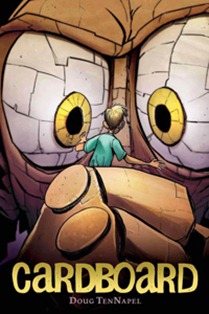
What’s the worst birthday present ever?  It just might be the cardboard box that Cam’s father had to give him.  Cam’s dad can’t find work, his mother is dead, and his family is falling apart.  But Cam is still optimistic about the fun the two of them can have together building things from cardboard.  Little does he know that the cardboard things they create are about to come to life!  There are rules that come with the magical cardboard.  Gather all of the scraps that are unused and return them to the man who gave Cam’s dad the cardboard.  Unfortunately, the local bully finds out that Cam has something worth taking away and starts to create an army of cardboard monsters.  What will it take for Cam and his dad to fix the misuse of magical cardboard?

TenNapel’s graphic novel is pure maniacal genius.  He takes a universal thing like playing with cardboard and makes it first pure magic and then dark and sinister.  He also carries the story to the extreme, refusing to back away and take an easier approach.  It makes for a riveting graphic novel that will have plenty of kid-appeal.  My only quibble is that the side story of the father’s romantic interest in the neighbor lady does not add to the story.

Because I am reviewing an advanced copy of the book, I don’t have it in the full color throughout.  The pages I do have are a mix of sandy tan, zips of red, deep purples with plenty of shadows in black.  He plays with angles and points of view, creating an entire world of cardboard before he is finished. 

This is a darker comic for kids, something that children will appreciate and gobble up.  Appropriate for ages 9-12.

Reviewed from ARC received from Scholastic.

Review: Lucy Can’t Sleep by Amy Schwartz

lucy cant sleep

Lucy Can’t Sleep by Amy Schwartz

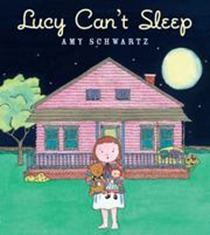
Lucy is in bed, but she just can’t fall asleep.  First, she tries counting sheep and other animals, but that doesn’t work.  So she climbs out of bed, puts on a sweater, stretches and wiggles.  Then she heads out of her room to try and find her doll and bear.  There they are in a chair downstairs.  Lucy then heads to the kitchen and rummages in the fridge for a snack.  She finds chocolate pudding and strawberry shortcake.  Everything is very quiet in her house.  Outside there is a squeaky door, a porch swing, and a radio playing.  Then Lucy’s dog appears and they head inside.  But Lucy isn’t quite ready for bed yet.

There is something old-fashioned and infinitely gentle about this book.  Lucy’s parents never awaken to find her out of bed, instead she putters around on her own with no fear of the dark, of the quiet or of being alone.  There is a great feeling of safety in this book with nothing startling or alarming in the least.  It is a welcome difference from many picture books.

Schwartz’s writing is done in stanzas with repetition and rhythm making it into a poem.  This makes it a great book for toddlers.  Her art is filled with small details of Lucy’s life and home.  It is all about warmth, familiarity and the small touches that mark a family’s life. 

Safe, sweet nighttime adventures will have young listeners enjoying Lucy and her escapades out of bed.  It will also make a nice addition to bedtime stories and story times.  Appropriate for ages 2-4.

Reviewed from copy received from Roaring Brook Press.