Review: How to Babysit a Grandpa by Jean Reagan

how to babysit a grandpa

How to Babysit a Grandpa by Jean Reagan, illustrated by Lee Wildish

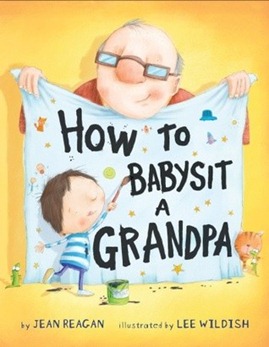
Done in the format of a how-to guide, this book takes a warm and cheerful look at a grandparent coming to babysit.  Except in this book, the child thinks that he is the babysitter.  He tells you how to stay quiet when you are hiding from your grandpa and what to feed your grandpa (hint: it involves a lot of ice cream and cookies).  Then there are walks to take, entertainment to provide, and lots of playing together.  When your grandpa finally announces naptime, it’s time for his nap.  Get him a long book to read, and he will be asleep in no time.  But since you are the babysitter, you have to stay awake.  You can wake up your grandpa later, help tidy the room, and then get ready for your parents to return.  Make sure you have some parting gifts for your grandpa, since he’s sure to miss you a lot.

What could have been an overly-sentimental picture book is taken to a sweet and comfortable level thanks to Reagan’s use of the how-to format.  I also appreciated that the little boy in the story did not use any of his advice to be naughty.  Instead, he took his duties very seriously.  Reagan’s writing has a great playful quality to it.  It is also writing that reads aloud very nicely, thanks to its light touch.

Wildish’s illustrations have a humor to them that adds to the book.  When the book says in a straight-forward tone that on a walk in the cold, grandpas need to be bundled up, she shows us a grandpa so very bundled that he cannot move.  In sun grandpas need sunscreen, and the image shows the boy emptying a bottle of sunscreen onto his grandpa’s head.  Small silly touches that really make the book fun.

A great book for grandparents to bring to share with their grandchildren, this would also make a great additional to a story time about grandparents.  Appropriate for ages 4-6.

Reviewed from copy received from Alfred A. Knopf.
Review: My Heart Will Not Sit Down by Mara Rockliff

my heart will not sit down

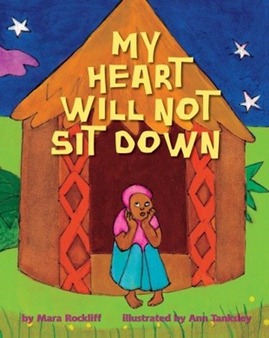
My Heart Will Not Sit Down by Mara Rockliff, illustrated by Ann Tanksley

Inspired by the true story of a village in Cameroon donating $3.77 in 1931 to the city of New York to help feed the hungry during the Great Depression.  In this picture book version of the story, the main character is Kedi, a girl who learns from her American teacher that people in his hometown of New York City were going hungry due to the Depression.  Kedi could not stop thinking of the hungry children in America, even though they lived so far away.  Her heart would not sit down until she did something.  So she talked with the grownups in her village and all of them told her at first that nothing could be done, they had no money to spare.  But then, one by one, all of the adults gave coins to help the hungry children. 

The author’s note at the end of the book, tells more about the Depression and about the donation too.  It explains that even in the Depression, this small amount of money would not have had a large impact.  But for the villagers who sent the funds, it would have been a fortune.  This book is a lesson in following your heart, finding compassion for others, and making an important difference in the world, even if it is just $3.77. Children will easily understand both the sacrifice made by the villagers and the meager amount that was raised.  It makes the story all the more haunting.

Tanksley’s illustrations have a roughness and organic quality that really grounds this story in reality.  Done in watercolor, pen and ink, and oils, they are filled with rich color and show the poverty and the beauty of Cameroon.

Throughout the book, the phrase “my heart would not sit down” is used.  It evokes a yearning, a calling, an inner distress that could only be quieted by doing something to help.  It’s that feeling that we need to cherish in both ourselves and our children.  It would also make a very good discussion book about what makes children’s hearts “not sit down.”

Based on a true story, this book is a call to follow our unquiet hearts.  Appropriate for ages 5-8.

Reviewed from copy received from Alfred A. Knopf.

Review: Lies, Knives and Girls in Red Dresses by Ron Koertge

lies knives and girls in red dresses

Lies, Knives and Girls in Red Dresses by Ron Koertge, illustrated by Andrea Dezso

Just for teens, Koertge has created subversive poems based on fairy tales that look at what happens after “Happily Ever After.”  You will meet a Little Red Riding Hood who wanted to be swallowed whole just to see what it felt like inside a wolf.  There’s also a Beast who longs for the days of wild abandon rather than being a prince again.  What happens when the boy who said the emperor had no clothes is pressured to fit in with the crowd?  Hansel and Gretel may just have been a lot closer and a lot more disturbed than readers thought.  And could Rapunzel long for the days when the witch thought only of her rather than her prince who is distracted?  Koertge plays with the idea of “ever after” and works in the same darkness and sexuality that is already in the stories if you just look at them differently.

This is not a poetry collection to hand to younger readers who are interested in fairy tales.  Rather, this is a dark delight for teens who remember the stories.  There are more obscure tales included in the book, a couple of which I had never read.  I enjoyed those poems as well, since Koertge works in backstory in his poems.  In most of the poems there is an adroit twist about them, sometimes involving the modern world and other times looking at the story in a new and twisted way.

Deszso’s illustrations are done entirely in black and white.  They are paper cutouts that have astonishing details cut into them.  The mood of the illustrations matches that of the poetry, there is a playfulness about them but also a terrific darkness too.

This entire book was like a box of the darkest chocolates.  They held surprises inside and you simply can’t stop reading them.  Appropriate for ages 14-17.

Reviewed from library copy.

Review: Mom, It’s My First Day of Kindergarten by Hyewon Yum

mom its my first day

Mom, It’s My First Day of Kindergarten by Hyewon Yum

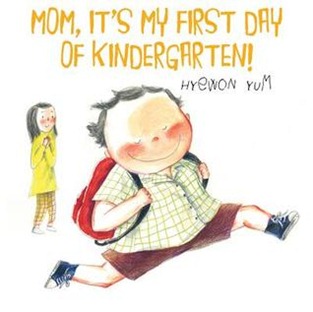
A little boy is all set for the first day of Kindergarten, eager to start.  His mother, on the other hand, is not quite to eager to see her little boy start school.  The boy runs to school with his mother trailing behind, worried and blue.  His mother frets about how big the school is, that they don’t know anyone there, but the boy is set to head in.  Then in the hall, things change and suddenly it is the boy who is smaller and bluer and more concerned and his mother is glowing and ready for him to start.  This book perfectly captures the mixed emotions of the first day of school for children and parents alike. 

Yum manages in a just a few words to really show the eagerness the boy feels and the reticence of the mother.  The boy is thrilled to be a big boy and head off to school, the mother is obviously seeing him a completely different light.  The book really comes into its own when the change happens and suddenly the mother feels confident and the boy is unsure.  It is that switch, that change that makes the entire book really work well.

Yum’s art also helps capture the emotions of the day.  At first, the boy is much larger than his mother, bright colored and dashing.  The mother is blue, almost wizened and delicate, worn away with worry.  When the change of attitude happens, the mother grows steadily in size and gains color as the boy shrinks to normal size and becomes bluer.  It’s a delight to watch the change come full circle by the end of the book where the day has ended and they are both large and bright.

A perfect pick for families facing their first day of Kindergarten this fall, this book will make a great jumping off place for discussions about the mixed emotions that everyone is sure to be feeling on the big day.  Appropriate for ages 4-6.

Reviewed from copy received from Farrar Straus Giroux.

Review: Happy Like Soccer by Maribeth Boelts

happy like soccer

Happy Like Soccer by Maribeth Boelts, illustrated by Lauren Castillo

Sierra loves to play soccer, especially on the field that is well maintained with a real soccer goal, not two garbage cans next to each other.  But now that she plays on a team, her aunt can’t come to her games because she has to work.  Sierra’s coach tells her he is glad to have her on the team and asks her if there is anything she needs, but Sierra always says no.  When her aunt manages to get time off to attend Sierra’s final game of the series, the game is rained out.  Sierra knows that her aunt can’t get two Saturdays off in a row, can’t ask for two favors so close together.  Sierra has to figure out how to fix this herself, because her aunt just has to see her play at least once this season!

Boelts has written this book poetically, with the lines in stanzas that make it read like a poem.  She also uses phrases that turn it into poetry, repetition and spare but true language.  Her writing has a great lilt to it, pointing to someone who speaks with an accent that makes their own phrasing dance.  It’s beautifully done, fully capturing the love between Sierra and her aunt and the fact that the two of them are a complete family. 

Castillo’s art adds to this feeling of family.  The book is set firmly in an urban environment, one that is escapable by bus but also one that is home.  The illustrations cement that setting.  The thick black lines and bright colors also have a subtlety that is unexpected.

A celebration of a small family, an urban community and sports, this picture book glows with love.  Appropriate for ages 5-7.

Reviewed from library copy.

Review: Amelia Anne Is Dead and Gone by Kat Rosenfield

amelia anne

Amelia Anne Is Dead and Gone by Kat Rosenfield

When the girl is found dead on the highway near Becca’s small hometown, the entire town is enveloped in the question of who she was and who killed her.  All Becca knows is that she is going to leave town at the end of the summer, and leave her boyfriend behind too.  But then her boyfriend breaks up with her right after they have sex, and Becca’s world shifts.  She too becomes captured by the drama of the murdered girl and finds herself unable to move forward with her plans to head to college.  Amelia Anne, the dead girl, was already in college.  Caught with a boyfriend who no longer understands her, Amelia continues to date him waiting for the best time to break up.  Two girls who end up in the same small town for very different reasons, one at the beginning of her life and the other at the end. 

Rosenfield’s writing is unique and heady.  She writes with all of her senses, creating a feeling that is almost smothering at times, flying high in others, and always remarkable.  Her writing is best when creating a world for just two people, something that happens often here.  Those dynamics ring true and painful and wistful. 

Her writing about the small town and its history of death is also beautifully done.  As readers, we inhale along with the characters, breathing in the scents of the woods and the roses.  We witness the fact that small town knowledge can also kill, work through grief with people, and jump to the wrong conclusions.  It’s an exhilarating ride of a novel that also takes the time to truly create its own setting and history.

Amazing writing, a violent mystery and a small town setting create a book that is impossible to put down, yet invites you to linger with it longer.  Appropriate for ages 16-18.

Reviewed from copy received from Dutton Books.

Review: Don’t Copy Me by Jonathan Allen

dont copy me

Don’t Copy Me by Jonathan Allen

When Little Puffin heads off on a walk all by himself, he is followed by three little gulls who all copy him.  How annoying!  He tried to scare Small Gull, Tiny Gull and Baby Gull away, but they all just repeated what he said to one another.  Little Puffin tried shouting at them and that didn’t work either.  He sat down to think how he could end the game, and all three little gulls sat down too.  Little Puffin tried running and that didn’t work.  So he tried sitting very still so they would get bored.  You will have to try out the book to see whether that worked or not.

Allen is the author of I’m Not Cute! which charmed readers in 2005.  This book gives us a new lead character who is having a great day until he gets teased by the little gulls.  Allen’s writing maximizes the humor of the situation.  I particularly enjoyed the smallest gull and his baby-speak interpretations of what Little Puffin is saying.  Children will get this humor immediately, enjoying both the teasing and the eventual solution.

Allen’s art continues his use of cloud-like feathers and thick black lines.  The expressions are vivid and great fun, with the obvious frustration of Little Puffin growing and growing just as the satisfaction of the little gulls does. 

Grab this one for a bird-themed story time for toddlers!  Appropriate for ages 2-4.

Reviewed from library copy.

Review: A Bus Called Heaven by Bob Graham

bus called heaven

A Bus Called Heaven by Bob Graham

It all started when the bus with a sign that said “heaven” was abandoned on Stella’s street.  Traffic slowed, people gathered, and Stella took her thumb out of her mouth and suggested that the abandoned bus could be “ours.”  So everyone helped move it out of the street and into Stella’s front yard.  It stuck out a bit into the sidewalk and took up the entire yard.  The next morning when Stella looked out her window, things had changed again.  Now there were people sitting on their front wall, children wrestling in the grassy shade under the bus.  The adults began cleaning things up.  When some boys spray painted the side of the bus one night, they were invited back to paint one of Stella’s designs instead.  The bus had become a hub of activity for the entire community.  But then one Saturday morning things changed again, when a tow truck arrived.  What will happen next to the bus called heaven?

Graham creates books that have a special sort of feel to them, a sense of place and community, but that are also infused with a wonder and magic all their own.  Here he takes one abandoned bus and creates that community in our modern world where it is lacking.  This is not a statement about the problems of our society, but rather a look at what it could be if we were only willing. 

The illustrations are done in his signature style that has lots of details, fine lines, and soft colors that manage to be bright too.  He plays with color here, making Stella almost ghostlike in her paleness.  When she gets excited two dots of pink appear, but she does not ever fully become colored like the other characters.  She is a pale but very solid young character.

This is an uplifting read about the little changes that create a community and the little children that can lead us there.  Appropriate for ages 4-6.

Reviewed from library copy.

Review: Brothers at Bat by Audrey Vernick

brothers at bat

Brothers at Bat by Audrey Vernick, illustrated by Steven Salerno

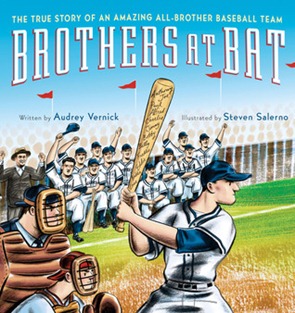
In one family from New Jersey, there were 12 baseball-playing brothers: the Acerra brothers.  All of the brothers played high school baseball and their high school had an Acerra on it 22 years in a row!  In 1938, the oldest nine brothers formed their own semi-pro baseball team.  Their father coached the team and they played on dirt fields that were littered in rocks.   Each of the brothers had a different skill set than the others.  Some were slow runners but great players, others posed for the cameras naturally, one was a great pitcher that people still talk about today.  But all of them supported one another.  Then came World War II and the team disbanded as six of the brothers headed off to war.  Happily, all six brothers returned from war.  The brothers played their last game together as a team in 1952.  By that time, they were the longest-playing all-brother baseball team ever.  In 1997, the brothers were honored by the Baseball Hall of Fame.

Vernick shares this story of brothers who played together for most of their lives with a real sense of wonder and amazement at what they achieved.  The story celebrates their strong brotherhood and sense of family as well as the love of baseball.  Vernick offers all sorts of details that really create a vivid picture of the family dynamic and their lives. 

Salerno uses a vintage style for the illustrations that firmly roots this picture book in the time period.  They are colorful and action filled. 

A great non-fiction picture book for baseball fans, brothers, or people who enjoy a little sports with their history.  Appropriate for ages 6-9.

Reviewed from library copy.