Review: The Letter Q

letter q

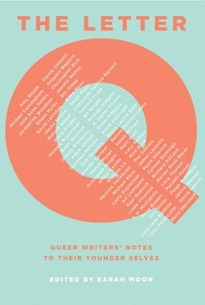
The Letter Q: Queer Writers’ Notes to Their Younger Selves edited by Sarah Moon

This was one of those books that I wanted to last forever.  I lingered over it, though I had a problem with not just wanting to read them all in one breath.  The entire book is made up of letters from successful gay and lesbian writers to their younger, usually teen, selves.  They are filled with hope, humor and acceptance for what they themselves thought, felt and lived.  Almost all are love letters to that younger, insecure and questioning person who is often closeted and always queer.  There are names here that teen readers will be familiar with: Malinda Lo, David Leviathan, Bruce Coville.  There are many others to be discovered through this book. 

Though the book is specifically about being GLBTQ, all teens will find it inspirational.  As one letter says, all of us have something that is queer about us.  All teens need to accept themselves, see themselves in that future state, and reach for those dreams.  All teens need to know that their thoughts and feelings are ok, whatever they are.  So I’d share this with straight and not narrow teens as well as GLBTQ teens too, of course. 

This is one of those books that should be in every public library.  It will probably be read in the back areas, the more private tables.  My ARC copy will be donated to a local café that has a GLBTQ club that meets regularly.  This is a book that café should have, since I can’t think of anything nicer to read with a cup of coffee.  Just as long as you are ready to really savor both.

Appropriate for ages 13-18.
Review: Dreams around the World by Takashi Owaki

dreams around the world

Dreams around the World by Takashi Owaki

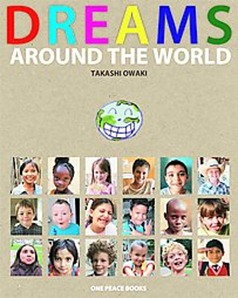
Meet thirteen children from around the world who are ready to share their dreams with you!  Photographer Takashi Owaki traveled the world, including 55 countries on six continents and interviewed over 1400 children about what they wanted to be when they grew up.  In this book, he shares the dreams of some of those children.  Each child and their dream is accompanied by photographs, their age, name and country, along with a short paragraph about where they live.  At the end of the book, all of the countries are shown on a world map.  The book is a celebration of our diversity but also our universal dreams.

Owaki’s photographs are the heart of this book, especially the full-page image of each child looking directly into the camera.  The writing itself is simple, speaking to how Owaki met the child and the family they live with.  The smaller images with each story also help give context, showing activities and the environment.  My only quibble with the book is that it would have been nice to have the map done in a smaller way with each child to help with understanding the geography.

Originally published in Japan, this is a book that celebrates our world and the beauty of dreams.  Appropriate for ages 5-8.

Reviewed from copy received from One Peace Books.

Review: The Children and the Wolves by Adam Rapp

children and the wolves

The Children and the Wolves by Adam Rapp

I made it through about the first 30 pages of this book and set it down, packed it in my bag to return it to the library, and started a new book.  But.  I could not get the story out of my head.  I couldn’t leave Wiggins and Frog there, so I finished it and loved it, after all. 

Frog is three years old and being held captive in a basement by three middle schoolers.  Bounce is the mastermind of it all, a wealthy and very intelligent sociopath who decides to kidnap a little girl in order to murder an old poet who upset her.  Orange is the boy whose basement they keep Frog in, his father is confined to a wheelchair and high on painkillers.  Wiggins takes care of Frog, washing her clothes and making sure she takes vitamins.  The three of them take drugs, get into lots of other trouble as well, and take revenge where it suits Bounce.  The book cycles through all of their points of view, including Frog’s.  It is a book filled with so much hate and aching that it hurts to read.  It pushes the limits of teen books, exploring all of the dark places possible while at its heart having something shining with truth.

Rapp doesn’t shy away from anything here.  The book is filled with swear words and not only the four letter ones.  Drugs are seen as ways of release, not things that get you into trouble.  Sexuality is explored in a matter-of-fact way.  Violence is in almost every scene, and even when it’s not there you as a reader are waiting for it with shallow breaths. 

And yet, there is something here beyond the shock value and the clawing desperation.  There is somehow hope.  I’m not sure where it comes from, it’s like a green sprout in the torn-up sidewalk.  Rapp through the vileness of this book also gives us moments that shine.  In any other book they may have been tragic scenes, but here they are light and warmth.  It is all in comparison with the rest, just like the lives of these children.  Victims all.

Stunning, violent, vile and filled with heart wrenching beauty of its own unique sort, this book is one that you can’t turn away from, though you may want to.  Amazing.  Appropriate for ages 16-18.

Reviewed from library copy.

Review: John Jensen Feels Different by Henrik Hovland

john jensen feels different

John Jensen Feels Different by Henrik Hovland, illustrated by Torill Kove

John Jensen lives in Norway.  He lives in an apartment, eats cereal for breakfast, brushes his teeth, and takes the bus to work.  But he feels different than everyone else and knows that people are looking at him because he is different.  He notices that no one else wears a bowtie, so he changes and wears a regular one.  But he still feels different.  John Jensen decides that the real problem is his tail, since no one else has a tail like his.  So he ties it up and hides it, but all that results in is not being able to sit comfortably and losing his balance.  In fact, he loses it so badly that he falls and has to go to the doctor.  Thank goodness that Dr. Field turns out to be just what John Jensen needs, a friendly doctor who is also an elephant.

Told in a deadpan voice, this book is pure delight.  John Jensen is obviously different, since he’s an alligator.  But the book never gives that away except in the illustrations.  Instead, it is told as if he is just another Norwegian on the bus.  The tension leading to the realization builds and is only partly fixed by the appearance of the elephant towards the end.  The book ends shortly thereafter with no sudden realization by John Jensen, just an acceptance that he truly is different.  I loved the fact that there was no culminating event at the end, because it made the book really work as a vehicle to talk about all sorts of differences even if you are a human too.

Kove’s illustrations add to the deadpan humor of it all.  There are marvelous touches like Camus’ The Stranger as bedtime reading, and the fact that absolutely no one on the bus is actually looking at John Jensen.  The illustrations are a large part of what really create the strong Norwegian setting that permeates the book. 

Translated from Norwegian, this is a striking picture book in so many ways.  It will be one of those books that children shout at thanks to the deadpan nature and the lack of reveal, and I love sharing those books with kids.  After all, we all feel different and even a bit green and scaly at times.  Appropriate for ages 4-6.

Reviewed from copy received from Eerdmans Books for Young Readers.

Review: Rachel Carson and Her Book That Changed the World by Laurie Lawlor

rachel carson and her book

Rachel Carson and Her Book That Changed the World by Laurie Lawlor, illustrated by Laura Beingessner

This is a biographical picture book about the environmentalist Rachel Carson.  The book covers her childhood, which she spent outside in her family’s woods, orchards and fields.  Her mother loved nature and passed her passion on to her daughter.  Though times were tough and her father struggled to make enough money to support the family, Rachel was able to attend Pennsylvania College for Women in Pittsburgh.  It was during this time that she started to be concerned about the environment. Rachel decided to become a biologist and received her Master’s Degree, becoming one of the few female biologists.  After some time jobless due to the Great Depression, her two skills of science and writing came together in a job for the Bureau of Fisheries writing radio scripts about sea life.  After World War II, Rachel became alarmed at the chemicals being sprayed everywhere.  Though she had been diagnosed with breast cancer, she continued work on Silent Spring which caused such a reaction that new laws were created to protect the environment.  This book tells the story of a woman who was smart, scientifically gifted, and passionate about the natural world she loved so much. 

Lawlor pays real homage to Rachel Carson here.  It is the story of her entire life, from the early days of connecting with nature through her years of study to the final, vital book she wrote.  Hers is an inspirational story of what can be done by someone who is smart and passionate about a subject.  It is also a great story about a woman who defied the conventions and followed her dreams.  Lawlor makes Carson both intensely human but also heroic.

The illustrations are done in a simple style with ink and watercolor.  They celebrate the natural world around Carson with plenty of the greens of the woods and the blues of the waters.  And in each, Carson is observing and making notes.  It’s a glimpse of a woman who is a scientist first and foremost.

This is a celebration of a groundbreaking book by a groundbreaking woman.  Appropriate for ages 5-8. 

Reviewed from library copy.

Review: Jimmy the Greatest by Jairo Buitrago

jimmy the greatest

Jimmy the Greatest by Jairo Buitrago, illustrated by Rafael Yockteng

Jimmy lives in a small village in Latin America where there is nothing but a small church and a little gym.  Thanks to that little gym, Jimmy and the other children in town spend their time learning to box.  Since Jimmy didn’t have much else to do, he started to train.  He wanted to become a famous boxer and get his mother the icebox she needed.  It all changed though when his trainer, Don Apolinar, gave Jimmy a box of clippings and books about Mohammad Ali.  Jimmy started reading all about Ali, started wearing his glasses, and even shadowboxed while continuing to read.  Jimmy learned about respect and dignity from Ali, creating his own sayings from Ali quotes.  He grew into a great boxer.  When Don Apolinar left the village for a larger city, Jimmy stayed behind and kept up the gym and opened a library.

This picture book took my breath away with its ending.  As Don Apolinar headed to the bus to leave town, I assumed that Jimmy was joining him or following close behind.  Instead, Jimmy stays where he is and continues to pass on the training he received and share his inspiration and learning with others.  It is a tribute to those who stay in their home communities and make a difference.  Jimmy learned a lot, let his dreams flow, and still stayed, not because he felt trapped or stuck, but because he wanted to. 

Yockteng’s illustrations are filled with warm, yellow light.  They display the barren environment around the village, the lack of things to do, and yet they also show a community of bright-colored shacks and friendly people.  There is a beauty to the barren landscape and certainly a beauty to the people themselves.

Highly recommended, this book pays homage to the local hero, the person who stays and makes a difference.  It’s one character that is often missing in children’s picture books and it’s great to see such a wonderful tribute.  Appropriate for ages 4-7.

Reviewed from library copy.

Review: Bird Talk by Lita Judge

bird talk

Bird Talk: What Birds Are Saying and Why by Lita Judge

Incredible displays of feathers, bright-colors and complex songs are all ways that birds communicate and try to find a mate.  Some birds puff and strut, others have large wattles, and still others drum on a branch with a stick.  Once birds have found that mate, they communicate their pairing to others using dances, clattering bills, or by providing food for one another.  When eggs and baby birds arrive, the parents use flashing wing colors, trickery or pretending to be wounded to lead predators away from their young.  The parents teach their babies to eat, fly and more with clucks, demonstrations, and plenty of talk.  Celebrate the birds that live around your house as well as exotic birds that have amazing ways of communicating.

Judge has written a very detailed but also very readable book about birds.  It has a wide range of species that are all intriguing in the way they communicate with one another.  This makes the book engaging and great fun to read.  At the end of the book are even more facts about the birds, that share their habitat and range.   Judge’s illustrations have a wonderful playfulness to them, but also display the beauty of the birds with accuracy and skill. 

A great pick for children’s nonfiction collections, this is an inviting book about wildlife that will give new and intriguing information to young nature lovers.  Appropriate for ages 8-10.

Reviewed from copy received from Roaring Brook Press.

Review: A Path of Stars by Anne Sibley O’Brien

path of stars

A Path of Stars by Anne Sibley O’Brien

Dara has a close relationship with her grandmother, Lok Yeay, who tells her stories about life in Cambodia when she and her brother were growing up.  She remembers Cambodia as a place of beauty, filled with moon and star light.  Lok Yeay also shared her darker memories of the soldiers coming and hiding in the jungle until they could make their way to Thailand.  But when the phone call came and Lok Yeay found out that her brother had died, she stopped telling stories.  In fact, she stopped getting out of bed entirely and stopped eating.  The entire family was worried.  Dara went to the garden and picked a rose and a ripe tomato.  Then she put them on a tray along with a photograph of Lok Yeay’s brother and went into the darkness of her grandmother’s room.  They shared the tomato and prayed for her brother, and Dara shared a story of the future and going back to visit Cambodia.

Commissioned by the Maine Humanities Council, this book reflects the story of a family that survived the Killing Fields in Cambodia and came to Maine afterwards.  According to her author’s note, O’Brien did extensive research not only about Cambodia’s history but also about its culture and environment.  As a reader, it is clear that she took Cambodia into her heart and showed its beauty.  O’Brien focuses on the intergenerational relationships in the family, demonstrating the importance of the grandparent in the Cambodian culture.  Additionally, the book is about war, families torn apart, and grieving. 

The art in the book is done in oil paints and oil crayon.  It has a wonderful jewel-tone and great depth and richness.  The illustrations focus on the family relationship, none of them showing the atrocities of war at all. 

This is a strong picture book that looks at the Cambodian Americans and the violent history that they fled from.  Appropriate for ages 7-9.

Reviewed from copy received from Charlesbridge.

Review: I Too Am America by Langston Hughes

i too am america

I, Too, Am America by Langston Hughes, illustrated by Bryan Collier

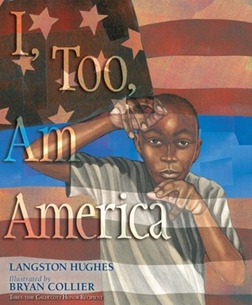
Collier marries the famous poem by Hughes with the story of the African-American Pullman porters, who served the wealthy white patrons aboard trains.  The poem speaks to the dream of freedom and equality that we are moving towards but have not yet attained in America.  It tells of servants sent to eat in the kitchen but also that in the future that will change and no one will again be sent to eat separately.  Collier’s illustrations depict the real work of the Pullman porters and the rhythm of the train seems to appear in Hughes’ poem too.  These men who worked in a racist world long after slavery was abolished are a fitting match to this strong poem that sings.

Hughes was able to write with such spare poetry, that it gives a strong vehicle for illustrations.  Collier built an incredible story around those lines, one of porters and a small boy who has new chances in the modern world.  He wraps his illustrations in the flag, playing with stars and stripes and the blue of the open sky throughout the book.  There is a gravity, a seriousness to his work that is truly fine.  It lifts up to the level of the poem, creating a harmony that is very special.

This is an extraordinary picture book about freedom, African Americans, and the struggle that still goes on every day for equality.  Appropriate for ages 7-10.

Reviewed from library copy.