Review: Traction Man and the Beach Odyssey by Mini Grey

traction man beach

Traction Man and the Beach Odyssey by Mini Grey

Traction Man and his faithful sidekick Scrubbing Brush are on the way to the beach.  There they explore the depths of the Rockpool to discover what creature live beneath the calm surface.  They are then called upon to guard the picnic from any intruders.  Unfortunately, Truffles the dog decided to bury Traction Man.  Happily Scrubbing Brush was there to dig him free.  But just as they are feeling safe, a wave comes and sweeps both of them out into the ocean.  When they resurface, they have been discovered by a girl who carries them to the Dollies’ Castle where there are garlands, sweet treats, and plenty of pink.  Truffles returns to save Traction Man from the castle, and Traction Man and the dolls head off on a shared adventure, to explore digging to the Center of the Earth.

This is the third Traction Man book, and I continue to delight in them.  Grey has exactly the right tone in the writing with Traction Man often speaking like a movie announcer and always in capital letters.   She incorporates plenty of humor into the book, but the reader is not laughing at the adventures or the play of the children.  Instead it is the inherent humor of action figures, their worlds, and that strong dialogue voice. 

Grey also uses small details throughout the book to really create a full world for Traction Man.  Garbage on the beach has brand names and logos, the text of the book is shown on graph paper with torn edges, action sequences are put into frames and read like comic books.  The end pages of the book are just as fun with details about Beach-Time Brenda, one of the dolls, at the front of the book and a comic featuring both Traction Man and Brenda at the end. 

A great summer read for Traction Man fans, this third book can stand happily on its own.  Appropriate for ages 4-6.

Reviewed from library copy.
Review: Three Times Lucky by Sheila Turnage

three times lucky

Three Times Lucky by Sheila Turnage

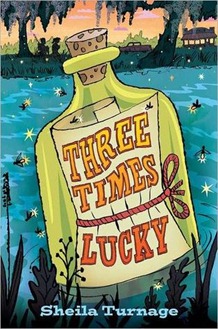
Mo LoBeau arrived in the small North Carolina town of Tupelo Landing as an infant riding on a hurricane wave.  She was discovered by the Colonel, a man also trapped in the storm who completely lost his memory.  Now at age 11, Mo helps the Colonel and Miss Lana run the café that is attached to their home.  It’s a quiet life, punctuated by the hope of her long-lost mother finding one of the bottles that Mo sends off upstream.  Then the law comes to town and things get interesting.  A murder was committed in a nearby town, then someone is murdered right in Tupelo Landing!  Mo and her best friend, Dale, form a detective agency and try to stay a step ahead of the police as they investigate the murder, try to clear Dale’s name, and worry that the Colonel may be mixed up in things too.  All Mo knows is that it is up to her to continue to trust the people she loves so fiercely and to prove their innocence. 

I must admit that I sighed a bit when I discovered that this was another book set in a small town in the south.  I knew that it would be filled with interesting small town characters, probably have a spunky heroine, and expected that it would be pretty formulaic as well.  It does have interesting small town characters, but also ones that resemble modern society.  As much as this is a story of a family that is created out of love alone, it is also the story of what a small town community can be.  Yes, Mo is spunky.  She is also smart, savvy and wonderfully inventive.  And while the story starts out in a familiar way, it quickly turns into a book that is a fun, fast-paced read.

The story is not as light-hearted as it might seem on the surface.  Dale lives with his mother in fear of his drunken father returning and beating him.  There are families that are divided in other ways, including money.  And without giving anything away, there are twists that are surprising in a children’s book.

Turnage’s writing is filled with humor.  She creates memorable characters, dancing quickly with stereotypes and then reaching beyond them to something that means much more.  She is not afraid of real danger in her book and she is also not shy about deep love.  It is a book about family, community, bravery and friendship. 

This is one to read on a slow summer day, preferably one threatening a nice fat thunderstorm.  Now if someone can just find me a real café like Miss Lana’s I’m all set.  Appropriate for ages 9-12.

Reviewed from ARC received from Dial Books.

Review: A Home For Bird by Philip C. Stead

home for bird

A Home for Bird by Philip C. Stead

Vernon, the toad, was out finding interesting things when he met Bird.  Bird wasn’t much for talking, not responding to anything that Vernon said, not even when he introduced Bird to his friends, Skunk and Porcupine.  Despite his silence (and his stiffness and button eyes) Vernon proceeded to show Bird around the river and forest.  But when Bird didn’t react even to watching clouds together, Vernon started to worry that Bird was depressed.  So Vernon and Bird set out to help Bird find his home.  They  looked at all sorts of homes, but none of them were right for Bird.  Then they came to a small blue house where they decided to stop for the night.  In the house was another small house, a cuckoo clock, up on the wall.  And that was where Bird and Vernon spent the night.  Until in the morning, Bird finally found his voice.

Stead writes and illustrates with a wonderful charm.  His writing is so solid that it is a joy to read aloud.  The story is carefully crafted and then playfully told, making for a book that is a pleasure to share.  Vernon is a character that children will relate easily and happily to.  Bird will immediately be recognized for the toy he is, but the story is less about that mistake by Vernon and more about the journey to find where Bird belongs.

The illustrations have a wonderful freedom to them, filled with swirls of color, that fill the air and cover the walls.  Stead draws the main characters with detailed fine lines, but their world is a more childlike, looser scrawl that reveals trees, flowers and dirt.   The way the detail plays against the less structured backgrounds adds to the cheer of the title.

Finding ones home, friendship and a grand quest fill this picture book to the brim and combine wonderfully with the charm of the illustrations.  Appropriate for ages 4-6.

Reviewed from copy received from Roaring Brook Press.

Review: A Greyhound of a Girl by Roddy Doyle

greyhound of a girl

A Greyhound of a Girl by Roddy Doyle

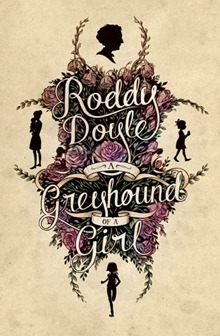
Four generations of a Dublin family come together in this ghost story.  Mary is a modern Dublin pre-teen who finds herself moving away from her childhood rituals but also wanting to cling to them too.  One day on her way home from school, she meets Tansey, a woman who wants her to give a message to her grandmother.  Mary forgets, distracted by visiting her grandmother in the hospital with her mother.  So it isn’t until later that she mentions the woman to her mother, who pales at being told the name, Tansey, because that was her own grandmother’s name.  Soon Mary is having her mother meet Tansey and her relationship is revealed as is her status as a ghost.  The three of them conspire to get Tansey and her daughter together again, even though Tansey can’t survive the harsh lighting of the hospital.  The result is a road trip filled with hellos, memories, family stories, and goodbyes.  Richly layered, this slim volume holds a grand tale.

Doyle plays with the format of a ghost story here, at first starting with a little shiver and danger and then turning the story into that of a family that has dealt with an early death for generations.  It is a story of maternal love and the connections of women in a maternal line.  It is also the story of loss, death and above all, life.  Doyle creates fascinating characters, particularly in the two older women, Tansey and Emer.  Their stories have a pastoral beauty, a vivid warmth, and yet are damaged by death.  It is poignant, lovely and tragic.

The story is character driven and told in a slow, transformational way.  It takes its time, filled with small moments of lives, hands wrapped around tea cups, children on laps, slow steps up stairs for the last time.  Yet it is not a slow story, it is engaging, rich and builds a mood that is inescapable and memorable.

I loved this little book and the world that it created that seemed just for me.  Doyle’s writing is confident and beautiful, meticulously crafted.  This is a ghost story but so much more as well.  Appropriate for ages 11-13.

Reviewed from ARC received from Amulet Books.

Review: The Conductor by Laetitia Devernay

conductor

The Conductor by Laetitia Devernay

This wordless picture book is tall and narrow, just like the trees featured within.  A man enters a forest of trees that are shaped like lollipops with long trunks and round tops.  He climbs to the very top of one tree and raises his hands.  Suddenly, birds start to appear, formed from the leaves of the trees.  They fly off leaving holes in the tree leaves shaped like them.  The leaf patterns are on their wings and they fly above the conductor in a variety of formations.  Until eventually they are gone, and all that are left are the blank trees.  The man climbs down and plants a seed that quickly grows into a tree.  As he is planting, the birds return to the trees, covering them once again in leaves.  The man leaves the forest just as he has found it, but with one more small trees.  It’s a beautiful look at the environment and the impact humans can have if they choose.

The art here is wonderfully done.  It has a limited palette of just yellow, green, black and white.  The juxtaposition of tree leaves and flying birds is spectacular visually and surprising at first.  It lifts the book to a more surreal place, a world where you are unsure what could possibly happen next.  The fine lined art, the scale of the book and the gentle theme all work well together, creating a memorable whole.

A surprising wordless picture book that is a work of art, this book would work well in art curriculum or as a quiet, beautiful book to share.  Appropriate for ages 3-5.

Reviewed from copy received from Chronicle Books.

Review: Hippopposites by Janik Coat

hippopposites

Hippopposites by Janik Coat

This clever board book takes a hippo and runs through a variety of opposite pairs with him.  There are light and dark hippos, dotted and striped hippos, soft and rough hippos, small and large hippos.  Then there are the more intriguing opposites like opaque and transparent, positive and negative, clear and blurry.  My favorite opposite pairing is the front and side, which made me laugh out loud with surprise.  Something that rarely happens with board books!  This is truly a modern, hip board book that will be enjoyed not only by young children but also their parents.

Coat makes this book dynamic and modern with her very solid graphic skills.  She has a wonderful quirky sense of humor that is on display throughout the book and that combined with the strength of the simple illustrations makes this book a winner.  I also like the limited color palette and the simplicity of the page design, which will work particularly well with infants.

Have a cool friend expecting a baby?  This book would make an ideal gift.  It will also be a great addition to the myriad of pastel board books on library shelves.  Appropriate for ages birth-2.

Reviewed from copy received from Abrams Appleseed.

Review: More by I. C. Springman

more

More by I. C. Springman, illustrated by Brian Lies

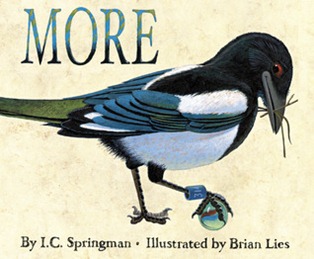
The book opens with a dejected magpie who has nothing at all.  Then a mouse gives him a marble that he takes to his nest.  Soon the marble is joined by a few other toys.  Then more and more, until there are so many things that the magpie has filled all sorts of nests in the tree with them.  Finally, the magpie adds one little penny to a nest and the branch cracks.  He has much too much now!  Everything tumbles to the ground, burying the poor magpie in his treasures.  The mice appear to dig him free and the pile becomes less and less as they work.  In the end, the magpie selects a few items to keep and lets the rest go, leaving with just enough.

This book is written in very spare language with only a few words per page.  They are all concept words, moving from nothing to everything to enough.  In between, there are terms like more, much, and less.  The dynamic illustrations really carry the story.  The magpie’s facial expressions range from greed to shock to satisfaction, all playing out nicely just in the shine of an eye and the curve of a bill.  Space is also played with in the images, speaking to the freedom of having just enough and the clutter of having too much.

This picture book deals directly with the idea of downsizing or having just enough toys and not too many, something that many children struggle with.  It is also a creative concept book that will work to teach those concepts through humor.  Appropriate for ages 2-4.

Reviewed from library copy.

Review: That’s Not a Daffodil by Elizabeth Honey

thats not a daffodil

That’s Not a Daffodil by Elizabeth Honey

When Tom’s neighbor gave him something that looked like an onion and said it was a daffodil, Tom was very skeptical.  Mr. Yilmaz told him to plant it to find out.  So they planted it in a large pot and Tom waited, and waited, and waited with nothing happening at all.  When Mr. Yilmaz asked how the daffodil was doing, Tom answered that it was not a daffodil, it was a desert.  So the two watered the pot.  Later, Mr. Yilmaz asked again and Tom said that the small green point sticking out of the dirt was a green beak, not a daffodil.  The beak slowly began to open.  Soon the daffodil looked more like a hand, hair, and even a rocket!  It even survived being toppled over by a dog.  Until finally, Tom gets to show Mr. Yilmaz exactly what that onion turned into.

Not only does this book perfectly capture the wonder of gardening with children with the impossibly long wait for results, but it also offers a beautiful zip of creativity along with it.  As Tom learns about patience with his daffodil, he also incorporates it into his playing.  The writing is simple and straight forward, yet has a sense of playfulness too.

Honey’s illustrations appear to be a mix of watercolor and pastels that have a homey warmth.  They also have a great texture that works well for the rough ground, dirt in the pot, and sweater knit.  At the same time, the watercolor smoothness plays against that. 

A sweet book about patience, gardening and creativity, this book would make a great addition to springtime story times.  Appropriate for ages 3-5.

Reviewed from library copy.

Review: Virginia Wolf by Kyo Maclear

virginia wolf

Virginia Wolf by Kyo Maclear, illustrated by Isabelle Arsenault

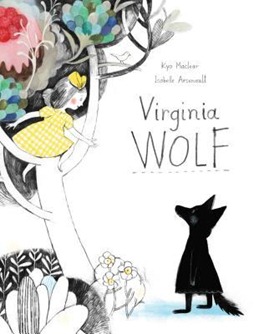
This picture book is loosely based on the life of Virginia Wolf and her sister.  Adults will enjoy the tie-ins, but they are not necessary for children to understand in order to enjoy the book.  It is a story told from Vanessa’s point of view.  Virginia was having a “wolfish” sort of day where nothing pleased her and any sort of noise bothered her.  Vanessa tried to talk with her and discovered that Virginia was dreaming of a far-away perfect place to be.  So Vanessa snuck away and found art supplies and paper to create that world for her sister.  Soon her walls were covered in birds, butterflies, flowers and color.  There was even room for a wolf to wander.  Virginia’s mood lifted and she was ready to play once again. 

This book takes a direct look at depression but can also be used for more transient moods of children.  The author’s writing is rich and beautiful.  When Virginia first gets depressed, she explains it this way: “The whole house sank.  Up became down.  Bright became dim.  Glad became gloom.”  When Vanessa paints the garden it is described this way: “I painted leaves that said hush in the wind and fruit that squeaked and slowly I created a place called Bloomsberry.  I made it look just the way it sounded.”  This is a book that not only has art as a solution and an escape, but also has art in the writing itself.

Arsenault’s illustrations have a wonder to them that is astonishing.  Done in mixed media of ink, pencil, watercolor and gouache, the images play with darkness and light with a fearlessness.  Color is used sparingly at first, then when the art appears it is lush and vibrant.  One completely understands the way that art can lift a person.  Perhaps my favorite small detail is that the art at first when seen through Vanessa’s eyes is adult, lush and fine lined.  Later when glimpsed in retrospect, it has a childlike quality to it instead. 

This picture book is a small work of art that speaks to the power of creativity and art to lift moods.  Appropriate for ages 5-7.

Reviewed from copy received from Kids Can Press.