Review: Animal Masquerade by Marianne Dubuc

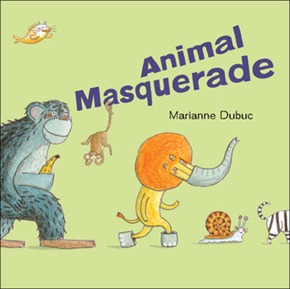
animal masquerade

Animal Masquerade by Marianne Dubuc

This picture book takes one long-running gag and turns it into a very funny picture book.  As the animals get ready for the masquerade, they have to dress up in costumes.  Each animal dresses up as another animal and then that animal chooses yet another animal to dress up as.  It forms a neat chain.  Much of the humor is in the depictions of the costumes themselves and also in the occasional asides that break the rhythm of the book for even more of a punch-line effect.  Fonts are also played with as the hummingbird disguised as an ostrich has its fonts hidden half underground just like its head.  In another spot, the butterfly disguised as a bat has its font upside-down.  All of the small touches add to the giggles in this picture book.

Dubuc’s art here is wonderfully whimsical and playful.  The different animals in disguise are often absurd and completely strange.  Just wait until you get to the animals that dress up like a three-headed monster, Red Riding Hood dressed as a chocolate cake, and the hen that is too dim to understand what is happening and doesn’t dress up as anything at all.   The book is longer than most picture books in terms of number of pages, but that adds to the running gag theme here. 

This picture book will do well read aloud very straight and seriously until the first big joke hits.  Then make sure to leave plenty of time for the giggles to pass before moving on.  It will work well for Halloween too, without anything scary about it.  Appropriate for ages 4-6. 

Reviewed from library copy.

Review: Boy & Bot by Ame Dyckman

boy bot

Boy & Bot by Ame Dyckman, illustrated by Dan Yaccarino

One day when out collecting pinecones in the forest, a boy meets a robot.  The two of them play together and have a lot of fun.  But then when rolling down a hill, the robot’s power button gets pressed and he turns off.  The boy thinks the robot must be sick, so he takes the robot home and feeds him, reads him a book and puts him to bed.  When the boy’s parents look in at him before going to bed, they press the switch on the robot.  Now the robot notices the sleeping boy and thinks that he has malfunctioned.  Bot takes the boy to his home, gives him oil, reads him an instruction manual and is just about to replace his battery, when the Inventor arrives.  Soon all is straightened out and the two continue their grand friendship.

Dyckman’s story has a wonderful symmetry that works well.  With the two friends and their misunderstandings of one another, the story mirrors itself in a delightful way.  Both instances have their humor, as does the rest of the book.  It is this wry sense of humor that carries the story forward and makes it a pleasure to read.  The book is written in a straight-forward way, making it a great read aloud.

Yaccarino’s illustrations are very successful.  They have a wonderful sort of fifties vibe to them, while at the same time being modern.  The large robot is never frightening, thanks to his permanent smile and his care for the boy.  Yaccarino plays with bright colors throughout the book, keeping his art simple and dynamic.

Robot fans will rejoice at this fresh new take on friendship and embracing differences.  Appropriate for ages 4-6.

Reviewed from copy received from Alfred A. Knopf Books for Young Readers.

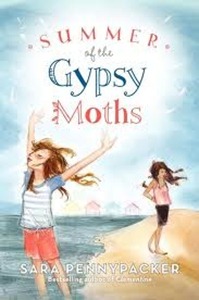
Review: Summer of the Gypsy Moths by Sara Pennypacker

summer of the gypsy moths

Summer of the Gypsy Moths by Sara Pennypacker

Stella lives with her great-aunt Louise on Cape Cod, where the house is always tidy, and even though Louise is not very demonstrative, Stella feels right at home.  Angel, a foster child, lives with them too, but Stella and Angel don’t get along at all.  Then one day, the girls return home to find Louise dead in her chair.  The two girls know that if anyone finds out, they will be put back into the child welfare system.  So they work together to create a plan that will let them stay in the tidy little house near the sea.  It would take a lot of work, because they would have to cover for Louise at her job of caring for four cottages on the property, and they would have to take care of the dead body too!  It’s a challenge for two girls who never got along in the first place and are headed in different directions when the summer is done.  This hope-filled book starts with a death and strangers and ends with hope and family. 

Pennypacker writes the sort of book that Stella would like to read.  It’s filled with all of the between-times, the moments of cleaning up afterwards, the small details, the real parts of life.  And it is through those moments that we get to know both girls, and Louise too.  The two girls are very different, and yet not so different after all, as readers get to know them.  They are both suffering from disappointments and loss, from being left behind, from not having families.  Stella holds onto her Hints from Heloise, determined to have a life of order and neatness that makes sense.  Angel listens to the music her mother played, hiding behind her earbuds and blocking everything out. 

One might think this would be a macabre book, and it does have those moments.  But it is much more a book about people and life, not death.  It is a book that celebrates summer, the days that stretch and lengthen, days shortened by working hard at times.  It is a story about secrets, opening up and revealing things.  It is a story about truth and lies, enemies and friendship.  Throughout the entire book, the story works naturally.  Things happen in their own good time, friendships blossom in a believable way.

This book does have a very neat ending with all of the storylines nicely fitting together.  I can only believe that Stella would approve of that being the way her story ended.  Appropriate for ages 9-12.

Reviewed from library copy.

Review: The Cloud Spinner by Michael Catchpool

cloud spinner

The Cloud Spinner by Michael Catchpool, illustrated by Alison Jay

This is the story of a boy who could weave cloth out of clouds.  The color of the thread would change throughout the day, as the clouds’ colors shifted with the changing light.  There was gold in the morning, white in the afternoon, and crimson in the evening.  The boy had learned from his mother to only use as much as he needed, nothing more.  But when the boy’s amazing scarf caught the eye of the king as he rode through town, the boy was ordered to create a scarf for the king.  The king was pleased with the scarf and immediately ordered the boy to create a cloak and also dresses for the Queen and the Princess.  The boy spun and spun, pulling the clouds from the sky until there were no clouds left at all.  Then the rain stopped falling and a terrible drought hit the country.  It will take two children to figure out how to fix it.

Catchpool has written a very enjoyable tale with a strong environmental heart.  The story is structured as a traditional folktale, rather than a modern one.  It has lines that repeat, a medieval setting, and the play of rich and powerful against poor subjects.  The book reads aloud well, thanks not only to the structure, but also to the writing being clear yet filled with lovely little details such as the colors of the thread from the clouds.

Jay’s illustrations are done in her signature crackle glazed style.  That lends a sense of history and time to the entire work.  Her pictures are filled with light and color.  Keep an eye out for the smiling hills that dot the countryside, a jaunty little touch.

A timely picture book about conservation, the environment and using just what you need and no more, this picture book would make a great addition to Earth Day or green programming.  Appropriate for ages 4-6.

Reviewed from copy received from Alfred A. Knopf.

Review: Falcon by Tim Jessell

falcon

Falcon by Tim Jessell

Told in lush illustrations and verse, this picture book follows the daydreams of a young boy.  A boy in a summer field dreams of being a falcon.  He would fly high in the mountains, along the coast, and roost in the cliffs where he could hear the crashing waves.  He would journey to the city, where he could perch far above the noise and bustle and watch the city from above.  Then he would dive down, faster and faster, towards the sidewalks and the people.  At the very last moment, he would spread his wings and fly above their heads.  The fun he could have, if only he were a falcon.

Told in verse that is spare and lovely, this poetry will work well for a young audience.   The imagery in the poem is directed at that audience.  For example, towards the beginning of the book, this symbolism is used:

With the sound

of tearing paper,

my wings would

slice through

the air.

Immediately, children will hear the sound and realize just how fast that falcon is flying.  It is beautifully, clearly written to great effect.

Combined with this poetry are incredible illustrations that are deep colored and striking.  They range from close-ups of the falcon to long-distance images of the coastline at night.  They are immensely beautiful and captivating as they capture this imaginary life of a falcon.

A radiant picture book about imagination and flight, this book will have young readers dreaming their own daydreams of gliding high above the earth.  Appropriate for ages 4-6.

Reviewed from copy received from Random House.

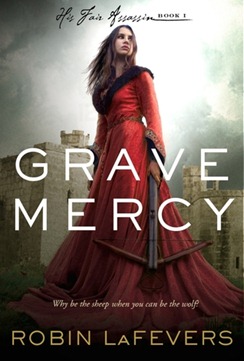
Review: Grave Mercy by Robin LaFevers

grave mercy

Grave Mercy by Robin LaFevers

Hated by her father since the day she was born, Ismae had survived her parents’ attempt at abortion and was left permanently scarred.  Sold into the brutality of an arranged marriage, she manages to escape into the hands of the convent of St. Mortain.  There she is offered the chance to become what she has always wanted to be: a woman with choices and power.  In the case of Mortain, it is the power to kill.  Ismae discovers that she is tolerant of poisons, allowing her to work closely with them and learn all of their secrets.  She is sent to the court of Brittany to do the work of Mortain, killing those she is instructed to and reporting her political findings back to the convent.  She must pose as the mistress of Duval, bastard son of the dead Duke.  Ismae quickly becomes embroiled in the politics and betrayals of the court: the many men vying for the promised hand of the young Duchess, and the French pressuring for capitulation or war.  And of course, there is also a romance blooming.  This adventure in 15th century Brittany will be sure to please historical fiction and fantasy fans alike.

First, I have to take a moment to mention this cover.  Even better, it is a cover that is not only beautiful but wonderfully in sync with the storyline.  This is Ismae, an incredibly strong and vibrant heroine.  She has little interest in the more womanly pursuit of needlecraft and even less in flirtation.  Instead she turns into a disturbingly eager assassin, ready to dole out damage where required.  That is until things are not quite so clear as she had thought.  Then the book turns and becomes deeper and even more magnetic.  LaFevers allows her young heroine to guide this book, telling her own strange, amazing story.

The characterizations here are compelling and original.  The setting is just as much so.  And the setting here is a large part of the storyline itself.  The high court of Brittany is a place of dangers and yet wonders.  The political pressures add organically to the dynamic storyline.  The use of the old gods and ancient religion as a backbone to the story also works very well.  It adds yet another dimension to the story, creating great depth.

Highly recommended, this book is a luminous gem of a book.  Get this into the hands of older teens who will wait breathlessly for the next in the His Fair Assassin series.  Appropriate for ages 15-17.

Reviewed from library copy.

Review: Vote for Me by Ben Clanton

vote for me

Vote for Me by Ben Clanton

This picture-book look at the campaigning process takes young readers through a comical look at politics.  The donkey and elephant represent Democrats and Republicans only superficially.  They make no claims that match the party platforms at all.  Instead, it is about how cute elephant is, whether you will accept candy or peanuts as a bribe for your vote, and lots of grandstanding.  Soon the two are completely at odds with one another and slinging actual mud along with their bitter words.  The insults they use are harsh but humorous, just right for the picture book crowd.  Soon both of them have said things they regret and they agree to get along.  But it just might be too late for either of them to win the election!

This book is not an in-depth look at voting or politics.  Instead Clanton has created a light-hearted look at arguments and fighting through the lens of an election.  Adults will enjoy the clear ties to modern American elections while children will be engaged by the humor. 

The illustrations have a great vintage feel with a modern edge.  The pages are dappled like old paper that has just begun to mildew.  The two characters show lots of emotion throughout the book and it is clearly conveyed by their body language and facial expressions.

A chance to laugh a bit at the cantankerous campaign ahead of us, this book would work for discussions about arguments as well as a light-hearted look at elections.  Appropriate for ages 4-7.

Reviewed from copy received from Kids Can Press.

Review: Chloe and the Lion by Mac Barnett

chloe and the lion

Chloe and the Lion by Mac Barnett, illustrated by Adam Rex

You know this book is going to be unique when you get introduced to the author and illustrator before the book begins.  Then you meet Chloe, a little girl, who is the main character in the book.  The story begins and Chloe is collecting loose change that she would use to ride the merry-go-round in the park as many times as she could.  When she headed home, dizzy from the ride, she got lost in the forest.  Then a huge lion jumped out at her!  Except Adam Rex, the illustrator, did not draw a lion.  He thought a dragon would be a much better choice.  Mac Barnett, the author, doesn’t like that idea at all and insists that this is HIS book because he is the author.  The fight goes on from there, until Mac feeds Adam to the lion that a new stand-in illustrator drew for him.  Unfortunately, he doesn’t really like the art of the new illustrator and also finds that he can’t draw well enough himself to fill in for Adam.  What is an author to do?!

I love books that break that fourth wall and take a look at the inner workings of the author/illustrator or involve the audience in an interesting way.  The book’s art and writing are so closely integrated together that it is almost impossible to review them separately.  The tone here is clean and clear until the fight scene where it becomes comically fraught with emotion.  There are running gags, funny comments and lots of humor throughout the story that make it all the more fun to read.

The illustrations are inventive and add real dimension to the book.  There are several elements at play.  There are the figures done in clay that represent the author and illustrator.  There are the flat drawings of Chloe and the lion.  Then there is a stage where the book story takes place.  It’s a wonderful mix of theater, reading, and art.

The silliness doesn’t stop at the end of the book, make sure to check out the author blurb at the back, along with the very short illustrator blurb.  This book will thrill children with its silliness, dynamic illustrations, and its clever look behind the curtain of making a picture book.  Appropriate for ages 5-7.

Reviewed from library copy.

Review: It’s Milking Time by Phyllis Alsdurf

its milking time

It’s Milking Time by Phyllis Alsdurf, illustrated by Steve Johnson & Lou Fancher

This picture book looks at milking time on a modern dairy farm.  A little girl works alongside her father.  She helps to bring the cows in from the field and then into the barn.  She scoops feed into their stalls and helps get the milkers ready.  Then she opens the big barn doors and the cows enter the barn and line up in their stanchions.  The little girl goes around and locks them.  Milking starts, and there are quiet moments to look out at the growing corn, but then milk is ready to be carried to the milk house, a pitcher filled for the family.  Then the calves must be fed, the manure shoveled, and finally the two walk up to the house in the twilight.

Told with great detail and a loving tone, this story shines with love for the heartland and dairy farms.  While the farm is clearly modern, there is a great timelessness to the story with the interaction of farmer and cows, the buckets of milk, and even the pitcher of milk for home use.  Alsdurf uses a refrain throughout the book, “Every morning, every night, it’s milking time.”   That repetition works well, reminding readers that this same activity happens over and over again on a farm.

The illustrations add to that feeling of timelessness.  They are done in soft colors with late afternoon light flowing golden over the images.  They also have soft edges, like favorite jeans that have been washed many times.  They are pure comfort.

For librarians in Wisconsin, this book is a natural fit.   It’s good to see a farm setting that is not historical but keeps that pastoral feel.  Appropriate for ages 4-6.

Reviewed from copy received from Random House Children’s Books.