Review: Bambino and Mr. Twain by P. I. Maltbie

bambino and mr twain

Bambino and Mr. Twain by P. I. Maltbie, illustrated by Daniel Miyares

In 1904, after losing his beloved wife, Mark Twain shut his door on the public life he had led.  Instead, he stayed indoors spending much of his time alone except for his daughter’s cat, Bambino.  The two of them grew closer as they played billiards together, shared ice cream for his birthday, and stayed together in a bed crowded with books and papers.  One day, after spotting a squirrel outside the window, Bambino leapt out and disappeared.  Twain put an ad in the paper and many people came with cats and kittens just to meet the famous author.  But none of the cats were Bambino.  Three days later, Bambino appeared on the doorstep as if nothing had happened.  Mark Twain took inspiration from his small companion, and started being part of public life again. 

This book explores the powerful relationship between people and animals.  It is also an exploration of grief and could be used with children in elementary school to discuss death and grief.  Maltbie includes many small touches about Twain, including those white suits, details about his wife, and traditions of their family.  Those little points create a much more human story, even though we are talking about one of the most famous authors ever. 

The black cat and the figure of Twain in his trademark white suit make for a great pairing visually as well.  Miyares’ illustrations are filled with great textures and colors, with the palette changing as the mood of Twain lifts.  The shadows are stronger when the grief is at its worst, but lightens and even brightens as the book continues. 

A personal look at a great figure of American literature, this book about Twain offers the depth of grief and the joy of connection with a pet.  Appropriate for ages 6-8.

Reviewed from copy received from Charlesbridge.

Review: Rosie Sprout’s Time to Shine by Allison Wortche

rose sprouts time to shine

Rosie Sprout’s Time to Shine by Allison Wortche, illustrated by Patrice Barton

Everyone thought that Violet was the best at everything.  She could run the fastest, sing the highest, and dress the fanciest.  But Rosie did not think that Violet was the best and was tired of hearing about Violet all the time.  When their teacher gave them an assignment to plant pea plants and care for them, Violet was sure that hers would be the best.  She decorated her pot with lots of sparkles.  Rosie’s plant was the first the pop up above the dirt, but Violet announced hers first.  So when Rosie came in early the next morning, she pushed soil over the top of Violet’s plant.  That day, they learned that Violet had chicken pox and would not be in for several days.  So Rosie started to care for both of their plants.  Rosie’s teacher told her that she was the best gardener she ever had in her class, as Rosie watered, rotated and sang to both plants. 

This book celebrates the quiet child, the one who is not the sparkliest or the loudest.  The book speaks to the need for all children to be praised and to be seen as being good at something.  Rosie definitely feels left out and jealous of Violet, and those feelings turn into action when she buries Violet’s plant.  But at the same time, that is the moment that the book turns around and Rosie starts to shine.  Happily, the jealous act is temporary and not the focus of the book.  Instead it is a much merrier book because of that.

The art work here has a wonderful softness to it that is very welcoming.  There is a freedom to the art as well that is very successful.  The lines are soft, the colors blend, and the effect is fresh.  The children in the classroom are multicultural, another small touch that makes the story all the more universal. 

A great book to share in the spring, when gardens start being planted, or when jealousies grow.  Appropriate for ages 4-6.

Reviewed from copy received from Random House Children’s Books.

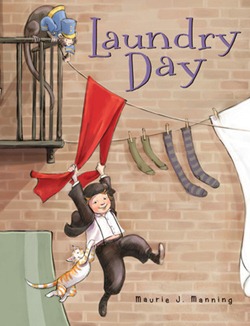
Review: Laundry Day by Maurie J. Manning

laundry day

Laundry Day by Maurie J. Manning

A young boy tries to sell shoe shines on the streets of New York City in a time before cars, when the streets are crowded with horses and carts.  Suddenly, a red cloth drifts down from above.  The boy looks up to see rows and rows of laundry drying above the street, so he starts to climb with the red cloth around his neck and his small cat following behind.  As he searches for the owner, he meets people from all over the world.  There is the Chinese woman who offers him a mooncake after he helps fold some laundry.  A Ukranian woman with a wailing baby suggests he check with the Italian organ grinder who lives above her.  A family of Polish little girls try to get him involved in their games.  When he finally finds the owner, he has traveled the world in just a few buildings, sharing in treats, hearing a few words of their language.  His high-wire antics add a little spice to the story and a wonderful play off of old films.  This is an old-fashioned treat of a picture book.

Manning adroitly wraps international content in a comfortable package.  The various cultures shown in tiny tastes here are done with a gentle hand and an eye to history.  There is a feeling of merriment throughout this book, with never a fear that the boy will injure himself or that he will find anyone unkind on his adventures.  

The illustrations too have a playful vintage quality about them.  There is a freshness mixed with a timeless feel.  The freshness comes from the cartoonish lines of the art and the comic-like panels used on some pages.  It’s an inventive mix of modern and timeless.

This picture book mixes vintage and new, international and American into one wonderful diverse story.  Appropriate for ages 3-5.

Reviewed from library copy.

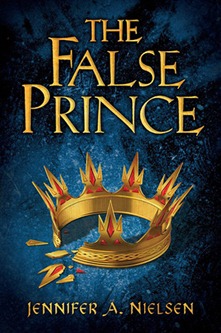
Review: The False Prince by Jennifer A. Nielsen

false prince

The False Prince by Jennifer A. Nielsen

It is a strange, unique day when only an orphan boy of no particular breeding can save a kingdom from war.   But that is the plan hatched by Conner, a nobleman, when the entire royal family is poisoned.  The only possible way to save the kingdom from immediate war is to find a young man who resembles the prince, who was thought to be dead years before.  So it is that Sage and three other young orphans are gathered up.  It is made clear from the beginning that this is no joke, and that Conner will do anything to keep this secret safe.  The boys begin learning to be princes, competing for the one spot as the prince.  They must learn to read, write, ride a horse, fight with swords, and use genteel manners.  Among them, Sage is the one with the arrogance, fearlessness and pride to be a prince, but if he doesn’t try at his lessons, he may not be the one chosen.  All of the boys realize what it means not to be chosen – certain death.

Nielsen has created a book that dashes forward, blazing with a strong concept from the beginning.  The idea of the false prince and a life-or-death competition for a single role makes for exhilarating reading.  Her pacing is brilliant, as is the ease of her writing, making the book almost impossible to put down.  In Sage, she has created a boy who could have been dislikable but instead reads as brave, valiant, and true. 

Nielsen does not shy away from violence or death.  This is a world of lies, cunning and manipulation.  Within that world, people will do what they have to in order to get ahead.  That is a large part of the appeal of Sage.  He is somehow immersed in that world of desperation, but remains unwilling to ever be desperate or eager.  He is a complex character filled with charisma.

Written in the first person, a rather daring choice for this sort of book, Nielsen manages to not allow the reader to guess the truth of the story until she reveals it.  While readers may guess at how the book will end, they will not be certain until that moment of revelation.  It’s another feature that makes the book so very readable.

The first in a trilogy, I was thrilled to find a book that stands on its own.  While there are plot points that I look forward to finding out more about, this book has a very satisfying ending.  Get this into the hands of readers who want action, intrigue and enjoy a little sinister darkness in their books.  Appropriate for ages 12-14.

Reviewed from ARC received from Scholastic.

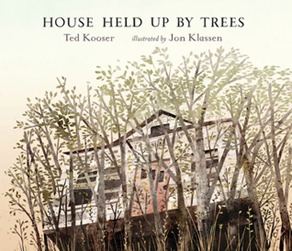
Review: House Held Up by Trees by Ted Kooser

house held up by trees

House Held Up by Trees by Ted Kooser, illustrated by Jon Klassen

This is the story of a family and a house.  When the house was new, it stood upon a newly planted lawn where the trees had been removed.  It was bare, not even a stump left behind.  On either side of the bare lot were trees of all sorts, the kind that spread seeds and scents.  Two children lived in the new house and often played in the trees at the edges, watching their father care for the lawn.  Their father mowed down all of the small tree seedlings before they could get started at all.  But the children grew up, the man moved away to be closer to them, and the house was left alone.  Alone except for the trees, which grew and took over the barren lawn, and eventually lifted the house high on their shoulders.

Kooser writes with amazing depth here, each sentence resonant with meaning and feeling.  While the book can be read more lightly, the joy here is in that dark deep that lies behind the lines.  The story plays with man vs. wilderness, the American obsession with lawns, children being pulled to the edges to find their own wild spaces, and the return to nature in the end.  The writing is beautiful because of that ever-present ache that is there, the tug of the trees, the dance of the seeds.

Klassen has illustrated this book with such delicacy that it shows he feels that same amazing pull.  He lets us peek at the house from the shelter of the woods, our eyes almost aching with the bareness in the sun.  He captures the tree seeds in flight from high above, allowing us to fly with them and plant ourselves too.  He plays with light, shadow and darkness, just as Kooser does. 

This book is poetry, without the stanzas.  It is a picture book that has depth, courage and looks deeply into our relationship with nature and with our families.  Beautiful.  Appropriate for ages 7-10.

Reviewed from library copy.

Review: Remarkable by Lizzie K. Foley

remarkable

Remarkable by Lizzie K. Foley

Jane Doe is a very ordinary person, which wouldn’t be that odd, except she lives in the town of Remarkable, which is filled with the most gifted and talented people anywhere.  Her family is full of gifted people, like her grandmother the mayor, her mother the architect, her brother the painter, her father the best-selling author, and her sister the mathematical genius.  Jane on the other hand is just like her grandfather, easily overlooked and ordinary.  They are so ordinary that they can’t get noticed long enough to get ice cream at the local soda shop.  Jane is the only student left in the regular school, since all of the other children are in the gifted school.  But then things start to change in Remarkable.  A pirate captain comes to town, followed by three of his crew who are searching for him.  Jane gets two classmates who have been kicked out of the gifted school because of their mischief.  In fact, Jane’s life might not be quite as dull and ordinary as she first thought.

Foley takes the idea of a very ordinary character and runs with it.  Jane is completely normal and it is her surroundings that are wild, extraordinary and unusual.  At the same time though, Foley does much to celebrate the ordinary and to point out that the quiet, the plain and the unassuming have gifts too though it may take some time to find them or notice them.

Foley’s writing is great fun in this book that mixes a huge sense of humor with some wild adventures.  The book starts slowly, nicely building towards the incredible ending that is filled with pirates, storms, music, cheap jelly, and even a sea monster.  The story has wonderful little touches, side characters who are nice diversions, and plenty to love. 

This would make a great pick for a class read aloud in elementary school and it would also make a remarkable read this summer.  Appropriate for ages 9-12.

Reviewed from ARC received from Dial Books for Young Readers.

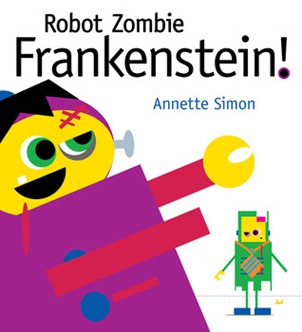
Review: Robot Zombie Frankenstein! by Annette Simon

robot zombie frankenstein

Robot Zombie Frankenstein! by Annette Simon

Two robots who are friends try to out-do each other as they dress in costumes.  It starts out with Robot Zombie and goes on from there, until they each have pirate hats, eye patches, capes, chef hats, space helmets, and much much more.  By the end, the two of them look very silly, dressed in all of that gear.  The competition continues until one robot pulls out a cherry pie and the two friends decide to drop the costume competition and share a treat.

A large part of the appeal of this book are the illustrations.  They have white backgrounds that really make the bright-colored shapes pop against them.  Simon uses simple shapes, wild colors and lots of creativity to make costumes for these characters.  Along the way, she shows just how little it takes to evoke a character, sometimes only a few stitches on the head, or a cape around the shoulders.

The writing takes a backseat here, simply supporting the wild antics in the images.  Its use of popular subjects like zombies and robots will get young readers to pick up this book.  The cover completely drew in my son, who just had to read this book immediately.

Halloween story times can be tricky, and this is just the right story to add to your not-scary-at-all version for the youngest listeners.  It’s also a book with plenty of humor and zip that will appeal to any youngster who enjoys a good giggle and a great costume.  Appropriate for ages 3-5.

Reviewed from copy received from Candlewick Press.

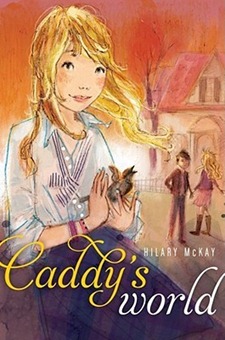
Review: Caddy’s World by Hilary McKay

caddys world

Caddy’s World by Hilary McKay

If you have not yet discovered the artistic, free-spirited, dynamic world of the Casson family, you are in for a treat!  This is the sixth book in the series that started with Saffy’s Angel.  In this book, we return to a time when Caddy, the oldest of the Casson children, was twelve.  She had three best friends and all of them had a role to play in their little group.  But this year, all of them are facing challenges in their lives.  Alison is completely bored with school and longing for something new, so she starts rebelling against school rules.  Ruby has been asked to try for a prestigious scholarship to a private school but she doesn’t want to leave her friends.  Beth is outgrowing her pony and decides to limit her diet. Caddy too has a challenge, a new baby is coming to the family, and her father who usually lives away from the family in London returns to help take charge.  But things are never that easy in the chaos of the Casson family!

McKay has the ability to speak about serious issues like premature babies, growing older, potential bulimia, and chaotic family life without heading into deep drama.  While the subjects are deep and the emotions are real, she keeps a lighter touch on them than most authors.  My favorite example of this is the chaos of this family.  It’s a family filled with love, art projects, failed cooking, and laughter.  But it’s also a family that is often adrift, rudderless, and late for school.  McKay walks the line, demonstrating that there are many sorts of families and that some of them that may look fragmented are actually strong and true.

McKay is also adept at drawing characters.  Here we get to see younger versions of several beloved characters:  Saffy, Indigo and Caddy.  They are all wonderfully true to their older selves, showing interest that later come to full light.  The addition of the three new characters and glimpses of other previous ones make for a book that is fresh but also warmly familiar to fans of the series. 

This sixth book in the series would work as a stand-alone read.  Taking place earlier than the other novels, it will delight fans and should encourage new ones to enter the world of the Cassons.  Appropriate for ages 9-12.

Reviewed from library copy.

Review: Sadie and Ratz by Sonya Hartnett

sadie and ratz

Sadie and Ratz by Sonya Hartnett, illustrated by Ann James

Hannah’s hands are named Sadie and Ratz, and they get into all sorts of trouble.  They like to crunch, squish and squeeze things.  They are especially active when Hannah’s little brother, Baby Boy, does things like going into her room or using all of the markers.  Then Sadie and Ratz try to rub off his ears.  Baby Boy screams for help and Hannah gets into trouble.  But then one day, something strange happens and Sadie and Ratz get accused of drawing on the wall, when they were nowhere near there.  Baby Boy was there, but he tells his parents that Sadie and Ratz were the ones who did it.  Later, Baby Boy blamed Sadie and Ratz for his skinned knee.  He got a cookie and cuddles, while Hannah only got a cookie.  Things were getting out of control, so Hannah sent her hands on vacation so they could no longer be blamed for things they had not done.  After that, she discovered that her pet stick insect, Pin, was missing a leg.  Now that was taking it too far!  Whose busy hands could have done this?

This book is a delight.  It’s going to bother some people that the behavior the children are modeling here is not perfect.  Rather, it is naughty, childlike, and accurate.  This book reflects great parenting on the part of the parents in the book, an openness for creativity, and a welcome zing of real life.  These are children who don’t always tell the truth and have hands that get into mischief. 

The charcoal illustrations by James have a wonderful wild quality as well.  They are rough, often dark, and filled with shadows.  These are not illustrations filled with color, pink and glitter.  All signs point to the fact that this is a different sort of chapter book altogether.  And so it is.

An outstanding addition to beginning readers in libraries, this book will appeal to a certain kind of family and a certain kind of kid.  You know if you are one of those parents and if you are raising on of those kids.  Mine both are.  Appropriate for ages 6-8.

Reviewed from library copy.