Review: The Pirates Next Door by Jonny Duddle

pirates next door

The Pirates Next Door by Jonny Duddle

This book first came to my attention when it won the Waterstone’s Children’s Book Prize in the UK.  It is the story of a girl living in a neighborhood where all of the lawns are neat and tidy, until the pirate family moves in next door.   They arrive complete with pirate ship, treasure chests and barrels of grog.  There is a pirate boy named Jim Lad, his parents, his grandfather, and his little sister, Nugget.  Jim Lad and the girl quickly became friends, but the rest of the community was not as welcoming to the pirate family.  Rumors spread quickly about all the nasty things the pirates were up to and the fear was that if one pirate family lived there, then more would come.  But this pirate family is only there while their ship is being repaired, so soon Jim Lad is off again, leaving behind a touch of pirate treasure for everyone.

Duddle has written a child-friendly book about segregation without ever using the word or focusing on that concept.  It is a book about people who are different from you moving into your neighborhood.  Happily, the pirates expect to be shunned to a large degree, and just live their lives the way they always would.  They are unapologetic, make no efforts to fit in, and then disappear, but not without making a real impact and changing people’s minds. 

The illustrations in this book really set it apart.  They have that lush feel of cinematic animation.  Each character has a unique feeling to them, effortlessly distinct and interesting.  That’s true of the pirate family and also of the many elderly neighbors who gossip about them.  The effect is rich and striking.  The illustrations also use the color palette of cinema, with the dramatic lush colors, deep blues of night, and often playing with light and dark. 

This exceptional book takes the appeal of a pirate story and weaves in social commentary with great restraint.  Appropriate for ages 4-6.

Reviewed from library copy.
Review: Plant a Kiss by Amy Krouse Rosenthal

plant a kiss

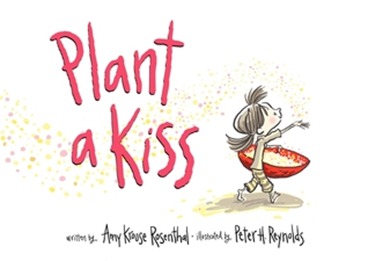
Plant a Kiss by Amy Krouse Rosenthal, illustrated by Peter H. Reynolds

Perfect for spring and Valentine’s Day, this book celebrates the way that love can grow.  A little girl plants a kiss in the ground using a shovel and watering can.  Then she gives it sun, water and attention.  For awhile she doubts if it is going to grow into anything, but then there is a sprout of glittery yellow and pink emerging from the ground.  Others gather around and she decides to share it, she hands out glowing yellow and pink wisps to everyone, even though others try to warn her that it is too rare and precious to share.  When she runs out, she heads back to her plant where she discovers that there is even more to give away!

When glitter is added to a book, it does a lot to create immediate appeal.  Unfortunately, many glitter-filled books don’t live up to that shimmery hype.  This one though is one that is designed to share, just like the kiss itself.  Rosenthal’s writing is light, airy and offers just a few words per page.  While her message of sharing love is clear, there is nothing preachy about the book, thanks to the cheery writing.

Reynolds’ art has that same light feel, including the wafting glittery clouds of kiss.  His young protagonist has a great quirky quality to her.  The glitter is incorporated into the story very successfully, adding to the book rather than distracting from it. 

The perfect snuggling book for the little one that you plant kisses on.  Appropriate for ages 3-5 and could be used as a gift for adults as well.

Reviewed from copy received from HarperCollins.

Review: Seed Magic by Jane Buchanan

seed magic

Seed Magic by Jane Buchanan, illustrated by Charlotte Riley-Webb

Rose and her brothers make fun of the old man who feeds the pigeons all day long from his wheelchair.  When Rose asks him why he likes pigeons so much, he tells her how beautiful they are.  But Rose can’t see it at all; she thinks that gardens are much more lovely than birds.  So Birdman gives her some seeds to put outside her window and grow a garden on her windowsill.  Rose knows that it won’t work, since there’s no dirt for them to grow in, but Birdman is insistent that they will grow a garden on her bare windowsill.  Her brothers make fun of her for even trying, but Rose starts to dream of the incredible flowers that could sprout there.  Then one day, something magical does happen, much to her surprise and delight.

Buchanan’s writing is poetic.  It has a strong rhythmic quality that beats to the heart of the urban setting perfectly.  She plays with imagery, describing the sunflower seeds as “black as tar, slick as oil” as Birdman share them with Rose.  This is a book that speaks to the power of making connections, rather than dismissing those around us.  It is also about beauty and seeing it in the most unlikely places.

The illustrations have a wonderful texture and thickness to them, the paint layered and deep.  Riley-Webb uses plenty of color to depict the urban park: greens, blues, and rich browns.  There is movement to her illustrations from the people, the birds and the gardens.  It is a fresh way to show a city, rather than the cold of concrete.

This book celebrates nature in an urban setting and the sharing of beauty.  Thanks to the rhythm of its writing, it’s a great read-aloud as well.  Appropriate for ages 4-7.

Reviewed from copy received from Peachtree Publishers.  

Review: The Obsidian Blade by Pete Hautman

obsidian blade

The Obsidian Blade by Pete Hautman

This is the dazzling first book in a new trilogy by veteran author, Hautman.  It is the story of Tucker, a teen boy from Hopewell, Minnesota who sees his minister father suddenly disappear into a disk that hangs in mid-air.  His father returns an hour later, changed.   He looks older, his clothes are worn, and his feet are covered in odd blue boots.   But the most significant change is that he no longer believes in God.  After his father returns, Tucker’s mother begins a slow descent into madness.  She stops cooking, stops getting dressed, and her hair turns from red to pure white.  Tucker longs to return to the days when his family was not falling apart, but before he can even begin to hope for that, his father disappears with his mother.  Tucker knows they have both entered the disk again, looking for a cure for her.  This book blends family relationships, technology, time travel and religion into one intoxicating mixture that is impossible to sip slowly.

This book would definitely be categorized as science fiction, but that definition does not fit quite so easily here.  With its detailed look at modern life and families, the audacity with which it explores faith and religion, and the wrenching take on modern technologies, this book is far more than that narrow genre might imply.  Hautman has created a work that transcends simple definition, reaching quickly beyond them. 

Hautman whirls readers through time, creating places that read like Narnia, others that seem more like an Indiana Jones film, and then slows down to take in the crucifixion.   It is a trip through our shared past and future, dancing back and forth across the line until the reader is unsure which is which.  Hautman excels at asking impertinent questions, taking great risks, and exploring the lines that teens themselves like to toy with. 

The book is beautifully written.  The character of Tucker is well done, though others may need time in the upcoming books to come more fully to life.  The book is plotted tightly, picking up pace until by the end, you simply cannot read fast enough to figure things out.  And the final trick is the end of this first book, which is just like stepping through a diskos of your own.  

A triumph of a first book in a series, this reminds me strongly of the wonder of Chaos Walking by Patrick Ness.  I’d suggest getting it into the hands of teens who enjoyed that series which had the same complexity both in terms of storyline and ethics.  Appropriate for ages 14-17.

Reviewed from ARC received from Candlewick Press.

Review: Kate & Pippin by Martin Springett

kate and pippin

Kate & Pippin: An Unlikely Love Story by Martin Springett, illustrated by Isobel Springett

When Pippin, a fawn, is abandoned by her mother, photographer Isobel Springett found her crying for help.  She took Pippin home and placed her by Kate their old Great Dane.  The two immediately bonded:  Pippin thought she had found a new mother and Kate started to mother her even though she had never raised any puppies of her own.  Pippin learned to drink from a bottle and when she got bigger started to adventure outside.  One evening, Pippin disappeared into the forest and didn’t return for bedtime.  Kate was very concerned, but the next morning Pippin came back just in time for breakfast.  Pippin returned to the woods every night after that, returning to the farm almost every morning to eat and play.  As she grew into an adult deer, she still continued to return to visit Kate and play.  She even still comes into the house once in awhile for a visit. 

This is one of the most lovely picture books about a relationship with a wild animal that I have seen.  I especially appreciate that Pippin was allowed to continue to be a wild deer, returning to the forest and being allowed to create a relationship on her own terms.  It’s definitely refreshing to see.  Here the human and dog were able to rescue, aid but also step back and not absorb this little creature.  The relationship that emerges is breathtakingly touching, seeped in fragility yet incredibly strong.

A large part of the success here are the photographs of this tiny deer bonding with the enormous dog.  By the end of the book, the animals are the same size.  It is clear that both of them adore one another on a deep level, and one that is delightfully separate from the humans. 

This nonfiction picture book reads like fiction, making it a great pick for a touch of nonfiction in a story time.  It’s a story that children will relate to easily and naturally.  Appropriate for ages 4-7.

Reviewed from copy received from Henry Holt and Company.

Review: Old Robert and the Sea-Silly Cats by Barbara Joosse

old robert

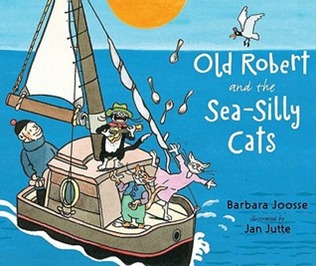
Old Robert and the Sea-Silly Cats by Barbara Joosse, illustrated by Jan Jutte

Old Robert sailed his ship at sea during the day and docked it at night because it was so dark.  At night, he prepared his dinner of toast in buttered milk and ran through his list of things that were all in their proper place, including clean socks, a clock, one dish and one spoon, and the moon.  He was all alone until one night when a dancing cat asked to come aboard.  Old Robert hesitated because there wasn’t much room aboard, but in the end he agreed.  So he made dinner of toast in buttered milk for both of them and when he went to bed, he noticed the moon was bigger.  Now his list included the cat in its hammock as he went to sleep.  On subsequent days, another two talking cats joined him on board, for dinner, and on his list.  And the moon got bigger still.  Finally, a cat that didn’t talk at all arrived and Old Robert let it on board too.  There was no room for a hammock, for Old Robert let it sleep on his chest.  Finally, the moon was full and Old Robert sailed off into the moonlit night with all of the cats. 

I expected quite a different book when I saw the cover.  I thought it was going to be silly, zany, and rather wild.  Instead, this book has a beautiful quietness to it, a thoughtfulness, and makes for a perfect bedtime read.  Joosse incorporates repetition so well here that it becomes a lullaby.  His listing of his belongings doesn’t change much, except for the size of the moon and the number of cats.  It speaks to the simplicity of his life, but also to how lonely he is.  This is shown rather than told, giving the book a lovely little ache that heads right for the heart.

Jutte’s illustrations too have a mix of silly and quiet.  They have a vintage feel, of old comic books that will make readers feel right at home.  They have great color with explosions of pinks, blues and yellows that pop and glow. 

A great read aloud, this would make a great bedtime pick but it is also a good one to turn into reader’s theater for children.  Appropriate for ages 3-5.

Reviewed from copy received from Philomel Books

Review: Mrs. Noodlekugel by Daniel Pinkwater

mrs noodlekugel

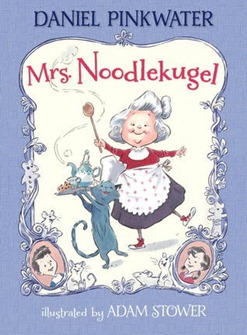
Mrs. Noodlekugel by Daniel Pinkwater, illustrated by Adam Stower

Siblings Nick and Maxine have just moved into an apartment building where they live on an upper floor.  Soon after they moved in, they discovered a tiny house behind their apartment building, but they could not figure out how to get there.  They decided to ask the janitor of the building who told them they had to go through the boiler room.  But their parents told them not to bother the woman who lived in the house and not to visit.  Of course, the two children just had to meet her.  So they traveled through the dark, pipe-filled boiler room and off to the sweet little house where they met Mrs. Noodlekugel and her talking cat, Mr. Fuzzface.  She fed them apple cookies (baked by Mr. Fuzzface) and tea.  She insisted that the four mice be invited to the tea, because you can’t have tea without mice.  And that was just the first time that the children came to visit!

Pinkwater has created a jolly book for beginning readers here.  It has the wonderful charm of an old-fashioned story filled with baked goods, talking animals and more than a touch of magic.  At the same time, it takes place in an urban setting of apartment buildings and the city.  Pinkwater’s writing is as solid as ever, creating a strong foundation for the story. 

Stower’s art adds to that feeling of the juxtaposition of vintage and new.  There are full-page illustrations and then others that offer just small images on the page.  The illustrations have a wonderful sweetness to them, especially as the magic starts.

A cheery book for new readers, this is a confection of a book for children starting to read chapter books on their own.  Appropriate for ages 5-7.

Reviewed from library copy.

Review: The Secret Tree by Natalie Standiford

secret tree

The Secret Tree by Natalie Standiford

The neighborhood that Minty lived in had some very interesting stories.  There was the Man-Bat, a huge combination of man and bat that lived in the woods.  On the other side of the woods was the Witch’s House, where Minty’s best friend Paz was brave enough to knock but then lost her little sister’s favorite stuffed animal when the witch emerged and grabbed her.  When Minty saw a flash in the woods one day, she headed off to see what it was. That’s how she met Raymond, a boy who lived alone in the new development model house.  She also discovered the Secret Tree, a hollow tree where people in town left their secrets.  She and Raymond started collecting the secrets and trying to match them with people.  Who is the person who is only loved by their goldfish?  Who has put a curse on their enemy?  Who is betraying their best friend?  And what secrets are the people closest to Minty keeping?

Standiford has created a compelling story about the power of secrets, but also the necessity for them at times.  The slow unraveling of the mysteries of the secrets makes for fascinating reading that will capture the interest of children.  It is one of those books that reads lightly, but has a great deal of depth behind it, especially as the secrets of the community are revealed. 

Minty is a great heroine.  She is at the cusp of becoming a teen and her best friend is maturing faster than she is.  Minty isn’t interested in laying out in the sun at the pool (at least not without eating a snow-cone) and she doesn’t like the new, older girls her friend is hanging out with.  Instead Minty wants to plan on becoming a roller derby star, discover the secrets around her, and just be herself. 

This rich novel will be a great pick for classroom reading and discussions.  It is also the ideal summer read, especially for all of us who love a great secret.  Appropriate for ages 10-13.

Reviewed from ARC received from Scholastic.

Review: Kali’s Song by Jeanette Winter

kalis song

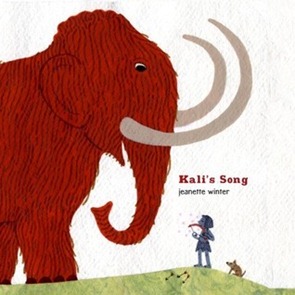
Kali’s Song by Jeanette Winter

Kali’s mother painted amazing paintings of animals on their cave walls.  Soon Kali would be a man and so he started practicing with a bow and arrows.  But on his first session of practice, he discovered that he could do something else with the bow:  he could make music!  Soon he was making music instead of practicing his shooting at all.  When the day of the big hunt came, his bow was taut and his arrows sharp.  The men and boys approached the huge mammoths, that were far larger and more impressive than Kali had ever expected.  Kali forgot all about the hunt and just felt that he had to play the music he was hearing in his head.  As he played, the mammoths gathered closer around him and the other hunters laid down their bows.  Everyone realized that Kali must be a shaman to charm animals in this way.  Even as Kali grew much older, he continued to play music on his bow.

Winter has created such a remarkable story here.  It is a story without modern judgment about killing animals, which would be out of place in this book.  Yet Winter does not turn entirely away from modern sensibilities either with this book about a young shaman who does not kill, but instead charms.  It is a book that celebrates innate talents of people, relishes in inventiveness, and demonstrates a large heart for acceptance too.  Kali is not shunned for being different, but instead embraced for it. 

Winter’s illustrations are also very special.  Framed with torn edges, the illustrations are filled with the texture of papers that mimics that of cave walls.  The characters are roughly painted, just as his mother’s cave paintings are with additional fine details drawn on in ink.  The result is a book that is a winning combination of rough and fine. 

This picture book embraces differences, celebrates art and music, and does it all surrounded by stars and mammoths.  Appropriate for ages 4-6.

Reviewed from copy received from Schwartz & Wade Books.