Trowbridge Road by Marcella Pixley

Cover image for Trowbridge Road

Trowbridge Road by Marcella Pixley (9781536207507)

June Bug lives with her mother in the house on Trowbridge Road that everyone thinks is haunted. Her father died of AIDS, leaving June Bug with her mother who is scared of germs and obsessed with being clean. That means that she never leaves the house and food can be scarce. June Bug’s uncle brings her food once a week, limited because her mother won’t allow him to come more often, so she is often hungry as the supplies run out. Then Ziggy arrives to live with his grandmother down the road. June Bug watches them from a nearby tree, dreaming of being friends and sharing the food that his grandmother prepares for him throughout the day. Ziggy too has experienced his own troubles, immediately getting the attention of the local bullies. As June Bug and Ziggy meet and become friends, their troubles mount, but they have one another as a safe place to share and heal, because at times home is not that place at all.

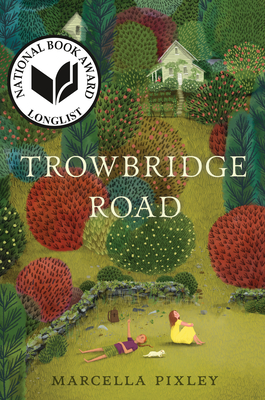
Set in the mid-80’s, this novel for middle graders is written with such beauty. Pixley creates a neighborhood that is lovingly shown as a mix of safety, imaginative play and also reveals the harshness of reality too. From the foundations of a fallen house where magic blossoms to the shelter of a large tree that can be scrambled up and down, this is a neighborhood seen through the eyes of two creative children who create their own reality together to care for one another.

The two protagonists are children who have experience abuse of various kinds and find kindred spirits in one another. They have both been hungry, both been physically hurt, and both lived with emotional abuse. They are both survivors, using their imagination and the neighborhood itself as places to escape to together. The power of love soars through this book, in extended families who offer care and shelter, in neighbors who reach out and take action. It’s a book about being able to ask for help and the positive change that can come when aid arrives.

Wrenching, powerful and filled with hope, this book is exceptional. Appropriate for ages 11-14.

Reviewed from copy provided by Candlewick.

The Boy and the Gorilla by Jackie Azúa Kramer

Cover image for The Boy and the Gorilla

The Boy and the Gorilla by Jackie Azúa Kramer, illustrated by Cindy Derby (9780763698324)

In a sad, gray world, a huge gorilla appears. He joins a boy out in his mother’s garden. The two talk about the death of his mother, about how you know when someone is dead. The two spend time together, coloring, flying kites on the beach. The beach was one of his mother’s favorite places. The boy misses his mother’s pancakes and her reading books at bedtime. Sometimes he just wants to be alone. Other times, he wants to climb high into trees to see if he can reach his mother. The gorilla stays at his side throughout, while baking Mom’s special cookies, picking daisies in her garden and playing baseball. Eventually, the boy reached out to his father about how much he misses his mother. After holding father and son close, the gorilla moved off, heading elsewhere.

Kramer tells a gentle and sorrowful story here, where sadness and loss is embodied in a huge, purple and black gorilla. That gorilla shows such tenderness and such attention to the boy, keeping silent when needed, dashing up trees together, sitting and lingering with one another. The gorilla becomes more than loss, he becomes care and healing without pressure or timetable. The book reads in a series of linked scenes, the process not linear but complex with motion forward and back. It is not until the boy connects more with his father that progress is made, a new team formed.

The art by Derby is instrumental here. Her huge and furry gorilla appears out of the gray, his black and purple dark against the fog of loss. Color tones are used very effectively through her watercolors in the book, moving from the initial grays to more blues, eventually having touches of red and yellow, sunshine nearby. Towards the end of the book, the pages are aglow with light and hope.

A lovely and touching look at loss. Appropriate for ages 4-6.

Reviewed from e-galley provided by Candlewick.

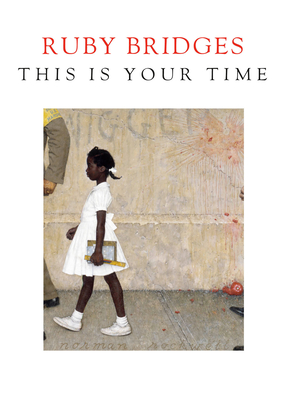
This Is Your Time by Ruby Bridges

Cover image for This Is Your Time

This Is Your Time by Ruby Bridges (9780593378526)

At age six, Ruby Bridges was the first Black child to attend an all-white elementary school in New Orleans. She had to be escorted to school by federal marshals, leading to iconic photographs of her small size and the screaming, threatening crowds. In this book for children, Bridges tells the story of her harrowing time attending school, how she was taught in a classroom all by herself with a teacher who made her feel safe and loved, and how it felt to be that little girl. Filled with historical photographs, the book shows and explains the battle for desegregation across the country and also the modern fights for equity, inclusion and antiracism.

This is one of those books that gives chills. It is a profoundly moving read as Bridges shares photos that demonstrate the intensity of the battle, the danger she was in, and the bravery that it took her and her family to take such a public stand for change. As Bridges moves into talking about modern youth and their battles, she maintains the same tone, challenging all of us to join us in the fight for civil rights and social justice.

The photographs and the iconic Norman Rockwell picture add a deep resonance to this book, taking Bridges’ beautifully written words and elevating them. The photo selection is done for the most impact, at times mixing modern and historical photographs together to show how little has changed but also how important the fight is.

One of the most important books of the year, this brings history and future together in one cry for justice. Appropriate for ages 9-12.

Reviewed from e-galley provided by Random House Children’s Books.

Butterflies Belong Here by Deborah Hopkinson

Butterflies Belong Here by Deborah Hopkinson

Butterflies Belong Here by Deborah Hopkinson, illustrated by Meilo So (9781452176802)

A Latina little girl has moved to the United States, discovering that she acts like a caterpillar and hides in the back of the class since she can’t speak English. In the summer, she looks for monarch butterflies, but can’t find any even in the community garden. In fall, she finishes her book about monarch butterflies. Able to read better now, she learns that the monarchs need milkweed to survive. Encouraged by her school librarian and inspired by the monarch’s migration, she forms a plan that she presents to her class. It’s hard to stand in front of the class and speak in English, but she really wants to plant a migration station for the monarch butterflies. Soon they are all working together, led by her, to create the station. She feels herself evolving now, into a citizen activist who stands at the front of the crowd.

The parallels between the narrator’s experience and that of the monarch butterfly offers a great framework for this picture book. Those connections are not overplayed, rather they form the reason that this little girl finds solace in studying butterflies. Interspersed throughout the book are excerpts from the nonfiction book on butterflies that she is reading. It’s a clever way to offer information in a separate and clear way.

The illustrations show a girl finding her way in a new country and a new city. The transformation in her body language as she becomes more confident and finds her voice is profound in the illustrations. By the end, she glows on the page alongside her garden.

An inspiring look at how to help butterflies but also how to find your voice. Appropriate for ages 5-7.

Reviewed from copy provided by Chronicle Books.

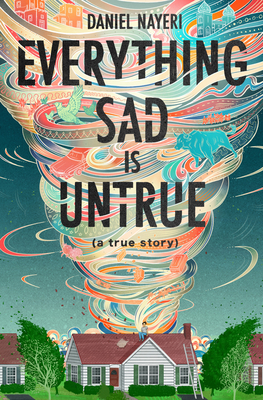
Everything Sad Is Untrue by Daniel Nayeri

Cover image for Everything Sad Is Untrue

Everything Sad Is Untrue by Daniel Nayeri (9781646140008)

Khosrou answers his teacher’s writing prompts with stories of his extended Persian family. He and his older sister and mother immigrated to Oklahoma, often living in a motel while staying away from his mother’s abusive new husband, who she marries and divorces multiple times. The other kids in his class don’t believe his stories. They are full of blood and poop, told by a boy who doesn’t speak or think like them who is unpopular and hairy and whose lunch smells bad. Khosrou’s stories though reveal where he came from, a home with birds in the walls and a family of huge wealth. They show how his mother and sister found Christianity, putting their lives at risk in Iran and the resulting loss of his father, his nation and their status. The story moves between life in Oklahoma, full of bullies and violence to the amazing setting of Iran filled with the smell of jasmine, epic grandparents, and color.

Closely tied to Scheherazade’s story telling in One Thousand and One Nights, this novel is remarkable. Nayeri beautifully uses that framework of a series of stories that lead one to the next, hinting at future tales and never stopping as they move forward. He incorporates stories at so many levels, from poop humor that is a welcome relief (pun intended) to stories of his family in Iran to stories of immense bravery to stories of abuse and fear. It’s a world of stories that shows the tangled lives of immigrants, from what they have lost to what they discover as well.

Nayeri tells his own personal story here. It’s tie to his own childhood is clear, giving the stories an honesty that shines through even when the story is fantastic and wild. The book is like a woven Persian tapestry, though I don’t see the single fault that Nayeri has woven into it. It’s complete and marvelous, a rug of jewels that can still be walked on by us all.

A journey of a book that deeply shows the experience of an Iranian immigrant. Appropriate for ages 12-15.

Reviewed from library copy.

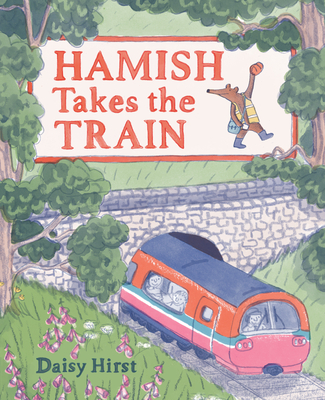
Hamish Takes the Train by Daisy Hirst

Hamish Takes the Train by Daisy Hirst (9781536216592)

Hamish the bear and Noreen the goose love to watch trains together. Hamish longs to take a train to the city, but Noreen isn’t interested. So Hamish set off, following the train tracks on foot. When he got to the station though, he found he needed a ticket, so he just kept on walking. As night fell, he came to a railroad yard and discovered a caboose all lit up inside. There he found Christov who was sick with the flu and too ill to go to work in the morning and run a big crane. So Hamish offered to help. He borrowed Christov’s hat and jacket and headed into the city on the train. When he got to the building site though, he didn’t have any boots, luckily he was able to find some nearby. Then it was time to run the huge crane. Hamish worked hard, running the crane from the cozy cabin. He did it for the five days that Christov was sick and was offered a job himself by the end. But Hamish was missing Noreen and took a train home, to share his adventures with her, and maybe have some new ones together.

Hirst tells a charming tale of Hamish, a bear with a taste for adventure and trying new things. He is also a very helpful and thoughtful character, helping out where he can and finding unique solutions to problems he encounters along the way. I was most impressed that Hamish was a success as he tried to help. It became a celebration of trying new things, learning and succeeding rather than what is often seen in children’s books like Curious George where helping becomes failing in a funny way.

The art is simple and friendly, capturing both the expanse of the countryside and the bustle of the city streets. Some of the pages are fully colored while others use white space and smaller images that move the story ahead. Throughout there is a sense of happy positivity.

A glorious adventure full of trains and cranes. Appropriate for ages 2-4.

Reviewed from e-galley provided by Candlewick Press.

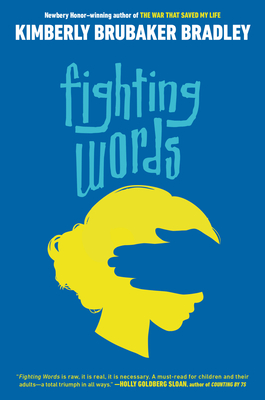
Fighting Words by Kimberly Brubaker Bradley

Cover image for Fighting Words

Fighting Words by Kimberly Brubaker Bradley (9781984815682)

Della has always been taken care of by her older sister, Suki. The two of them stayed together after their mother went to prison and they moved in with her mother’s boyfriend. That boyfriend did something horrible to Della, so the sisters fled. Now they are in foster care together, being really taken care of for the first time in their lives. Suki has always been Della’s protector so what happens when Suki suddenly is the one who needs help and caring for? Della is willing to talk in court about what happened to her, but Suki wants to be silent. Della is good at being loud, sometimes being too loud or swearing in class. It’s time for Della to use her voice to stand up for what they both need, but also to listen to her sister in a new way too.

This book is seriously one of the best of the year. Period. Written by an author who is consistently impressive, this is a book that is stunningly good. Bradley gives a voice to those who have experienced child abuse, showing them that they are more than the abuse, more than that trauma. It is a book that doesn’t duck what happened to these sisters, but builds towards the awful truth, warning readers that it is coming and then dealing with it when it happens. It removes the stigma of the trauma in a way that is full of compassion and empathy, giving space for assault and for the recovery from it.

Bradley’s writing is exceptional. She does so much with the voice of Della, making her both a clarion call to be heard and listened to, but also giving her a realistic vocabulary of swear words and a way to deal with them in a book for children. This book is beyond impressive. It is important and vital: a book to be shared with children and adults, an example of what children’s literature can be at its highest level.

Bravo! One of the best of the year, if not one of the best of all time. Appropriate for ages 10-13.

Reviewed from library copy.

The Scary Book by Thierry Dedieu

Cover image for The Scary Book

The Scary Book by Thierry Dedieu (9783791374642)

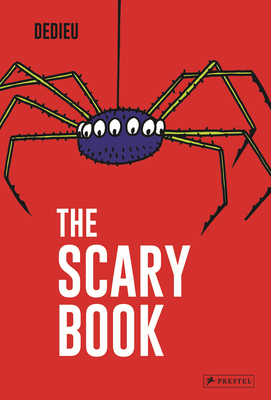
This board book offers plenty of creepy shivers when you take a normal sort of already frightening creature and then extend the flap. This one is not for the littlest children, though it is in board book format. It’s preschoolers and elementary-aged children who will love the wild and scary nature of the flaps opening. You may think that a bat is already pretty scary, but extend its jaws and find how sharp and huge its teeth really are. The ghost is pretty blank until you lift its head higher and discover a skeleton and some bloody spurts underneath. The wolf has a jaw that opens wider and wider, displaying a skeletal Little Red Riding Hood inside!

The words take a firm back seat to the art in this bold book with each double-page spread filled with a solid-colored background that really lets the sinister art stand out. The book is a blend of silliness and scariness, with the first flap the most surprising as they all open much wider than readers expect. Expect a mix of giggles and gasps as children explore this one.

Not for the faint of heart, readers must take their own hands directly into the jaws of the beasts to see the surprises. Appropriate for ages 5-7.

Reviewed from copy provided by Prestel Junior.

Margaret’s Unicorn by Briony May Smith

Cover image for Margaret’s Unicorn

Margaret’s Unicorn by Briony May Smith (9781984896537)

Margaret and her parents moved to a faraway place to be closer to her grandmother. When they got there, the rooms were bare and strange. Her parents sent Margaret out to explore, warning her not to go past the big stone. When Margaret reached the stone at the end of the garden, she could see the sea. And up in the clouds were unicorns that disappeared in a blink. As Margaret headed home, she heard a noise and discovered a baby unicorn tangled in the weeds. Her grandmother was shocked to see the unicorn, because she thought they had all disappeared. They had to get flowers for the unicorn to eat from the local shop and soon made him a cozy nest in Margaret’s room. That night, they gathered water touched by the moon, which made the unicorn’s horn glow. Margaret cared for the unicorn all the way until spring returned. Then Margaret returned the unicorn to its herd and its mother. Will Margaret ever see her unicorn again?

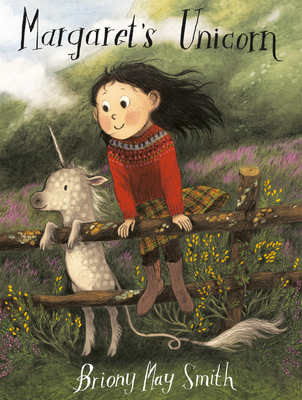
Smith has created a magical picture book about unicorns that isn’t sparkly and full of glitter. It’s a beautiful homey sort of magic, fed with flowers and moon-touched water. It’s also a book about caring for something but also being willing to return it and let it leave you. Because she knows she will lose the unicorn in spring, the entire book is filled with a wistfulness that plays well with the wonder of having your own unicorn.

The illustrations add so much to the appeal of the book. Filled with landscapes of moors and hills that butt up against the sea, the land is wild and wondrous too. There is a distinct coziness to the images, of a family that works together to create their new home and one for the baby unicorn too.

A lovely look at unicorns, families and love. Appropriate for ages 3-5.

Reviewed from e-galley provided by Schwartz & Wade.