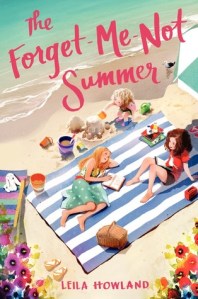
Review: The Forget-Me-Not Summer by Leila Howland

The Forget Me Not Summer by Leila Howland

The Forget-Me-Not Summer by Leila Howland (InfoSoup)

Marigold, Zinnie and Lily are sisters. They live busy lives in California where Marigold is hoping to have a real kiss for the first time, not one done on set. Zinnie is trying to get her curly wild hair under control and hopes to be able to spend time with Marigold and her friends. Lily is five and wants nothing more than to stay home with her nanny and eat great food. But then their parents get jobs out of town and the sisters are sent to spend the summer with an aunt they have never met across the country in Cape Cod. The three girls suddenly have to share a room with one another, live without a TV, not have cell phone service, and even the internet access is outdated and slow. Marigold is furious at losing a chance to be in a major film and having to spend time with her little sisters. Zinnie finds herself talking to trees for advice and watching for surprises created by special brownies. Lily longs for the food she had at home but also enjoys a good clambake too. Just as things seem to be starting to turn around, parts of California life appear and set everything askew again. These three sisters will have to figure out how to be themselves even when kisses, peer pressure and fame appear.

This book will inevitably be compared to the Penderwicks and rightly so. The sisters have that same spunk about them and the setting offers that timelessness that works so well. Though in this book, the girls chafe against the loss of TV and Internet, struggling to get along with one another. These sisters have fights, that are so well done that you understand both sides of the problem and can take the side of either one. The two older girls in particular both are human and far from perfect. Lily may look angelic but she too can throw tantrums and have horrible days, especially if baths are not negotiated properly.

It is that human quality that makes this book work so very well. The sisters are realistically portrayed and their relationships develop and change right in front of the reader in a way that makes sense. The unknown aunt turns out to be a very special person, kind and caring and someone who is a leader in the Cape Cod community. It’s a treat to see such a great female adult portrayed in a children’s book. One who is strong, enjoys children and gives them plenty of space to learn and grow without being overly odd or incompetent in any way.

A great summer read for fans of The Penderwicks, I’m hoping for another book featuring these girls. Appropriate for ages 8-12.

Reviewed from copy received from HarperCollins.
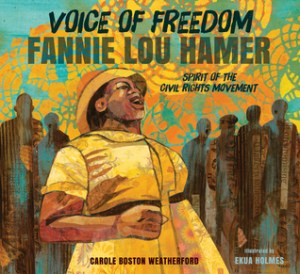
Review: Voice of Freedom: Fannie Lou Hamer by Carole Bostone Weatherford

Voice of Freedom Fannie Lou Hamer by Carole Bostone Weatherford

Voice of Freedom: Fannie Lou Hamer:The Spirit of the Civil Rights Movement by Carole Bostone Weatherford, illustrated by Ekua Holmes (InfoSoup)

This biographical picture book is written in verse, singing the life of Fannie Lou Hamer, a woman who was at the heart of the civil rights movement. The book begins with Hamer’s childhood in Mississippi as the youngest of twenty children in a sharecropper family. She grew up working in the cotton fields, seeing it for the slavery that it was. School was only held for four months a year, because the children needed to work in the fields in order for their family to survive. Even in the early part of the 1900s, Hamer was taught that black was beautiful and that she was special. She stayed in the south rather than moving north like her siblings, taking care of her mother and getting married. The in the 1960s, voter registration became an issue and Hamer found herself standing up to the system despite the violence and the threats. She joined the movement for voter rights and starting to use her singing voice to bring people together. Soon she was seen as a leader in the movement, running for office, and speaking out for those who did not have a voice. She is an inspiration for today’s Black Lives Matter movement and youth activism in general.

Weatherford’s writing is gorgeous and the verse she uses to tell Hamer’s story is very effective. She is able to directly talk about racism and violence in her poems, never dancing away from the toughest of subjects. Each poem reads as a call to action, a reason to stand up and make sure civil rights are not being abridged. Even the poem where Hamer is beaten by police and other prisoners rings with strength and power. This is a biography of a woman who was immensely determined and strong. She stood up to the system, risked her own life for change, and used her own skills for the sake of the cause.

Alongside the powerful poetry are equally impressive illustrations. The collage art by Holmes is a mix of paper art and paintings. The illustrations are deep colored and tell the story of oppression and then accomplishment. There are illustrations that take the bright colors of Africa and the 1970s and make the pages blaze while others are dark and somber as violence and death cloud the pages.

Important and powerful, this nonfiction picture book shares the story of a woman vital to the civil rights movement. Appropriate for ages 7-10.

Reviewed from library copy.

Review: Swan by Laurel Snyder

Swan by Laurel Snyder

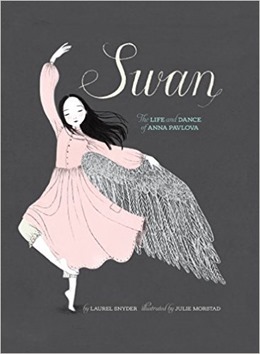
Swan: The Life and Dance of Anna Pavlova by Laurel Snyder, illustrated by Julie Morstad

This is a poetic and radiant look at the life of Anna Pavlova, prima ballerina. It begins with her childhood where she grew up poor, the daughter of a laundress in Russia. Then her mother takes her to the ballet one night and Anna’s life is transformed by a desire to dance. She auditioned twice for the Imperial Ballet School, turned down the first time because she was too young. At age 10, she was admitted and studied dance. Her body was considered all wrong for ballet, since she was so thin and not athletically built. She became the most famous ballerina of all time, helped by her tireless work to bring dance and music to those who had never experienced it. The book goes all the way through to her death, where she still longed to perform and dance until the very end.

Snyder’s poetry is just as delicate and strong as Pavlova herself. Through the words you can feel the tremble of desire, the longing for a different life and then the drive to learn and perform. As Pavlova’s story continues, Snyder captures the way that she created a home for herself when Russia changed and the importance of her performing around the world. Her performance as the swan is particularly beautifully captured in words, allowing her grace and particular style to be understood by young readers.

Morstad’s illustrations help with this as well. They highlight her beauty and grace, allow her to shine on the page and dance across it. Her pale beauty and black hair captivate on the page. Other pages show how hard she worked both in learning to dance and then again in a repeating format how hard she worked as a prima ballerina as well.

Beautifully written and illustrated, this picture book in poetry offers a glimpse at the wonder that was Anna Pavlova. Appropriate for ages 6-8.

Reviewed from copy received from Chronicle Books.

Review: Poet by Don Tate

Poet by Don Tate

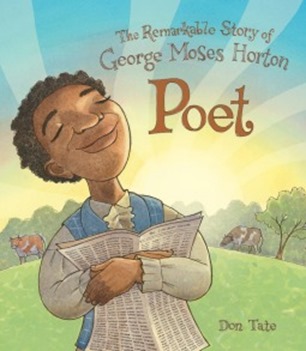
Poet: The Remarkable Story of George Moses Horton by Don Tate

Released September 1, 2015.

George’s family were slaves in North Carolina. Though he loved words, George was not allowed to learn to read. But he listened when the white children did their ABCs and then got himself an old spelling book along with a book from his mother and taught himself how to read. He read everything that he could find, but loved poems most of all. He spent his workdays composing poems in his head, though he didn’t know how to write them down. Soon after, his family was split apart and he was sent to live on another farm. He worked in the fields and was sent to Chapel Hill to sell fruit and vegetables to the students. While there, he started to share his poetry aloud. The students loved his words and helped him by giving him more books to read and paying him to write poems for them. He was also taught to write his poems down and soon had his writing published in newspapers. George could then negotiate with his master to pay him for his time away from the farm where he could write. As George created the best life he could while still living a slave, the country was changing and a war for freedom was about to be fought. It was a war that would free George finally and allow him to continue writing but this time a free man.

Tate captures the life and times of this remarkable man with a tone of wonder at times. What Horton managed to do in his lifetime under slavery is amazing and a sign of the quality of the words he wielded so well. As readers watch Horton grow up and then fight for his freedom in his own way, with words, they will be devastated when he continues to be a slave despite his best efforts. Even the work of others on his behalf could not get him free.

Tate’s illustrations are exceptional. One can see the yearning for education on Horton’s face as he watches the white children learn to read. Tate also makes sure that Horton’s image shines on the page. He is regularly lit from outside lights of candles and the sun, creating a light around him. The illustrations also show North Carolina in the mid-1800s and Chapel Hill in particular. Tate also incorporates some of Horton’s poems into the illustrations, allowing them to flow past visually.

This is a choice nonfiction picture book that shows the strength of one man, his intelligence and the power of his words. Appropriate for ages 6-8.

Reviewed from digital galley received from Peachtree Publishers and Netgalley.

Review: Binny in Secret by Hilary McKay

Binny in Secret by Hilary McKay

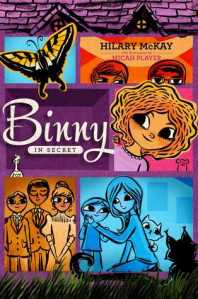
Binny in Secret by Hilary McKay (InfoSoup)

This second book in the series about Binny is another charmer. Binny has to start school in her new town now that summer is over. She doesn’t know anyone at all and the only child she has met she managed to knock into and spoil her mother’s birthday gifts while Binny was pursuing a butterfly. When a storm hits their small town, Binny and her family find that the roof of their house has caved in and they have to move to a rental house out in the country. At school, Binny is mercilessly bullied by the girl she knocked into and her friends. They call her “grockle” and make fun of the way she talks and acts. Binny finds herself taking solace in her family, helping her little brother James with his chickens. Then one of the chickens is taken by a “jagular” and Binny discovers a paw print that might lead her to figure out the puzzle of what animal took the hen. Tied together with Binny’s story is that of Clarry, a girl who lived in the house during World War I and who found herself drawn to the natural world in the same way that Binny does. It may just take the two of them together to solve the mysteries that Binny has discovered.

McKay has such a way of writing. It exudes warmth and humor. It’s rather like the cinnamon cake that appears in this book, something to be both savored and lingered over, but also one to be devoured with delight. If I could leave the house with a book like this tucked in my pocket to munch on each day, I’d be very happy indeed. The dual story lines of Binny and Clarry work particularly well. Clarry too is an intriguing character, a girl interested in an education in a time when that simply wasn’t done. Readers find out fairly soon in the book that Clarry lived to be 100 years old, but there are questions about how long others in her story lived which add to the mysteries of the book.

McKay creates characters who are their own people. There is Binny who is complicated both in the ones she loves and her own interests. She finds things on the fly and feels deeply about everything. Her younger brother James is also a delight. His way of greeting people, his vague general statements, his inquisitive nature. They all combine to one little boy with a huge personality. Clem, Binny’s older sister, has depths that are hinted at but not yet revealed. All of the characters are robust and personable. Those who seem one way upon first meeting them develop into intriguing full characters by the end of the book, and even the adults are treated this way.

Another wonderful read by the incredible Hilary McKay. I can’t wait to see what Binny gets up to next! Appropriate for ages 8-11.

Reviewed from copy received from Margaret K. McElderry Books.

Review: Billy’s Booger by William Joyce

Billys Booger by William Joyce

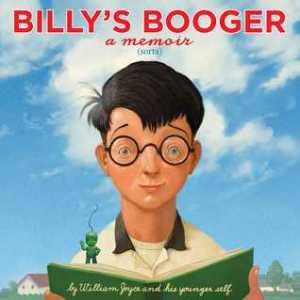
Billy’s Booger by William Joyce (InfoSoup)

This memoir in picture book format celebrates the creativity of a child destined to become an author. William has trouble at school. He wishes math were as much fun as the comics in the newspaper. He wants to play invented sports in gym instead of the normal ones. Notes are sent home from school. Then along comes a creative writing contest and William is very excited. He works and works on his entry. It’s title is Billy’s Booger and it’s all about a booger in his nose that gets super powers. But when the prizes are given out, Billy doesn’t win any of them, not even honorable mention. He is devastated and starts to act like everyone else. When he’s returning all of the book he used for research for his own book, he hears laughter in the library and heads over to investigate. A group of kids is reading his book and the librarian tells him that out of all of the entries in the contest, his is the most popular! He may not have won the actual prizes, but got something even better.

Joyce tells the story with a wonderful tone. He explains the earlier time when he grew up and children played outside rather than at playdates, when there were only three channels on the TV, and when funnies in the paper were a huge part of your day. It is a memoir about a kid who doesn’t quite fit into the school mold. It’s less about the grownups and how they dealt with him, though that is there in the background and more about him as a child and what he loved to do even then. It’s a testament to following your dream, to doing what you love and what you have always loved.

The illustrations are done in Joyce’s signature style, one that embraces vintage elements but also shines with a modern feel too. My favorite part of the book was the insert with William’s book in it. Happily, the pages are made from construction paper that feels so different in your hand. When I turned the page and saw it I cheered aloud. It is such a change from the finished and lovely illustrations in the rest of the book to move to these rougher drawings and paper. What an important element to embrace.

Fans of Joyce will love this glimpse of him as a child and it may inspire children to try their own hands at writing. Get this funny book out when creative writing projects are coming to help inspire really creative responses. Appropriate for ages 7-9.

Reviewed from copy received from Atheneum Books for Young Readers.

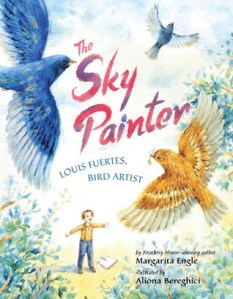
Review: The Sky Painter by Margarita Engle

Sky Painter by Margarita Engle

The Sky Painter: Louis Fuertes, Bird Artist by Margarita Engle, illustrated by Aliona Bereghici (InfoSoup)

Told in verse, this nonfiction picture book celebrates the life and work of Louis Fuertes. As a child, Louis loved watching birds and caring for them if they were injured. Even in his youth he started drawing and painting birds, despite the fact that his father wanted him to be an engineer. He kept drawing and painting in college, and learned to paint quickly and capture birds in action. At the time, the practice was to hunt the birds and then paint the dead bodies posed. Fuertes instead watched birds in life and painted them. Soon he was traveling the world to see different birds and paint them for museums, books and scientific record. Fuertes painted murals at the Natural History Museum and had a series of collectible cards with his paintings of birds on them. He helped make bird watching one of the most popular sports in the world by reinventing the way artists approached painting wildlife.

Engle speaks as Fuertes in her poems, giving him a voice to describe his own life and his own art. The book swirls like birds wings, moving from one colorful part of the world to another, delighting in the diversity of bird life everywhere. The format is rather like Fuertes’ work itself. She captures Fuertes in his real life, speaking as himself, traveling around the world, and then settling down to be the Bird Man in his old age. He is in his natural habitat throughout. Engle also captures the power of art and the importance of following the natural gifts you have.

The illustrations by Bereghici are bright with color and filled with birds. She labels each one, so that readers can learn about the different types of birds along the way. The book is filled with different habitats, even showing Fuertes underwater attempting to learn more about ducks so that he doesn’t have to shoot them. The illustrations of the birds are serious and detailed while there is often a playfulness to Fuertes’ image on the page.

A beautiful celebration of an artist who forever changed the way that birds and wildlife are painted. Appropriate for ages 7-9.

Reviewed from library copy.

Review: Chasing Secrets by Gennifer Choldenko

Chasing Secrets by Gennifer Choldenko

Chasing Secrets by Gennifer Choldenko (InfoSoup)

Lizzie works alongside her father who is a doctor in San Francisco at the turn of the century. It gives her a break from the loneliness of attending a school where the girls won’t speak with her and from her brother who is getting more and more moody and secretive. It’s very unusual for a girl to be allowed to help a physician and Lizzie plans to go to college herself rather than being married off to a rich beau. But something strange is happening on the streets of San Francisco and there are rumors of plague in the city. Chinatown is suddenly quarantined and no one is allowed in or out. Lizzie’s family’s Chinese cook is caught in the quarantine and unable to return home. When Lizzie hears noises in his rooms, she investigates and discovers that his son has been staying there. The two become friends and he even convinces her to try to be friends with the girls at school too. Soon Lizzie is going from having no friends to having several, but even glittering social events can’t distract her from the medical mystery afoot in the city.

Choldenko has written a book that explores racism from a unique angle and perspective. Starting with the rumors of plague in San Francisco, she has built a mystery with a sound footing in history. Throughout the entire story, racism is a central theme as is social standing. Lizzie breaks both social conventions by befriending the cook’s son, someone who shows her just how much more there is to know about his father too. Though Lizzie is close to the servants and never demanding or cruel, even she has much to learn about their lives and the social forces at work.

Lizzie is a strong and brave heroine who risks her own social standing and reputation to do what is right. I enjoyed that she has trouble making friends, preferring books to approaching others. It is also noteworthy that she makes a great friend herself and the winning personality that readers immediately experience is the same that she shows those that she befriends. Lizzie also stands up to her aunt, someone who is trying to control her destiny and future. Yet even that aunt has another side, one that Lizzie has to work hard to discover.

Another strong historical novel from Choldenko, this book will be enjoyed by her fans who will like Lizzie immediately. Appropriate for ages 9-12.

Reviewed from digital galley received from Wendy Lamb Books and Edelweiss.

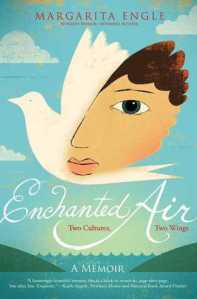
Review: Enchanted Air by Margarita Engle

Enchanted Air by Margarita Engle

Enchanted Air: Two Cultures, Two Wings by Margarita Engle (InfoSoup)

Released August 4, 2015.

In this verse memoir, Engle tells the story of her childhood during the Cold War. With half of her family coming from Cuba and a grandmother who still lived there, Engle had a strong connection to Cuba. It was there that as a child she found herself, connected to the island culture and lifestyle, ran wild in nature, and discovered a quieter life. It contrasted with her life in Los Angeles, filled with bustle and crowded with people. Through both of these distinct worlds, she has a constant, her love of books and words. As the Bay of Pigs escalates, Engle fears for her island family and has to deal with the increased hatred of Cuba and Cubans in America. Cut off from family with the Cuban embargo, Engle can do little to help and again turns to her words to express herself.

Engle is one of the best verse novelists working today. While all of her previous books are splendid, this one is personal in a new way, one that offers up her heart. She shows her love of Cuba so vividly and so profoundly that her connection there runs through the entire novel. At the same time, she also shares the loneliness of a girl who likes books and words and who struggles to make friends at times. Add to that the political turmoil that has continued for decades and you have a book that could have been a tragedy but instead rises beyond that and straight into hope.

As always, Engle’s verse is exceptional. She captures emotions with a clarity in her verse that makes it immensely compelling to read. There are poems that show a pig being slaughtered on the farm in Cuba that makes it sound both brutal and delicious, the perfect mix of tempting and revolting. There are poems that capture the night sounds of Cuba and the longing for a horse of her own. They show the beauty of milking cows, the strength of a hard-working hand, the joy of connecting with a horse as you ride it. It all melts together into a picture of Cuba that is both personal and universal.

Give this to children who loved Brown Girl Dreaming for another verse memoir that is sure to inspire young readers to see the world in a more diverse and brilliant way. Appropriate for ages 9-12.

Reviewed from digital galley received from Atheneum Books for Young Readers and Edelweiss.