Review: Nooks & Crannies by Jessica Lawson

Nooks and Crannies by Jessica Lawson

Nooks & Crannies by Jessica Lawson (InfoSoup)

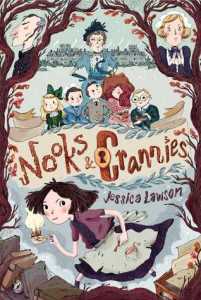
Tabitha has been given an envelope and sternly told that her parents have to be the ones to open it. But when she gets home, she finds her parents packing up and getting ready to leave on a lengthy vacation. They are also planning to leave Tabitha in the local orphanage. Once the envelope is open though, their plans change since Tabitha and her parents have been invited to the home of a wealthy countess for the weekend. Once there, Tabitha discovers that she is one of six children who have been invited to the estate and that the countess is searching for the child who is her grandchild. But all is not what it seems and Tabitha also finds out that she is in the middle of a great mystery. With the help of her pet mouse, it is up to Tabitha to solve the mystery and stay alive while doing it!

Lawson offers up a gorgeous mystery here with all sorts of treats along the way. Readers who enjoy a good British whodunit will find so much to love here. There is a great mansion to explore, complete with hidden passages. There are ghosts all around, haunting everyone in the house. There are odd servants, a prickly butler, and a mad countess. Throughout the mystery makes sense and the pleasure of figuring out the mystery is heightened thanks to the twists and turns along the way.

Tabitha is a great protagonist. She is a true friend, one who stands by her mouse. As she gets to know the other children, the sorrow of her own upbringing is heightened and her loneliness which could have been used as a shield is beautifully displayed and then slowly cracked until she is fully engaged with the others. The mystery is the heart of the book but so is the growth of the confidence of Tabitha as she works to solve the mystery and grows a lot in the process.

A strong British mystery, this book is dark and lovely. A great way to spend some summer afternoons. Appropriate for ages 9-12.

Reviewed from copy received from Simon & Schuster.

Review: High Tide for Horseshoe Crabs by Lisa Kahn Schnell

High Tide for Horseshoe Crabs by Lisa Kahn Schnell

High Tide for Horseshoe Crabs by Lisa Kahn Schnell, illustrated by Alan Marks (InfoSoup)

The annual spawning of the horseshoe crabs serves as a way to speak about the life cycle of this fascinating creature. As the crabs come to the shore, they ride the high tide to get far enough up on the beach for their eggs to be safest. Following the crabs are the shorebirds who are looking for a feast. Humans are coming too, scientists who study both the crabs and the birds. The horseshoe crabs begin laying their eggs, their bodies piled high at the edge of the shore, all trying to reach the sand to deposit their eggs. The scientists tag the crabs, allowing them a better way to study how these creatures live and where they travel. The eggs that survive the birds feasting start to grow and the adult crabs return to the sea. A few weeks later, the baby crabs hatch and make their way down the sand to the sea too.

Schnell has created a book that celebrates the horseshoe crabs and highlights not only their life cycle but their impact on the larger habitat as well. Tying the human scientific element into the book as well informs young readers that there are interesting natural studies happening all around them. The final pages of the book offer many additional details on the horseshoe crab and how they function in the food system. Readers will also find more resources on the crabs including websites and books to explore.

Marks’ illustrations are beautiful and functional. He shows the wonder of life under the water as well as the gorgeous moonlit night that the crabs come to shore. The mix of underwater, sea and sky create a palette of blue that celebrates life.

A strong nonfiction picture book that highlights a fascinating and unique creature. Appropriate for ages 5-7.

Reviewed from library copy.

Review: Mesmerized by Mara Rockliff

Mesmerized by Mara Rockliff

Mesmerized: How Ben Franklin Solved a Mystery that Baffled All of France by Mara Rockliff, illustrated by Iacopo Bruno (InfoSoup)

When Benjamin Franklin went to France to ask them for their help in gaining freedom for the American colonies, he discovered that they were fascinated by science. Particularly, they were abuzz about Dr. Mesmer, a man who staged shows and used an unseen force that he claimed was similar to electricity to cure people of their health issues and control their thoughts. Even Marie Antoinette was taken with Dr. Mesmer and in awe of his powers. The King of France asked Ben Franklin to explore what the force was. So Franklin started the very first blind test, literally, by blindfolding people and experimenting to see if they could tell if Dr. Mesmer was using the force or not. In the end, several things were discovered like the placebo effect and the amazing power of the human mind itself.

Rockliff writes a rollicking book where science is what everyone wants to know more about but also where science is in its infancy. This look at a specific moment in history is dynamic and great fun, particularly due to the personalities involved and also the fact that it demonstrated scientific ideas that are still in use today. Rockliff relishes the fun of the entire story along with the reader, allowing this story to carry forward on its own wild pace which will delight teachers looking for a book on science that is fun to share aloud.

Bruno’s illustrations add to that wild feel with their fancy flounces when talking of Dr. Mesmer and the straight-forward but period touches when Franklin takes the page. There are full color double-page spreads mixed with other pages with more white space. The illustrations have a broad sense of humor that ties in well with the text.

A fabulous nonfiction book that is sure to surprise and enthrall history and science buffs. Appropriate for ages 6-9.

Reviewed from library copy.

Review: Dreams of Freedom

Dreams of Freedom

Dreams of Freedom: in words and pictures (InfoSoup)

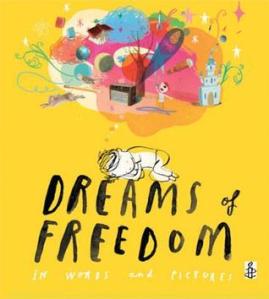
An incredible picture book that follows its sister book, We Are All Born Free. In association with Amnesty International, this book celebrates freedom around the world in a variety of ways. With quotations about freedom, the book’s text flies and builds an expectation that no one should live in the different forms of slavery or abridged freedom. The freedoms are large and expansive: the freedom to be a child, the freedom to learn, freedom from fear and freedom from slavery. This book embraces them all, creating a place where conversation can leap from.

The quotes from various luminaries from around the world were carefully selected so that children will be able to understand them. Sources range from the Dalai Lama to Harriet Tubman to Anne Frank. The illustrations are also rich and varied. They are done by various master children’s book illustrators including Mordicai Gerstein, Birgitta Sif and Chris Riddell. Each page of the book creates a singular moment to explore that type of freedom and to create hope and peace.

A strong book about freedom that invites conversation, this book belongs in both public and school libraries. Appropriate for ages 7-10.

Reviewed from library copy.

Review: Elvis by Bonnie Christensen

Elvis by Bonnie Christensen

Elvis: The Story of the Rock and Roll King by Bonnie Christensen (InfoSoup)

This picture book biography offers a glimpse into the journey of Elvis Presley from poverty to becoming a rock and roll legend. The book begins in segregated Mississippi with the birth of Elvis in 1935. Elvis’ father went to jail and even after he returned to the family, they lived a hard life of poverty. But through it all flowed music from their Sundays in church to listening to the radio at home. Elvis was shy and quiet, but he could sing and at age 10 he entered his first contest and then at 11 got his first guitar. His family moved to Memphis when he was 13 and Elvis found a new kind of music. He graduated from high school and eventually worked up the courage to enter a recording studio and offer his singing services. After a disastrous first session, Elvis was filled with nerves and picked up a guitar, singing That’s All Right. It got onto the radio and suddenly everyone wanted to hear more!

Christensen makes sure that readers understand that Elvis came from a difficult background, one where there was no money and no opportunities. His shyness was another thing that Elvis had to overcome, turning his shaking on stage into his signature moves. Christensen also keeps it clear that this was a different time, a time when these sorts of music did not mix together and that Elvis was uniquely situated to be the one who created the new sound. In all, this is a testament to the power of dreams and talent.

Christensen’s illustrations gleam with hope and the future even as Elvis is being moved to yet another house and another school. She makes sure that the light shines on the little boy and that readers see that there are possibilities to come.

A strong introduction to Elvis, make sure to play some of his music when reading it to children so that they can feel that beat too. Appropriate for ages 6-9.

Reviewed from library copy.

Review: Mad Scientist Academy: The Dinosaur Disaster by Matthew McElligott

Mad Scientist Academy The Dinosaur Disaster by Matthew McElligott

Mad Scientist Academy: The Dinosaur Disaster by Matthew McElligott (InfoSoup)

Released July 7, 2015.

In this graphic novel for elementary-aged children, facts about dinosaurs mingle with a great adventure. A new class of young monsters are enrolled at the Mad Scientist Academy. On their first day of school, they meet Dr. Cosmic, a teacher at the academy who has managed to lose the school pet, Oscar, a dinosaur. The children are sent to find Oscar and set off on an adventure through the various exhibits that Dr. Cosmic has been working on. The focus of the exhibits is dinosaurs and there are mechanical dinosaurs throughout who are set to be tame. Unfortunately, their setting is accidentally set to live mode and all of the dinosaurs start acting as if they are real. It is up to the students to figure out how to escape the rampaging T-Rex and find Oscar too.

McElligott has a great feel for pacing and humor in this graphic novel. There are small touches of humor throughout the book, from one students stinky lunch to the out-of-control exhibits that have too much lava and are a bit too effective in showing meteors. The book is thoughtfully designed too with each monster character having characteristics that come into play in the story line. The lizard boy uses his long tongue to reach something, the insect girl uses her wings to remove smoke from the room, and much  more. The insertion of the dinosaur information is done in a light way and includes plenty of illustrations to keep the information accessible and fun.

The art is very effective throughout the book. The characters are diverse enough to be recognizable even in images where they are smaller. Double-page spreads of the full exhibit show the largeness of both the exhibit and the dinosaurs too. Dramatic moments are nicely captured and the timing of funny events is done very effectively.

Get this into the hands of children growing out of Magic School Bus books. The mix of graphic novel, information and fantasy elements will find lots of young fans. Appropriate for ages 6-9.

Reviewed from digital galley received from Crown Books for Young Readers and Edelweiss.

Review: In Mary’s Garden by Tina and Carson Kugler

In Marys Garden by Tina and Carson Kugler

In Mary’s Garden by Tina & Carson Kugler (InfoSoup)

This picture book biography of Mary Nohl, a Wisconsin artist, tells the story of her first creations of large art. When she was young, Mary discovered that she loved art and making things and drawing. It was when she started to collect odds and ends from the beach near her home that she started to create her statues in her garden. Cement was combed and crafted, dotted with stones and other objects. One after another, huge creatures filled her yard, drawing visitors to see what Mary was creating. Mary died in 2001 at the age of 87 and her home still serves as a gallery of her art.

The Kuglers focus primarily on the finding of objects and the process that Mary used to create the art. Then they turn to the gallery she created with her huge creatures who are friendly and welcoming and wild. One can immediately see the appeal of her art. Turning to the back of the book, readers can see the actual art and her garden gallery. The more detailed prose found there also explains how her works is still problematic for her neighbors and how people are working to preserve it.

The illustrations are great and completely capture the whimsical and decidedly friendly nature of Mary Nohl’s art work. From the finding of objects on the lake beach to the creation of the art itself, the illustrations invite young readers to try their own hand at found-object art and to make themselves happy too.

Ideal for Wisconsin libraries, art teachers will enjoy having a book about a woman modern sculptor. Appropriate for ages 4-6.

Reviewed from library copy.

Review: Detective Gordon: The First Case by Ulf Nilsson

Detective Gordon the First Case by Ulf Nilsson

Detective Gordon: The First Case by Ulf Nilsson, illustrated by Gitte Spee (InfoSoup)

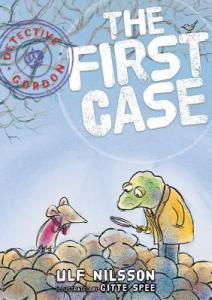
When a squirrel discovers that some of his nuts are missing one winter night, he heads straight to the police station where Detective Gordon, Chief of Police, can help him. But when he gets there, no one seems to be around until he finds the great detective fast asleep on his paperwork with cake crumbs all around. Once awoken though, Detective Gordon heads out to help solve the crime. But it’s a very cold night and Detective Gordon can’t climb to the hole in the tree to see the crime scene. When he stands watch, he manages to freeze solid. That’s when a little mouse steals one nut from the tree and ends up helping Gordon back to his warm police station. The little mouse is soon named Buffy and settles into the police station as an assistant to Gordon. She can scramble up trees and seems to have a knack for crime solving too. It doesn’t hurt that it’s all accompanied with lots of warmth, tea and cakes. But who is stealing the nuts? Will they strike again? And how can one very young mouse and one old toad figure it all out?

Translated from the original Swedish, this book is a toasty little joy. It has gorgeous elements to it, filled with small touches that bring it entirely to life. From the various cakes for each time of day and the delight at discovering each new flavor to the pleasure both Buffy and Gordon get from stamping each document when its completed, this book is perfect for quiet and cozy crime fighters and detectives. The mystery is just right for small children and the cozy nature of the story makes this an idea bedtime read. The descriptions are vivid, enhancing the strong feeling of a woodsy community as a whole.

Spee’s illustrations add to the snug feeling of the story. She creates fires that glow with a halo of warmth, cakes that line up with plenty for everyone, and beds that are stacked with eiderdown. It is all very domestic and wonderful and also has a little humor mixed in, just like the story itself. The full-color illustrations make this a perfect book to move young readers and listeners to longer books.

A pleasure of a book, this cozy mystery for children is clearly European in origin which adds to the fun. Appropriate for ages 7-9.

Reviewed from copy received from Gecko Press.

Review: Trapped! by Robert Burleigh

Trapped by Robert Burleigh

Trapped!: A Whale’s Rescue by Robert Burleigh, illustrated by Wendell Minor (InfoSoup)

A wild whale is jumping, swimming and enjoying lots of krill to eat in the ocean waters. But then she runs into discarded netting from a crab fisherman floating in the water. The net catches her, cutting into her mouth and making swimming difficult. The a boat motor sound comes and along with it a group of humans who are hoping to rescue the huge animal. But it is so dangerous being near an animal of that size where even small motions can cause injuries to the rescuers. Still, they work close to the whale and begin to cut her free. They swim away if necessary and touch her with gentleness and care. Eventually the ropes and netting fall away and the whale is free to swim again. To say thanks, she gently touches each of her human rescuers before jumping for joy.

Burleigh’s text contains lots of information but it is presented through the lens of a story. This is a tale of one very fortunate whale, rescued in time from the netting. It is a story of wild freedom at first and then a desperate struggle and then impossible hope that she will survive after all. This is a real drama played out on the pages, from the danger to the whale to then the danger to her rescuers solely from her size. The final pages of the book offer resources about rescuing trapped whales and talk more about the dangers and about the whales themselves too.

Minor’s art is luscious on the page, taking readers under the water alongside the whale. There we float as the water changes colors and the light changes. Minor makes sure the show the size of the whale and of the humans on the same page, so that children will understand the size of the animal. It is beautifully and touchingly done.

An inspiring tale of the difference that even a small group of people can make in sustainability and saving animals, this picture book is a compelling mix of story and fact. Appropriate for ages 6-8.

Reviewed from copy received from Charlesbridge.